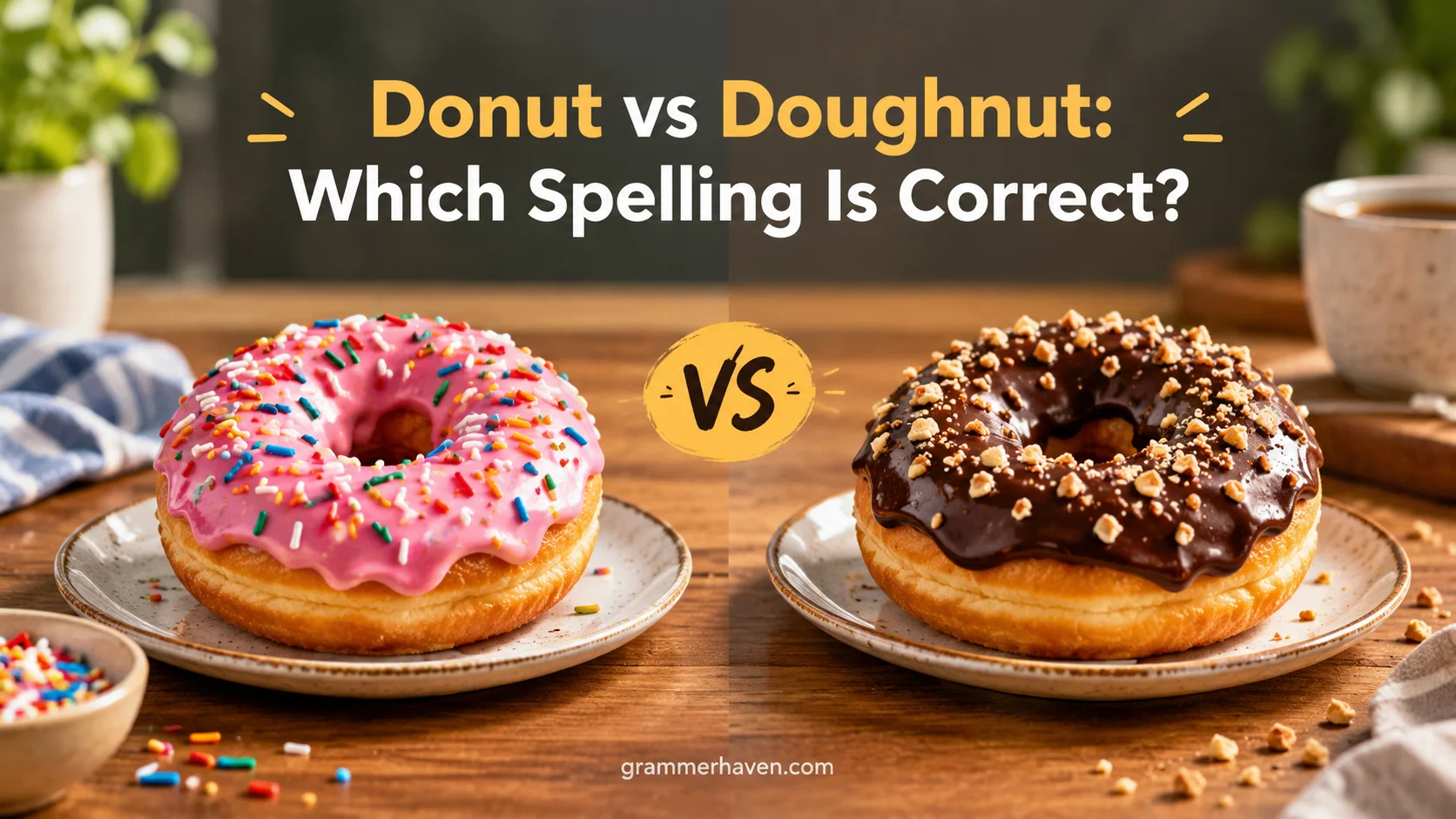
Donut vs Doughnut has a small spelling difference, but the choice matters in clear, credible writing for different English-speaking audiences and contexts.
Both Donut and Doughnut are accepted English words for the same fried pastry. The correct version depends on regional usage and spelling tradition. Donut is a shortened spelling linked strongly with American English and North American usage, while Doughnut remains the traditional form.
The history of the word explains why both forms appear in modern writing. Dictionaries, including Oxford, recognize Doughnut, while donut has become an established spelling variation. The two forms can appear in blogs, emails, menus, and other written material without changing the meaning. This pattern shows how ordinary words can develop different spellings across a region.
For professional writing, the practical choice depends on your audience. A US audience may expect donut, while UK readers may be more familiar with doughnut. US vs UK usage creates a clear regional distinction, although both spellings remain acceptable in appropriate contexts. When writing for a US audience, donut often fits naturally; when following a traditional spelling,
Doughnut works well. Good professional writing also requires consistency. Pick the appropriate corresponding form, use consistently across your blog, menu, or other content, and keep the spelling preference aligned with your audience. This approach makes the text look polished, avoids unnecessary mistakes, and keeps the right spelling choice clear.
Quick Answer: Donut vs Doughnut
Donut and doughnut are both correct spellings of the same word.
- Doughnut is the traditional spelling.
- Donut is a shortened spelling that became established in American English.
- Both refer to the same type of fried dough pastry.
- Both have essentially the same pronunciation in English.
- Donut is particularly common in North American English.
- Doughnut remains widely recognized and used in American and British English.
Oxford defines a donut as a small cake made from fried dough, usually ring-shaped or filled. Its entry for doughnut gives the same basic meaning and identifies donut as an alternative, especially in North American English.
| Spelling | Correct? | Meaning | Common Usage |
| Donut | Yes | Fried dough pastry | Especially common in North American English |
| Doughnut | Yes | Fried dough pastry | Traditional form; common internationally |
In other words, you don’t need to worry that donut is a spelling mistake. It isn’t.
What Do Donut and Doughnut Mean?
Both donut and doughnut describe a small pastry made from fried dough. The most familiar version has a hole through the middle, although many doughnuts are round and filled rather than ring-shaped.
Common varieties include:
- Glazed doughnuts
- Chocolate doughnuts
- Jelly-filled doughnuts
- Cream-filled doughnuts
- Cake doughnuts
- Yeast-raised doughnuts
- Powdered sugar doughnuts
- Cinnamon doughnuts
- Boston cream doughnuts
- Apple-filled doughnuts
Oxford describes the pastry as a small cake made from fried dough that is usually shaped like a ring or filled with ingredients such as jam, fruit, or cream.
For example:
“I bought a glazed donut on the way to work.”
You could replace donut with doughnut:
“I bought a glazed doughnut on the way to work.”
The meaning doesn’t change.
Donut and Doughnut Have the Same Basic Meaning
This distinction matters because some spelling comparisons involve words with genuinely different meanings. Donut vs doughnut isn’t one of them.
Compare:
- Donut = a fried pastry
- Doughnut = a fried pastry
There isn’t a special type of pastry called a donut that differs from a doughnut. The spelling simply varies.
Why Are There Two Spellings of Donut and Doughnut?
The answer becomes more interesting when you look at the word’s history.
The traditional form doughnut combines dough and nut. Historical evidence suggests that nut could refer to a small rounded lump or cake-like object, which helps explain the older construction. The modern ring shape wasn’t originally essential to the word.
That history also explains why doughnut looks different from what you might expect from its pronunciation.
English spelling has many words containing ough, and that letter sequence can represent several different sounds:
- though
- through
- tough
- cough
- drought
- dough
The spelling donut removes the visually complicated ugh sequence. It’s shorter and more closely resembles the way the word sounds.
Think of it as English taking the scenic route and then discovering a shortcut.
A Brief History of the Word Doughnut
The history of doughnut reaches back into early American English.
The Online Etymology Dictionary dates doughnut to 1809 in American English. It describes the word as a combination of dough and nut, probably referring to a small rounded lump. It also notes that references to the hole in the middle came later, with such references appearing around 1861.
That last detail is surprisingly important.
The word doughnut didn’t necessarily begin with the familiar ring-shaped pastry that most people picture today. Earlier doughnuts could be solid balls or small pieces of fried dough.
Washington Irving and Early Doughnuts
Washington Irving provided an early written description of the food. According to the Online Etymology Dictionary, Irving described doughnuts as balls of sweetened dough fried in hog’s fat and also connected them with the Dutch term olykoek.
This history reflects the broader Dutch influence on early American food culture, particularly in areas such as New York.
The pastry itself has a much longer culinary story than the modern spelling suggests. Fried dough foods existed in various cultures long before the English word doughnut became established.
When Did Donut Become a Common Spelling?
The shorter spelling donut isn’t a recent internet invention.
Etymological records show that donut appeared as an alternative spelling in the United States as early as 1870. The spelling became common in bakery names around 1920.
That timeline helps settle an important question: Is donut an incorrect modern shortcut?
No.
It’s an established spelling with a history stretching back more than a century.
The shorter version likely benefited from several practical advantages:
- It contains fewer letters.
- It avoids the complicated ough sequence.
- It closely matches the pronunciation.
- It works well in signs and business names.
- American commercial usage helped spread it.
Over time, repeated usage turned the shortened spelling into a normal part of English rather than a casual misspelling.
Donut vs Doughnut in American English
For US English, both forms are acceptable, but donut has a particularly strong presence.
Oxford’s American English dictionary gives doughnut with donut as an alternative. Its separate donut entry identifies the word as especially North American English.
That makes donut a natural choice for everyday American writing.
For example:
- “Let’s grab some donuts.”
- “The bakery makes fresh donuts every morning.”
- “She ordered a chocolate donut.”
- “We brought a box of donuts to the office.”
None of these sentences needs the longer spelling.
However, doughnut isn’t unusual or incorrect in American English. You can still find it in newspapers, books, menus, recipes, dictionaries, and other edited writing.
Why Americans Often Use Donut
American English often favors shorter spellings in certain contexts. That doesn’t mean Americans systematically remove letters from every word. Rather, individual spelling variants can become established through usage.
The popularity of donut also received a boost from commercial language. Bakery names, menus, signs, packaging, and advertising repeatedly put the shorter form in front of readers.
Once a spelling becomes familiar, it tends to reinforce itself.
Donut vs Doughnut in British English
The spelling pattern changes somewhat across the Atlantic.
Doughnut is the traditional and widely recognized form in British English. Oxford’s main entry uses doughnut while noting donut as an alternative, particularly in North American English.
That doesn’t make donut incomprehensible to British readers. Far from it. The shorter spelling is familiar because American English has enormous cultural influence through movies, television, advertising, books, and the internet.
Still, if you’re specifically writing traditional British English, doughnut is generally the safer choice.
Regional Usage at a Glance
| Variety of English | Common Form | Alternative |
| American English | Donut | Doughnut |
| British English | Doughnut | Donut |
| North American English | Donut | Doughnut |
| International English | Doughnut is widely recognizable | Donut |
These aren’t rigid rules. English speakers don’t all follow the same regional pattern. Individual writers, publications, and businesses may choose differently.
Is Donut Less Formal Than Doughnut?
Not necessarily.
A common misconception says that donut is informal while doughnut is formal. That’s too simplistic.
Both spellings appear in edited English. The difference is better understood as one of usage and style preference rather than correctness.
If you’re writing a formal article, academic paper, report, or professional document, you can use either form if your style guide allows it.
What matters most is consistency.
For instance, don’t write:
“The bakery sells fresh doughnuts and delivers donuts every morning.”
There’s nothing grammatically wrong with the sentence, but switching spellings without a reason can look careless.
A cleaner version would be:
“The bakery sells fresh donuts and delivers them every morning.”
Or:
“The bakery sells fresh doughnuts and delivers them every morning.”
Choose one and stick with it.
Donut vs Doughnut in Brand Names
Brand names create a special case.
If a company officially uses Donuts, don’t “correct” it to Doughnuts. Proper names have their own spelling conventions.
A famous example is Dunkin’ Donuts, whose name uses the shorter spelling.
This illustrates an important writing principle:
A dictionary spelling preference shouldn’t override an official brand name.
The same rule applies to:
- Restaurant names
- Bakery names
- Product names
- Store names
- Book titles
- Company names
- Trademarked products
If a business calls its products donuts, preserve that spelling when referring to the business.
Does Donut or Doughnut Change the Pronunciation?
No. In ordinary English usage, donut and doughnut have the same basic pronunciation.
The spelling looks dramatically different, but the spoken word doesn’t gain an extra syllable simply because doughnut contains more letters.
Oxford gives the same basic pronunciation for the two forms.
This is another reason the shorter spelling feels natural to many American English speakers.
| Word | Basic US Pronunciation | Syllables |
| Donut | /ˈdoʊ.nʌt/ | 2 |
| Doughnut | /ˈdoʊ.nʌt/ | 2 |
So don’t pronounce doughnut as though the spelling contains an extra sound.
Common Uses of Donut and Doughnut
The words can describe more than the pastry sitting beside your coffee.
Food
The most obvious use refers to the familiar fried pastry.
- “I had a donut for breakfast.”
- “She made homemade doughnuts.”
- “The shop sells glazed donuts.”
- “He prefers jelly-filled doughnuts.”
Shape
The word can also describe something with a roughly circular shape and an opening in the center.
For example, a doughnut-shaped object resembles the familiar ring pastry.
The same applies to donut-shaped.
Driving
In American English, donut can also refer to a driving maneuver in which a vehicle travels in tight circles, creating a circular tire mark.
That extended sense has its own history. The Online Etymology Dictionary dates the US slang sense meaning “a driving in tight circles” to 1981.
This meaning is distinct from the food but comes directly from the shape and motion associated with a doughnut-like circle.
Donut vs Doughnut: Examples in Sentences
Seeing both forms in context makes the difference easier to understand.
Examples With “Donut”
- “I grabbed a donut before work.”
- “The bakery sells fresh donuts every morning.”
- “She ordered a glazed donut with her coffee.”
- “We bought a dozen donuts for the party.”
- “That chocolate donut looks delicious.”
Examples With “Doughnut”
- “I grabbed a doughnut before work.”
- “The bakery sells fresh doughnuts every morning.”
- “She ordered a glazed doughnut with her coffee.”
- “We bought a dozen doughnuts for the party.”
- “That chocolate doughnut looks delicious.”
Notice what happens when you compare the pairs. The meaning remains exactly the same.
Donut vs Doughnut: Common Mistakes to Avoid
Understanding what not to do can save you from unnecessary editing.
Mistake: Calling Donut Incorrect
Donut isn’t a misspelling.
Major dictionaries recognize it as an established form. Oxford even provides a dedicated donut entry and identifies it with doughnut.
Mistake: Assuming the Two Words Have Different Meanings
They don’t.
Donut = doughnut.
The difference is spelling, not the basic definition.
Mistake: Calling Donut Pure Slang
The shorter spelling has been documented since at least the nineteenth century and became common in American bakery names by around 1920.
It has therefore been part of established written usage for a long time.
Mistake: Changing a Brand Name
If a business uses Donuts in its official name, preserve the brand’s spelling.
Mistake: Mixing Spellings Without a Purpose
Consistency gives your writing a cleaner appearance.
If you choose donut, keep using donut throughout the article. If you choose doughnut, use doughnut consistently.
Donut vs Doughnut: Quick Comparison
| Feature | Donut | Doughnut |
| Correct? | Yes | Yes |
| Meaning | Fried dough pastry | Fried dough pastry |
| Pronunciation | Same | Same |
| Traditional spelling | No | Yes |
| Common in US English | Yes | Yes |
| Common in British English | Less common | Yes |
| Appropriate in formal writing | Yes | Yes |
| Appropriate in casual writing | Yes | Yes |
| Used for the same food | Yes | Yes |
| Can describe a circular shape | Yes | Yes |
The biggest difference is therefore usage preference, not grammar.
Donut or Doughnut: Which One Should You Use?
The best choice depends on your audience and the style you’re following.
Use “Donut” When:
- You’re writing primarily for a US audience.
- Your publication prefers American usage.
- You’re writing casual or everyday American English.
- A brand or business officially uses donut.
- You want the shorter, more streamlined spelling.
Use “Doughnut” When:
- You’re following a traditional spelling style.
- You’re writing primarily for a British English audience.
- Your publication’s style guide prefers the longer form.
- You’re discussing the historical development of the word.
- You simply prefer the traditional spelling.
There isn’t a universal rule that forces every writer to choose one.
The Most Useful Rule
Follow your audience and your style guide, then remain consistent.
That’s more useful than memorizing a supposed rule that says one spelling is right and the other is wrong.
Donut vs Doughnut and SEO
If you’re writing online content, you may wonder whether search engines prefer one spelling.
The better approach isn’t to force one keyword repeatedly. Instead, cover the topic naturally.
Useful variations include:
- donut vs doughnut
- donut or doughnut
- is donut correct
- is doughnut correct
- donut spelling
- doughnut spelling
- American spelling of doughnut
- British spelling of donut
- donuts vs doughnuts
- how to spell donut
A strong article should answer the reader’s actual question rather than repeat the keyword in every paragraph.
For example, someone searching “is donut correct?” needs a direct answer. Someone searching “why are donut and doughnut spelled differently?” needs historical context.
Good SEO serves both questions.
A Simple Way to Remember Donut vs Doughnut
Here’s an easy memory trick:
Doughnut keeps the word dough visible.
Donut removes the extra letters and gives you a shorter spelling.
Think of the relationship this way:
DOUGH + NUT → DOUGHNUT → DONUT
The spelling becomes shorter, but the meaning stays intact.
That’s the whole mystery in a nutshell.
See also: Herd or Heard: Which Word Is Correct?
FAQs:
Is donut or doughnut correct?
Both are correct. Doughnut is the traditional spelling, while donut is an established alternative that is especially common in North American English.
Is donut a real word?
Yes. Donut is a standard dictionary word, not merely an informal misspelling. Oxford lists donut as equivalent to doughnut.
Is doughnut the original spelling?
Doughnut is the traditional form. Historical records place the word in American English by the early nineteenth century. The Online Etymology Dictionary dates the recorded form to 1809.
Why are there two spellings of doughnut?
Donut developed as a shorter spelling of doughnut. It has been documented as an American variant since at least 1870.
Which spelling is more common in American English?
Donut is especially common in American English, although doughnut remains fully acceptable. Oxford specifically labels donut as especially North American English.
Which spelling is preferred in British English?
Doughnut is generally the more traditional British English form. Oxford lists donut as especially North American.
Is donut informal?
Not necessarily. Donut is an established spelling and can appear in edited and professional writing. Your choice should depend on your audience and style guide.
Are donut and doughnut pronounced the same?
Yes. In ordinary English usage, the two spellings have the same basic pronunciation.
Does donut mean something different from doughnut?
No. The two spellings refer to the same pastry and related shape-based meanings.
Should formal writing use doughnut?
Not automatically. Doughnut may feel more traditional, but donut is also an accepted spelling. Follow the style guide or regional convention relevant to your writing.
Why does Dunkin’ use Donuts instead of Doughnuts?
Dunkin’ Donuts is a brand name that uses the shorter spelling. Proper names should retain their official spelling rather than being “corrected” according to a different preference.
Conclusion:
The Donut vs Doughnut difference is mainly a matter of spelling and regional preference, not meaning. Doughnut is the traditional form, while donut is especially common in American English. Both forms are accepted, so your choice can depend on your audience and writing style. For professional writing, the key is to choose the form that fits your context and use it consistently. Whether you write donut or doughnut, keeping your spelling consistent makes your content clear, polished, and credible.













