No Thank You or No, Thank You depends on punctuation, as a comma separates a polite refusal from an expression of gratitude in standard written English.
The comma is a tiny mark with a big punch in message reception. It improves sentence structure, helps readers understand your thoughts, and adds clarity to everyday messages, emails, conversations, a thank-you note, or a card. English uses punctuation marks to organize meaning, yet commas remain a common source of confusion and punctuation perplexity. Understanding comma rules, language conventions, and writing accuracy makes written communication clearer.
Consider an example from everyday communication. Someone offers you a cup of coffee, and you want to decline politely. Write, “No, thank you.” The comma creates a natural pause between the refusal and thankfulness. The same rule applies when turning down an invitation or responding to a business offer. Although no thank you appears in informal writing, conventional comma placement is preferred in a complete, punctuated response. From an editing perspective, correct punctuation improves sentence clarity and makes the meaning easier to understand. Even with a pen in hand or your fingers hovering over the keyboard, this little squiggle supports a polished expression of politeness.
The right punctuation helps you express a polite decline in different situations. Resources such as Learna Language discuss the nitty-gritty of comma usage and the importance of understanding the basic rule. Proper comma placement separates “No” from “thank you,” allowing the phrase to communicate refusal and appreciation. This practice strengthens communication clarity and makes the sentence meaning more precise. A better understanding of grammar lets you see the phrase in a whole new light and use it confidently in professional settings and personal settings. Whether you’re declining an offer or expressing gratitude while saying no, the comma helps you communicate naturally.
Quick Answer: No Thank You or No, Thank You?
“No, thank you” is the preferred form in standard written English. The comma separates the response “no” from the expression of gratitude “thank you.”
For example:
- Correct: “Would you like another slice of cake?” “No, thank you.”
- Less conventional: “Would you like another slice of cake?” “No thank you.”
The second version remains understandable, especially in casual texts and informal online conversations. However, the first version follows conventional punctuation and is the better choice for professional emails, formal writing, and edited content.
Remember this simple rule: When you use “no” to decline an offer and “thank you” to express appreciation, place a comma after “no.”
“No Thank You” vs. “No, Thank You”: Key Differences
The main difference between these expressions is punctuation, not the basic message. Both can communicate a polite refusal, but the comma makes the structure more explicit.
| Feature | “No Thank You” | “No, Thank You” |
| Punctuation | No comma | Comma after “no” |
| Standard edited writing | Less conventional for a simple refusal | Preferred for a simple refusal |
| Basic meaning | Usually a polite refusal | A polite refusal with thanks |
| Casual texting | Commonly understood | Equally suitable |
| Professional emails | Use the conventional comma | Recommended |
| Special grammatical use | Can appear when “thank you” acts as a noun phrase | Can express a refusal followed by gratitude |
The distinction becomes clearer when you look at complete sentences.
Example 1: A polite refusal
“Would you like another cup of tea?”
“No, thank you.”
The comma separates the negative answer from the expression of gratitude.
Example 2: A noun phrase
“No thank you is necessary for such a small favor.”
Here, “no thank you” means that nobody needs to express gratitude. It doesn’t function as a refusal, so the comma would be inappropriate.
Example 3: An informal conversation
“Want to come with us?”
“No thank you.”
Readers will understand the response. However, “No, thank you” follows conventional punctuation more clearly.
The lesson is simple: consider how the words function in the sentence rather than treating every instance of “no thank you” identically.
When to Use “No, Thank You”
A polite refusal works best when it communicates your decision without making the other person feel dismissed. “No, thank you” is useful in several everyday situations.
In Formal and Professional Communication
Professional situations often require a balance between being direct and remaining courteous. This phrase lets you decline without sounding unnecessarily harsh.
For example, imagine a colleague offering you an additional assignment when your workload is already full.
Instead of responding with a blunt “No,” you could write:
“No, thank you. I won’t be able to take on another project this week.”
You can also use the phrase when declining optional services, business proposals, or workplace invitations.
Here are a few practical examples:
- Declining an offer: “No, thank you. We’ve already selected a supplier.”
- Turning down additional work: “No, thank you. I need to finish my current assignments first.”
- Declining a meeting invitation: “No, thank you. I won’t be available that afternoon.”
- Refusing an optional service: “No, thank you. I don’t need the additional package.”
However, professional communication sometimes calls for a more detailed explanation. If your refusal affects a business relationship, briefly explain your decision when appropriate.
In Everyday Conversations
You don’t need a long explanation every time someone offers you something. A short, courteous response usually does the job.
Consider these everyday exchanges:
Declining food
“Would you like another slice of pizza?”
“No, thank you. I’m full.”
Turning down assistance
“Would you like me to help with those bags?”
“No, thank you. I’ve got them.”
Refusing a drink
“Can I get you some water?”
“No, thank you. I have my bottle.”
In each case, the response communicates two things: you don’t want what the person offered and you appreciate the gesture.
That’s why the phrase works so well. It keeps the refusal clear without making the interaction awkward.
In Emails and Text Messages
Written communication removes facial expressions and vocal cues. As a result, your word choice and punctuation carry more of the message.
For example, compare these replies to a coworker offering to help:
- “No.”
- “No, thank you.”
- “No, thank you. I appreciate you offering.”
The first response is direct but may sound abrupt without additional context. The second is courteous and concise. The third adds warmth and acknowledges the other person’s effort.
For a quick text, the second option is usually enough. For a professional email, the third may be more appropriate.
Example email response:
Hi Jordan,
No, thank you. I’ve got the report covered, but I appreciate you offering to help.
Best,
Alex
The wording is polite without being overly formal. The comma also follows the standard punctuation used for the expression.
Examples of “No, Thank You” in Sentences and Conversations
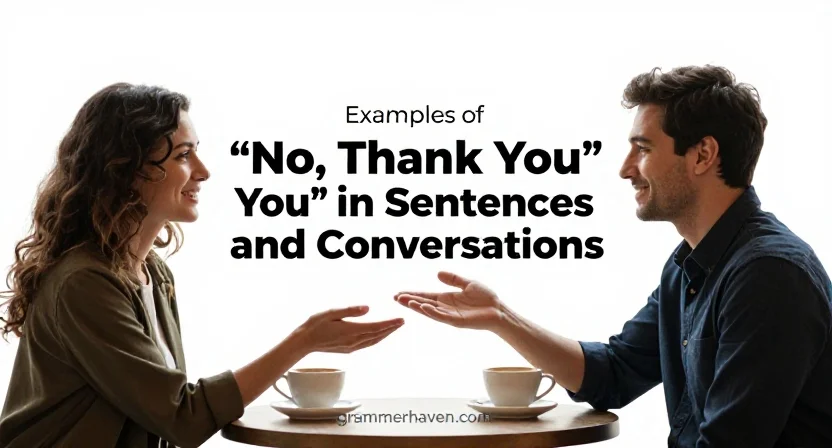
The best way to understand a punctuation rule is to see it in action. These examples show how the phrase works in different contexts.
Declining Food or Drinks
Food and drink offers are among the most common situations in which people use this expression.
- “Would you like some more coffee?” “No, thank you. I’ve had enough.”
- “Can I get you a glass of lemonade?” “No, thank you. I’m fine.”
- “Would you like to try this dessert?” “No, thank you. I’m saving room for dinner.”
Notice that the comma remains after “no” regardless of the reason for declining.
Politely Refusing Help
When someone offers assistance, a polite refusal can acknowledge their kindness while making your preference clear.
- “Do you need help carrying those boxes?” “No, thank you. I can manage.”
- “Would you like me to review your draft?” “No, thank you. I’ve already finished revising it.”
- “Can I give you a ride home?” “No, thank you. I’ve arranged transportation.”
You can add a short explanation when it helps the conversation feel natural.
Declining an Invitation
Invitations can be more sensitive because the other person may have spent time planning an event. A courteous response helps you decline without dismissing the invitation.
- “Would you like to join us for dinner?” “No, thank you. I already have plans.”
- “Can you attend the meeting on Friday?” “No, thank you. I have another commitment.”
- “Would you like to come to our party?” “No, thank you. I won’t be able to make it, but I hope you have a wonderful time.”
For social invitations, consider acknowledging the invitation itself. That small addition can make your response sound more thoughtful.
Refusing a Sales Offer
Sales conversations often involve repeated offers. A clear response can help you establish your decision without inviting further discussion.
- “Would you like to upgrade your subscription?” “No, thank you. My current plan meets my needs.”
- “Can I show you our premium model?” “No, thank you. I’m only browsing.”
- “Would you like to add an extended warranty?” “No, thank you. I don’t need it.”
If the seller continues pushing, you can be firmer without becoming rude: “No, thank you. I’ve made my decision.”
Responding to Unwanted Suggestions
Sometimes a suggestion doesn’t suit your needs. In these situations, you may want to decline while keeping the conversation friendly.
For example:
“Why don’t you try applying for that position?”
“No, thank you. I’m focusing on other opportunities right now.”
The response makes your decision clear without criticizing the suggestion.
Is “No, Thank You” Rude or Polite?
“No, thank you” is generally considered a polite way to refuse an offer. However, politeness depends on more than punctuation.
Your tone, relationship with the other person, and the situation all influence how your words come across.
Compare these responses:
| Response | Likely impression |
| “No, thank you.” | Polite and straightforward |
| “No, thank you! That’s very kind of you.” | Warm and appreciative |
| “No, thank you. I’m all set.” | Friendly and relaxed |
| “No, thank you. I’ve already decided.” | Firm and clear |
| “No. Thank you.” | More separated or emphatic, depending on context |
The last example uses a period instead of a comma. That creates two sentences and may make the refusal sound more deliberate.
Still, punctuation alone can’t determine a speaker’s attitude. A cheerful voice can make a brief refusal sound friendly, while a sharp delivery can make the same words feel dismissive.
If you want to sound especially considerate, add a genuine acknowledgment:
- “No, thank you. I appreciate the offer.”
- “No, thank you, but that’s very thoughtful of you.”
- “No, thank you. Perhaps another time.”
Use the last option only if you genuinely might accept in the future. There’s no need to suggest future interest when you don’t intend to follow up.
Alternative Ways to Say “No, Thank You”
Sometimes the standard phrase feels too brief or formal. Fortunately, English offers several alternatives that communicate the same general message with different tones.
| Alternative | Tone | Best use |
| No, thanks. | Casual and friendly | Everyday conversations |
| I appreciate it, but no thank you. | Appreciative | Declining a thoughtful offer |
| Thanks, but I’ll pass. | Informal | Social situations |
| I’m all set, thank you. | Relaxed and friendly | Declining assistance or additional items |
| Not this time, but thank you. | Gentle | Declining a temporary opportunity |
| I’ll have to decline, but thank you. | Formal | Professional invitations or offers |
| Thank you for the offer, but I’ll pass. | Courteous and direct | Business or personal communication |
Let’s look at a few of these alternatives more closely.
“No, Thanks.”
This shorter version works well with friends, family, and familiar coworkers.
Example: “Would you like another soda?”
“No, thanks. I’m good.”
It sounds casual without losing its polite meaning.
“I Appreciate It, but No Thank You.”
Use this version when someone has made a thoughtful offer or taken time to help you.
Example: “I can stay late and help you finish the presentation.”
“I appreciate it, but no thank you. I’ve already arranged to finish it tomorrow.”
The response recognizes the person’s generosity while maintaining your decision.
“Thanks, but I’ll Pass.”
This expression is informal and conversational. It’s especially common when declining invitations, activities, or optional purchases.
Example: “We’re going to karaoke tonight. Want to join us?”
“Thanks, but I’ll pass. I’m tired.”
It’s a natural choice among friends, although it may sound too casual for some formal situations.
“I’m All Set, Thank You.”
This phrase offers a softer alternative when someone asks whether you need something.
Example: “Can I bring you another plate?”
“I’m all set, thank you.”
It works particularly well in restaurants, shops, and everyday interactions.
“I’ll Have to Decline, but Thank You.”
When you need a more formal response, this version communicates your decision clearly.
Example: “We’d like to invite you to speak at our conference.”
“Thank you for the invitation. I’ll have to decline because of a prior commitment.”
It’s useful for professional correspondence, formal invitations, and situations where a simple refusal might feel too abrupt.
Common Mistakes to Avoid
The phrase itself is straightforward, but a few punctuation and usage mistakes can make your writing less polished.
Omitting the Comma in Formal Writing
If you’re writing a formal email or edited article, use the conventional form:
- Less conventional: “No thank you. I already have one.”
- Preferred: “No, thank you. I already have one.”
The first version is understandable. The second follows standard punctuation more clearly.
Assuming the Comma Changes the Basic Meaning
The comma doesn’t turn a refusal into acceptance or create a completely different message. It separates the negative response from the expression of gratitude.
Context still matters.
For example, “No, thank you” usually declines an offer. However, “No thank you is necessary” uses the words differently.
Confusing “No, Thank You” With “No, Thanks”
Both expressions can politely decline an offer. The main difference is tone and wording.
“No, thanks” generally sounds more casual. “No, thank you” can sound slightly more formal, although both work in everyday conversations.
Choose the one that suits your audience.
Adding Unnecessary Punctuation
Avoid inserting a comma between “thank” and “you.”
Incorrect: “No, thank, you.”
Correct: “No, thank you.”
Also, don’t separate the refusal and gratitude with an exclamation point unless you deliberately want a stronger tone.
“No, thank you!” is possible, but it may sound more emphatic than a simple “No, thank you.”
Treating Every Appearance of “No Thank You” the Same Way
Remember that the words can perform different grammatical functions.
- Refusal: “No, thank you. I don’t need another one.”
- Noun phrase: “No thank you is necessary.”
The first uses a negative response followed by gratitude. The second refers to an expression of gratitude itself.
Understanding that distinction will help you punctuate similar expressions more accurately.
See also: Mastering the Art of Referring to the Last Two Items in English
FAQs:
Is “No Thank You” or “No, Thank You” Correct?
“No, thank you” is the preferred form when politely declining an offer. The comma separates “no,” the negative response, from “thank you,” the expression of gratitude. The version without a comma also appears in informal writing, but the punctuated form is the safer choice for standard edited English.
Should There Always Be a Comma in “No, Thank You”?
Use a comma when “no” is a response followed by an expression of gratitude. However, the words can form a noun phrase in a sentence such as “No thank you is necessary.” In that construction, you shouldn’t insert a comma because the phrase performs a different grammatical function.
Is “No Thank You” Acceptable in Text Messages?
Yes, readers will generally understand “no thank you” in a text message. Informal digital writing often omits punctuation in short responses. However, “No, thank you” remains appropriate in texts and provides a more conventional, polished form.
Is “No, Thank You” More Polite Than “No, Thanks”?
Both phrases can express a polite refusal. “No, thanks” usually sounds more casual, while “No, thank you” may suit professional or formal situations better. Neither phrase guarantees a particular impression because tone and context also influence how people interpret a response.
Should “Thank You” Be Capitalized After “No”?
When the phrase begins a sentence, capitalize the first word and use lowercase for the rest: “No, thank you.” If you write “No” as a complete sentence followed by “Thank you,” capitalize both because each begins a separate sentence: “No. Thank you.” In headings, capitalization depends on the style you’re following.
Conclusion:
Referring to the last two items in English becomes easier when you understand the differences between common expressions. “The last two” and “the final two” work well for items at the end of a list or sequence. Use “the latter” when referring to the second of two previously mentioned choices. Meanwhile, “the two most recent” emphasizes time and “the remaining two” highlights items left after others have been handled.
Although “the latter two” can appear in discussions of longer lists, it may create confusion in formal writing. Choose simpler wording whenever possible. By selecting the right expression for your context, you can make your sentences clearer, more natural, and easier to understand.