Onto or Into explains a common grammar question about movement, direction, position, and the difference in a sentence. Writers often feel confused about which word to use when describing a change in direction or position. Onto describes movement toward a surface, such as when a cat jumped onto a table, while into describes movement toward the inside or interior of a box.
These everyday uses show the distinction between movement to a surface and movement toward a destination or inside space. The same idea appears in roads, stages, vehicles, transformations, idioms, and figurative expressions.
The right use depends on direction, position, surface, inside, destination, and interior meaning. UK and US notes, examples, comparison table, and Google Trends data can provide useful context for school, work, email, report and academic.
Onto or Into: Quick Answer
Onto generally describes movement to a position on a surface or area.
Into generally describes movement inside or toward the interior of a place, container, area, or object.
| Word | Main idea | Example |
| Onto | Movement to a surface or position on something | She climbed onto the roof. |
| Into | Movement to the inside of something | She walked into the house. |
A useful memory trick is simple:
Onto = movement to a position on something.
Into = movement to the inside of something.
Cambridge Dictionary describes onto as showing movement to or on a particular place and into as movement toward the inside or middle of a place, container, or area.
So, if someone climbs onto a roof, they end up on its surface. If someone climbs into a truck, they enter its interior.
That distinction is the key.
What Does “Onto” Mean?
Onto is a preposition that commonly expresses movement toward a position on a surface, platform, area, or similar destination.
Think about a person stepping onto a stage. They start somewhere else, move forward, and finish on the stage.
Cambridge’s grammar guidance makes the same basic distinction between on and onto: on normally describes position, while onto emphasizes direction or movement toward that position.
Onto Means Movement to a Surface
The clearest use of onto involves physical movement toward a surface.
Consider these examples:
- The cat jumped onto the sofa.
- She stepped onto the platform.
- He climbed onto the roof.
- The child crawled onto the bed.
- The bird landed onto the branch.
- The keys fell onto the floor.
In each case, the subject moves toward something and ends up on it.
You can picture the movement as:
Outside → movement → surface
That’s different from entering an enclosed space.
Onto Can Describe Movement to an Area
A surface doesn’t have to be a tabletop or floor. Onto can also describe movement toward places such as roads, fields, stages, paths, and platforms.
For example:
- The players ran onto the field.
- The actor walked onto the stage.
- The driver turned onto the highway.
- The hikers stepped onto the trail.
- The cyclist moved onto the main road.
The destination has a surface or positional quality. The movement ends with the person or object on that area.
Cambridge specifically notes that onto can describe movement toward an end position along a road or river.
Onto Can Also Show Attachment
Onto sometimes describes something being attached or added to another thing.
For example:
- Clip the device onto your belt.
- The technician loaded the software onto the computer.
- She stuck the label onto the package.
- The company added the new feature onto the existing platform.
Here, the idea isn’t necessarily dramatic physical movement. Instead, the word highlights the resulting connection or placement.
Cambridge notes that on and onto can sometimes have very little difference when describing attachment, although onto often gives a stronger sense of movement.
“Onto” Has Several Figurative Uses
Here’s where the word gets more interesting.
In the expression be onto someone or something, onto means being aware of useful information or realizing what is happening.
For example:
The detective is onto the suspect.
This doesn’t mean the detective is physically standing on the suspect. It means the detective has discovered something suspicious and may be close to uncovering the truth.
You might also say:
- “I think she’s onto something.”
- “They’re onto his plan.”
- “The teacher is onto the students’ trick.”
Cambridge lists this “knowing” use of onto as a distinct meaning.
Onto can also appear when changing subjects:
- Let’s move onto the next question.
- How did we get onto this topic?
- After lunch, we’ll move onto the final section.
It can also mean continuing to hold something:
- Hold onto the railing.
- She held onto my hand.
These meanings don’t follow the simple surface rule, so context matters.
What Does “Into” Mean?
Into usually describes movement from outside to inside something.
If you walk into a room, you cross its boundary and enter its interior. If you put a book into a bag, the book ends up inside the bag.
Cambridge defines this primary use as movement toward the inside or middle of a place, container, or area.
Into Means Movement Inside
This is the most important use of into.
Examples include:
- She walked into the room.
- He ran into the house.
- The dog jumped into the car.
- They moved into the new apartment.
- The children went into the classroom.
The basic pattern is:
Outside → movement → inside
That’s why into works naturally with rooms, buildings, vehicles, containers, and enclosed spaces.
Into Works With Containers
You also use into when something moves from outside a container to its interior.
For example:
- Pour the milk into the glass.
- Put the clothes into the drawer.
- Drop the coins into the jar.
- Place the documents into the folder.
- Pour the ingredients into the bowl.
The object crosses an opening and ends up inside.
That’s the important part.
Into Can Describe Movement Toward an Area
An area doesn’t always have four physical walls.
For example:
- She walked into the garden.
- They drove into town.
- The hikers moved into the forest.
- He wandered into the crowd.
The emphasis is on entering or moving toward the interior of the area.
Into Can Describe a Change
One of the most important uses of into has nothing to do with physical entry.
We use into after verbs that describe transformation or change.
Examples:
- The caterpillar turned into a butterfly.
- They transformed the garage into an office.
- The discussion turned into an argument.
- The company grew into a global brand.
- She divided the cake into six pieces.
Cambridge identifies this as a separate use of into, where something changes from one form or condition to another.
The underlying idea is still directional. Something moves from one state to another.
Into Can Show Interest
In informal English, be into means to be strongly interested in something.
For example:
- I’m into jazz.
- She’s really into photography.
- He’s into fitness.
- They’re into vintage cars.
Here, into doesn’t describe physical movement. It describes involvement, enthusiasm, or interest. Cambridge also recognizes this meaning.
Onto vs. Into: The Main Difference
The easiest way to understand onto vs. into is to focus on the destination.
Onto points toward a surface or position on something.
Into points toward the interior of something.
| Situation | Correct word | Example |
| Moving to a table surface | onto | Put the phone onto the table. |
| Entering a room | into | She walked into the room. |
| Climbing to a roof surface | onto | He climbed onto the roof. |
| Entering a vehicle | into | He got into the car. |
| Stepping onto a stage | onto | She stepped onto the stage. |
| Entering a box | into | The ball rolled into the box. |
| Entering water | into | He jumped into the pool. |
| Landing on a platform | onto | The bird landed onto the platform. |
A quick mental picture can help:
ONTO
Outside → → → ON a surface
INTO
Outside → → → INSIDE
Once you visualize the destination, the correct preposition often becomes obvious.
Onto or Into: Common Examples Compared
Sometimes the best way to learn the distinction is to place similar sentences side by side.
| Onto | Into |
| The cat jumped onto the bed. | The cat jumped into the box. |
| She climbed onto the roof. | She walked into the house. |
| He stepped onto the stage. | He walked into the theater. |
| Put the phone onto the desk. | Put the phone into the drawer. |
| The ball bounced onto the floor. | The ball rolled into the corner. |
| They ran onto the field. | They ran into the building. |
| She stepped onto the platform. | She stepped into the elevator. |
Notice something important: the verbs themselves don’t always determine the answer.
Jump can work with both:
- Jump onto the platform.
- Jump into the pool.
Step can also work with both:
- Step onto the stage.
- Step into the room.
The destination determines the preposition.
When to Use “Onto”
Use onto when the movement ends on a surface, platform, road, field, stage, or similar position.
Common situations include:
- Climbing: climb onto the roof
- Jumping: jump onto the bed
- Stepping: step onto the platform
- Landing: land onto the surface
- Running: run onto the field
- Moving: move onto the road
- Placing: put something onto the table
- Attaching: clip something onto a belt
Here are a few natural examples:
The child climbed onto the chair.
The driver turned onto the main road.
The actor stepped onto the stage.
The bird flew down onto the fence.
In each sentence, the destination has an “on” relationship.
When to Use “Into”
Use into when someone or something moves inside a place, container, area, or enclosed space.
Common situations include:
- Entering a room: walk into the room
- Entering a building: go into the building
- Entering a vehicle: get into the car
- Entering a container: put it into the box
- Entering water: jump into the pool
- Changing form: turn into something
- Showing interest: be into something
- Becoming involved: get into an argument
For example:
She walked into the kitchen.
He put the letter into the envelope.
The children jumped into the pool.
The conversation turned into an argument.
The destination is inside, or the situation involves movement toward a new state.
Common Mistakes With Onto and Into
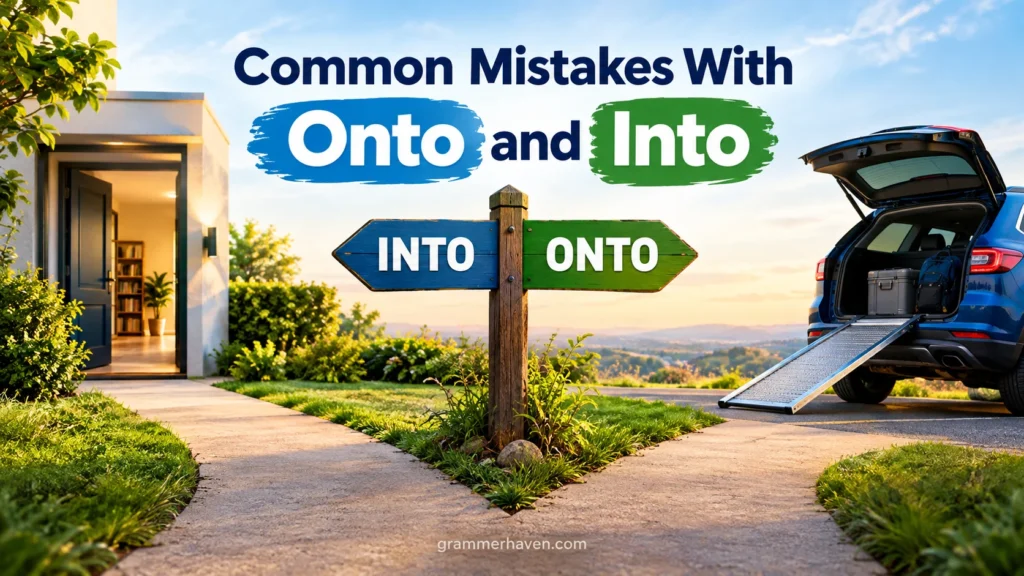
These two words become easier once you see how small changes in meaning affect the sentence.
“Jumped Onto the Pool” vs. “Jumped Into the Pool”
Usually, you jump into a pool.
Why? You enter the water.
He jumped into the pool.
By contrast, jumped onto the pool would suggest landing on something considered a surface. That could make sense in a very unusual context, such as jumping onto a pool cover, but it doesn’t describe entering the water.
So when you mean entering the water, choose into.
“Walked Onto the Room” vs. “Walked Into the Room”
The standard expression is:
She walked into the room.
A room has an interior. You enter it.
Onto the room would imply movement to a surface associated with the room rather than entry into the room itself.
“Climbed Into the Roof” vs. “Climbed Onto the Roof”
These sentences describe two completely different ideas.
He climbed onto the roof.
He reached the roof’s exterior surface.
This could mean he entered a space inside the roof, perhaps an attic or cavity, depending on context.
The preposition changes the mental picture dramatically.
“Put It Into the Table” vs. “Put It Onto the Table”
Normally:
Put the book onto the table.
The book sits on the table’s surface.
But imagine a table with a built-in drawer:
Put the documents into the table drawer.
Now the documents enter an enclosed compartment.
The same object can therefore take either preposition depending on where it ends up.
Onto or Into a Car: Which One Is Correct?
This is a particularly useful comparison because both expressions are possible.
Usually, you get into a car:
She got into the car and drove away.
You enter the vehicle’s interior.
But you can climb onto a car:
The mechanic climbed onto the car’s roof.
Now the person moves to the exterior surface.
The difference isn’t about the vehicle. It’s about the destination.
| Sentence | Meaning |
| He got into the car. | He entered the vehicle. |
| He climbed onto the car. | He moved to its exterior surface. |
| She jumped into the car. | She entered the vehicle. |
| She jumped onto the car. | She landed on its exterior. |
This is a perfect example of why memorizing isolated phrases isn’t enough. Think about the spatial relationship.
Onto vs. Into vs. On vs. In
The larger picture becomes clearer when you compare all four words.
| Word | Main function | Example |
| On | Position on a surface | The keys are on the table. |
| Onto | Movement to a surface | Put the keys onto the table. |
| In | Position inside | The keys are in the drawer. |
| Into | Movement toward the inside | Put the keys into the drawer. |
This distinction between position and movement is especially useful.
Compare:
The dog is in the house.
The sentence describes location.
The dog ran into the house.
The sentence describes movement.
Likewise:
The cat is on the roof.
This tells you where the cat is.
The cat climbed onto the roof.
This tells you where the cat moved.
Cambridge makes this same position-versus-direction distinction when explaining in/into and on/onto.
Can “Onto” and “Into” Ever Be Interchanged?
Sometimes a sentence may allow more than one construction, but the meanings aren’t always identical.
For example:
Put the milk in the refrigerator.
Put the milk into the refrigerator.
Both can be natural. Cambridge notes that certain verbs, including put, fall, jump, and dive, can sometimes take in or into without a meaningful difference in context.
However, don’t assume the same flexibility applies everywhere.
Compare:
She walked into the room.
You can’t normally replace into with onto without changing the meaning.
Likewise:
She stepped onto the stage.
Replacing onto with into would suggest entering some interior space rather than stepping onto the stage surface.
So the safest approach is to ask what spatial relationship you mean.
Figurative Uses of “Into”
The word into reaches well beyond physical movement.
Change or Transformation
Use into when something becomes something else:
- Water turned into ice.
- The hobby developed into a business.
- The discussion turned into a debate.
- The company evolved into a major brand.
Interest
Use into when someone has a strong interest:
- She’s into classical music.
- He’s into photography.
- They’re into hiking.
Involvement
Into can also describe entering a situation or activity:
- He got into trouble.
- She got into an argument.
- They got into a difficult situation.
These expressions retain the basic idea of movement toward or involvement in something, even though no physical doorway exists.
Figurative Uses of “Onto”
Onto has its own set of figurative meanings.
Being Aware of Something
The police are onto him.
This means they have discovered information that makes them suspicious.
Discovering an Idea
I think we’re onto something.
This suggests that someone may have found a useful idea, solution, or promising direction.
Changing Topics
Let’s move onto the next subject.
Here, onto signals progression from one topic to another. Cambridge lists this use for changing or beginning a different subject.
Holding Something
Hold onto the railing.
Here, the expression means to keep holding something firmly.
These idiomatic uses show why a simple “surface versus interior” rule is useful but not complete. It explains the core spatial meanings, while context handles the rest.
A Simple Trick to Choose Between Onto and Into
When you’re stuck between onto or into, ask one question:
Where does the movement end?
If the answer is on a surface, choose onto.
If the answer is inside, choose into.
Try the “On or In?” Test
Imagine removing the movement and describing the final position.
For example:
She climbed onto the roof.
Final position: on the roof.
So onto makes sense.
Now:
She walked into the house.
Final position: in the house.
So into makes sense.
This isn’t a perfect test for every idiom or figurative expression, but it works remarkably well for everyday physical movement.
Real-World Case Study: One Door, Two Directions
Imagine you’re moving furniture into a house.
First, you carry a chair from the sidewalk and place it on the porch:
You carry the chair onto the porch.
Then you pick it up and carry it through the doorway:
You carry the chair into the house.
The chair hasn’t changed. The movement has.
First, it reaches a surface. Then, it crosses a boundary and enters an interior.
That simple scenario captures the central difference between the two prepositions.
Onto or Into: Quick Reference Guide
Use onto when:
- Something moves to a surface.
- Someone steps onto a platform or stage.
- Something lands on an object.
- Someone moves onto a road or field.
- Something becomes attached to another thing.
- You use an expression such as be onto someone.
Use into when:
- Someone enters a room or building.
- Something moves inside a container.
- Someone enters a vehicle.
- Something moves into an area.
- Something changes into another form.
- Someone becomes involved in a situation.
- Someone shows strong interest in something.
Quick takeaway
| If you mean… | Use |
| Movement to a surface | Onto |
| Movement inside something | Into |
| A position on something | On |
| A position inside something | In |
| Transformation or change | Usually into |
| Strong interest | Into |
| Awareness or discovery | Onto in expressions such as be onto |
In short: onto puts something on; into takes something in.
See also: Follow Up or Follow-Up: Which Is Correct?
FAQs:
Is “onto” or “into” correct?
Both are correct words. The correct choice depends on the meaning.
Use onto for movement to a position on something. Use into for movement toward the inside of something.
What is the easiest way to remember onto vs. into?
Remember:
Onto = on.
Into = in.
If something ends up on a surface, use onto.
If something ends up in an interior space, use into.
Do you jump onto or into a pool?
Usually, you jump into a pool because you enter the water.
She jumped into the pool.
You might use onto if you’re talking about landing on a physical surface associated with the pool, such as a pool cover.
Do you walk onto or into a room?
You normally walk into a room.
He walked into the room.
The movement takes him from outside the room to its interior.
Do you climb onto or into a car?
Both can be correct, depending on the destination.
He climbed onto the car.
He moved onto its exterior surface.
Is “onto” always about physical movement?
No. Onto has several figurative and idiomatic uses.
For example:
- “She’s onto something.”
- “The police are onto him.”
- “Let’s move onto the next topic.”
- “Hold onto the rope.”
Can “into” describe something other than physical movement?
Absolutely.
Into can describe transformation, interest, and involvement:
- turn into something
- get into trouble
- be into music
- divide something into pieces
Cambridge recognizes these as established uses of into.
Conclusion:
Knowing the difference between Onto or Into makes everyday writing clearer. Use onto when something moves to a surface, and use into when something moves toward the inside or interior of something. Keeping the direction, position, and destination in mind can help you avoid common mistakes in sentences, emails, reports, and academic writing.













