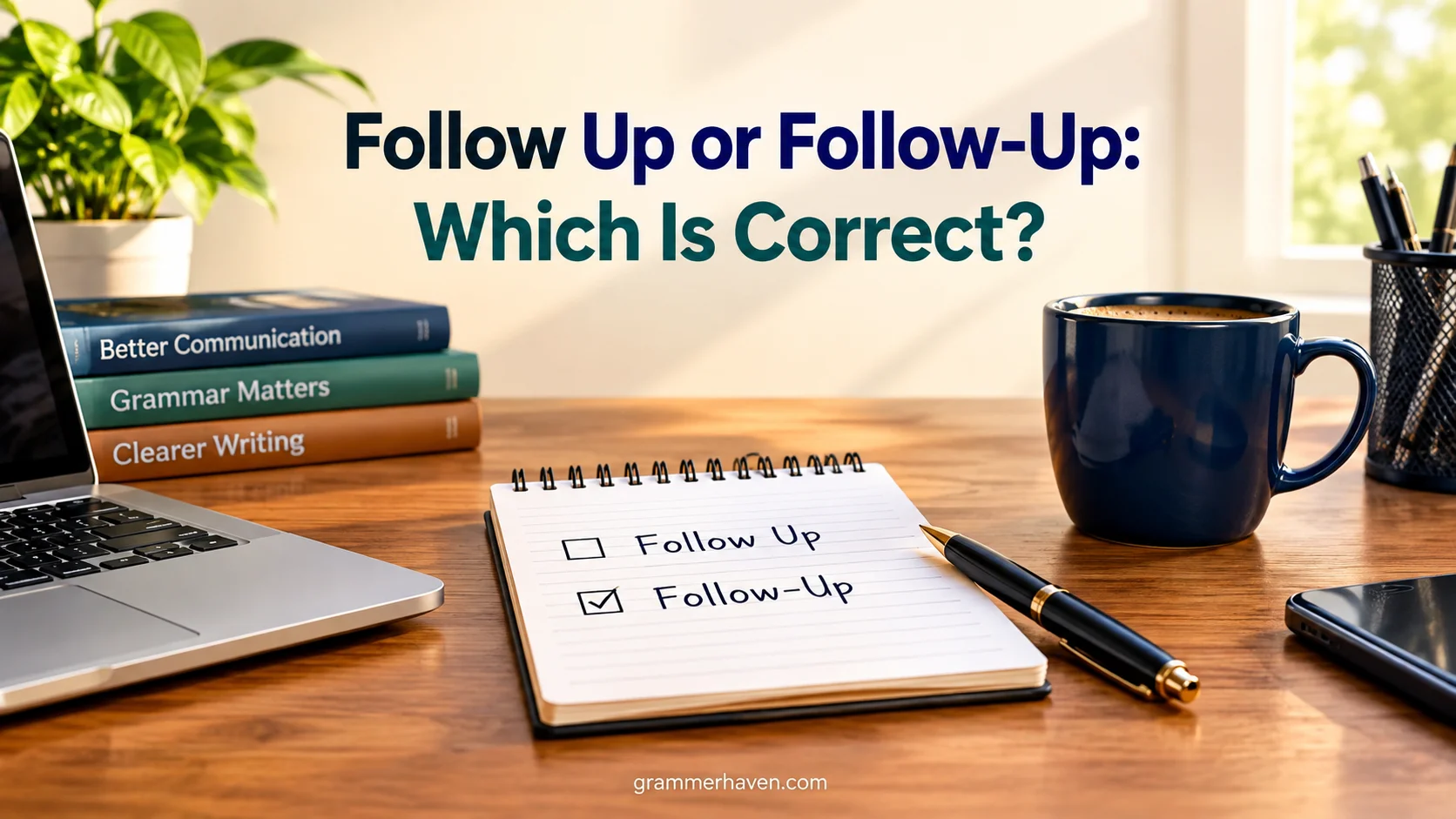
Follow Up or Follow-Up explains a common spelling mix-up for writers, professionals, and people who need the right form in clear writing today. The phrase follow up works as a verb, while follow-up works as a noun or adjective. Followup is not the standard form in modern general-purpose American English or American English. This rule helps with confusion in writing, communication, emails, reports, texts, and documents.
Use follow up when describing an action, such as when you send another message or contact someone tomorrow. Use follow-up with a hyphen when it functions as a noun or adjective, as in follow-up email or a follow-up message. This pattern appears in business documents, medical writing, academic papers, and everyday conversation. Clear-writing guidance supports this practical distinction because the grammatical role and grammatical job become easier to identify, keeping the forms correct.
The CDC uses follow-up in medical contexts involving continued care and communication. Professional emails may say “Please follow up tomorrow” or “I’ll send a follow-up email.” Learn how each verb, noun, and adjective form works, then use the correct form based on its grammatical role. The general-purpose pattern remains simple: follow up describes the action, while follow-up identifies a thing or modifies another word. This approach supports clear communication across emails, reports, texts, and formal documents.
Follow Up or Follow-Up: Quick Answer
Here’s the rule you can remember:
Use “follow up” as a verb. Use “follow-up” as a noun or adjective.
| Form | Grammar | Correct? | Example |
| follow up | Verb | ✅ Yes | I’ll follow up tomorrow. |
| follow-up | Noun | ✅ Yes | We scheduled a follow-up. |
| follow-up | Adjective | ✅ Yes | She sent a follow-up email. |
| followup | General standard usage | ❌ Avoid | Write follow-up instead. |
Merriam-Webster lists follow up as a verb and follow-up as both a noun and an adjective. Its examples include phrases such as follow-up email, follow-up questions, and follow up on complaints.
So, if you’re describing an action, choose follow up.
If you’re naming a thing, event, or type of action, choose follow-up.
That one distinction solves most cases.
What Does “Follow Up” Mean?
Follow up means to take additional action after something has already happened. You might contact someone again, investigate an issue, seek more information, or continue an earlier effort.
For example:
- I’ll follow up with the customer tomorrow.
- The reporter followed up on the original story.
- Please follow up after the meeting.
- The doctor will follow up with the patient.
- Police followed up on several leads.
In each sentence, follow up describes something someone does. That makes it a verb phrase, so you write it as two separate words.
Merriam-Webster defines the verb in several related ways, including taking further action, maintaining contact, and pursuing something to obtain additional information.
“Follow Up” Is a Verb Phrase
A useful test is to ask:
What is the person doing?
If the answer is “following up,” you need the two-word form.
Consider these examples:
- I need to follow up.
- She will follow up later.
- They followed up after the interview.
- We’re following up with the supplier.
- He has followed up on the complaint.
Notice how the phrase changes with tense:
| Tense | Correct Form | Example |
| Present | follow up | I follow up with clients. |
| Third person | follows up | She follows up every Friday. |
| Past | followed up | He followed up yesterday. |
| Present participle | following up | We’re following up now. |
| Future | will follow up | I’ll follow up tomorrow. |
| Perfect | has followed up | She has followed up twice. |
The hyphen doesn’t belong in these verb constructions.
When to Use “Follow Up” With “With”
One of the most common constructions is follow up with.
Use it when you mean that you’re contacting or communicating with a particular person, group, or organization again.
Examples include:
- I’ll follow up with you next week.
- Please follow up with the sales team.
- She followed up with the client after the presentation.
- The doctor asked the patient to follow up with the specialist.
- We should follow up with everyone who attended.
The grammatical structure is straightforward:
Subject + follow up + with + person
For example:
I’ll follow up with Sarah tomorrow.
Here, follow up is the action and Sarah is the person receiving that action.
When to Use “Follow Up” With “On”
You can also follow up on something.
This construction usually means that you’re investigating an issue, pursuing a request, checking information, or taking further action.
Examples:
- I’ll follow up on your request.
- The manager followed up on the complaint.
- Police followed up on the information.
- We need to follow up on that lead.
- She promised to follow up on the problem.
Merriam-Webster specifically defines follow up on as trying to obtain more information or taking appropriate action about something.
“Follow Up With” vs. “Follow Up On”
These two expressions are easy to mix up.
| Expression | Usually refers to | Example |
| follow up with | A person or group | I’ll follow up with John. |
| follow up on | An issue, request, lead, or matter | I’ll follow up on the request. |
You can also use both in one sentence:
I’ll follow up with John on the request.
That means John is the person you’ll contact, while the request is the matter you’ll discuss or investigate.
When to Use “Follow-Up”
Now the hyphen enters the picture.
Follow-up works as a noun or an adjective. Merriam-Webster recognizes both uses and gives examples involving medical care, journalism, communication, and additional questions.
“Follow-Up” as a Noun
A noun names a person, place, thing, idea, event, or concept.
When follow-up names a subsequent action, contact, appointment, report, or development, use the hyphen.
Examples:
- We scheduled a follow-up.
- The doctor recommended a follow-up.
- I sent a follow-up after the meeting.
- The newspaper published a follow-up to the original article.
- She requested a follow-up with the manager.
Here, follow-up isn’t telling someone what to do. It names the additional action or event.
That’s the key difference.
Compare these two sentences:
I’ll follow up tomorrow.
We scheduled a follow-up for tomorrow.
The first sentence describes an action. The second names an event.
“Follow-Up” as an Adjective
Follow-up can also describe another noun.
This is especially common in professional, medical, academic, and business writing.
Examples include:
- follow-up email
- follow-up question
- follow-up meeting
- follow-up appointment
- follow-up call
- follow-up interview
- follow-up study
- follow-up report
- follow-up visit
- follow-up letter
Look at this sentence:
She sent a follow-up email after the interview.
The word follow-up describes what kind of email she sent. Therefore, it functions as an adjective.
Merriam-Webster explicitly lists follow-up as an adjective and provides examples such as “follow-up email” and “follow-up questions.”
Follow Up vs. Follow-Up: The Grammar Test

When you’re unsure, don’t rely on how the phrase sounds. Instead, identify its job in the sentence.
Ask yourself:
Is “follow up” describing an action?
If yes, use follow up.
Is “follow-up” naming or describing something?
If yes, use follow-up.
Compare These Sentences
| Sentence | Why? |
| I’ll follow up tomorrow. | Verb |
| Please follow up with the client. | Verb |
| We need to follow up on the issue. | Verb |
| I sent a follow-up yesterday. | Noun |
| We scheduled a follow-up. | Noun |
| She sent a follow-up email. | Adjective |
| He asked a follow-up question. | Adjective |
| They conducted a follow-up study. | Adjective |
The distinction becomes almost mechanical once you focus on grammar rather than spelling.
Follow Up or Follow-Up in Email Writing
Email communication creates some of the most common examples.
Suppose you contacted a potential customer yesterday. You could write:
I’ll follow up with you tomorrow.
Here, follow up is a verb.
However, if you describe the email itself, write:
I’ll send a follow-up email tomorrow.
Here, follow-up modifies email, so the hyphen belongs there.
You might also write:
Thanks for your follow-up.
In this sentence, follow-up acts as a noun.
Common Email Examples
Correct:
- I’ll follow up next week.
- I wanted to follow up on my previous email.
- This is a follow-up email regarding your request.
- Thanks for the follow-up.
- We’ll send a follow-up message shortly.
Incorrect in standard usage:
- I’ll follow-up tomorrow.
- I sent a followup email.
- Please follow-up with the customer.
The CDC uses the same basic rule: “Follow up is a verb. Follow-up is a noun or adjective.”
Follow Up or Follow-Up in Business Writing
Business communication uses these forms constantly.
You might need to follow up with a client, send a follow-up email, schedule a follow-up meeting, or make a follow-up call.
Each phrase has a different grammatical structure.
| Correct phrase | Function |
| follow up with a client | Verb |
| follow up on a request | Verb |
| follow-up email | Adjective |
| follow-up meeting | Adjective |
| follow-up call | Adjective |
| a follow-up | Noun |
Example: One Situation, Three Forms
Imagine that you met a client on Monday.
On Tuesday, you might say:
I’ll follow up with the client tomorrow.
On Wednesday:
I sent a follow-up email.
Later, your manager might ask:
Did you get a response to the follow-up?
All three forms are correct because they perform different grammatical jobs.
Follow Up or Follow-Up in Healthcare
Healthcare writing provides another clear example.
Medical professionals commonly use:
- follow-up appointment
- follow-up visit
- follow-up care
- follow-up examination
- follow-up treatment
- follow up with your doctor
For example:
The patient has a follow-up appointment next month.
Here, follow-up modifies appointments.
But:
The patient should follow up with the doctor next month.
Here, follow up is the verb.
Merriam-Webster’s medical definition describes follow-up as continued contact or reexamination after diagnosis or treatment. It also lists constructions such as follow-up visit and follow-up care.
This distinction matters in healthcare because precise wording can make instructions easier to understand.
Follow Up or Follow-Up in Academic Writing
Academic and research writing uses the same grammatical pattern.
You might encounter:
- follow-up study
- follow-up research
- follow-up survey
- follow-up analysis
- follow-up experiment
- follow-up questions
For example:
Researchers conducted a follow-up study three years later.
But:
Researchers followed up with participants three years later.
The first sentence uses follow-up as an adjective. The second uses followed up as a verb.
This distinction doesn’t disappear just because the writing becomes more formal. The underlying grammar remains the same.
Is “Followup” One Word?
For general American English writing, followup should be avoided.
The standard forms are:
- follow up when used as a verb
- follow-up when used as a noun or adjective
The CDC’s writing guidance explicitly labels followup as incorrect in its general usage recommendation.
There is an important nuance, though. Historical or specialized style guides haven’t always handled the word identically. For example, an older CDC style guide contains a specialized medical usage that treats followup as a noun.
That doesn’t change the practical recommendation for ordinary modern writing. If you’re writing a blog post, email, business document, school assignment, or general professional article, follow-up is the safer standard noun form.
Common Follow Up and Follow-Up Mistakes
Mistake: “I Will Follow-Up Tomorrow”
❌ I will follow-up tomorrow.
✅ I will follow up tomorrow.
Why? Will is followed by a verb. Here, follow up describes an action.
Mistake: “Follow Up Email”
❌ I sent a follow up email.
✅ I sent a follow-up email.
Why? Follow-up works as a compound adjective describing email.
Mistake: “Followup Email”
❌ I sent a followup email.
✅ I sent a follow-up email.
The standard compound modifier uses the hyphen.
Mistake: Using One Form Everywhere
A common shortcut is to decide that one version “looks right” and use it throughout a document.
That’s where errors multiply.
You shouldn’t write follow-up every time simply because it appears in a phrase about future communication. Grammar determines the form.
Compare:
I’ll follow up with the customer.
I’ll send a follow-up email.
We scheduled a follow-up.
Three sentences. Three grammatical roles.
Follow Up or Follow-Up: A Simple Memory Trick
Here’s the easiest way to remember the distinction:
Action = follow up. Thing or description = follow-up.
Think of follow up as something you do.
- I’ll follow up.
- She followed up.
- They’re following up.
Think of follow-up as something you name or describe.
- a follow-up
- a follow-up email
- a follow-up appointment
This works like a small grammatical compass. When you get lost, ask whether the phrase represents an action or a thing/description.
Follow Up vs. Follow-Up: Real-World Case Study
Consider a simple job application.
You submit your résumé on Monday. On Thursday, you decide to contact the employer.
You might write:
I’d like to follow up on my application.
Here, follow up is a verb.
Then you send the message:
I sent a follow-up email to the hiring manager.
Now follow-up modifies email.
The hiring manager responds:
Thank you for your follow-up. We’ll review your application.
Now follow-up functions as a noun.
The situation hasn’t changed. Only the grammatical role has.
That’s why trying to memorize isolated spellings isn’t as effective as learning the underlying rule.
Follow Up or Follow-Up Examples
Here are more examples across different situations.
Examples With “Follow Up”
- Please follow up with the customer.
- I’ll follow up tomorrow morning.
- She followed up on the complaint.
- We need to follow up after the interview.
- The journalist followed up on the original report.
- They plan to follow up with participants.
- He promised to follow up on the request.
Examples With “Follow-Up”
- She sent a follow-up email.
- We scheduled a follow-up appointment.
- He asked a follow-up question.
- The study included a follow-up survey.
- The newspaper published a follow-up.
- We had a brief follow-up after the meeting.
- The doctor recommended follow-up care.
Merriam-Webster also uses follow-up for a subsequent news story, which shows that the term extends beyond business and healthcare.
Quick Quiz: Follow Up or Follow-Up?
Test the rule before moving on.
- Please ______ with the customer tomorrow.
- She sent a ______ email.
- We scheduled a ______ appointment.
- I need to ______ on that request.
- He asked a ______ question.
- The reporter ______ on the original story.
- We had a ______ after the interview.
- The doctor will ______ with the patient next week.
Answer Key
| # | Answer | Reason |
| 1 | follow up | Verb |
| 2 | follow-up | Adjective |
| 3 | follow-up | Adjective |
| 4 | follow up | Verb |
| 5 | follow-up | Adjective |
| 6 | followed up | Verb |
| 7 | follow-up | Noun |
| 8 | follow up | Verb |
If you can identify the grammatical function, the spelling choice becomes much easier.
See also: Cancellation vs. Cancelation: Which Spelling Is Correct?
Follow Up or Follow-Up at a Glance
Keep this table handy if you regularly use the expression in professional writing.
| If you mean… | Use… | Example |
| An action | follow up | I’ll follow up tomorrow. |
| Contacting someone | follow up with | I’ll follow up with her. |
| Pursuing an issue | follow up on | We’ll follow up on the complaint. |
| A subsequent event | follow-up | We scheduled a follow-up. |
| A thing being described | follow-up | Send a follow-up email. |
| A later appointment | follow-up | She has a follow-up appointment. |
| A later question | follow-up | He asked a follow-up question. |
| One-word general form | Avoid followup | Use follow-up instead. |
FAQs:
Is “follow up” one word or two?
As a verb, follow up is written as two words.
Example:
I’ll follow up tomorrow.
Is “follow-up” hyphenated?
Yes. Use follow-up when it functions as a noun or adjective in standard general usage.
Examples:
- a follow-up
- a follow-up email
- a follow-up visit
Is “followup” correct?
For general modern American English, followup is best avoided. Use follow up as the verb and follow-up as the noun or adjective. The CDC recommends this distinction directly.
Is it “follow up email” or “follow-up email”?
Follow-up email is the standard form.
Here, follow-up acts as a compound adjective describing email.
Is it “follow up with” or “follow-up with”?
Use follow up with when you’re using the phrase as a verb.
Correct:
I’ll follow up with the manager.
Incorrect in this construction:
I’ll follow-up with the manager.
Is “follow-up” a noun or an adjective?
It can be both.
As a noun:
We scheduled a follow-up.
As an adjective:
We scheduled a follow-up appointment.
What is the plural of “follow-up”?
The plural is follow-ups.
Example:
The clinic scheduled several follow-ups for the patients.
Is “follow up on” correct?
Yes. Follow up on is a standard verb construction meaning to pursue something, seek additional information, or take further action.
Example:
I’ll follow up on your request.
Merriam-Webster specifically records follow up on with this meaning.
What is the difference between “follow up” and “follow-up”?
The simplest distinction is grammatical:
- follow up = verb
- follow-up = noun or adjective
So:
I’ll follow up tomorrow.
But:
I’ll send a follow-up email.
Conclusion:
Knowing when to use follow up and follow-up makes your writing clearer and more professional. Use follow up when it acts as a verb, such as “I’ll follow up tomorrow.” Use follow-up as a noun or adjective, such as “I sent a follow-up email.” Avoid followup in standard American English. Once you understand this simple grammatical role, the correct form becomes easy to choose in emails, reports, texts, and other documents.