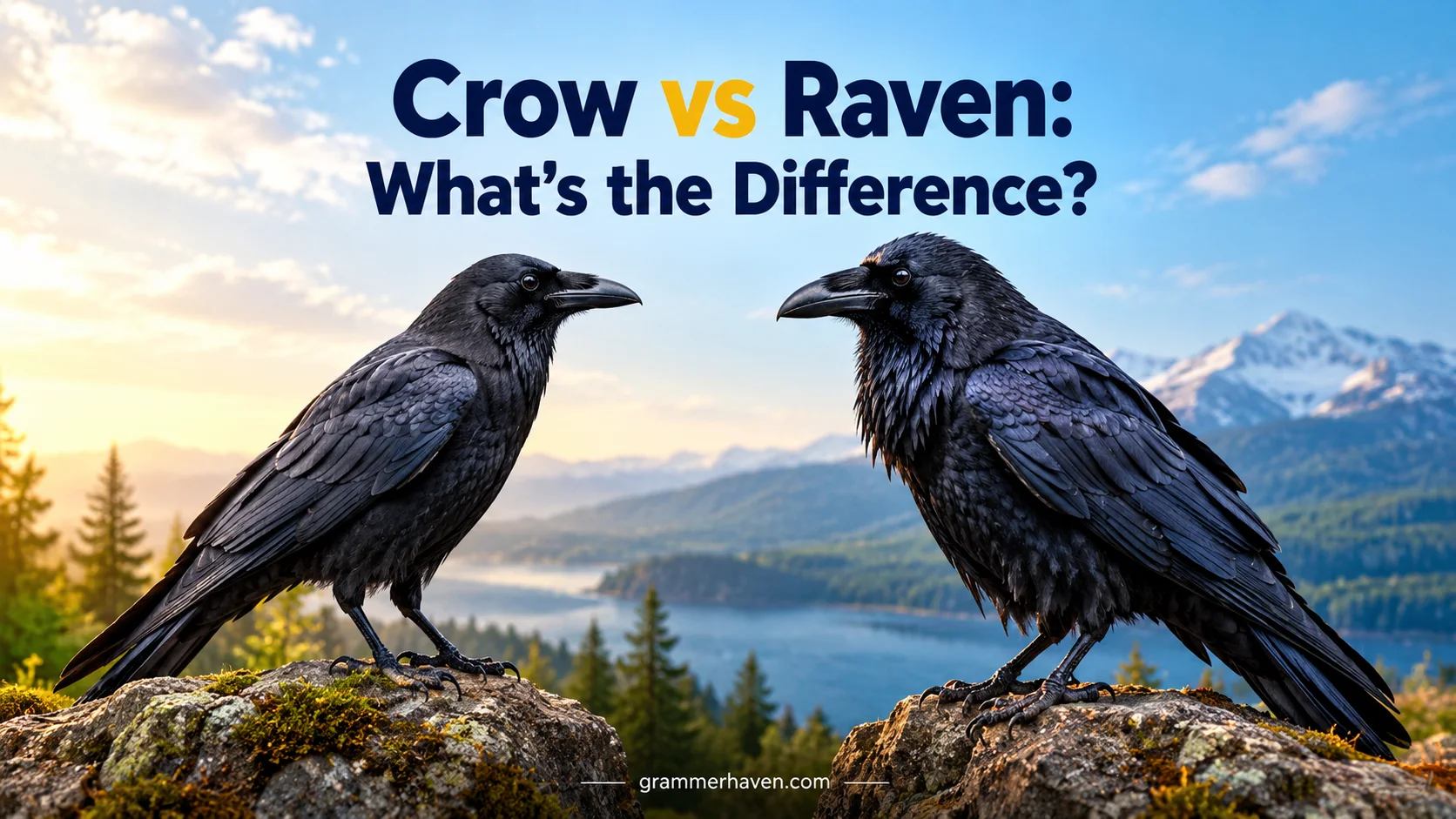
Crow vs Raven becomes easier when you compare size, bill, tail shape, and voice instead of judging a dark bird by appearance alone. Both belong to the Corvidae family, but the American Crow and Common Raven are different species. Their black coat, mysterious image, and role in stories and myths can make identification confusing.
A closer look gives you a useful clue, especially when you check several features together. Beginners may see them as twins, but their body structure and behavior offer clear ways to separate them. American Crows are smaller than Common Ravens, while ravens have a larger body, heavier bill, and more visible throat feathers. Their dark plumage can make the difference hard to notice from far away.
Flight also provides a useful comparison because a raven often appears broader and more powerful in the air. The sound and voice can help too, since a crow and raven produce different calls. Looking at the tail, feathers, throat, and bill together gives you a better guide than relying on color alone.
Both birds are intelligent, and their intelligence helps explain their place in human stories and myths. They can eat a wide range of foods, so food habits alone may not provide a clear distinction. To quickly spot the difference, focus on size, tail, feathers, throat, bill, flight, and voice.
You can also search trusted identification resources for more detail. With practice, the separation between these birds becomes less confusing, helping you use the names correctly and avoid a common identification question.
Quick Answer: Crow vs Raven
The American Crow is smaller, with a relatively short rounded or square-tipped tail, a moderate bill, and a familiar cawing voice. The Common Raven is much larger, with a heavy bill, shaggy throat feathers, a long wedge-shaped tail, and a deep, guttural call.
Here’s the fastest way to remember the difference:
| Feature | American Crow | Common Raven |
| Size | Smaller | Much larger |
| Length | 15.8–20.9 inches | 22–27 inches |
| Wingspan | 33.5–39.4 inches | About 46–47 inches |
| Weight | 11.2–21.9 ounces | 24.3 ounces–3.6 pounds |
| Bill | Moderate and straight | Large, thick, heavy |
| Tail | Rounded or squared | Long and wedge-shaped |
| Throat | Relatively smooth | Shaggy feathers |
| Flight | More frequent wingbeats | More soaring and gliding |
| Call | Familiar “caw” | Deep, guttural croak |
| Social pattern | Often highly social | Often alone or in pairs |
| Typical impression | Compact and sturdy | Large and imposing |
Cornell gives American Crows a length of about 15.8–20.9 inches and Common Ravens a length of roughly 22–27 inches. The raven can therefore look dramatically larger when the two species appear together.
Are Crows and Ravens the Same Bird?
No. Crows and ravens aren’t the same bird, although they’re close relatives.
Both belong to the genus Corvus, a group that includes numerous crow and raven species around the world. They also belong to the larger Corvidae family, alongside birds such as jays and magpies.
That close relationship explains the visual confusion. They share many traits because they inherited similar body structures and behavioral abilities from related ancestors.
Think of them like close cousins. They share the family resemblance, but you can still spot meaningful differences once you know where to look.
The terms “crow” and “raven” also don’t represent a perfectly clean scientific division across the entire genus. Different Corvus species carry different common names. That’s why a comparison between American Crow and Common Raven gives you a much more useful identification framework than simply comparing every bird called a crow with every bird called a raven.
Crow vs Raven Appearance: The Biggest Visual Differences
The easiest way to separate these birds visually is to stop focusing on their color.
Both are predominantly black. Instead, study their shape.
American Crow Appearance
An American Crow has a compact, sturdy appearance. Its bill is substantial but doesn’t overwhelm the head. Its tail looks relatively short and ends in a rounded or squared shape.
Cornell describes the American Crow as having broad, rounded wings, a relatively short tail, and a heavy but proportionate bill.
From a distance, the overall silhouette often looks like this:
Shorter tail + broader wings + moderate bill = likely crow
American Crows measure about 15.8–20.9 inches long, with wingspans of approximately 33.5–39.4 inches. Their reported weight ranges from about 11.2 to 21.9 ounces.
Common Raven Appearance
A Common Raven looks more dramatic.
Its head appears larger, its bill is noticeably heavier, and the throat has long, shaggy feathers. The body also looks more elongated because of its longer wings and tail.
Cornell describes the raven as having a thick neck, shaggy throat feathers, a massive bill, long narrow wings, and a long wedge-shaped tail.
The Common Raven measures roughly 22–27 inches long and can weigh approximately 1.5–3.6 pounds. Its wingspan reaches around 3 feet 10 inches to 3 feet 11 inches according to Audubon’s field guide.
That’s a substantial bird.
Crow vs Raven Size: How Much Bigger Is a Raven?
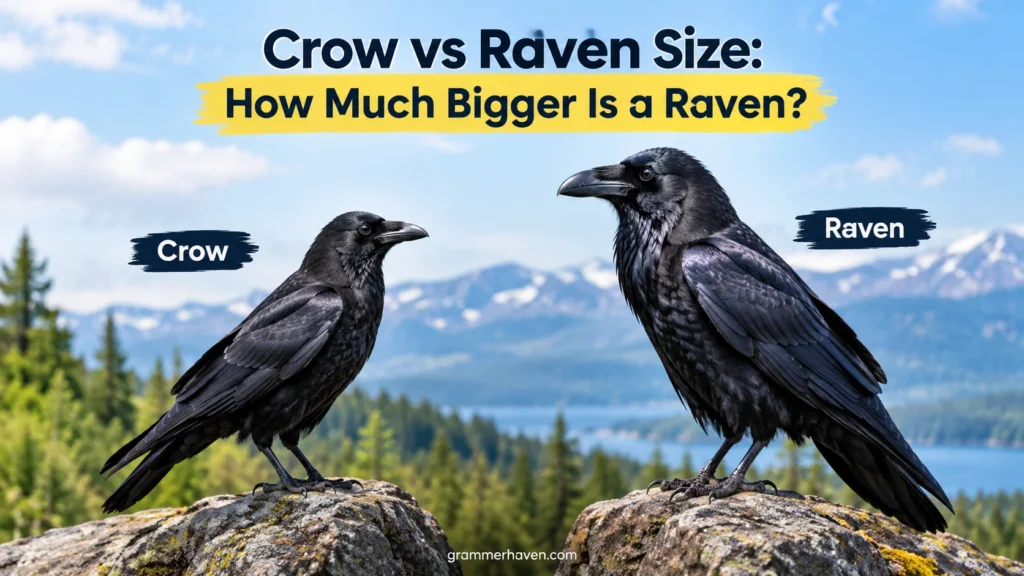
Size is one of the most useful clues when you see the two species in the same area.
The Common Raven is considerably larger than the American Crow. Cornell’s comparison describes the American Crow as about two-thirds the size of a Common Raven.
| Measurement | American Crow | Common Raven |
| Length | 15.8–20.9 in | 22–27 in |
| Wingspan | 33.5–39.4 in | About 46–47 in |
| Weight | 11.2–21.9 oz | About 24.3 oz–3.6 lb |
Sources report slightly different measurements depending on the population and measurement method, so these figures work best as field ranges rather than rigid limits.
What Does the Size Difference Look Like?
Imagine seeing two black birds on the same fence.
The crow looks substantial.
The raven looks massive.
A raven can have the presence of a small hawk, which is one reason Audubon describes the Common Raven as the largest of the birds classified as perching birds or songbirds.
Still, don’t identify a bird from size alone. Perspective can fool you. A distant raven may look like a crow, while a nearby crow can appear surprisingly large.
Crow vs Raven Tail: The Best Clue in Flight
If you only learn one visual trick, learn this one.
Look at the tail.
The American Crow has a relatively short, rounded or square-tipped tail. When viewed from below during flight, the tail doesn’t form the long, pointed silhouette associated with a raven.
The Common Raven has a long wedge-shaped tail. When its tail feathers spread during flight, the central feathers extend farther than the outer feathers. That creates a distinctive tapered or diamond-like silhouette.
Why Tail Shape Works So Well
A bird flying overhead may give you only a few seconds to identify it. You might not see its eyes, bill, or throat clearly.
The tail remains visible.
That’s why this simple rule helps:
- Rounded or squared tail → think crow
- Long wedge-shaped tail → think raven
It’s not foolproof for every Corvus species. However, it’s an excellent clue for separating an American Crow from a Common Raven.
Crow vs Raven Bill: Look at the Beak
The bill offers another strong clue.
An American Crow has a sturdy bill, but it looks relatively modest compared with the bird’s head. Cornell describes it as a heavy, straight bill that remains proportionate to the head.
A Common Raven’s bill is different.
It’s large, thick, and imposing. From the side, the raven’s bill can look almost oversized.
That heavy bill fits the raven’s feeding lifestyle. Ravens are opportunistic omnivores and scavengers that consume everything from insects and small animals to carrion and discarded food.
A Simple Bill Test
Ask yourself:
Does the bill look proportionate, or does it seem unusually large and heavy?
If the bill looks enormous relative to the head, a raven becomes much more likely.
Crow vs Raven Throat: Check the Feathers
Here’s another detail that’s easy to miss.
Common Ravens have shaggy throat feathers.
These elongated feathers give the raven a somewhat rough, almost bearded appearance around the throat. Cornell specifically highlights the shaggy neck and throat as an identification feature.
American Crows don’t have that same pronounced throat ruff.
This clue works especially well when the bird is perched nearby. At a great distance, however, the throat may blend into the overall black silhouette.
That’s why experienced birders combine several clues rather than betting everything on one feature.
Crow vs Raven Sounds: What Does Each Bird Sound Like?
When visual clues fail, listen.
Sound can be one of the fastest ways to tell these birds apart. Cornell’s Bird Academy notes that American Crows and Common Ravens are easiest to identify by sound when you’re dealing with the two species.
What Does a Crow Sound Like?
The American Crow produces the familiar “caw” that most people associate with crows.
Its call can sound sharp, rough, and straightforward.
However, “caw” doesn’t capture the full vocal range of the species. Crows produce different sounds in different situations, and their communication is more varied than the stereotypical movie-version crow call suggests.
What Does a Raven Sound Like?
A Common Raven has a much deeper voice.
Its calls can sound guttural, croaking, hollow, or resonant. Audubon describes the species as having deep, varied, guttural croaking calls.
That difference can be striking.
If the bird looks black and substantial but produces a deep, gravelly croak from high overhead, you’re probably dealing with a raven.
Quick Sound Comparison
| Bird | Typical sound impression |
| American Crow | Sharp, familiar caw |
| Common Raven | Deep, guttural croak |
| Fish Crow | Nasal calls that can be difficult to distinguish visually |
Sound becomes particularly important with similar crow species. For example, Audubon notes that Fish Crows can be identified with certainty by sound, because their appearance overlaps substantially with American Crows.
Crow vs Raven in Flight
Flight behavior can reveal what your eyes can’t see while the bird is perched.
How American Crows Fly
American Crows tend to fly with more regular wingbeats. Their wings appear broad and rounded, and their relatively short tails give them a compact silhouette. Cornell notes that American Crows fly with a rowing motion and rarely glide.
They can certainly fly high and cover long distances. Yet their flight usually looks more deliberate and flapping-heavy.
How Common Ravens Fly
Ravens are different.
Their wings are longer and narrower. They can soar, glide, roll, and use rising air currents with impressive control. Audubon specifically classifies their flight behavior as both direct flight and soaring.
A raven riding a thermal can look almost effortless.
That graceful soaring behavior is one of the reasons a large black bird circling over mountains or cliffs is worth a second look.
The Flight Test
When you see a black bird overhead, ask:
- Does it flap steadily most of the time?
- Does it have broad, rounded wings?
- Does the tail look short and squared?
If yes, think crow.
If instead you see:
- Longer, narrower wings
- Frequent gliding or soaring
- A long wedge-shaped tail
think raven.
Crow vs Raven Behavior
Appearance isn’t the only difference. Their behavior can also give you useful clues.
American Crow Behavior
American Crows are famously adaptable. They occupy forests, farms, fields, shorelines, towns, suburbs, and cities. Audubon notes that they have adapted especially well to human environments.
They’re also highly social.
Outside the breeding season, American Crows may gather in communal roosts containing thousands or even tens of thousands of birds.
That sight can be spectacular.
Imagine an entire grove filled with black silhouettes at sunset. That’s classic crow behavior.
Common Raven Behavior
Common Ravens are often seen alone or in pairs, although they can gather where food is abundant.
They also show strong adaptability. Their habitat ranges from deserts and coastal cliffs to forests, mountains, and Arctic tundra.
Ravens can also cooperate while foraging. Audubon notes that pairs may work together to flush prey.
So, if you see one enormous black bird soaring above a rugged landscape, a raven is a strong possibility.
Crow vs Raven Habitat and Range
Habitat can narrow down your identification, but it shouldn’t replace physical clues.
Where Do American Crows Live?
American Crows occupy a huge variety of environments, including:
- Woodlands
- Farmland
- Open fields
- River corridors
- Shores
- Suburban areas
- Urban parks
- Towns and cities
They’ve become particularly successful around people. Their ability to exploit changing food sources has helped them thrive in environments heavily modified by humans.
Where Do Common Ravens Live?
Common Ravens are even more versatile than their rugged reputation suggests.
They can inhabit:
- Mountain forests
- Boreal forests
- Coastal cliffs
- Deserts
- Canyons
- Tundra
- Open country
- Some urban environments
Audubon describes the species as capable of surviving from hot desert environments to High Arctic tundra.
Can Crows and Ravens Live in the Same Place?
Absolutely.
Their ranges overlap in many areas. That’s where identification gets interesting.
If both species occur locally, geography alone won’t tell you which bird you’re watching. You’ll need to examine the size, tail, bill, throat, flight, and sound.
Crow vs Raven Diet
Both birds are opportunistic omnivores. Neither species sticks to one narrow menu.
What Do American Crows Eat?
American Crows eat a remarkably broad range of foods, including:
- Insects
- Spiders
- Snails
- Earthworms
- Frogs
- Small snakes
- Shellfish
- Carrion
- Eggs
- Seeds
- Grain
- Berries
- Fruit
- Human food waste
Audubon also documents a fascinating behavior: crows may carry hard-shelled mollusks into the air and drop them onto rocks to crack them open.
That’s not random scavenging. It’s a practical solution to a food-access problem.
What Do Common Ravens Eat?
Ravens also eat a wide variety of foods.
Their diet includes:
- Carrion
- Insects
- Rodents
- Lizards
- Frogs
- Eggs
- Young birds
- Garbage
- Other available animal matter
Audubon notes that animal matter makes up a large part of the raven’s diet, although the species remains highly opportunistic.
Both species play an ecological role as scavengers. Their willingness to consume carrion helps move nutrients through ecosystems and removes animal remains from the landscape.
Are Ravens Smarter Than Crows?
This question sounds simple, but the answer isn’t.
Both crows and ravens demonstrate impressive cognitive abilities. Calling one species universally “smarter” oversimplifies animal intelligence because different species can excel at different tasks.
Why Are Crows Considered Intelligent?
American Crows can:
- Learn from experience
- Adapt to new food sources
- Solve practical feeding problems
- Recognize environmental threats
- Use objects in food-acquisition behaviors
- Learn from other birds
Their success in cities and other human-dominated landscapes is itself a powerful example of behavioral flexibility. Audubon describes American Crows as among the most intelligent birds and connects their success around civilization with that adaptability.
Why Are Ravens Considered Intelligent?
Ravens also show sophisticated problem-solving and flexible behavior.
They can cooperate while foraging, exploit temporary food sources, and survive in dramatically different environments. Their ability to operate across deserts, forests, mountains, and Arctic landscapes reflects remarkable behavioral flexibility.
So Which Is Smarter?
There isn’t a scientifically useful one-word winner.
Crows and ravens are both highly intelligent corvids, but intelligence depends on what behavior or task you’re measuring.
It’s like asking whether a chess player is smarter than a mountain climber. The answer depends heavily on what you’re asking each one to do.
Crow vs Raven Nesting and Family Life
Their family behavior provides another interesting contrast.
American Crow Nesting
American Crows typically build bulky stick nests in trees or large shrubs. Nests are often positioned about 10–70 feet above the ground, according to Audubon.
A typical clutch contains four to six eggs, although larger or smaller clutches occur.
Young usually leave the nest around four to five weeks after hatching. Both parents feed the young, and older offspring from previous seasons may help the breeding pair.
That cooperative family structure is one of the more fascinating aspects of crow life.
Common Raven Nesting
Common Ravens often place nests on:
- Rock cliffs
- Tall trees
- Towers
- Poles
- Bridges
- Other elevated structures
They may reuse a nesting site over multiple years and add material to an existing nest.
Raven eggs generally hatch after around 18–21 days of incubation, and young leave the nest at approximately five to six weeks.
Crow vs Raven vs Other Black Birds
Not every black bird is a crow or raven.
That distinction matters, especially when you’re birdwatching in areas with multiple dark-colored species.
Crow vs Grackle
Common Grackles can look black at first glance, but they’re generally more slender and have different proportions. Their tails can be long, and their calls differ noticeably from a crow’s familiar caw.
Crow vs Fish Crow
Fish Crows are particularly tricky.
They can overlap heavily with American Crows in appearance and habitat. Audubon notes that Fish Crows are best distinguished by their distinctive vocalizations rather than visual appearance alone.
Raven vs Chihuahuan Raven
This distinction becomes important in the southwestern United States.
The Chihuahuan Raven is smaller than the Common Raven and can be closer in size to an American Crow. It also has a different voice and occupies different habitat patterns.
This is an excellent reminder that common names can hide considerable biological diversity.
How to Tell a Crow From a Raven in 30 Seconds
When you’re standing outside and don’t have time for a field guide, use this five-point test.
1. Check the Size
Does the bird look exceptionally large?
Yes → Raven becomes more likely.
2. Look at the Tail
Is the tail rounded or squared?
Crow.
Does it form a long wedge?
Raven.
3. Study the Bill
Does it look moderate and proportionate?
Crow.
Does it look thick, heavy, and oversized?
Raven.
4. Check the Throat
Smooth-looking throat?
Crow.
Shaggy throat feathers?
Raven.
5. Listen
Sharp, familiar caw?
Crow.
Deep, guttural croak?
Raven.
The more clues that point in the same direction, the more confident the identification becomes.
Crow vs Raven Identification Decision Guide
A practical identification sequence looks like this:
Black bird spotted
↓
Is it unusually large?
- No → Consider the American Crow or another smaller black bird.
- Yes → Continue.
Does it have a heavy bill and shaggy throat?
- No → Crow becomes more likely.
- Yes → Raven becomes more likely.
What does the tail look like?
- Rounded or squared → Crow.
- Long and wedge-shaped → Raven.
How does it fly?
- Frequent steady wingbeats → Crow.
- Soaring and gliding → Raven.
What does it sound like?
- Caw → Crow.
- Deep croak → Raven.
This method works because it combines multiple independent clues instead of relying on a single feature.
Common Myths About Crows and Ravens
Myth: A raven is simply a big crow
Reality: They’re different species, even though both belong to the genus Corvus.
Myth: Every large black bird is a raven
Reality: Size can help, but other Corvus species and unrelated black birds can complicate identification.
Myth: Crows only make one sound
Reality: American Crows have a varied vocal repertoire. The familiar caw is only the sound most people recognize.
Myth: Ravens always travel alone
Reality: Ravens are often encountered alone or in pairs, but they can gather around concentrated food sources.
Myth: Crows are less intelligent because they’re smaller
Reality: Body size doesn’t provide a reliable measure of cognitive ability. Both crows and ravens show impressive behavioral flexibility.
Myth: Ravens and crows have completely different habitats
Reality: Their habitats overlap considerably in some regions.
Why Are Crows and Ravens Important to the Ecosystem?
Their reputation often focuses on scavenging, but that description sells them short.
Both species are opportunistic omnivores, which means they occupy several ecological roles. They consume insects and other invertebrates, eat plant material, prey on smaller animals, and take advantage of carrion.
Their scavenging behavior also matters.
When animals die, scavengers help break down organic material and return nutrients to ecosystems. Crows and ravens are therefore more than dramatic black silhouettes circling overhead. They’re active participants in food webs.
Their intelligence adds another layer. Instead of relying on a narrow feeding strategy, they can adjust their behavior when conditions change.
That flexibility helps explain why American Crows thrive around farms and cities while Common Ravens can survive across environments as different as deserts and Arctic tundra.
Crow vs Raven: The Key Differences at a Glance
| Characteristic | American Crow | Common Raven |
| Scientific name | Corvus brachyrhynchos | Corvus corax |
| Length | 15.8–20.9 inches | 22–27 inches |
| Wingspan | 33.5–39.4 inches | About 46–47 inches |
| Weight | 11.2–21.9 ounces | About 1.5–3.6 pounds |
| Overall build | Compact and sturdy | Large and imposing |
| Bill | Heavy but moderate | Very large and thick |
| Tail | Rounded or squared | Long and wedge-shaped |
| Throat | Relatively smooth | Shaggy |
| Wings | Broad and rounded | Long and narrower |
| Flight | More flapping | More soaring and gliding |
| Voice | Cawing | Deep, guttural croaking |
| Social behavior | Often highly social | Often alone or in pairs |
| Diet | Omnivorous | Omnivorous, with substantial animal matter |
| Habitat | Fields, forests, farms, towns, cities | Mountains, forests, deserts, coasts, tundra |
| Nest sites | Mostly trees and shrubs | Cliffs, trees, towers, structures |
The physical measurements and identification traits come from Cornell Lab of Ornithology and Audubon field guides.
See also: Onto or Into: What’s the Difference? Meaning, Rules & Examples
FAQs:
What is the main difference between a crow and a raven?
A raven is generally larger, with a heavier bill, broader wings, and more noticeable throat feathers. A crow is smaller and has a lighter build.
Are crows and ravens the same bird?
No. Both belong to the Corvidae family, but crows and ravens are different species.
Which is bigger, a crow or a raven?
A raven is bigger than a crow. Its larger body, heavier bill, and broader wings are useful identification clues.
Can you tell a crow from a raven by its voice?
Yes. Their voices differ. Crows commonly produce a familiar caw, while ravens have deeper, rougher calls.
Are crows and ravens both black?
Yes. Both can have dark plumage, which is why they can look similar from a distance. Color alone isn’t the best way to identify them.
Are crows and ravens intelligent?
Yes. Both crows and ravens are highly intelligent birds known for problem-solving and adaptable behavior.
How can you quickly identify a raven?
Look for its larger size, heavy bill, shaggy throat feathers, broader wings, and distinctive flight and voice.
How can you quickly identify a crow?
Look for its smaller body, lighter bill, smoother throat, and characteristic flight and vocalizations.
Conclusion:
Knowing the difference between a crow and a raven becomes easier when you focus on size, bill, tail, throat feathers, flight, and voice. Both are intelligent birds with dark plumage, but their physical features and calls can help you identify them correctly. When you remember these key differences, you can confidently tell a crow from a raven without relying on color alone.