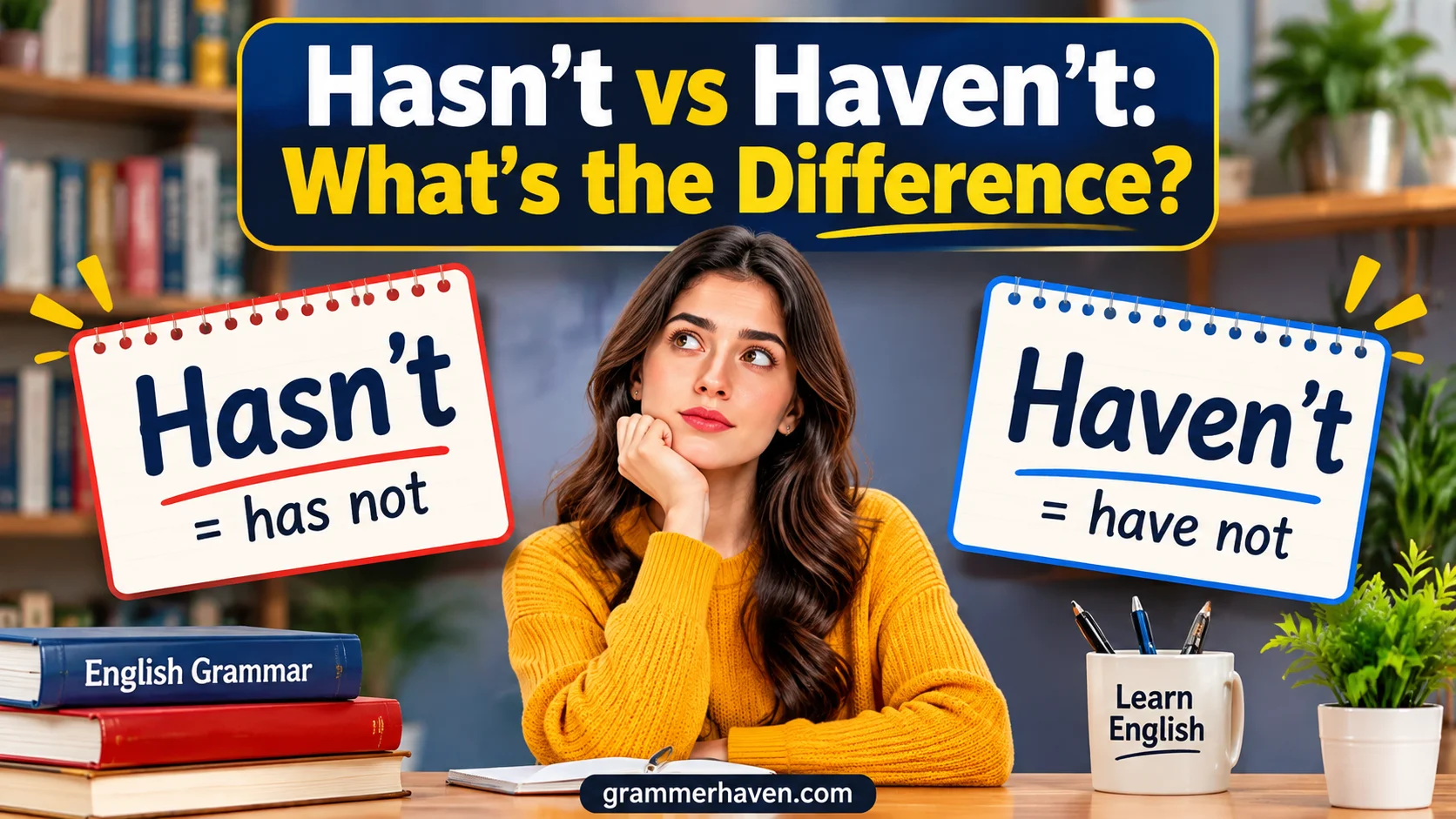
Hasn’t vs Haven’t: What’s the Difference? helps English learners master English grammar by understanding simple grammar rules and correct subject-verb agreement.
Many learners struggle with the Difference between Hasn’t and Haven’t because both are English contractions that look similar in everyday conversation. From my experience, this grammar lesson becomes much easier once you stop memorizing random rules and focus on the meaning instead. Has not becomes Hasn’t, while have not becomes Haven’t. The correct use depends on the subject. He, she, and it are singular subjects, so they take singular verbs. I, you, we, and they take plural verbs. These forms regularly appear in the present perfect tense, making them essential in everyday English, spoken English, and natural spoken English.
As you learn, your understanding grows and the challenge becomes easier to manage. A good guide helps you match subjects with the correct verbs while paying attention to the tense. This habit helps you avoid grammar mistakes and common grammar mistakes when expressing your ideas. Working through real sentence examples, other sentence examples, words, sentences, and even a short string of terms helps you notice small nuances, important details, and meaningful differences. I always encourage learners to follow patterns instead of guessing because it keeps your writing grammatically correct and your speaking naturally sounding.
With time, everything comes together. This lesson is about confidently using English with precision, responsibility, and accuracy in real life. Helpful language resources and helpers serve valuable purposes, but I still think the best way to explain the topic is to treat it as an interesting skill rather than a head scratching issue. Don’t let this tiny devil of English stop you from knowing the correct expression. If you have ever found yourself confused, wonder which form fits, or make a trip through a bunch of different examples, remember that another small change can entirely improve how your sound and writing means to others, and with practice every key point becomes clear.
Hasn’t vs Haven’t: What’s the Difference (Quick Answer First)
Before we go deep, here’s the fast rule you can use anytime:
- Use hasn’t with he, she, it, or singular nouns
- Use haven’t with I, you, we, they, or plural nouns
Think of it like this:
“Hasn’t = single subject”
“Haven’t = multiple or grouped subject”
Simple. Clean. No guesswork needed.
Now let’s build real understanding so you never mix them up again.
The Core Grammar Rule Behind Hasn’t vs Haven’t
English uses helping verbs like has and have to form present perfect tense. That’s the structure behind both “hasn’t” and “haven’t.”
Hasn’t (Has Not) — Singular Subjects
You use hasn’t when the subject is one person or one thing.
Here’s what that looks like in real sentences:
- She hasn’t finished her homework.
- He hasn’t called me today.
- The machine hasn’t started yet.
- My phone hasn’t charged properly.
Notice something? All the subjects are singular or treated as a single unit.
You can think of “hasn’t” as the “one-person form.”
Haven’t (Have Not) — Plural or Group Subjects
Now switch to haven’t when the subject becomes plural or includes “I/you/we/they.”
Examples:
- I haven’t seen that movie.
- You haven’t replied to my message.
- We haven’t decided yet.
- They haven’t arrived.
Even though “I” feels singular, English treats it differently. It always pairs with have, not has.
So in simple terms:
If more than one person or a group is involved, you lean toward haven’t.
Why “Has” and “Have” Matter So Much

At first, this might feel like unnecessary grammar detail. But there’s a reason English splits these forms.
“Has” and “have” show agreement between subject and verb. That agreement keeps sentences clear and structured.
Imagine if English didn’t follow this rule:
- She haven’t finished
- They hasn’t arrived
It would sound broken. And honestly, confusing.
English uses this system to help listeners instantly understand who is doing what.
The Simple Memory Trick That Actually Works
Let’s make this stick in your brain.
Try this mental shortcut:
- If you can replace the subject with he/she/it, use hasn’t
- If you can replace it with I/we/they, use haven’t
Example:
- ___ finished the work.
- She → She hasn’t finished the work ✔
- They → They haven’t finished the work ✔
It sounds basic, but this trick works because it forces instant subject recognition.
Common Mistakes with Hasn’t vs Haven’t (And Why They Happen)
Even people who speak English daily slip up here. Let’s look at the real reasons.
Mixing Singular and Plural Subjects
This is the most common mistake.
❌ She haven’t done it
✔ She hasn’t done it
Why it happens: People focus on “not” and forget subject agreement.
Confusion With “I”
This one surprises many learners.
❌ I hasn’t seen it
✔ I haven’t seen it
Even though “I” feels like one person, English grammar treats it as always pairing with “have.”
You just have to accept this as a fixed rule.
Overthinking in Fast Speech
When speaking quickly, your brain often chooses the wrong helper verb because you’re focused on meaning, not structure.
That’s why mistakes show up more in speaking than writing.
Borrowing Patterns from Native Language
If your native language doesn’t change verbs based on subject, English rules can feel unnatural.
So your brain tries to simplify things—and that leads to errors like:
- They hasn’t arrived
- He haven’t done it
Hasn’t vs Haven’t in Present Perfect Tense
Both forms live inside the present perfect tense, which connects past actions to the present moment.
You use it when:
- Something happened before now
- The result still matters
Examples:
- She hasn’t eaten today. (She is still hungry)
- We haven’t finished the project. (Still ongoing issue)
- They haven’t responded yet. (Still waiting)
This tense doesn’t focus on when exactly something happened. It focuses on the result.
Negative Questions: Hasn’t vs Haven’t in Real Conversation
Now let’s make things a little more natural.
People often use these forms in questions when they expect confirmation or surprise.
Hasn’t in Questions (Singular)
- Hasn’t he called yet?
- Hasn’t she finished her work?
- Hasn’t the train arrived?
These questions often sound surprised or impatient.
Haven’t in Questions (Plural or Group)
- Haven’t they finished already?
- Haven’t you seen this before?
- Haven’t we met somewhere?
These feel more conversational and often expect agreement.
Side-by-Side Comparison Table
Here’s a simple breakdown you can return to anytime.
| Situation | Use “Hasn’t” | Use “Haven’t” |
| He / She / It | ✔ | ✘ |
| I / You / We / They | ✘ | ✔ |
| Singular subject | ✔ | ✘ |
| Plural subject | ✘ | ✔ |
| One person or object | ✔ | ✘ |
| Group or multiple people | ✘ | ✔ |
Quick Practice: Test Yourself
Let’s lock this in with real examples.
Fill in the blanks:
- She ___ finished her homework.
- They ___ arrived yet.
- I ___ seen that movie.
- The dog ___ eaten its food.
- We ___ decided on the plan.
Answers:
- hasn’t
- haven’t
- haven’t
- hasn’t
- haven’t
If you got at least 4 right, you’re already solid on the rule.
Real-Life Usage: How People Actually Use Hasn’t vs Haven’t

Let’s step out of textbook grammar and into real situations.
Casual Conversation
People use contractions constantly in speech:
- “He hasn’t texted me back.”
- “We haven’t eaten yet.”
- “I haven’t slept well.”
This keeps speech natural and fast.
Workplace Communication
In emails or professional settings, clarity matters even more:
- The manager hasn’t approved the report.
- They haven’t responded to the proposal.
- I haven’t received the updated file.
Even a small mistake here can make writing look careless.
Text Messages and Social Media
Informal writing often shortens everything, but grammar still matters:
- “She hasn’t replied 😭”
- “We haven’t planned anything yet”
- “They haven’t shown up lol”
Even in casual texting, correct usage keeps communication clear.
Why Getting This Right Actually Matters
At first, it might feel like a tiny grammar detail. But it affects how people see your communication.
Here’s why it matters:
- Clarity: People understand your meaning instantly
- Credibility: Correct grammar builds trust in writing
- Professional tone: Especially in emails and formal settings
- Exam performance: Common in English tests like IELTS and TOEFL
Think of it like wearing clean shoes. Small detail. Big impression.
Case Study: The Email That Changed Tone
Let’s look at a simple scenario.
Incorrect:
She haven’t submitted the report yet.
This instantly feels wrong to a trained reader. It signals weak grammar control.
Correct:
She hasn’t submitted the report yet.
Now the message feels clear and professional.
Nothing else changed. Same meaning. Different impact.
That’s how powerful subject-verb agreement really is.
See also: Hear vs Here: Which Is Correct In 2026?
FAQs:
1. What is the difference between Hasn’t and Haven’t?
Hasn’t means has not and is used with singular subjects such as he, she, and it. Haven’t means have not and is used with I, you, we, and they.
2. Is it correct to say “I hasn’t”?
No. I hasn’t is grammatically incorrect. The correct form is I haven’t because I takes have, not has.
3. Why do people confuse Hasn’t and Haven’t?
Many learners confuse them because both are negative contractions used in the present perfect tense. The key is remembering which subjects take has and which take have.
4. Are Hasn’t and Haven’t used in formal writing?
Yes. Both forms are correct, but in very formal writing you may choose the full forms has not and have not instead of contractions.
5. How can I remember when to use Hasn’t or Haven’t?
Use this simple rule: Hasn’t goes with he, she, and it. Haven’t goes with I, you, we, and they. Practicing with real sentences will make the pattern feel natural.
Conclusion:
Understanding Hasn’t vs Haven’t becomes much easier once you know how subject-verb agreement works. Hasn’t is the short form of has not and goes with singular subjects like he, she, and it, while Haven’t is the short form of have not and works with I, you, we, and they. Learning this simple rule helps you avoid common grammar mistakes, write more clearly, and speak with greater confidence in everyday English.
Latest Post:
- Result In or Result To: Which Is Correct? (With Examples)
- A Dime a Dozen: Meaning, Definition, Origin and Real-Life Usage
- Hooplehead Definition, Meaning, Usage and Examples
- Whole vs Hole: What’s the Difference?
- Acumen vs Acuity vs Acuteness: What’s the Difference?