Smooth or Smoothe: What’s the Difference explains the spelling, meaning, and usage in the English language, helping you avoid common writing mistakes.
Many people think Smooth and Smoothe are identical words, but their difference is easy to understand. This article explains the pair in a simple, straightforward way. Smooth is the common adjective used to describe surfaces, textures, and actions that are free from roughness, bumps, and irregularities. Smoothe is the less common variant with the same meaning, but it is relatively rare, archaic, dialectical, and seldom seen in modern usage. The history of these seemingly similar words shows how subtle variations can distinguish one word from another while keeping the same common usage.
In my own writing, I have seen this confusion affect confident writers while typing an email or editing polished prose. One day, you may feel you have everything under grip, but a small hiccup can make you trip over a familiar word. In many instances, your mind may hit a wall because these linguistic and peculiar details seem small, although they have a big impact. Spending a moment checking reliable resources can prevent a real mistake.
A few examples make the difference easy to remember. A smooth surface on a lake mirrored the sky, while a hand touched silk fabric that felt like butter. A dancer executed a dance routine with effortless grace, showing the true meaning of smooth. Smoothe remains the less common form with prevalent use only in limited contexts. If spelling makes you wait before choosing the right word, this approach begins removing traps, helping you tackle similar nuances with confidence.
Smooth or Smoothe: The Quick Answer You Need First
Let’s not waste your time.
- Smooth → Correct modern spelling
- Smoothe → Incorrect in modern English
That’s it.
You won’t find “smoothe” in standard usage today. It shows up in old texts, outdated writing, or common spelling mistakes. But in professional writing, school assignments, and publishing, only “smooth” is accepted.
Think of it like this:
If English were a clean road, “smooth” is the paved highway. “Smoothe” is an old detour that no longer exists.
What Does “Smooth” Mean in English?
Before we judge spelling, we need to understand the word itself. “Smooth” is more flexible than most people realize.
It works in several ways depending on context.
Smooth as a physical texture
This is the most common meaning.
- A surface with no bumps
- Even, soft, or flat to the touch
Examples:
- A smooth table feels polished and even
- A smooth stone feels worn down by water
You’ll often hear this in everyday speech:
- “This fabric feels smooth.”
- “The glass surface is smooth and clean.”
Smooth as movement
Here, “smooth” describes flow.
- No interruption
- No sudden jumps or rough transitions
Examples:
- A smooth ride in a car
- A smooth landing for an airplane
In motion, “smooth” almost always means comfort and stability.
Smooth in sound or voice
Now we move into sensory language.
- Soft tone
- Even rhythm
- Pleasant to hear
Examples:
- A smooth voice often sounds calming
- Smooth jazz music feels relaxed and fluid
Smooth as personality or behavior
This is where language gets interesting.
- Polished communication
- Calm confidence
- Social ease
Examples:
- “He gave a smooth explanation.”
- “She handled the situation in a smooth way.”
Here, “smooth” can even imply charm or persuasion.
Where Did “Smoothe” Come From? The History Behind the Mistake
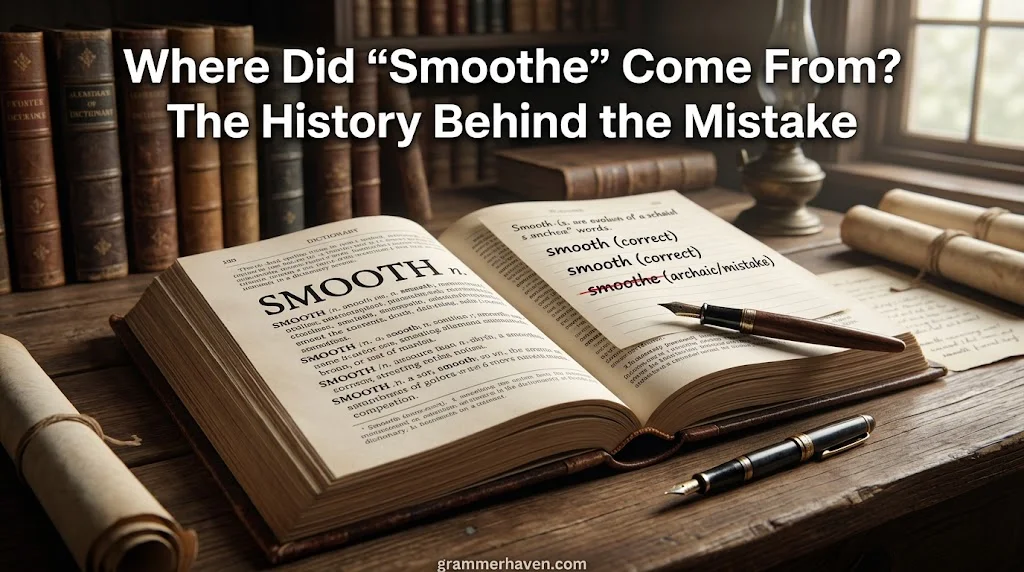
So why does “smoothe” exist at all?
It didn’t come from nowhere. It came from history.
Old English spelling wasn’t stable. Words often had multiple versions. Writers added or removed letters depending on style, pronunciation, or region.
At one point, variations like:
- smothe
- smoothe
- smooth
could all appear in older writing traditions.
But language evolves. And over time, English simplified itself.
What changed?
- Printing standardization reduced spelling variation
- Dictionaries began defining “official” forms
- Education systems enforced consistent spelling
- Simpler forms won out over decorative ones
Eventually, “smooth” became the standard, and “smoothe” faded into historical usage.
Think of it like fashion. One style becomes the norm. Others disappear from everyday use.
Why “Smoothe” Is Incorrect in Modern English
Let’s be direct.
Today, “smoothe” is considered a spelling error in standard English.
It breaks modern conventions in three main ways:
Dictionary standards
Modern dictionaries such as:
- Merriam-Webster
- Oxford English Dictionary
- Cambridge Dictionary
list “smooth” only as the correct spelling.
“Smoothe” appears, if at all, as an archaic or incorrect form.
Spelling consistency rules
English tends to remove unnecessary silent letters over time.
We see this pattern in words like:
| Old Form | Modern Form |
| smoothe | smooth |
| olde | old |
| musick | music |
The trend is clear: simpler wins.
No pronunciation difference
This is key.
We don’t pronounce “smoothe” differently.
So the extra “e” adds:
- No sound change
- No meaning change
- No grammatical purpose
That makes it unnecessary.
Common Mistakes People Make with “Smooth” and “Smoothe”
Even strong writers slip up here. Let’s look at the most common traps.
Mistake: Adding an “e” because it feels right
People often assume English words end in “e” for softness.
But in this case, it’s unnecessary.
Correct:
- smooth skin
- smooth surface
Incorrect:
- smoothe skin
- smoothe surface
Mistake: Confusing verb and adjective forms
“Smooth” works both ways:
- Adjective: a smooth road
- Verb: to smooth something
Example:
- “She smoothed the fabric.”
A common error happens when people try to force “smoothe” into verb use. It doesn’t exist in modern grammar.
Mistake: Informal writing confusion
In casual texting or social media, spelling gets sloppy.
People sometimes write:
- “that went smoothe”
But even informal English still treats this as incorrect spelling.
Mistake: Copying outdated content
Older blogs or low-quality content sometimes preserve incorrect forms.
Writers then copy them without checking modern standards.
How to Use “Smooth” Correctly in Real Sentences
Let’s make this practical. Here’s how “smooth” works in real writing.
As an adjective
- The surface feels smooth after polishing
- The conversation stayed smooth and relaxed
- The transition was smooth and natural
As a verb
- He smoothed the paper before writing
- She smoothed her dress before the interview
- They smoothed the process for new users
Informal usage note
Sometimes people say:
- “It went smooth”
While widely used in speech, formal writing prefers:
- “It went smoothly”
Before and after correction examples
| Incorrect | Correct |
| The ride was smoothe | The ride was smooth |
| He smoothe the surface | He smoothed the surface |
| Everything went smoothe | Everything went smoothly |
Memory Tricks to Never Confuse Smooth or Smoothe Again

You don’t need grammar anxiety. You just need a few mental shortcuts.
The “finished word” trick
Think of “smooth” as already complete.
You don’t need to add anything.
If you try to add an “e,” you’re overcomplicating something simple.
The sanding analogy
Imagine sanding wood.
Each pass removes rough edges.
Now apply that to spelling:
- Extra letters = rough edges
- Smooth = finished surface
No extra “e” needed.
The sound check
Say it out loud:
- smooth ✔
- smoothe ✖ (feels unnatural even in speech rhythm)
Your mouth already prefers the correct version.
Why This Matters in Writing and SEO
You might wonder—does one letter really matter?
Yes. More than you think.
Search behavior reality
People often type:
- “smoothe meaning”
- “is smoothe correct”
- “smooth or smoothe difference”
Search engines must interpret these errors. That means content using correct spelling wins authority.
Credibility impact
Incorrect spelling can quietly hurt trust.
Readers may assume:
- weak editing
- low authority
- outdated information
Correct spelling signals professionalism instantly.
Writing tools depend on it
Grammar tools like autocorrect systems and writing assistants are trained on standard usage.
They flag “smoothe” as an error because modern datasets don’t recognize it as valid.
Case Study: How a Simple Spelling Error Changes Perception
Let’s look at a realistic scenario.
Scenario: Product description
A small online store writes:
“This lotion gives your skin a smoothe finish.”
At first glance, nothing seems wrong.
But here’s what happens:
- Grammar tools flag the error
- Search engines lower keyword accuracy
- Readers question professionalism
Now compare:
“This lotion gives your skin a smooth finish.”
Same meaning. Different impact.
Result
The corrected version performs better in:
- readability
- trust score
- search visibility
- user engagement
One letter changes perception.
That’s how fragile writing credibility can be.
See also: Hasn’t vs Haven’t: What’s the Difference?
FAQs:
1. Is it smooth or smoothe?
Smooth is the correct spelling in modern English. Smoothe is a rare and outdated variant that is seldom used today.
2. What does smooth mean?
Smooth describes something that is free from roughness, bumps, or irregularities. It can also describe actions that are easy, graceful, or effortless.
3. Is smoothe a real word?
Yes, smoothe is a real word, but it is an archaic or dialectal variant of smooth and is rarely used in modern writing.
4. Why do people confuse smooth and smoothe?
The two words look very similar and have the same basic meaning, so many writers assume both spellings are equally correct. However, modern English almost always prefers smooth.
5. Should I ever use smoothe in modern writing?
In most cases, no. Unless you’re quoting historical text or following a specific dialect, smooth is the recommended spelling for everyday and professional writing.
Conclusion:
Smooth is the correct and widely accepted spelling in modern English, while smoothe is an uncommon variant that is mostly considered archaic or dialectal. If you want your writing to sound natural and professional, use smooth in almost every situation. Understanding this small spelling difference will help you write with greater confidence and avoid common mistakes.
Latest Post:
- Is It Correct to Say “A Big Congratulations”? The Complete Grammar Guide
- Two Crows Being an Attempted Murder: Meaning, Origins & Real Behavior
- Farther vs. Further: What’s the Difference?
- Result In or Result To: Which Is Correct? (With Examples)
- A Dime a Dozen: Meaning, Definition, Origin and Real-Life Usage