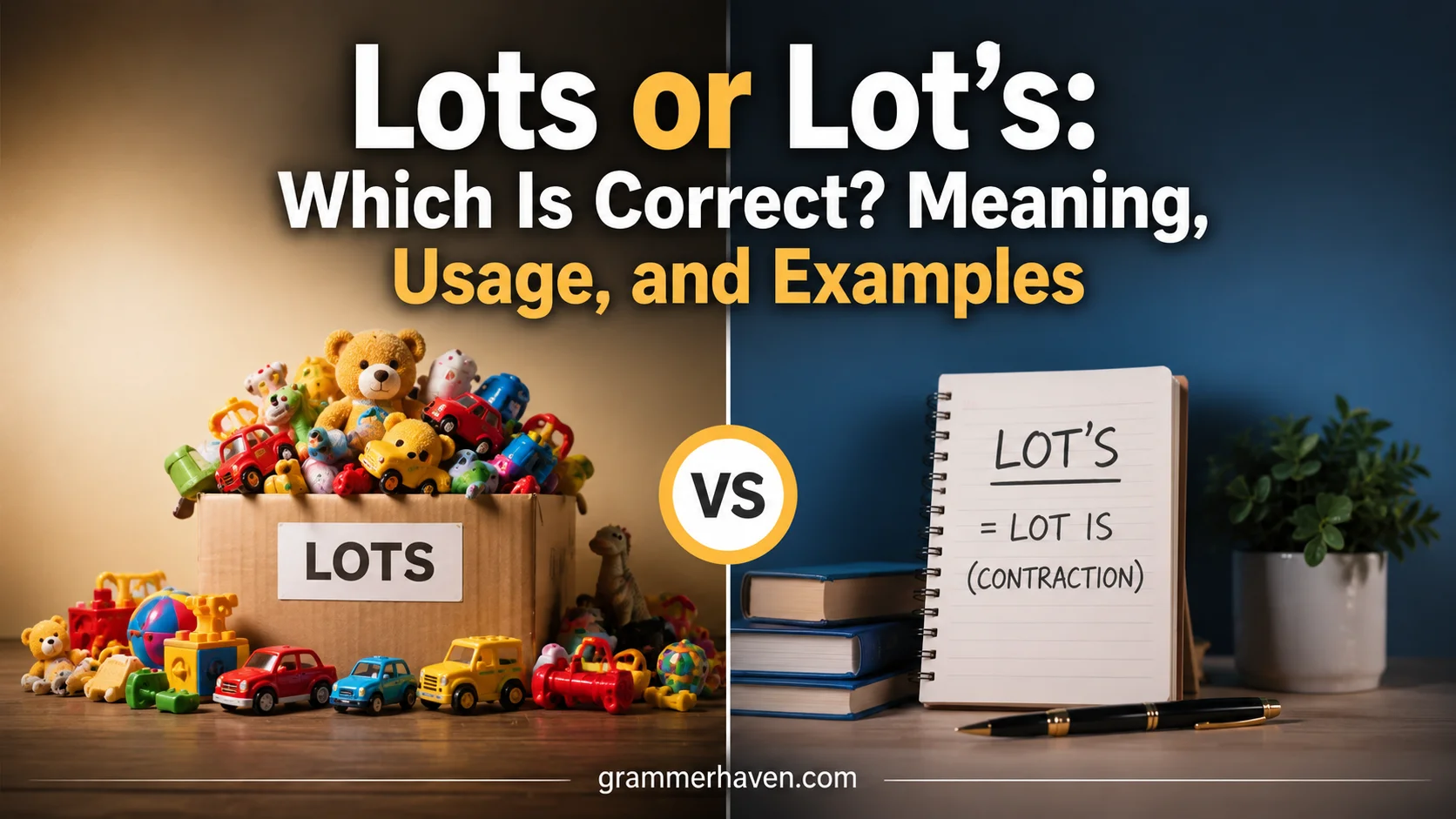
Lots or Lot’s: Which Is Correct? Meaning, Usage, and Examples helps you choose the right word when writing a clear sentence with correct grammar and meaning.
Lots and Lot’s look the same at first glance, but the apostrophe changes the meaning. Lots is the plural form of lot and means many, a large number, a group, collection, or quantity. You use lots, a lot, and lots of in everyday English usage.
Lot’s is a possessive form that shows possession. It means something belongs to or is associated with a particular lot. The tiny apostrophe can create a grammatical glitch when used by mistake. It can affect clarity, consistency, and professional tone. The correct choice depends on the context, meaning, and usage of the sentence.
Confusion about these words appears in emails, polished reports, and formal work because they look the same. The correct spelling becomes easier when you compare their grammatical uses. Lots does not need an apostrophe. Lot’s follows possessive noun structure and apostrophe usage rules. This matters in formal writing, academic writing, business reports, and client-facing communication because correct grammar supports credibility and clean writing. A wrong mark can cause mistakes, confusing details, and big misunderstandings. You may see these words in broadcasting, meetings, scheduling, project management, online booking, and coordinating daily tasks. The word lot can mean groups of land or a particular lot. Its possessive form is uncommon in normal conversation. Lot’s is not a contraction for lots.
A careful writing process can improve writing accuracy and writing clarity. LanguageTool, a multilingual text editor and writing assistant, offers stylistic improvements, spelling check, grammar check, proofreading, and writing correction as you type. A digital writing tool or online editor can support English grammar, language learning, text editing, correct usage, and grammar rules.
Lots or Lot’s: The Quick Answer
The easiest way to remember the difference is this:
Use “lots” when you mean many. Use “lot’s” only when you mean something belongs to a lot.
Here is the difference:
| Word | Meaning | Example |
| Lots | Many, a large amount, or multiple things | She has lots of ideas. |
| Lot’s | Something belonging to one lot | The parking lot’s entrance is closed. |
| Lots’ | Something belonging to multiple lots | The empty lots’ owners met today. |
In everyday writing, lots is the word you will use most often.
Lots Meaning Explained
The word lots has several meanings depending on the context. Most people use it as an informal way to say many or a large amount.
For example:
- I have lots of homework tonight.
- She received lots of support from her friends.
- There are lots of reasons to learn English.
In these examples, lots means “a large number” or “a large amount.”
You can often replace lots of with:
- many
- much
- plenty of
- a large number of
- a great deal of
However, the replacement depends on the noun.
Lots With Countable Nouns
Countable nouns are things you can count individually.
Examples:
- books
- cars
- people
- questions
- ideas
When you use lots of countable nouns, it means many items.
Examples:
| Sentence | Meaning |
| I have lots of books. | I have many books. |
| They invited lots of guests. | They invited many guests. |
| We saw lots of birds. | We saw many birds. |
The word lots gives the sentence a casual, conversational feeling.
Compare:
- I have many books. → Neutral or slightly formal.
- I have lots of books. → More natural in everyday conversation.
Both are correct.
Lots With Uncountable Nouns
Some nouns cannot be counted individually. These are called uncountable nouns.
Examples:
- water
- time
- money
- information
- patience
- advice
You can use lots of these nouns.
Examples:
- We need lots of time to finish the project.
- She has lots of experience in marketing.
- There is lots of water in the lake.
- He gave me lots of advice.
A common mistake happens because people try to use many with uncountable nouns.
Incorrect:
I have a lot of information.
Correct:
I have lots of information.
The reason is simple: you cannot count “information” as separate pieces unless you change the structure.
You can say:
- lots of information
- many pieces of information
What Does Lot’s Mean?
The word lot’s is not a synonym for lots.
The apostrophe changes its purpose.
Lot’s = something belonging to one lot.
Here, lot acts as a singular noun, and ’s shows possession.
Examples:
- The lot’s owner lives nearby.
- The lot’s location makes it valuable.
- The lot’s size is larger than expected.
Let’s examine one sentence:
The parking lot’s entrance is blocked.
What belongs to the parking lot?
The entrance.
The structure is:
parking lot + ’s + entrance
The apostrophe tells the reader:
“This entrance belongs to the parking lot.”
Lots vs Lot’s: Side-by-Side Examples
Seeing the difference makes the rule easier.
| Incorrect | Correct | Why |
| I have lot’s of work. | I have lots of work. | “Lots” means a large amount. |
| There are lot’s of people here. | There are lots of people here. | No ownership exists. |
| The parking lots gate is broken. | The parking lot’s gate is broken. | The gate belongs to the lot. |
| The empty lot’s are for sale. | The empty lots are for sale. | Plural does not need an apostrophe. |
Why Do People Confuse Lots and Lot’s?
The confusion usually comes from one simple misunderstanding:
Many people think adding ’s makes a word plural.
That rule is incorrect.
In English, apostrophes usually have two main jobs:
- Show possession
- Show missing letters in contractions
They usually do not make regular nouns plural.
Apostrophes Do Not Usually Create Plurals
Incorrect examples:
- Apple’s are healthy.
- Book’s are expensive.
- Car’s are parked outside.
Correct examples:
- Apples are healthy.
- Books are expensive.
- Cars are parked outside.
The same rule applies to lots.
Incorrect:
There are many empty lot’s.
Correct:
There are many empty lots.
Why?
Because you are talking about multiple pieces of land, not ownership.
The Different Meanings of Lot
Before understanding lots, it helps to understand the word lot itself.
The word “lot” has several meanings.
Lot Meaning: A Piece of Land
A lot can mean a piece of property.
Examples:
- They bought a vacant lot.
- The house sits on a large lot.
- The city sold several lots.
The plural form is:
lot → lots
Examples:
- One lot
- Two lots
- Several lots
No apostrophe is needed.
Lot Meaning: A Large Amount
In informal English, a lot means a large amount.
Examples:
- I learned a lot.
- She talks a lot.
- They travel a lot.
Notice that a lot is always written as two words.
Incorrect:
I learned alot.
Correct:
I learned a lot.
Lots vs A Lot: Are They the Same?
Many learners wonder whether lots and a lot mean the same thing.
In many situations, yes.
Examples:
- I have a lot of friends.
- I have lots of friends.
Both sentences mean the speaker has many friends.
However, there is a small difference in tone.
| Expression | Tone | Example |
| A lot | Neutral and very common | I enjoyed the movie a lot. |
| Lots | Slightly more casual | I enjoyed the movie lots. |
In professional writing, a lot, many, or a great deal often sounds more natural.
Lots vs Lot’s vs Lots’
The three forms look almost identical, but they serve different purposes.
Lots
Used for:
- Many things
- A large amount
- Multiple pieces of land
Examples:
- Lots of people attended.
- We have lots of information.
- The developer purchased several lots.
Lot’s
Used for:
- Possession by one lot
Examples:
- The lot’s value increased.
- The lot’s boundary is unclear.
Lots’
Used for:
- Possession by multiple lots
This form is less common but grammatically possible.
Example:
The empty lots’ owners received letters.
Meaning:
The owners of multiple empty lots received letters.
The structure:
lots + ’ = possession after a plural noun ending in s
Common Mistakes With Lots or Lot’s
Mistake: Writing “Lot’s of”
This is the most common error.
Incorrect:
I have lot’s of questions.
Correct:
I have lots of questions.
Why?
Because “questions” do not belong to a lot. The phrase means “many questions.”
Mistake: Using Apostrophes for Regular Plurals
Incorrect:
The company owns five lot’s.
Correct:
The company owns five lots.
You are counting multiple properties, so use the normal plural form.
Mistake: Confusing “A Lot” and “Alot”
Many people write:
I like this alot.
But alot is not a standard English word.
Correct:
I like this a lot.
Space matters.
How to Remember Lots or Lot’s Forever
Here is a simple trick:
Ask One Question:
“Does something belong to the lot?”
If yes:
Use lot’s.
Example:
The lot’s owner arrived.
The owner belongs to the lot.
If no:
Use lots.
Example:
I have lots of questions.
The questions do not belong to anything.
Real-Life Examples of Lots and Lot’s
Example: Everyday Conversation
Correct:
I have lots of things to do today.
Meaning:
I have many things to do.
Incorrect:
I have lot’s of things to do today.
The apostrophe has no purpose.
Example: Real Estate
Correct:
The lot’s location affects its price.
Meaning:
The location belongs to the lot.
Correct:
The developer purchased three lots.
Meaning:
The developer purchased three pieces of land.
Example: School Writing
Correct:
Students need lots of practice to improve their writing.
Incorrect:
Students need lot’s of practice to improve their writing.
Quick Practice: Choose Lots or Lot’s
Test yourself.
The parking ___ entrance is closed.
Answer:
✅ lot’s
The entrance belongs to the parking lot.
She has ___ of experience.
Answer:
✅ lots
It means a large amount.
The company bought several empty ___.
Answer:
✅ lots
It means pieces of land.
The ___ owners attended the meeting.
Answer:
✅ lots’
The owners belong to multiple lots.
See also: Smelled vs Smelt: What’s the Difference?
FAQs:
1. Is lots or Lot’s correct?
Lots is correct when you mean many, a large number, or a large amount. Lot’s is correct only when it shows possession.
2. What does lots mean?
Lots is commonly used to mean many or a large amount. For example, “She has lots of books.”
3. What does Lot’s mean?
Lot’s is the possessive form of lot. It shows that something belongs to a particular lot. For example, “The lot’s location is convenient.”
4. Is lots of grammatically correct?
Yes. Lots of is a common phrase used before countable and uncountable nouns. For example, “There are lots of people here.”
5. Can Lot’s mean lots?
No. Lot’s and lots have different grammatical functions. The apostrophe should not be added when you mean many or a large amount.
6. Is lots singular or plural?
Lots is the plural form of lot. The singular noun is lot, while the plural form is lots.
7. Why do people confuse lots and Lot’s?
People often confuse them because they look almost identical. The small apostrophe makes the grammatical difference.
8. Is Lot’s common in everyday English?
No. The possessive form Lot’s is relatively uncommon. Lots appears much more often in everyday English.
9. Can I use lots in formal writing?
Yes. Lots is grammatically correct, but phrases such as many or a large number may sometimes sound more precise in formal or academic writing.
10. What is an easy way to remember the difference?
Remember this simple rule: lots means many or a large amount, while Lot’s shows possession.
Conclusion:
Lots and Lot’s may look similar, but they serve different purposes. Use lots when you mean many, a large number, or a large amount. Use Lot’s only when the apostrophe shows possession. Checking the meaning of the sentence before choosing the word will help you avoid grammar mistakes and write with greater clarity and confidence.