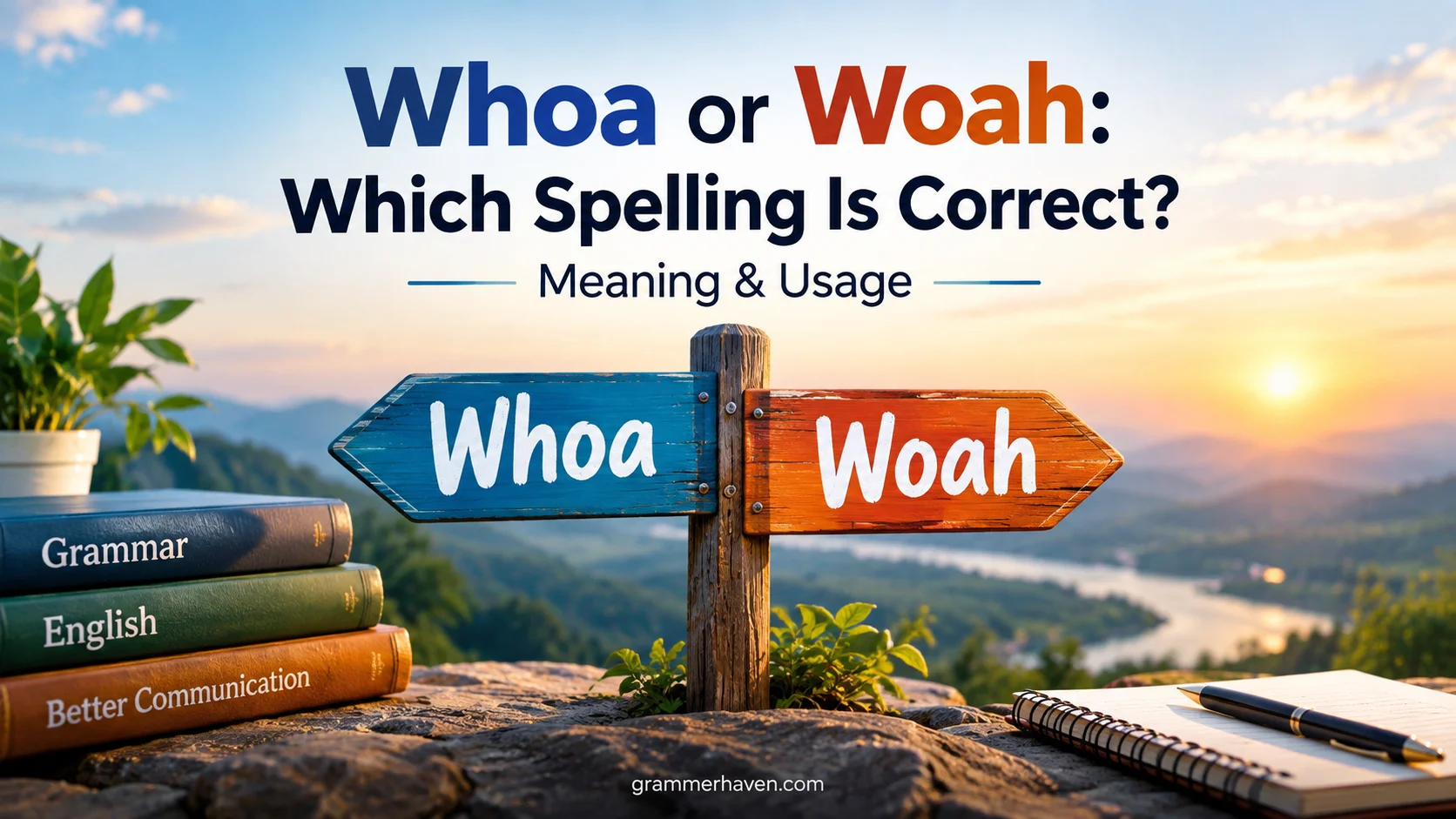
Whoa or Woah can look confusing, but whoa is the traditional and preferred spelling in standard English, while woah remains an alternate spelling.
The roots of whoa trace to a command telling a horse to stop. The modern variation, woah, gained popularity in informal contexts, casual settings, and online conversations. You’ll encounter both forms in texts, social media, books, dialogue, and everyday writing. Major dictionaries, including Cambridge and Collins, recognize them, with whoa remaining the conventional American English choice. Whoah and woa appear as variant spelling forms and are generally associated with less common usage.
In writing casually, either spelling can convey the same sound and reaction, expressing surprise, astonishment, or a sense of being taken aback or impressed. Personal preference can shape your choice, but clarity matters when readers need to understand your meaning immediately. A quick pause before you send a message can help you choose the more familiar form. Woah isn’t always a meaningless typo, yet whoa remains the default spelling for formal writing. The distinction between them is mainly one of usage, not meaning.
Quick Answer: Whoa or Woah?
Whoa is the safest and most established spelling. Woah is a common alternate spelling that appears frequently in informal writing.
Both forms generally express the same ideas:
- Stopping or slowing down: “Whoa, slow down!”
- Surprise: “Whoa! I didn’t expect that.”
- Shock: “Whoa, what just happened?”
- Amazement: “Whoa! That’s incredible.”
- Hesitation: “Whoa, let’s think about this first.”
Cambridge defines whoa as an exclamation used to tell a horse or person to stop or slow down and also as an informal expression of surprise or interest. Its American English entry gives the pronunciation as /hwoʊ/ or /woʊ/.
Dictionary.com likewise identifies whoa as the established form while noting that some people spell it woah.
Whoa vs. Woah at a Glance
| Feature | Whoa | Woah |
| Standard spelling | Yes | Alternate form |
| Meaning | Stop, slow down, surprise, amazement | Generally the same |
| Pronunciation | Usually /woʊ/ | Usually /woʊ/ |
| Traditional usage | Long established | More recent variant |
| Formal edited writing | Safer choice | Usually less preferred |
| Texting | Common | Very common |
| Social media | Common | Common |
| Best default choice | Yes | No |
The practical rule is simple: when you’re unsure, write “whoa.”
What Does “Whoa” Mean?
Whoa is an interjection, which means it can stand alone to express a reaction, command, or sudden feeling. Unlike a noun or verb, it doesn’t usually describe an object or action. Instead, it gives the reader a glimpse of the speaker’s immediate response.
The word has several closely related uses.
Whoa as a Command to Stop
The oldest and most recognizable use involves telling a horse to stop or slow down.
For example:
“Whoa, boy! Easy.”
A rider might say this when a horse starts moving too quickly. The expression functions almost like a verbal brake.
That original sense still exists today, even though most people don’t spend their afternoons riding horses. The word simply traveled beyond the stable.
Whoa as a Command to Slow Down
English speakers also use whoa with people when someone is moving, speaking, or reacting too quickly.
For example:
- “Whoa, slow down. I can’t follow you.”
- “Whoa! You’re driving too fast.”
- “Whoa there. Let’s not jump to conclusions.”
- “Whoa, that’s enough sugar.”
In these examples, whoa tells someone to pause or reduce the intensity of what they’re doing.
Collins also describes this conversational use, particularly when someone wants another person to slow down or stop making assumptions.
Whoa as an Expression of Surprise
Modern English uses whoa just as often to express surprise.
Imagine opening an unexpected gift and finding exactly what you wanted. You might simply say:
“Whoa! This is amazing.”
Nothing needs to follow. The word itself communicates the sudden emotional reaction.
It can express:
- Surprise
- Shock
- Amazement
- Excitement
- Admiration
- Disbelief
- Concern
For example:
“Whoa! That’s a huge house.”
Here, nobody is asking the house to stop. The speaker is reacting to something impressive.
Whoa as a Sign of Hesitation
There’s another subtle use. You can say whoa when you want to interrupt a conversation or slow down an idea.
Consider this exchange:
“We’re going to sell the house tomorrow.”
“Whoa. Tomorrow? Don’t we need to discuss that first?”
The speaker isn’t commanding anyone to stop physically. Instead, whoa creates a conversational pause.
It says, in effect, “Hold on. Let’s slow down and examine this.”
What Does “Woah” Mean?
Woah generally carries the same meaning as whoa.
The difference lies primarily in spelling and usage rather than definition.
For example:
- “Woah! That’s incredible.”
- “Whoa! That’s incredible.”
Both sentences communicate surprise or amazement.
Likewise:
- “Woah, slow down.”
- “Whoa, slow down.”
The basic message remains unchanged.
Cambridge includes woah among alternate forms associated with whoa, while Collins goes even further by defining woah specifically as a variant spelling of whoa.
Why Do People Write “Woah”?
The answer is partly about how English evolves in everyday communication.
People don’t always spell words according to historical convention. They often spell sounds according to what seems intuitive. Woah looks straightforward because it closely mirrors the pronunciation many speakers hear.
Digital communication has amplified this tendency.
Text messages, social media posts, memes, gaming chats, and online comments encourage quick, expressive language. In those settings, writers aren’t necessarily trying to follow formal editorial conventions.
That’s why you’ll encounter:
- “Woahhh!”
- “Woah, seriously?”
- “Woah, that’s wild.”
- “Woah, hold up.”
- “Woah! Did you see that?”
The spelling can even add personality. Extra letters, unusual capitalization, and informal spellings can make a reaction feel more dramatic.
Whoa vs. Woah: What’s the Actual Difference?
Here’s the important part: the two spellings generally don’t represent two different words.
They function as alternate written forms of the same interjection.
The clearest difference is register.
Register refers to the style of language appropriate for a particular situation. You might use different vocabulary when writing a business report than when texting a friend.
The same principle applies here.
| Situation | Better Choice |
| School assignment | Whoa |
| Professional article | Whoa |
| Formal report | Avoid the interjection if possible; use precise wording |
| Casual email | Whoa |
| Text message | Whoa or Woah |
| Social media | Whoa or Woah |
| Fictional dialogue | Either, depending on character voice |
| Meme or casual post | Woah can fit naturally |
| When you’re unsure | Whoa |
Dictionary.com describes whoa as the older and more standard spelling and explains that woah is a newer alternate form commonly found in informal settings.
Is “Woah” a Real Word?
Yes, but there’s an important qualification.
Woah is an established variant spelling in modern usage. That doesn’t mean every style guide or dictionary treats it exactly like whoa. Dictionary policies differ.
For example, Cambridge lists woah alongside whoah and woa under its whoa entry. Collins also has a dedicated woah entry and labels it a variant spelling of whoa.
That evidence makes one thing clear: woah exists in real English usage.
However, if you’re writing carefully edited American English and want the conventional spelling, whoa remains the better choice.
This is an important distinction between “recognized” and “preferred.”
A word or spelling can appear in dictionaries without becoming the best choice for every writing situation.
Is “Whoa” the Standard American English Spelling?
Yes. Whoa is the safest standard form for American English.
Dictionary.com lists whoa as the main entry and gives woah as a spelling used by some people.
For everyday American writing, that makes the decision easy:
If you need one spelling to remember, remember WHOA.
You don’t need to panic when you see woah, though. The reader will almost certainly understand it.
The distinction becomes more useful when you’re editing content, writing professionally, preparing an academic assignment, or choosing a conventional dictionary form.
Whoa or Woah in Formal and Informal Writing
Whoa in Formal Writing
There’s a small wrinkle here: even though whoa is the standard spelling, the word itself is an interjection. Interjections are usually conversational.
So there’s a difference between:
Correct spelling:
“Whoa!”
and
Appropriate formal style:
“The result was unexpectedly large.”
The first sentence isn’t misspelled. It simply has a more conversational tone.
In formal writing, you should ask whether the reaction adds meaning. If it doesn’t, remove it.
For example:
Informal: “Whoa! The experiment produced a massive increase.”
More formal: “The experiment produced a substantial increase.”
The second version communicates the fact without the emotional reaction.
Woah in Informal Writing
Woah fits naturally into casual environments.
You might see it in:
- Text messages
- TikTok captions
- Social media comments
- Online forums
- Gaming chats
- Memes
- Informal dialogue
For example:
“Woah, that escalated quickly.”
There’s nothing mysterious about the sentence. The spelling simply contributes to its relaxed voice.
Whoa vs. Woah Pronunciation
Most speakers pronounce whoa and woah the same way.
For American English, Cambridge gives whoa as /woʊ/ in its main pronunciation listing and also records /hwoʊ/ and /woʊ/ in its American dictionary entry.
The sound is roughly similar to the beginning of “Whoa!” in everyday speech.
That creates an obvious spelling problem: you hear one sound, but English offers multiple spellings.
Think of it this way:
Spoken reaction → “woʊ” → written as “whoa” or “woah”
English has plenty of spelling patterns like this. Pronunciation alone doesn’t always tell you which letters belong on the page.
Whoa vs. Wow: What’s the Difference?
Whoa and wow overlap, but they’re not interchangeable in every situation.
Examples:
- “Whoa! Stop the car.”
- “Whoa, slow down.”
- “Whoa, that’s expensive.”
- “Whoa! I didn’t expect that.”
Wow
Wow mainly expresses strong surprise, admiration, or amazement.
Examples:
- “Wow! That painting is beautiful.”
- “Wow, you’ve improved a lot.”
- “Wow! What an incredible view.”
Here’s the easiest distinction:
| Word | Main Idea | Example |
| Whoa | Stop, slow down, surprise | “Whoa, hold on.” |
| Wow | Amazement or admiration | “Wow, that’s beautiful.” |
If you’re telling someone to stop, whoa makes sense.
If you’re admiring a spectacular view, wow may sound more natural.
Sometimes, though, either can express surprise.
How to Use “Whoa” in a Sentence
Because whoa is an interjection, punctuation plays an important role.
At the Beginning
“Whoa! That’s a huge wave.”
The exclamation mark makes the emotional reaction especially strong.
Before a Clause
“Whoa, I didn’t know you could do that.”
The comma separates the interjection from the rest of the sentence.
In the Middle
“I was, whoa, completely unprepared for that.”
This construction is more conversational and works particularly well in dialogue.
Repeated for Emphasis
“Whoa, whoa, whoa. Let’s back up.”
Repeating the word creates urgency. It sounds like someone is trying to stop a conversation from racing ahead.
“Whoa There”
“Whoa there. Let’s take a closer look.”
This expression softens the command while still asking someone to pause.
How to Use “Woah” in a Sentence
Because woah is informal, it works especially well when the surrounding sentence already has a casual tone.
Examples include:
- “Woah, that’s crazi.”
- “Woah! You actually did it.”
- “Woah, hold up.”
- “Woah, that was close.”
- “Woahhh, look at that!”
Notice the final example. The extended “woahhh” isn’t a formal spelling at all. It’s a stylistic device.
Online writing often stretches words to imitate speech. “Noooo,” “yessss,” “wowww,” and “woahhh” all work in the same way.
The writer isn’t trying to create a dictionary entry. They’re trying to capture a voice.
Common Mistakes With Whoa and Woah
Mistake: Assuming “Woah” Has a Different Meaning
It generally doesn’t.
Whoa and woah usually communicate the same reaction. The spelling changes, not the fundamental meaning.
Mistake: Calling Every “Woah” a Typo
That’s too simplistic.
Some dictionaries recognize woah as a variant. Collins explicitly labels it a variant spelling, while Cambridge lists it alongside other alternate forms.
So the better description is “alternate or informal spelling,” rather than automatically calling every occurrence an error.
Mistake: Using “Woah” When You Need Conventional Standard English
If you’re writing an academic paper, professional article, or edited publication, whoa is the safer option.
When there’s no stylistic reason to choose the alternate form, don’t make the reader wonder why you selected it.
Mistake: Confusing “Whoa” With “Wow”
Remember the stopping sense.
“Whoa, slow down!”
You wouldn’t normally replace that with:
“Wow, slow down!”
The second sentence sounds different because wow primarily expresses amazement rather than a command to slow down.
Mistake: Thinking “Whoa” Only Applies to Horses
The horse connection is historical, but modern usage is much broader.
You can say whoa to:
- A friend
- A child
- A driver
- A colleague
- Someone speaking too quickly
- Someone making an assumption
- Yourself when you’re surprised
The word left the barn a long time ago.
Whoa or Woah? Which One Should You Use?
Use whoa when you want the safest and most conventional spelling.
Choose “Whoa” When:
- You’re writing for a broad audience.
- You’re producing edited content.
- You’re writing a school assignment.
- You’re writing professionally.
- You’re unsure which spelling to choose.
- You want the traditional form.
Choose “Woah” When:
- You’re writing an informal social media post.
- You’re texting a friend.
- You’re creating casual dialogue.
- You’re deliberately matching an informal voice.
- You’re quoting someone who used that spelling.
- You want the writing to feel spontaneous or internet-native.
The choice isn’t really about meaning. It’s mostly about style, convention, and context.
Whoa or Woah Examples Side by Side
| Meaning | Whoa | Woah |
| Surprise | “Whoa! That’s incredible.” | “Woah! That’s incredible.” |
| Shock | “Whoa, what happened?” | “Woah, what happened?” |
| Stop | “Whoa! Stop right there.” | “Woah! Stop right there.” |
| Slow down | “Whoa, slow down.” | “Woah, slow down.” |
| Amazement | “Whoa, look at that view.” | “Woah, look at that view.” |
| Casual texting | “Whoa, seriously?” | “Woah, seriously?” |
The meanings remain essentially identical. The difference becomes most noticeable when you consider the tone of the writing.
A Simple Trick to Remember the Spelling “Whoa”
Here’s an easy memory trick:
Think about a horse.
The traditional expression is:
“Whoa, horse!”
The word whoa contains the H before the O, which helps distinguish it from woah.
Another useful association is:
Horse → stop → whoa
When you remember the original command, the conventional spelling becomes easier to recall.
You can also remember this simple rule:
When in doubt, choose WHOA.
It’s short, reliable, and works for most standard writing situations.
The History of “Whoa”
The history of whoa explains why the spelling looks slightly unusual.
Dictionary.com records the word as first appearing around 1460–1480 and identifies it as a dialectal variant of ho.
Dictionary.com also explains that the word originally served as a command associated with stopping a horse. Over time, its meaning expanded beyond that narrow setting.
That expansion is a classic example of how language changes.
A word begins with one concrete job. Speakers then apply it metaphorically to new situations.
Horse command → physical stopping → conversational stopping → emotional reaction
Today, someone can say:
“Whoa, hold on.”
without being anywhere near a horse.
The horse has disappeared. The underlying idea of pause remains.
Why “Woah” Became So Common
Language doesn’t stay frozen in place.
Dictionary.com notes that woah emerged later than whoa and became increasingly visible in informal communication. It also connects its modern popularity with digital communication and informal writing.
That makes sense when you consider how people actually communicate online.
Social media rewards immediacy. Texting rewards speed. Memes reward personality. None of these environments require every sentence to follow formal editorial conventions.
As a result, alternate spellings can spread quickly.
Woah is especially easy to understand because it mirrors the sound people hear. Once enough readers encounter it, the spelling becomes familiar.
That’s how a seemingly unusual spelling can move from “obvious mistake” toward recognizable variant usage.
A Practical Case Study: Which Spelling Fits?
Imagine three people reacting to the same surprising event.
A Text Message
“Woah, did you see that?”
This works perfectly in casual communication.
A Novel’s Dialogue
“Whoa, wait. What did you just say?”
Here, whoa works naturally and keeps the dialogue conversational.
An Edited Article
Instead of:
“Woah! The company doubled its revenue.”
A polished article might simply say:
“The company’s revenue doubled.”
The issue isn’t that the first sentence is incomprehensible. It’s that the writer needs to decide whether an emotional interjection adds anything useful.
That’s an important lesson: correct spelling doesn’t automatically mean the word belongs in every sentence.
See also: Emigrate or Immigrate: What’s the Difference? Meaning & Usage
FAQs:
Is “Whoa” or “Woah” Correct?
Whoa is the safest standard spelling. Woah is a recognized alternate spelling used widely in informal contexts. Cambridge lists woah as an alternate form, while Collins defines it as a variant spelling.
Is “Woah” a Correct Spelling?
Yes, woah is used as an alternate spelling of whoa. However, if you need the conventional form for standard writing, choose whoa.
Do “Whoa” and “Woah” Mean the Same Thing?
Generally, yes. Both can express surprise, amazement, shock, or a request to stop or slow down.
Is “Whoa” More Standard Than “Woah”?
Yes. Whoa is the traditional spelling and remains the safer default for standard edited English.
Can You Use “Woah” in Text Messages?
Absolutely. Texting is informal, so woah can fit naturally. The spelling often contributes to a casual tone.
Is “Whoa” Only Used With Horses?
No. Although its traditional use involved horses, modern speakers use whoa with people and in reactions to surprising events.
What’s the Difference Between “Whoa” and “Wow”?
Whoa can mean “stop” or “slow down” and can also express surprise. Wow mainly expresses amazement, admiration, or surprise.
How Do You Pronounce “Whoa”?
In American English, it is generally pronounced /woʊ/, although Cambridge also records /hwoʊ/ as an American pronunciation.
Should You Use “Whoa” in Formal Writing?
If you genuinely need the interjection, whoa is the safer spelling. However, formal writing often works better when you replace casual reactions with precise statements.
Why Do People Spell “Whoa” as “Woah”?
The spelling woah closely resembles the way the word sounds. Its popularity has also grown through informal digital communication.
Is “Woah” a Different Word?
Usually, no. Woah is generally an alternate spelling of whoa, rather than a word with an entirely separate definition.
Conclusion:
Whoa is the standard and more widely preferred spelling, especially in formal writing and standard English. Woah is a common variant used in casual settings, texts, and online conversations. Both forms express the same reaction, so your choice depends mainly on context and personal preference.