Emigrate or Immigrate explains whether a person leaves one country to live elsewhere or arrives in another country to settle there permanently. Emigrate describes leaving a country, while immigrate describes entering another country to live there. The difference depends on direction. Emigrate focuses on the country a person moves from, while immigrate focuses on the country a person moves to.
Maria moves from Mexico to Canada. From Mexico’s perspective, Maria emigrated from Mexico. From Canada’s perspective, she immigrated to Canada. The same person can be described with both words because each word presents a different viewpoint. Mexico is the country she leaves, while Canada is the country she enters and makes her new home.
English learners often confuse emigrate and immigrate because the words look and sound similar. The easiest rule is to connect emigrate with leaving and immigrate with arriving. Ask whether the person is moving from a country or to a country. This rule can improve grammar accuracy, writing, everyday communication, and overall understanding of the difference.
Emigrate or Immigrate describes international movement, but the correct word depends on whether someone leaves a country or arrives in one. Emigrate means leaving your country to live somewhere else, while immigrate means entering another country to live there. For example, if Maria moves from Mexico to Canada, she emigrates from Mexico and immigrates to Canada. The two words describe the same move from different perspectives. Emigrate connects with the country someone leaves, while immigrate connects with the country someone enters. English learners often confuse these words because their spelling and meanings are closely related. A simple way to remember the difference is to connect emigrate with leaving and immigrate with arriving. This distinction helps you use both words accurately in writing and everyday communication.
Quick Answer: Emigrate or Immigrate?
Emigrate means to leave your country and move to another country to live there.
Immigrate means to come into another country to live there.
The easiest way to remember the difference is:
- E = Exit → Emigrate
- I = Into → Immigrate
| Word | Meaning | Focus | Common Pattern |
| Emigrate | Leave one country to live elsewhere | The country you leave | emigrate from |
| Immigrate | Enter another country to live there | The country you enter | immigrate to |
| Migrate | Move from one place to another | Movement generally | migrate to/from |
So, you can say:
She emigrated from India and immigrated to the United States.
Both verbs are correct because each one describes a different side of her move.
What Does Emigrate Mean?
Emigrate is a verb that means to leave one country permanently or for long-term residence and move to another. Cambridge defines it as leaving a country permanently to live in another one.
The important idea is leaving.
When you use emigrate, your sentence usually emphasizes the country or place the person left.
Examples of Emigrate
- My grandparents emigrated from Italy.
- Thousands of families emigrated from the region.
- She emigrated from India to Australia.
- His parents emigrated from Ireland in the 1950s.
- Many workers chose to emigrate to neighboring countries.
Notice how naturally from fits when the sentence focuses on the starting point.
Emigrate in a Sentence
Consider this example:
Daniel emigrated from Brazil when he was twenty-five.
The sentence tells you where Daniel left.
If you want to mention where he went, you can add the destination:
Daniel emigrated from Brazil to Portugal.
Here, emigrate still puts emphasis on Daniel’s departure from Brazil.
Does Emigrate Always Mean Permanent?
The word generally carries a long-term or permanent sense. Cambridge describes emigration as leaving a country permanently to live somewhere else.
That means you normally wouldn’t use emigrate for a two-week vacation.
You’d say:
- “She traveled to France.”
- “He visited Canada.”
- “They moved abroad for work.”
If the person leaves their country to establish a new life elsewhere, emigrate becomes much more appropriate.
What Does Immigrate Mean?
Immigrate means to come to another country to live there. The focus shifts from the place someone left to the destination they entered.
Think of immigrate as the arrival side of the journey.
Examples of Immigrate
- Her family immigrated to Canada.
- He immigrated to the United States as a child.
- They immigrated to Australia after the war.
- My grandparents immigrated from Germany in 1928.
- Thousands of people immigrate to the country each year.
The most important pattern is:
immigrate to + destination
For example:
She immigrated to the United States.
The sentence focuses on where she settled.
Can You Say “Immigrate From”?
Yes. This is an important point because many learners assume immigrate can only appear with to.
In actual English, immigrate from can appear when the sentence mentions a person’s country of origin.
For example:
His parents immigrated from another country.
Cambridge’s examples also include constructions involving immigrated from and immigrated into.
However, when you’re choosing between emigrate and immigrate, the simplest rule remains:
- Emigrate → focus on leaving.
- Immigrate → focus on arriving.
Emigrate vs. Immigrate: The Exact Difference
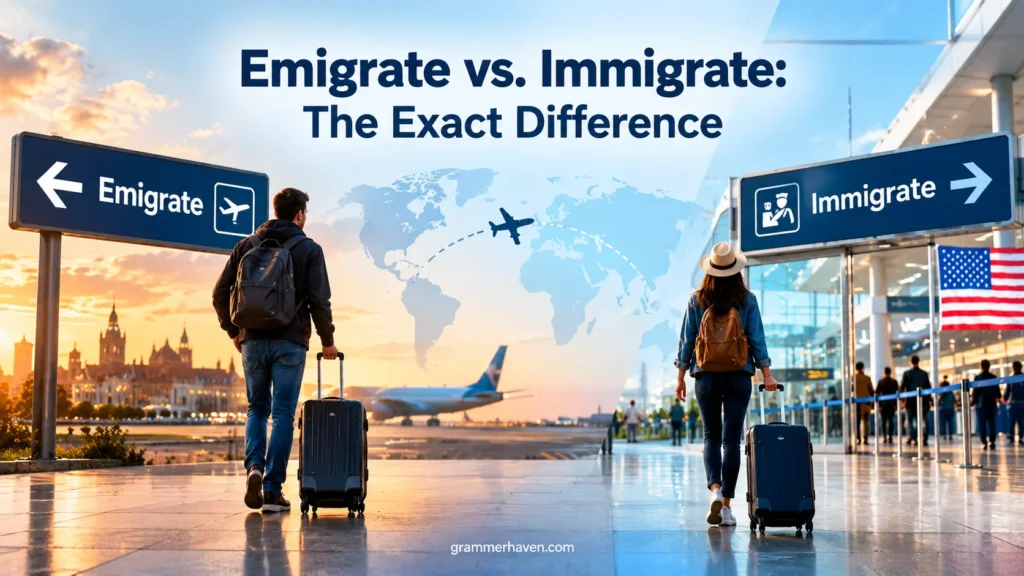
The difference isn’t really about two completely different kinds of travel. Instead, it’s about perspective.
Imagine a person traveling from Country A to Country B.
Country A → Country B
From Country A:
The person emigrates.
From Country B:
The person immigrates.
That’s the whole concept in one diagram.
A Realistic Example
Suppose Ahmed moves from Pakistan to the United States to establish a permanent home.
From Pakistan’s perspective:
Ahmed emigrated from Pakistan.
From the United States’ perspective:
Ahmed immigrated to the United States.
Both statements describe the same person and the same move.
That’s why emigrate and immigrate aren’t contradictory. They’re two lenses pointed at the same journey.
A Simple Memory Trick
Remember these two letters:
E = Exit
I = Into
So:
Emigrate = Exit your country.
Immigrate = Into a new country.
It isn’t a perfect linguistic explanation of every grammatical construction, but it’s an excellent memory aid.
Emigrate vs. Immigrate vs. Migrate
A third word often enters the conversation: migrate.
Unlike emigrate and immigrate, migrate has a much broader meaning. It refers to moving from one place to another and doesn’t necessarily focus on international relocation.
For example:
Many birds migrate south during winter.
You wouldn’t normally call that immigration or emigration because those words are strongly associated with moving between countries to live.
Compare the Three Words
| Word | Core Meaning | Example |
| Migrate | Move from one place to another | Birds migrate south. |
| Emigrate | Leave a country to live elsewhere | She emigrated from Spain. |
| Immigrate | Move into another country to live | She immigrated to Canada. |
The distinction becomes clearer when you picture the words as different camera angles.
Migrate shows the movement.
Emigrate shows the departure.
Immigrate shows the arrival.
Emigration vs. Immigration
The same distinction applies to the noun forms.
Emigration
Emigration means the process of leaving a country to live in another country.
Example:
Emigration from the region increased during the economic crisis.
The sentence focuses on people leaving.
Immigration
Immigration means the process of coming into another country to live there.
Example:
Immigration to the country increased during the decade.
Here, the focus is on people coming in.
Emigration vs. Immigration at a Glance
| Term | Direction | Focus |
| Emigration | Out | People leaving |
| Immigration | In | People arriving |
| Emigrant | Person leaving | Origin country |
| Immigrant | Person arriving | Destination country |
This distinction also appears in population studies, government reports, journalism, and demographic research.
Emigrant vs. Immigrant
The person who leaves is an emigrant.
The person who enters another country to live is an immigrant.
Cambridge defines an emigrant as someone who emigrates and specifically describes an emigrant as someone who leaves a country to live permanently elsewhere.
For immigrant, Cambridge describes the person as someone who comes to another country to live there permanently.
One Person Can Be Both
This is where the distinction becomes especially interesting.
Imagine Sofia moves from Argentina to the United States.
She is:
- an emigrant from Argentina
- an immigrant to the United States
Nothing about Sofia changed between those descriptions. Only the viewpoint changed.
Example
Sofia emigrated from Argentina in 2018.
She immigrated to the United States that same year.
The first sentence emphasizes departure.
The second emphasizes arrival.
Emigrate From or To?
This question causes plenty of confusion because emigrate to is also grammatically possible.
Emigrate From
Use emigrate from when you want to identify the country someone left.
They emigrated from France.
Her family emigrated from India.
This construction makes the origin the main point.
Emigrate To
You can also use emigrate to when naming the destination.
He emigrated to Australia.
They emigrated to Canada in 1995.
Cambridge provides examples using both emigrate from and emigrate to.
Emigrate From X to Y
When you want to identify both places, this structure works well:
She emigrated from Brazil to Portugal.
It gives the reader the entire route in one sentence.
Immigrate To or Into?
Immigrate to is extremely common when naming the destination.
They immigrated to Canada.
She immigrated to the United States.
You can also find immigrate into when the sentence emphasizes entry into a place. Cambridge specifically lists immigrate into/to in its Business English definition.
For everyday writing, however, immigrate to will often sound more natural:
He immigrated to Germany in 2005.
Can You Use Emigrate and Immigrate in the Same Sentence?
Absolutely.
In fact, using both words can make a sentence especially precise.
Maria emigrated from Mexico and immigrated to Canada.
This sentence tells you both sides of the move.
Another example:
His grandparents emigrated from Poland and immigrated to the United States in the early twentieth century.
There’s no contradiction. The verbs simply describe two different perspectives.
Why This Matters
If you write only:
Maria immigrated.
The sentence doesn’t tell the reader where she came from.
If you write:
Maria emigrated.
The sentence doesn’t necessarily tell the reader where she went.
But:
Maria emigrated from Mexico and immigrated to Canada.
gives you the complete picture.
Common Mistakes With Emigrate and Immigrate
Mistake: Treating Them as Exact Synonyms
Although both words describe international relocation, they aren’t identical in focus.
❌ He immigrated from his country.
This isn’t necessarily impossible, especially when from identifies an origin, but it doesn’t highlight departure as naturally as emigrated from.
Better when emphasizing departure:
He emigrated from his country.
Better when emphasizing arrival:
He immigrated to Canada.
Mistake: Using Immigrate for a Vacation
A vacation isn’t normally immigration.
You might say:
She traveled to France for two weeks.
You wouldn’t normally say:
She immigrated to France for two weeks.
Immigrate concerns moving to another country to live there rather than simply visiting it.
Mistake: Using Emigrate for Every Move
Moving from one apartment to another isn’t emigration.
She moved from Chicago to Denver.
That’s relocation within the same country.
Likewise, moving from one neighborhood to another isn’t normally described as emigration.
Mistake: Assuming “Immigrant” Automatically Describes Legal Status
The word immigrant identifies someone who moves to another country to live there. The word itself doesn’t explain every detail of that person’s legal status.
That’s an important distinction when writing about immigration because ordinary vocabulary and legal terminology don’t always operate in exactly the same way.
Emigrate, Immigrate, and Expatriate
Expatriate, often shortened to expat, is another related term.
An expatriate is generally a person living outside their native country. The word can describe someone who has moved abroad without making emigrant and immigrant the central focus.
Consider this:
James emigrated from Britain and immigrated to Spain.
You could also describe James as an expatriate living in Spain.
The terms overlap, but they aren’t interchangeable in every context.
The same caution applies to refugee, asylum seeker, and other immigration-related terms. These words can carry specific legal, political, or humanitarian meanings. They shouldn’t be treated as simple synonyms for immigrant.
Emigrate, Immigrate, and Their Word Families
Learning the related forms makes the distinction much easier to retain.
| Verb | Person | Noun | Meaning |
| Emigrate | Emigrant | Emigration | Leaving a country |
| Immigrate | Immigrant | Immigration | Entering another country |
Think of the word families as two matching sets:
Emigrate → Emigrant → Emigration
Immigrate → Immigrant → Immigration
Once you understand the direction of the verbs, the noun forms become much easier.
A Practical Case Study: One Journey, Six Correct Terms
Consider this fictional example.
Elena was born in Spain. She moved to Canada permanently in 2020.
You could describe her journey in several accurate ways:
- Elena emigrated from Spain.
- Elena immigrated to Canada.
- Elena became an emigrant from Spain.
- Elena became an immigrant in Canada.
- Her move was an act of emigration from Spain.
- Her arrival represented immigration to Canada.
The underlying event hasn’t changed.
Only the direction and grammatical viewpoint have changed.
That is the central lesson behind emigrate or immigrate.
How to Choose the Right Word in Seconds
When you’re unsure, don’t stare at the two words and hope one looks right. Ask yourself one question:
Are you focusing on leaving?
Use emigrate.
She emigrated from Ireland.
Are you focusing on entering?
Use immigrate.
She immigrated to Australia.
Are you describing movement generally?
Consider migrate or move.
The population migrated toward the cities.
The Fastest Decision Rule
Leaving → Emigrate
Entering → Immigrate
General movement → Migrate
And if you’re still stuck, remember:
E = Exit. I = Into.
It’s short enough to remember when you’re writing quickly.
Emigrate or Immigrate: Examples in Context
Here are several examples that show the distinction naturally.
| Sentence | Correct Word | Why? |
| She ___ from France. | emigrated | The sentence focuses on leaving France. |
| She ___ to Canada. | immigrated | The sentence focuses on entering Canada to live. |
| They ___ from Italy to Australia. | emigrated | The move is framed from the origin. |
| They ___ to Australia from Italy. | immigrated | The destination receives the emphasis. |
| His grandparents were ___ from Poland. | emigrants | They left Poland. |
| His grandparents were ___ in the United States. | immigrants | They arrived there to live. |
The surrounding words usually give you a helpful clue.
From often points toward the place someone left.
To often points toward the place someone entered.
Emigrate or Immigrate: Final Comparison
| Feature | Emigrate | Immigrate |
| Basic meaning | Leave a country to live elsewhere | Come into another country to live |
| Main focus | Departure | Arrival |
| Common viewpoint | Origin country | Destination country |
| Common preposition | from | to |
| Person | emigrant | immigrant |
| Noun | emigration | immigration |
| Memory clue | E = Exit | I = Into |
The distinction may look tiny on the page, but it carries real meaning.
See also: A Hour or An Hour: Which Is Correct? The Complete Grammar
FAQs:
Is it “emigrate or immigrate to another country”?
Both can appear with to, but they emphasize different aspects.
She emigrated to Canada.
This describes her leaving her original country to establish a life elsewhere.
She immigrated to Canada.
This emphasizes her arrival in Canada.
If you’re simply naming the destination and focusing on arrival, immigrate to is usually the clearest choice.
Is it “emigrate from” or “immigrate from”?
Both constructions can occur, but they don’t carry the same emphasis.
Emigrate from naturally highlights departure:
He emigrated from Germany.
Immigrate from can identify where an immigrant came from:
She immigrated from India.
The safest approach is to decide whether your sentence emphasizes departure or arrival.
Is immigrate the opposite of emigrate?
Yes, in the practical sense of international movement, they function as directional counterparts.
Emigrate focuses on leaving.
Immigrate focuses on entering.
Can someone be both an emigrant and an immigrant?
Yes.
Someone who leaves Mexico and settles in Canada is an emigrant from Mexico and an immigrant to Canada.
Is migrate the same as immigrate?
No.
Migrate is broader. It describes movement from one place to another and can apply to people, animals, and populations.
Immigrate specifically focuses on coming into another country to live there.
Does emigrate mean moving permanently?
Generally, yes. The standard dictionary meaning centers on leaving a country to live elsewhere permanently or long term.
Does immigrate mean moving permanently?
The standard meaning also centers on moving to another country to live there rather than making a short visit.
What’s the easiest way to remember emigrate and immigrate?
Use this:
Emigrate = Exit
Immigrate = Into
Then check the direction of the sentence.
Conclusion:
Emigrate and immigrate describe the same international move from different viewpoints. Emigrate means leaving a country, while immigrate means entering another country to live there. Remember “emigrate = exit” and “immigrate = enter.” This simple distinction makes it easier to use both words correctly in writing and everyday English.