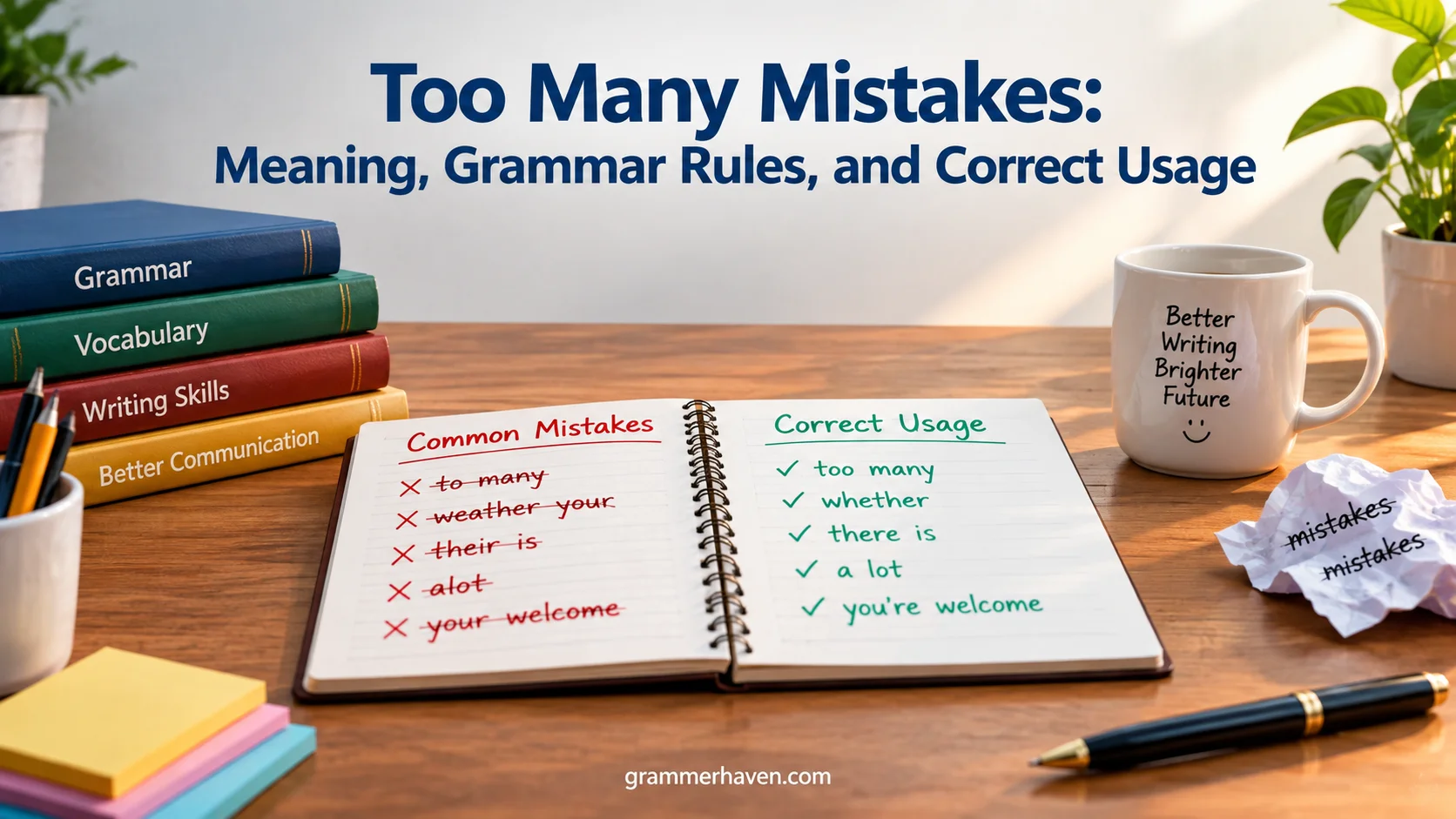
Too Many Mistakes often appear when learners confuse grammar rules, small words and countable noun patterns in English academic writing. The phrase too many mistakes is grammatically correct because too + many + plural countable noun is a standard pattern and construction. Too describes an excessive number, many works with a plural, and mistakes functions as a countable noun. The rule is straightforward to understand, although learners may find it tricky and confuse it with too much mistakes, to many mistakes, or too many mistake. The correct, grammatically accurate phrase is too many mistakes. An Oxford example can help you recognize the pattern in an essay, report, or other form of writing.
In academic writing, clarity, precision, and credibility matter because grammatical errors can weaken your message, academic voice, and overall professionalism. A thesis, research paper, journal article, or report may contain an expected number of errors, especially in a bad first attempt, but the number of errors should remain within a reasonable limit. A particular situation can make some errors manageable, while repeated common grammatical mistakes can become distracting. Reviewing, checking, and using a corrected version are necessary steps for a student or researcher who wants to polish their prose. A real-world example shows why this matters: even brilliant insights can lose their impact when readers encounter too many avoidable errors.
For homework, an essay, research paper, or other academic work, careful checking helps you identify recognizable and avoidable problems before your readers see them. The explanation remains simple: understand the phrase, follow the standard pattern, and correct the error. That approach supports clear writing and helps you focus on conveying ideas rather than distracting mistakes. The same principle applies across academic, scholarly, and research contexts, including a journal, article, paper, or thesis. Looking at 20 examples of grammar mistakes can also strengthen your awareness of common patterns and help you make the necessary corrections without letting errors hide your strongest ideas.
Quick Answer: Is “Too Many Mistakes” Correct?
Yes. “Too many mistakes” is correct English.
Use too many before a plural countable noun when you mean that the quantity exceeds what is wanted, needed, or acceptable.
Correct examples:
- There are too many mistakes in this paragraph.
- I made too many mistakes on the test.
- The editor found too many mistakes in the article.
- You made too many mistakes to pass the exam.
- There were too many mistakes in the original report.
The most important rule is simple:
Too many + plural countable nouns = more than necessary or acceptable.
Because mistakes are countable, you can say one mistake, two mistakes, three mistakes, and so on. That’s why many is the correct quantity word here.
What Does “Too Many Mistakes” Mean?
“Too many mistakes” means an excessive number of mistakes.
The phrase doesn’t merely tell you that mistakes exist. It suggests that their number has gone beyond some expected or acceptable level.
Consider these two sentences:
- I made many mistakes.
- I made too many mistakes.
The first sentence focuses on quantity. It tells you that the speaker made a large number of errors.
The second carries an additional judgment. The speaker believes the number was excessive.
For example:
“I made many mistakes while learning Spanish.”
This could simply describe the learning process.
Now compare:
“I made too many mistakes to pass the test.”
Here, the number of mistakes created a consequence. The errors weren’t merely numerous. There were enough of them to prevent the desired result.
What Does “Too” Add?
In quantity expressions, too means more than necessary, wanted, or acceptable. Cambridge explains that too much and too many describe quantities that are more than enough.
That’s why these sentences carry different meanings:
| Sentence | Meaning |
| I made many mistakes. | I made a large number of mistakes. |
| I made too many mistakes. | I made more mistakes than acceptable. |
| I made a few mistakes. | I made a small number of mistakes. |
| I made several mistakes. | I made more than a few mistakes. |
| I made no mistakes. | I made zero mistakes. |
The exact threshold for too many depends on context. Five mistakes might be too many on a short spelling quiz but perfectly normal during a difficult first draft.
Is “Too Many Mistakes” Grammatically Correct?
Absolutely.
The construction follows a standard English quantifier pattern:
too + many + plural countable noun
In this phrase:
- too = indicates excess
- many = indicates a number
- mistakes = plural countable noun
Oxford specifically notes that many is used with plural nouns and commonly appears after so, as, and too.
Why Is “Mistakes” Plural?
The word many refers to more than one item. Therefore, the noun following it needs to appear in plural form.
Compare:
- ❌ too many mistake
- ✅ too many mistakes
The same pattern appears in:
- too many errors
- too many questions
- too many problems
- too many interruptions
- too many distractions
- too many assignments
You wouldn’t say “too many questions” because the question is singular. The same grammatical logic applies to mistake.
Why Is “Many” Appropriate?
A mistake is a countable noun because you can identify individual mistakes.
You can have:
- one mistake
- two mistakes
- ten mistakes
- twenty mistakes
That makes many the appropriate quantifier.
By contrast, English treats nouns such as information, advice, and money as uncountable in ordinary usage. You therefore don’t normally say “many informations” or “many advices.” The countability distinction determines whether many or much works.
“Too Many Mistakes” vs. “Too Much Mistakes”
This is one of the most common errors.
The correct expression is:
too many mistakes
Not:
❌ too much mistakes
The reason comes down to countability.
Use “Too Many” With Countable Nouns
Use too many with things you can count individually.
Examples:
- too many mistakes
- too many books
- too many students
- too many emails
- too many questions
- too many cars
Use “Too Much” With Uncountable Nouns
Use too much with nouns treated as an amount or mass rather than individual units.
Examples:
- too much information
- too much time
- too much work
- too much money
- too much noise
- too much confusion
Oxford gives the same fundamental distinction: too many comes before countable nouns while too much comes before uncountable nouns.
Compare the Structures
| Countable | Uncountable |
| too many mistakes | too much information |
| too many errors | too much work |
| too many questions | too much confusion |
| too many problems | too much noise |
| too many assignments | too much time |
A useful test is to ask:
Can I count the individual items?
If the answer is yes, many is usually the right choice.
“Too Many Mistakes” vs. “Many Mistakes”
These expressions look almost identical, but too changes the meaning considerably.
“Many Mistakes” Means a Large Number
“She made many mistakes during her first attempt.”
The sentence tells you that she made a large number of mistakes. It doesn’t necessarily say that the number was unacceptable.
“Too Many Mistakes” Means Excess
“She made too many mistakes during the final exam.”
Now the speaker sees the number as excessive.
The difference becomes even clearer when you add a consequence:
“He made too many mistakes to pass.”
The phrase too many establishes an amount that prevents a desired outcome.
A Simple Comparison
Many = a large number.
Too many = more than acceptable or needed.
That’s the distinction worth remembering.
“Too Many Mistakes” vs. “So Many Mistakes”
Another subtle comparison involves so many.
Both expressions can describe a large number. However, they don’t normally express the same idea.
What Does “So Many Mistakes” Mean?
So many emphasise quantity. It can also express surprise, frustration, admiration, or disbelief depending on context.
For example:
“Why are there so many mistakes in this report?”
The speaker may sound surprised or frustrated.
Cambridge notes that so much and so many can emphasize a very large quantity.
What Does “Too Many Mistakes” Mean?
Too many emphasizes excess.
“There are too many mistakes in this report to publish it.”
The sentence establishes a practical problem. The number of mistakes exceeds what the situation can reasonably tolerate.
| Expression | Main idea | Example |
| many mistakes | large quantity | She made many mistakes. |
| so many mistakes | emphasis or surprise | She made so many mistakes! |
| too many mistakes | excessive quantity | She made too many mistakes to pass. |
Think of so many as pointing at the size of the pile.
Think of too many as saying the pile has become a problem.
“Too Many Mistakes” vs. “To Many Mistakes”
This spelling error happens because to and too sound alike in many varieties of English.
Their meanings, however, are completely different.
“Too Many” Expresses Excess
There are too many mistakes in this essay.
Here, too means more than necessary or acceptable.
“To Many” Can Be Grammatically Correct in Another Structure
The phrase to many isn’t automatically wrong.
For example:
This rule is confusing to many students.
Here, to is a preposition.
Another example:
She spoke to many people at the conference.
The structure is:
to + many + plural noun
But that doesn’t mean to many can replace too many.
Compare:
- There are too many mistakes. ✅
- This explanation is confusing to many students. ✅
- There are to many mistakes. ❌
The first sentence talks about excess. The second identifies people affected by something.
The Easy Memory Rule
Too many = more than needed.
To many = “to” functioning as a preposition before many.
One extra o can change the entire meaning.
Common Uses of “Too Many Mistakes”
The phrase appears naturally in many situations. Here are the most useful patterns.
Talking About Writing
“There are too many mistakes in this paragraph.”
“The essay contains too many spelling mistakes.”
“The first draft had too many grammatical mistakes.”
In editing, too many mistakes can describe spelling, grammar, punctuation, factual errors, or structural problems.
Talking About Exams
“I made too many mistakes on the math test.”
“She made too many mistakes to earn a passing grade.”
“There were too many mistakes in my final answers.”
The phrase works especially well when the errors affect a result.
Talking About Work
“The report contains too many mistakes.”
“The manager rejected the document because it had too many errors.”
“We can’t send this version to the client. There are too many mistakes.”
Here, too many often implies that someone must revise or correct the work.
Talking About Everyday Life
“I made too many mistakes while following the recipe.”
“We made too many mistakes during our first attempt.”
“He made too many mistakes because he rushed.”
These examples show that the expression isn’t limited to academic grammar.
Common Mistakes With “Too Many Mistakes”
Ironically, an article about mistakes can contain them too. Here are the errors worth avoiding.
Mistake: Using “Too Much”
❌ I made too much mistakes.
✅ I made too many mistakes.
Because mistakes are countable plural nouns, use many.
Mistake: Forgetting the Plural
❌ There are too many mistake.
✅ There are too many mistakes.
The word many requires a plural countable noun in this structure.
Mistake: Writing “To Many”
❌ There are to many mistakes.
✅ There are too many mistakes.
The spelling too expresses excess.
Mistake: Assuming “Too” Simply Means “Very”
In some contexts, learners treat too as a stronger version of very.
That’s not a reliable rule.
Compare:
“She is very tired.”
This describes a high degree of tiredness.
“She is too tired to work.”
This suggests that her tiredness exceeds the level that permits her to work.
The same logic applies to quantities:
“There are many mistakes.”
versus
“There are too many mistakes.”
The second statement introduces an excess or problem.
Mistake: Mixing Up Countable and Uncountable Nouns
❌ too many information
✅ too much information
❌ too many advice
✅ too much advice
The noun determines the quantifier.
Sentence Patterns With “Too Many Mistakes”
Once you understand the rule, several useful sentence patterns become easy to recognize.
“There Are Too Many Mistakes…”
This construction focuses on the existence or quantity of errors.
Examples:
- There are too many mistakes in this document.
- There are too many mistakes to ignore.
- There are too many mistakes in the final version.
“I Made Too Many Mistakes…”
This structure focuses on the person’s actions.
Examples:
- I made too many mistakes during the interview.
- I made too many mistakes on the first attempt.
- I made too many mistakes because I didn’t check my work.
“You Made Too Many Mistakes…”
This form can sound corrective or critical depending on context.
“You made too many mistakes on this assignment.”
A softer version might be:
“There are a few mistakes we should correct before submitting this.”
The grammar stays the same. The tone changes.
“There Were Too Many Mistakes…”
Use this pattern when discussing a past situation.
“There were too many mistakes in the original report.”
“There were too many mistakes to approve the application.”
Can You Say “I Make Too Many Mistakes”?

Yes. “I make too many mistakes” is grammatically correct.
It usually describes a repeated pattern rather than one specific event.
“I make too many mistakes when I rush.”
The present tense suggests something that happens regularly.
Compare:
“I made too many mistakes yesterday.”
That’s a specific past event.
“I Make Many Mistakes” vs. “I Make Too Many Mistakes”
These sentences carry different attitudes.
I make many mistakes.
→ I make a large number of mistakes.
I make too many mistakes.
→ I believe my mistake rate is higher than acceptable.
That small word too adds judgment.
“Too Many Mistakes to…” — A Useful Grammar Pattern
One of the most useful structures is:
too many + noun + to + verb
For example:
“There are too many mistakes to correct tonight.”
“He made too many mistakes to win.”
“The document has too many mistakes to publish.”
The first too belongs to the quantity expression.
The second to, when present, introduces an infinitive:
to correct
to publish
Don’t confuse the two.
Why This Pattern Matters
It connects an excessive quantity with a consequence.
Consider:
“There are too many mistakes.”
That’s a complete statement about quantity.
Now:
“There are too many mistakes to publish the article.”
The second version explains the practical consequence of those mistakes.
That makes the sentence more informative.
“Too Many Mistakes” in Formal and Informal Writing
The expression works in both formal and informal English.
Formal Examples
“The manuscript contains too many grammatical mistakes for publication.”
“The report includes too many numerical errors to support the conclusion.”
“The submitted document contains too many inconsistencies.”
In formal writing, errors, inaccuracies, and inconsistencies can sometimes sound more precise than mistakes.
Informal Examples
“You made too many mistakes!”
“There are way too many mistakes here.”
“I keep making too many mistakes when I’m tired.”
Words such as way too many are conversational and emphatic. They’re common in speech but may not suit formal academic writing.
More Formal Alternatives
| Phrase | Tone | Best use |
| too many mistakes | Natural | General writing |
| numerous errors | Formal | Reports and academic writing |
| multiple errors | Professional | Technical documents |
| an excessive number of errors | Very formal | Formal analysis |
| several inaccuracies | Precise | Factual content |
| a series of errors | Context-specific | Sequential problems |
Don’t replace too many mistakes automatically. Each alternative changes the shade of meaning.
Numerous errors emphasise quantity.
An excessive number of errors emphasizes that the quantity exceeds an acceptable threshold.
A series of errors emphasizes sequence.
Precision matters.
Better Alternatives to “Too Many Mistakes”
Sometimes you need a different expression because the context calls for a more precise tone.
“Numerous Mistakes”
This means there are many mistakes.
“The document contains numerous mistakes.”
It doesn’t necessarily carry the same strong sense of unacceptable excess as too many mistakes.
“Multiple Errors”
This sounds professional and concise.
“The report contains multiple errors.”
It works particularly well in technical contexts.
“An Excessive Number of Errors”
This is a formal alternative.
“The analysis contains an excessive number of errors.”
It’s useful when you’re writing an evaluation or formal critique.
“Several Mistakes”
This suggests more than a few mistakes without necessarily implying an unacceptable number.
“The editor identified several mistakes.”
The distinction is subtle but important.
Real-World Examples of “Too Many Mistakes”
Education
Imagine a student submits a 500-word essay containing twenty spelling and grammar errors.
A teacher might reasonably say:
“There are too many mistakes to grade the final version.”
The phrase works because the number of errors has crossed a practical threshold.
Business
Suppose an employee prepares a financial report containing repeated incorrect figures.
A manager might write:
“There are too many mistakes in this version to send it to the client.”
Here, too many isn’t necessarily a mathematically fixed number. It depends on the document’s purpose and the consequences of publishing inaccurate information.
Technology
A software project can also have too many mistakes.
For example:
“The first version contained too many coding errors to release.”
The expression remains grammatically identical even though the mistakes are technical rather than linguistic.
Everyday Situations
Imagine someone learning to bake.
“I made too many mistakes with the recipe, so the cake didn’t rise.”
The phrase naturally connects mistakes with an unwanted result.
Case Study: Why Context Determines “Too Many”
Consider two proofreading situations.
Case Study One: A Casual Text
A friend sends:
“I cant believe your comming tommorow.”
There are several spelling errors. However, the message remains understandable.
You might say:
“There are a few mistakes, but I understand what you mean.”
Case Study Two: A Professional Report
Now imagine a financial report containing five incorrect figures, several missing decimal points, and inconsistent totals.
A reviewer might say:
“There are too many mistakes to approve this report.”
The number of errors matters, but context matters just as much.
Five mistakes in a casual text may be trivial.
Five errors in a financial statement could be unacceptable.
That’s why too many don’t require a fixed numerical threshold.
Quick Comparison: “Many,” “So Many,” and “Too Many”
| Expression | Meaning | Example |
| many mistakes | a large number | She made many mistakes. |
| so many mistakes | emphasizes a surprisingly large number | She made so many mistakes! |
| too many mistakes | more than acceptable or needed | She made too many mistakes to pass. |
| a few mistakes | a small number | She made a few mistakes. |
| several mistakes | an unspecified number greater than a few | She made several mistakes. |
| no mistakes | zero | She made no mistakes. |
This table captures the core distinction.
Many tells you about quantity.
So many adds emphasis.
Too many adds excess.
Quick Grammar Test: Choose the Correct Phrase
Test your understanding with these examples.
Question One
There are ___ mistakes in this paragraph.
- A. to many
- B. too many
- C. too much
Answer: B. too many
“ mistakes” is a plural countable noun.
Question Two
She received ___ information at once.
- A. too many
- B. too much
- C. to many
Answer: B. too much
Information is treated as an uncountable noun.
Question Three
I spoke ___ students about the problem.
- A. too many
- B. to many
- C. too much
Answer: B. to many
Here, to is a preposition.
Question Four
He made ___ mistakes to pass the test.
- A. too many
- B. too much
- C. to much
Answer: A. too many
The phrase means that the number of mistakes was excessive enough to prevent him from passing.
How to Remember the “Too Many Mistakes” Rule
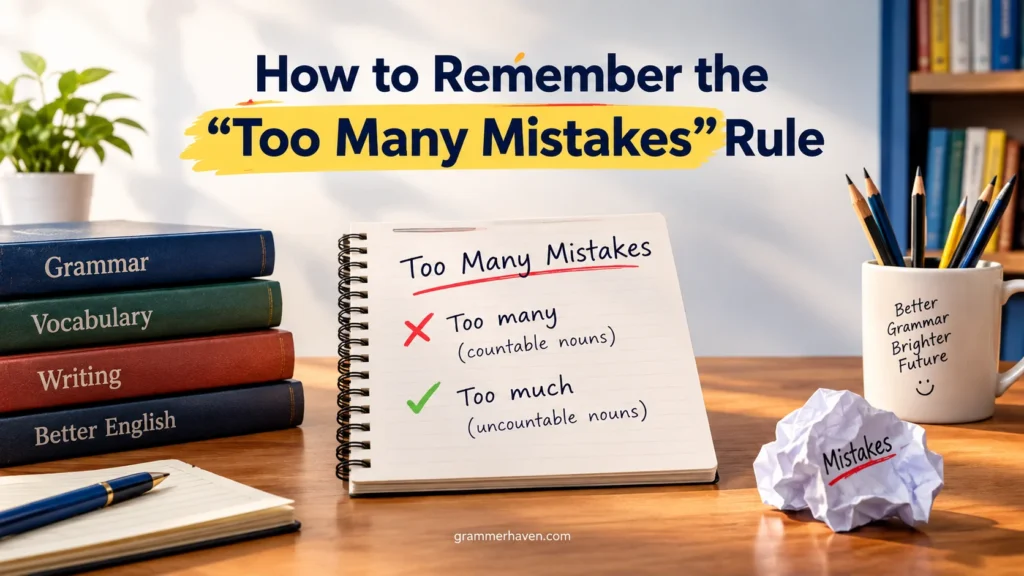
A simple countability check can save you from most errors.
Use This Three-Step Test
Step 1: Find the noun.
Is it mistakes?
Step 2: Ask whether you can count it.
Yes:
- one mistake
- two mistakes
- three mistakes
Step 3: Decide whether the quantity is excessive.
If yes, use:
too many mistakes
That’s it.
A Useful Memory Trick
Think of too many as a warning sign.
You don’t merely have a pile of something. The pile has grown beyond what you can reasonably handle.
many = a lot
too many = more than is acceptable
It’s a small distinction with a big effect.
See also: Whoa or Woah: Which Spelling Is Correct? Meaning & Usage
FAQs:
Is “too many mistakes” correct?
Yes. “Too many mistakes” is grammatically correct. It uses too many with the plural countable noun mistakes.
Is it “too many mistake” or “too many mistakes”?
The correct form is too many mistakes.
Because many refers to multiple countable items, the noun must be plural in this construction.
Is it “too much mistakes” or “too many mistakes”?
The correct expression is too many mistakes.
Use many with plural countable nouns. Use much with uncountable nouns.
Is “to many mistakes” correct?
Not when you mean an excessive number of mistakes.
Use too many mistakes.
However, to many can appear in other grammatical structures, such as:
“This rule is confusing to many students.”
What does “too many mistakes” mean?
It means more mistakes than are acceptable, necessary, wanted, or manageable in a particular context.
What’s the difference between “many mistakes” and “too many mistakes”?
Many mistakes means a large number.
Too many mistakes means the number is excessive.
Can you use “too many mistakes” in formal writing?
Yes.
The expression is grammatically standard. In particularly formal contexts, alternatives such as numerous errors or an excessive number of errors may provide a more technical tone.
What’s the opposite of “too many mistakes”?
The opposite depends on the intended meaning.
Possible expressions include:
- few mistakes
- very few mistakes
- an acceptable number of mistakes
- no mistakes
- not many mistakes
For example:
“The final draft contains very few mistakes.”
That suggests a low and manageable number of errors.
Conclusion:
The phrase “too many mistakes” is grammatically correct and follows the standard pattern too + many + plural countable noun. You can use it when you want to say that the number of mistakes is excessive. Forms such as too much mistakes, to many mistakes, and too many mistake are incorrect. In academic writing, mistakes are normal during drafting, but frequent errors can affect clarity, credibility, and readability. Careful proofreading, grammar checking, and revision can reduce errors and help your ideas come through clearly. Understanding the correct structure makes it easier to recognize and avoid too many mistakes in your writing.