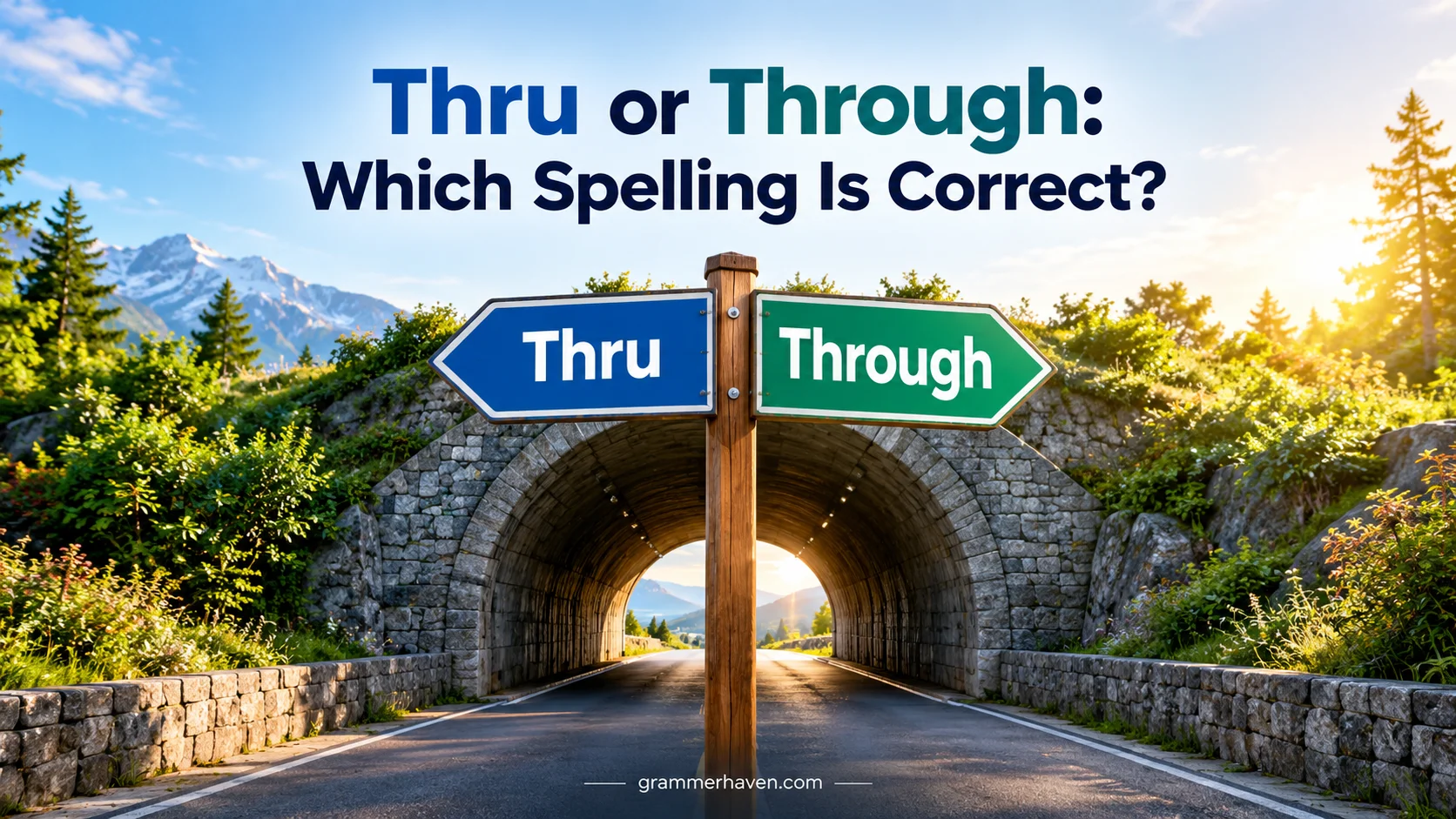
Thru or Through is the short answer when you need the standard and preferred spelling for formal English writing and everyday use. Through is a word that works as a preposition, adverb, and adjective. Thru is an alternate, informal, non-standard spelling. It isn’t necessarily incorrect, but it remains an acceptable choice for casual phrases, text messages, advertisements, and signs such as drive-thru. In everyday use, Through suits normal and formal writing.
The same basic word can appear at a different level of formality. Major dictionaries identify thru as a variant form and Through as the standard form. The distinction becomes clearer when you consider pronunciation. Throo may seem tempting because of its sound, but the ough ending creates an unexpected spelling pattern rather than a simple sound-to-letter match. A classic example is Monday through Friday in a business document. No Thru Traffic is suitable for a road sign.
Context determines which form fits. Which spelling Is Correct depends on where the word appears and how formal the writing needs to be. If readers understand the slang, thru can work in quick messages or fixed commercial signs. For formal words and sentences, Through remains the safest choice and sounds more natural than the shortened variant. Thru can still work naturally in casual settings without seeming strange.
Quick Answer: Thru or Through?
Through is the correct standard spelling for formal and general writing.
Thru is an informal shortened spelling of through. It’s especially common in signs, advertising, casual communication, and certain established expressions such as drive-thru. Oxford labels thru as North American English and informal, while Dictionary.com describes it as an informal, simplified spelling.
| Spelling | Status | Best Use |
| Through | Standard spelling | Formal, academic, professional, and everyday writing |
| Thru | Informal variant | Signs, advertising, casual writing, and some established compounds |
The easiest rule to remember
When in doubt, use through.
If you’re writing an essay, email, report, article, resume, application, or professional document, through is almost always the better choice.
If you’re reading a sign that says Drive-Thru Open, however, thru isn’t a spelling accident. It’s an established informal form.
Thru vs. Through: What’s the Difference?
At first glance, thru and through seem to be two spellings competing for the same job. In most cases, they represent the same basic word and meaning. The real difference is register.
Through belongs to standard written English. You can use it almost anywhere without raising questions about tone or correctness.
Thru, by contrast, deliberately shortens the word. It saves space and creates a more casual appearance. Oxford lists it specifically as an informal North American form, while Collins identifies it as an informal or chiefly US variant.
Consider these examples:
- We walked through the park.
- We walked thru the park.
The meaning is clear in both sentences. Yet the first version looks standard and polished. The second feels abbreviated.
That’s the central distinction.
The issue usually isn’t meaning. It’s context.
What Does Through Mean?
Through has a surprisingly broad range of uses. It’s much more than a word describing movement from one side of something to another.
Merriam-Webster lists uses involving movement, location, time, means, completion, and passage through a process.
Through as a Preposition
The most familiar use describes movement into one side or part of something and out another.
For example:
- We walked through the forest.
- The train passed through the tunnel.
- She looked through the window.
- Sunlight came through the curtains.
- The dog ran through the open gate.
Here, through emphasizes passage across or within something.
Think of a tunnel. You enter one end, travel inside it, and eventually emerge from the other side. You’re moving through it.
Through for Time
You can also use through to describe a period from beginning to end.
Examples include:
- We worked through the night.
- She stayed there through the summer.
- The store remains open Monday through Friday.
- He studied through the weekend.
In American English, through can also mean up to and including a final point. Oxford specifically documents this North American usage.
For example:
The office is open Monday through Friday.
This means the office is open on Monday, Tuesday, Wednesday, Thursday, and Friday.
Through for Completion
Another important use involves finishing something or successfully passing through a difficult experience.
For example:
- We finally made it through the interview.
- She got through the difficult exam.
- He worked through the entire assignment.
- They made it through the storm.
In these sentences, through suggests movement from one stage to another until you reach the other side.
That’s why people say:
“We’ll get through this.”
The phrase doesn’t describe a physical tunnel. Instead, it describes successfully reaching the end of a difficult situation.
Through as a Means
Through can also mean by means of or because of something.
Consider these examples:
- She found the job through a friend.
- He learned the skill through practice.
- The company grew through better marketing.
- They solved the problem through careful planning.
Here, through identifies the method, channel, or circumstance that produced an outcome.
What Does Thru Mean?
Thru is a shortened, informal spelling of through.
It isn’t simply a random misspelling invented by people who don’t know how to spell the word. Dictionaries recognize the form and explain its informal status. Oxford, for example, lists thru as a North American informal form of through.
Dictionary.com similarly describes thru as an informal, simplified spelling and notes its particular association with US usage.
The shorter spelling has a practical advantage: it takes less space.
That’s useful on:
- Road signs
- Store signs
- Restaurant signs
- Advertisements
- Labels
- Informal messages
- Space-limited displays
A road sign has limited room. A business wants a short, quickly readable phrase. Thru gets the job done with fewer letters.
Is Thru a Correct Spelling?
Yes, thru is a recognized spelling variant, but calling it simply “correct” without qualification can mislead readers.
The better explanation is this:
Thru is an accepted informal variant of through, while through is the standard spelling.
That’s an important distinction.
Imagine someone asks whether gonna is the same as going to. In casual speech, absolutely. In a formal academic essay, the shorter form would usually be inappropriate.
Thru works in a similar way.
Use Through When:
- You’re writing an academic paper.
- You’re preparing a business report.
- You’re writing a formal email.
- You’re creating a resume.
- You’re submitting a job application.
- You’re writing an article.
- You’re preparing professional documentation.
- You’re writing a school assignment.
- You’re communicating in polished standard English.
Thru May Be Appropriate When:
- You’re writing a casual text.
- You’re designing a sign.
- You’re creating an advertisement.
- You’re using a familiar compound such as drive-thru.
- Space is limited.
- The informal style is intentional.
So, if a teacher asks you to write a sentence using the word, choose through unless the assignment specifically concerns informal variants.
Through vs. Thru in Formal Writing
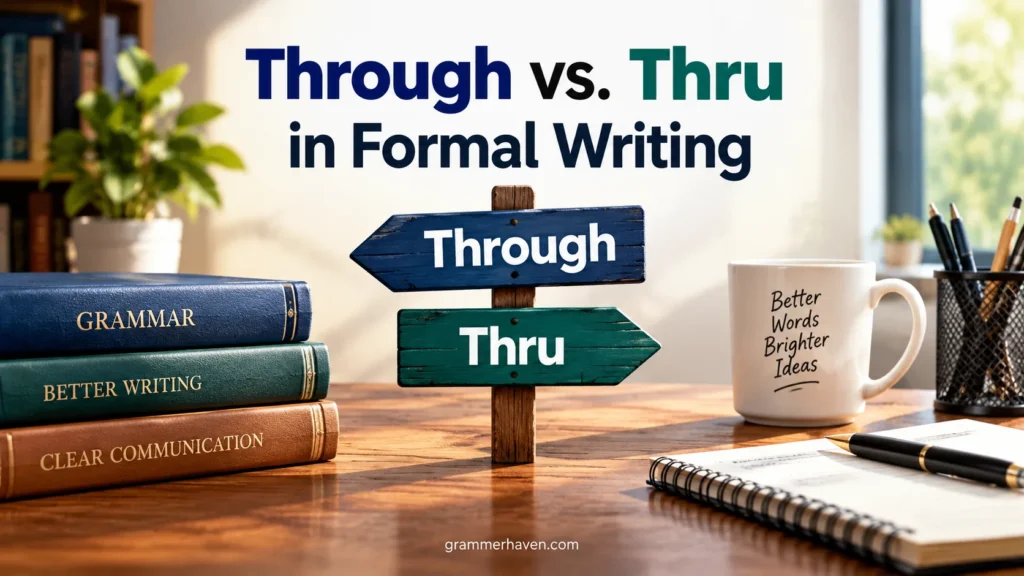
This is where the difference becomes especially important.
Suppose you’re writing a business report. You could write:
The company operated Monday thru Friday.
The meaning is perfectly understandable. However, the standard version is:
The company operated Monday through Friday.
The second sentence fits professional writing much better.
Here are several more comparisons:
| Informal Version | Standard Version |
| We walked thru the building. | We walked through the building. |
| She worked thru the night. | She worked through the night. |
| I read thru the report. | I read through the report. |
| We’re open Monday thru Friday. | We’re open Monday through Friday. |
| He made it thru the final round. | He made it through the final round. |
The shortened version isn’t necessarily incomprehensible. It simply doesn’t have the same polished feel.
Standard writing favors through.
When Should You Use Thru?
The best way to understand thru is to look at where it naturally appears.
Thru on Signs
Signs are one of the clearest places to encounter this spelling.
You may see:
- No Thru Traffic
- Thru Lane
- Drive-Thru
- Thru Road
The reason is straightforward. Signs need to communicate quickly and often have physical space limitations.
A shorter word can also make a sign easier to scan from a distance.
Thru in Advertising
Advertising often favors compact language.
A restaurant might advertise:
24-Hour Drive-Thru
A formal brochure might instead write:
24-Hour Drive-Through Service
Both communicate the same basic idea. The first feels shorter, punchier, and more familiar in commercial settings.
Thru in Casual Messages
Informal communication gives you more freedom.
Someone might text:
I’ll read it thru tonight.
Another person might write:
We made it thru the first round.
These forms are easy to understand. They also fit the abbreviated style common in casual digital communication.
Still, if you’re writing something polished, through remains the safer choice.
Drive-Thru or Drive-Through?
This is one of the most interesting cases because drive-thru has become an established expression in American English.
You’ll commonly see:
- drive-thru
- drive-through
Both forms exist, but drive-thru is especially familiar in American commercial usage.
For example:
The restaurant has a 24-hour drive-thru.
The shortened spelling works naturally because drive-thru has developed into a familiar compound expression.
That doesn’t mean you should replace every instance of through with thru. The fact that drive-thru is common doesn’t turn thru into the preferred spelling everywhere.
Think of it as a specialized use.
Drive-thru is familiar. “Walk thru the park” is still informal.
Thru or Through in Date Ranges
Date and number ranges create another common point of confusion.
In North American English, through can mean “up to and including.”
For example:
The course runs Monday through Friday.
This includes Friday.
You can also write:
Chapters 2 through 8 are required.
That means chapters 2, 3, 4, 5, 6, 7, and 8.
Oxford explicitly gives through this “until and including” meaning in North American English and notes thru as its informal alternative.
Is Monday Thru Friday Correct?
Monday thru Friday is understandable and appears in informal North American usage.
However, the standard form is:
Monday through Friday
For formal writing, schedules, reports, websites, and professional documents, through is the stronger choice.
| Context | Recommended Form |
| Formal schedule | Monday through Friday |
| Academic writing | Chapters 2 through 8 |
| Business document | January through March |
| Road sign | Monday thru Friday may appear |
| Casual message | Monday thru Friday is understandable |
Through or Thru in American English
The distinction becomes especially clear in US English.
American English uses thru in several highly visible informal contexts. Road signs, restaurant branding, advertisements, and casual messages have helped make the spelling familiar.
However, familiarity doesn’t make it the standard form.
Cambridge identifies through as the standard form and marks thru as nonstandard in its American English dictionary entry.
Oxford takes a slightly different descriptive approach by listing thru as an informal North American form.
Those descriptions point toward the same practical conclusion:
Americans recognize thru, but through remains the standard spelling for ordinary polished writing.
Why Is Through Spelled So Strangely?
There’s a historical reason through looks stranger than its pronunciation suggests.
Merriam-Webster traces the word back to Old English thurh, with related forms appearing in Middle English. The modern spelling developed over centuries rather than being designed around today’s pronunciation.
Oxford likewise traces the word to Old English thurh and notes changes in spelling over time.
English spelling is full of these historical leftovers.
That’s why you get unusual groups such as:
| Word | Pronunciation |
| through | “throo” |
| though | “thoh” |
| rough | “ruff” |
| cough | “koff” |
| bough | “bow” |
The -ough sequence doesn’t have one fixed pronunciation.
That’s one reason thru feels so logical. It writes the word almost exactly as it sounds.
But English spelling doesn’t always prioritize phonetic simplicity. History has a stubborn seat at the table.
Through vs. Threw: Don’t Confuse These Words
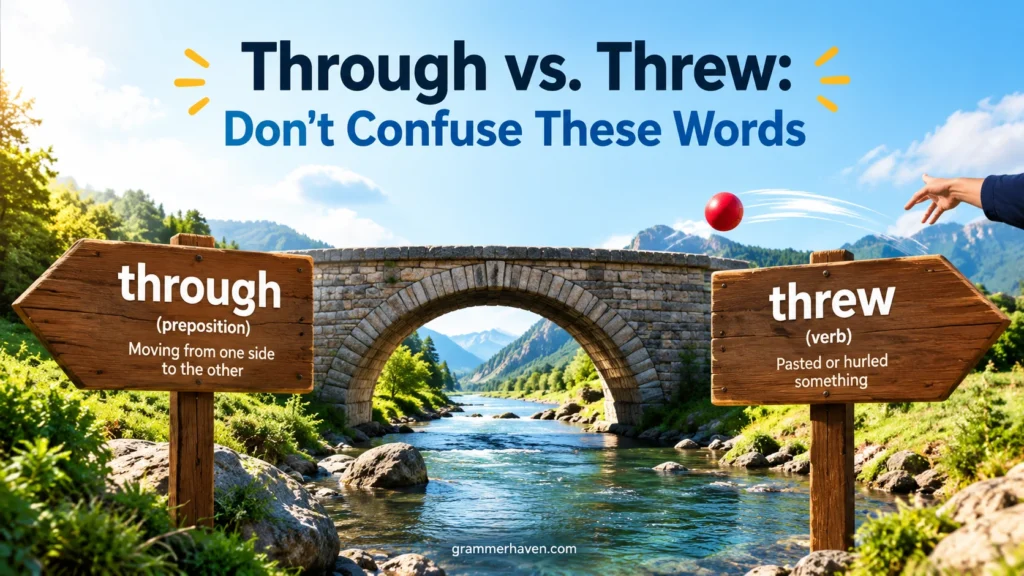
Another spelling can cause even more trouble: threw.
Although through and threw sound different in careful speech, they can confuse writers because their spellings look similar.
Their meanings are completely different.
Through
Through refers to movement, time, completion, means, or passage.
We walked through the tunnel.
Threw
Threw is the past tense of throw.
She threw the ball across the field.
A useful memory trick is simple:
Throw → threw
If you’re describing someone tossing something, you need threw.
If you’re describing passage or movement, you probably need through.
Through or Thru: Real-World Examples
Context makes the distinction much easier to remember.
Movement
The children ran through the house.
Use through because this is ordinary standard writing.
Time
The office is open Monday through Friday.
Again, through is the standard choice.
Completion
She worked through the problem carefully.
The word describes working from the beginning toward a solution.
Casual Texting
I’ll look thru everything tonight.
The abbreviated form can work because the message is informal.
Commercial Signage
Drive-Thru Open
Here, thru feels natural because it’s part of an established commercial expression.
Road Sign
No Thru Traffic
The shortened form makes practical sense in signage.
Common Mistakes With Thru and Through
Understanding the rule is easier when you know what usually goes wrong.
Mistake: Treating Thru as Always Wrong
This is too simplistic.
Thru is a recognized informal variant, not merely a typo. Oxford lists it as informal North American English, while other dictionaries also document its variant status.
The better rule is to judge the context.
Mistake: Using Thru in Formal Writing
This is the more important mistake.
A college essay should say:
The author guides the reader through several stages.
Not:
The author guides the reader thru several stages.
The second sentence sounds unnecessarily casual.
Mistake: Assuming Drive-Thru Proves Thru Is Always Preferred
It doesn’t.
Drive-thru is an established expression. That doesn’t mean thru should replace through throughout your writing.
You wouldn’t write:
She walked thru the museum.
simply because you saw drive-thru on a restaurant sign.
Mistake: Confusing Thru With Threw
Remember:
- through = passage or progress
- threw = past tense of throw
That one-letter difference can completely change your sentence.
Through or Thru: A Simple Decision Guide
When you’re unsure, ask yourself one question:
Am I writing standard English or intentionally using an informal shortened form?
If you’re writing standard English, choose through.
If you’re creating a sign, using an established expression, or writing casually, thru may fit.
| Situation | Best Choice |
| School essay | Through |
| Research paper | Through |
| Business report | Through |
| Professional email | Through |
| Resume | Through |
| Blog article | Through |
| Casual text | Thru can work |
| Road sign | Thru may work |
| Advertisement | Thru may work |
| Drive-thru restaurant | Thru is established |
| Formal schedule | Through |
| Casual schedule | Thru can work |
Through vs. Thru: Quick Comparison
| Feature | Through | Thru |
| Standard spelling | Yes | Informal variant |
| Same basic meaning | Yes | Yes |
| Formal writing | Recommended | Usually avoid |
| Academic writing | Recommended | Avoid |
| Professional writing | Recommended | Usually avoid |
| Casual texting | Fine | Common |
| Signs | Common | Very common |
| Advertising | Common | Common |
| Date ranges | Preferred | Informal |
| US usage | Standard | Informal/shortened |
| Drive-thru | Drive-through also works | Established form |
Is Thru Ever Better Than Through?
Yes, but “better” depends entirely on the job.
Suppose a designer has limited space on a sign. Thru may be the smarter choice.
Suppose a restaurant is naming its service lane. Drive-thru is familiar and immediately recognizable.
Now suppose you’re writing a legal document. Through is the better option.
The spelling isn’t merely about correctness. It also communicates tone.
That’s a useful lesson for many spelling questions. A word can be understandable without being the best choice for every setting.
Easy Trick to Remember Through
If you’re constantly tempted to write thru, remember this:
Through is the standard form. Thru is the shortcut.
Think of it like a full road versus a shortcut.
- Through = the full standard spelling
- Thru = the shortened route
When you’re writing something formal, take the standard route.
You can also remember the common phrase:
Monday through Friday
If you’re describing a normal range in polished American English, through is the form you want.
See also: Too Many Mistakes: Meaning, Grammar Rules, and Correct Usage
FAQs:
Is “thru” a real word?
Yes. Thru is a recognized informal variant of through. Dictionaries document its use, particularly in North American English.
Is “thru” grammatically correct?
The distinction is mainly about spelling and register, not grammar. Thru can function where through functions, but it has an informal character.
Is “through” the correct spelling?
Yes. Through is the standard spelling used in formal and general written English.
Can I use “thru” in an essay?
It’s best to use through in an essay. Academic writing normally calls for standard spelling.
Is “drive-thru” correct?
Yes. Drive-thru is a well-established informal compound in American English. Drive-through is also used.
Is “Monday thru Friday” correct?
It’s understandable and used informally, especially in North American English. However, Monday through Friday is the standard form for polished writing. Oxford specifically recognizes thru as an informal alternative in this range construction.
Is “thru” acceptable in texting?
Yes. Casual messages often use shortened spellings. In that setting, thru is easy to understand.
Is “thru” American English?
It’s especially associated with informal North American English, although readers elsewhere may recognize it as well. Oxford labels it North American and informal.
Does thru mean the same thing as through?
Generally, yes. Thru is a shortened variant of through, so the underlying meaning is usually the same. The main difference is how and where the spelling is used.
Conclusion:
Through is the standard spelling for formal English writing, while thru is an informal variant commonly seen in signs, advertisements, and casual messages. When you’re unsure which form fits your context, choose Through.