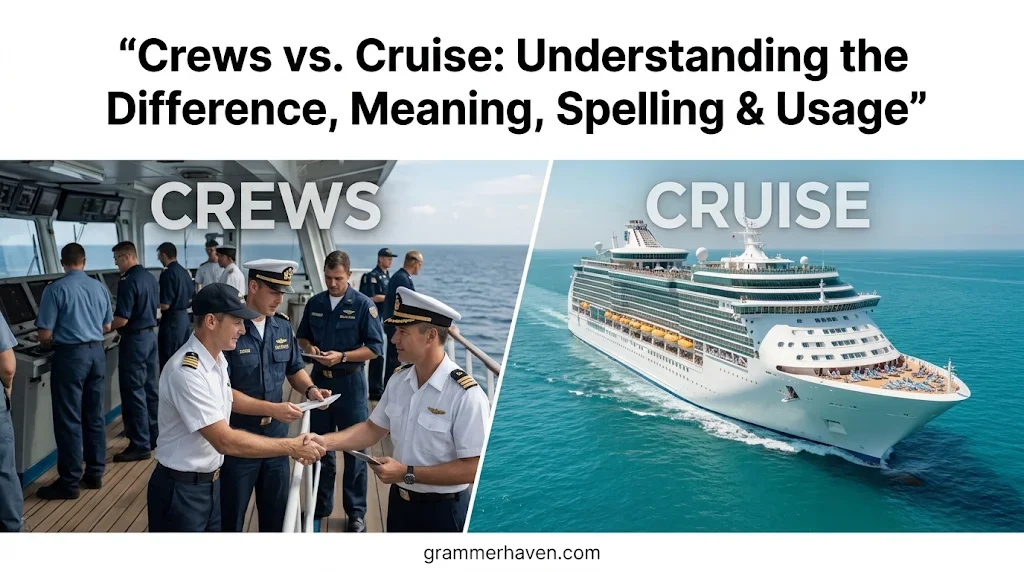
Crews vs. Cruise: Understanding the Difference helps English learners avoid confusing homophones by explaining their meanings and correct use with clarity.
Many people find these words confusing because they sound the same but have different meanings. A crew is the plural form of a group of individuals working together as members of a team on a ship, boat, plane, or film project. These teams operate in maritime, aviation, and other creative contexts where teamwork, coordination, roles, and performing every duty correctly are important. From my experience, learners often worry about spelling and spellings, but tools like Google, spellcheck, and autocorrect cannot always catch mistakes, so the correct choice depends on the context of the sentence.
A cruise is a verb or noun referring to travel, sailing, or movement through an area toward a destination for pleasure. For instance, we decided to sail along the coast during a vacation while enjoying the steady speed of the vessel. Cruise control also helps when driving a car by maintaining speed and control. This comparison and contrast make the concept easy-to-understand through clear examples, practical takeaways, and detailed study. As you keep practicing, your confidence, language skills, and ability to choose the right term for job decisions, trip plans, and everyday communication will continue to improve.
Crews vs. Cruise: Quick Comparison
| Feature | Crews | Cruise |
| Part of Speech | Noun, Verb | Noun, Verb |
| Meaning | Groups of workers or team members | A voyage or leisurely journey |
| Common Contexts | Aviation, construction, film, emergency services | Travel, tourism, vacations |
| Singular Form | Crew | Cruise |
| Plural Form | Crews | Cruises |
| Example | The rescue crews arrived quickly. | We enjoyed a cruise through Alaska. |
Quick Rule
Crews = People working together
Cruise = Travel or move leisurely
If you’re talking about workers, teams, or staff, use crews.
If you’re talking about a vacation, voyage, or relaxed travel, use cruise.
What Does “Crews” Mean?

The word crews is the plural form of crew.
A crew refers to a group of people working together to perform a specific task. When there is more than one group, the word becomes crews.
Definition of Crews
Crews (noun):
Groups of workers, operators, staff members, or team members who perform tasks together.
Common Industries That Use the Word Crews
Many professions rely on crews to complete specialized work.
These include:
- Airline crews
- Construction crews
- Film crews
- Television production crews
- Ship crews
- Maintenance crews
- Emergency response crews
- Utility repair crews
- Road repair crews
- Rescue crews
Whenever teamwork and coordinated effort are involved, the word crews often appears.
Examples of Crews in Sentences
Understanding context makes the distinction easier.
Workplace Examples
- The construction crews finished the bridge ahead of schedule.
- Several maintenance crews worked overnight to restore power.
- Airport crews prepared the aircraft for departure.
- Emergency crews responded within minutes.
Media and Entertainment Examples
- The film crews spent months shooting on location.
- Production crews handled lighting and sound.
- Television crews arrived early for the live broadcast.
Maritime Examples
- The ship crews completed safety inspections.
- Fishing crews returned before the storm arrived.
Notice something important.
Every example involves people working together.
That’s the core meaning of crews.
Crews as a Verb
Many people know crew as a noun, but it can also function as a verb.
Meaning
To crew something means to provide workers or personnel for it.
Examples:
- The company crews hundreds of vessels annually.
- They crew the rescue helicopters year-round.
- The military crews several aircraft during training exercises.
Although this usage exists, most people encounter crews as a plural noun.
Synonyms for Crews
Depending on context, you can replace crews with:
- Teams
- Staff
- Personnel
- Workers
- Operators
- Workforce
- Employees
- Group
- Unit
- Squad
Example
“The rescue crews arrived.”
Can become:
“The rescue teams arrived.”
The meaning remains largely the same.
What Does “Cruise” Mean?
Unlike crews, cruise usually relates to travel, transportation, or movement.
The word can function as both a noun and a verb.
Definition of Cruise
Cruise (noun):
A voyage or journey, usually for pleasure.
Cruise (verb):
To travel smoothly, leisurely, or continuously.
The travel industry uses this word extensively because cruises have become one of the world’s most popular vacation experiences.
Cruise as a Noun
When used as a noun, cruise refers to a journey.
Examples include:
- Ocean cruises
- River cruises
- Luxury cruises
- Expedition cruises
- Family cruises
Examples in Sentences
- We booked a cruise to the Caribbean.
- The Alaska cruise lasted ten days.
- Their Mediterranean cruise visited six countries.
- The cruise included meals and entertainment.
In every case, the word refers to a trip or voyage.
Cruise as a Verb
As a verb, cruise means to travel smoothly or casually.
Examples
- We cruised down the coastline at sunset.
- The yacht cruised through calm waters.
- She cruised along the highway.
- The aircraft cruised at 35,000 feet.
Notice that the idea of effortless movement appears in every example.
That’s a hallmark of the word cruise.
Types of Cruises
The travel industry offers many cruise experiences.
Ocean Cruises
Large ships travel across oceans and visit multiple destinations.
Popular regions include:
- Caribbean
- Mediterranean
- Alaska
- Northern Europe
- South Pacific
River Cruises
Smaller vessels travel inland waterways.
Popular rivers include:
- Danube
- Rhine
- Seine
- Nile
- Mississippi
Expedition Cruises
These focus on exploration and adventure.
Destinations often include:
- Antarctica
- Arctic regions
- Galápagos Islands
- Greenland
Luxury Cruises
Designed for premium experiences with high-end amenities.
Features often include:
- Fine dining
- Butler service
- Exclusive excursions
- Spacious suites
Examples of Cruise in Everyday Language
The word appears in many situations beyond vacations.
Driving
- We cruised around town on Saturday.
- He likes to cruise scenic roads.
Boating
- The yacht cruised near the coastline.
- They spent the afternoon cruising the bay.
Aviation
- The aircraft cruised above the clouds.
- Pilots entered cruising altitude shortly after takeoff.
Casual Speech
- Everything is going well. We’re just cruising along.
- The team cruised to victory.
In informal language, cruise often implies ease and comfort.
Why Do People Confuse Crews and Cruise?
The primary reason is pronunciation.
In many accents, the two words sound remarkably similar.
Pronunciation Comparison
| Word | Pronunciation |
| Crews | Krooz |
| Cruise | Krooz |
The sounds overlap heavily.
As a result, people often choose the wrong spelling when writing quickly.
Another factor involves spell-check software.
Sometimes writers focus on pronunciation rather than meaning. Since both words are correctly spelled English terms, spell-check tools won’t always catch the error.
Crews vs. Cruise: Side-by-Side Meaning Comparison
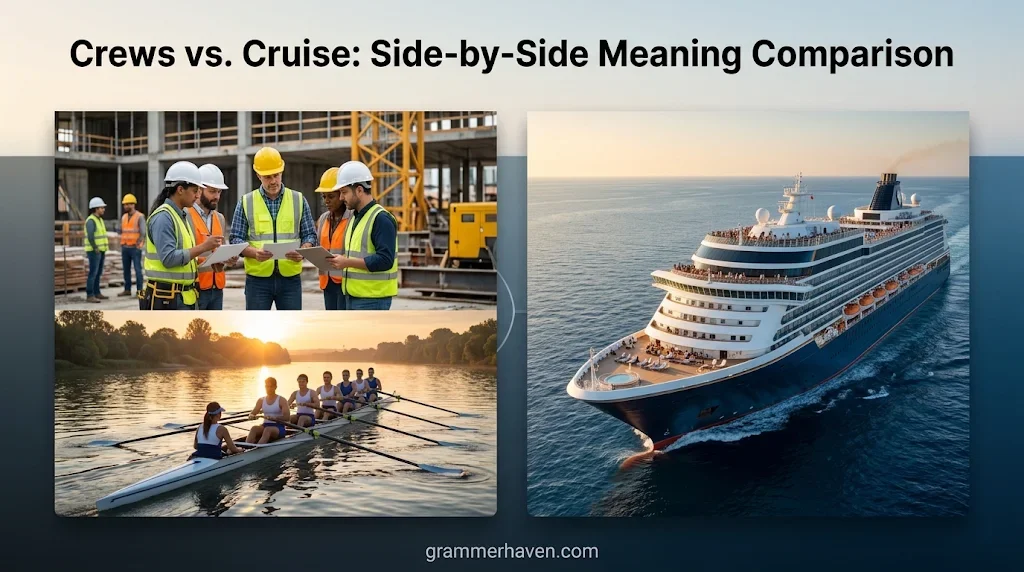
Let’s compare them directly.
| Aspect | Crews | Cruise |
| Refers To | People | Travel |
| Main Category | Workforce | Journey |
| Common Industry | Construction, aviation, film | Tourism, transportation |
| Singular Form | Crew | Cruise |
| Example | The crews repaired power lines. | The cruise visited three islands. |
A useful shortcut:
People = Crews
Travel = Cruise
This simple distinction solves most confusion.
Real-World Case Study: How One Letter Changes Meaning
Imagine an airline announcement.
Correct
“The flight crews completed all safety checks.”
Passengers understand that trained personnel prepared the aircraft.
Incorrect
“The flight cruise completed all safety checks.”
Now the sentence makes no sense.
The mistake changes the meaning completely.
Similarly:
Correct
“We booked a cruise for our anniversary.”
Incorrect
“We booked a crews for our anniversary.”
Again, the sentence becomes confusing.
This demonstrates why understanding homophones matters.
Common Mistakes Writers Make
Even experienced writers occasionally mix these words up.
Mistake #1: Using Crews for Travel
Incorrect:
- We enjoyed a crews around the Caribbean.
Correct:
- We enjoyed a cruise around the Caribbean.
Mistake #2: Using Cruise for Workers
Incorrect:
- The emergency cruise arrived quickly.
Correct:
- The emergency crews arrived quickly.
Mistake #3: Trusting Spell Check Too Much
Because both words are valid English terms, grammar software may not flag the mistake.
Always verify the meaning.
Easy Memory Tricks for Crews vs. Cruise
Memory devices can eliminate confusion permanently.
Trick #1: Crews Contains “Crew”
The word crew refers to workers.
Therefore:
- Crew = workers
- Crews = groups of workers
Trick #2: Cruise Contains “Cru”
Think of cruise ships.
The letters in cruise can remind you of:
- Cruise vacation
- Cruise ship
- Cruising the ocean
Trick #3: Ask One Question
Before writing:
Am I talking about people or travel?
If it’s people, choose crews.
If it’s to travel, choose a cruise.
Crews and Cruise in Professional Writing
Professional communication requires precision.
Small spelling errors can reduce credibility.
In Aviation
Correct:
- Flight crews completed inspections.
- The aircraft cruised at altitude.
Notice how both words may appear in the same industry while serving entirely different purposes.
In Maritime Writing
Correct:
- Ship crews prepared the vessel.
- The cruise departed at sunset.
Again, one refers to personnel.
The other refers to a journey.
In News Reporting
Journalists frequently use both words.
Examples:
- Rescue crews searched overnight.
- The cruise itinerary changed due to weather.
Context determines the correct choice.
Other Common Homophones Similar to Crews and Cruise

English contains many confusing word pairs.
Examples include:
| Word 1 | Word 2 |
| Their | There |
| Your | You’re |
| Principal | Principle |
| Affect | Effect |
| Stationary | Stationery |
| Brake | Break |
| Piece | Peace |
| Crews | Cruise |
Learning these distinctions improves writing accuracy significantly.
How Context Helps You Choose the Right Word
Context is your best tool.
Read the sentence carefully.
If the Sentence Involves:
- Workers
- Employees
- Teams
- Personnel
- Operators
Use crews.
If the Sentence Involves:
- Travel
- Vacation
- Sailing
- Journey
- Transportation
Use cruise.
Example Exercise
Sentence:
“The helicopter ______ arrived after the storm.”
Correct answer:
crews
Sentence:
“We booked a seven-day ______.”
Correct answer:
cruise
Context provides the answer immediately.
Quick Practice Quiz
Choose the correct word.
Question 1
The repair ______ restored electricity.
Answer: crews
Question 2
We booked a luxury ______.
Answer: cruise
Question 3
Several film ______ worked on the production.
Answer: crews
Question 4
The ship will ______ through the fjords.
Answer: cruise
Question 5
Emergency ______ responded rapidly.
Answer: crews
These examples reinforce the distinction through repetition and context.
See also: Based Out Of or Based In? Which Is Correct?
FAQs:
1. What is the difference between crews and cruise?
Crews is the plural of crew and refers to groups of people working together, such as on a ship, plane, or film set. Cruise refers to a journey for pleasure or the act of traveling or sailing.
2. Is “crews” a noun or a verb?
Crews is primarily a plural noun, although crew can also be used as a verb in some contexts. Most often, crews refers to multiple teams of workers.
3. Can “cruise” be both a noun and a verb?
Yes. As a noun, a cruise is a pleasure trip, usually by ship. As a verb, to cruise means to travel or move smoothly, often at a steady speed.
4. Why do people confuse crews and cruise?
People often confuse them because they are homophones—they sound very similar but have different spellings, meanings, and uses.
5. How can I remember the difference between crews and cruise?
A simple trick is to remember that crews always involves people working together, while cruise involves travel, sailing, or movement. Thinking about the sentence’s context will help you pick the correct word.
Conclusion:
Understanding the difference between crews and cruise becomes much easier once you remember what each word represents. Crews refers to groups of people working together, while cruise relates to traveling or sailing, either as a noun or a verb. Although these homophones sound alike, their meanings and uses are completely different. Paying attention to the context of a sentence and practicing with real examples will help you choose the correct word confidently in both writing and conversation.
Latest Post:
- Result In or Result To: Which Is Correct? (With Examples)
- A Dime a Dozen: Meaning, Definition, Origin and Real-Life Usage
- Hooplehead Definition, Meaning, Usage and Examples
- Whole vs Hole: What’s the Difference?
- Acumen vs Acuity vs Acuteness: What’s the Difference?