
Based Out Of or Based In? Which Is Correct? The Complete Grammar explains location phrases that confuse English speakers in professional writing. In English grammar, based in and based out of may seem like a tricky beast because native speakers and non-native speakers often face confusion about these expressions. These phrases describe the location of a company, person, or people, but their contextual meaning changes depending on the situation. Based in usually refers to a current location, fixed location, or main place where someone operates. A tech company based in New York has its primary location, headquarters, or workplace there, while based out of often suggests a place where someone started, operates from, or has a base while they work elsewhere in different areas.
When referring to a company, career, team, or operation, the correct usage depends on what you want to explain. Based in shows a stable business location or career location, whereas based out of points toward an origin point where operations are managed. A journalist, artist, or professional may be based out of Silicon Valley but work in several regions. These subtle differences matter in formal communication, informal communication, academic writing, and creative contexts. From my experience guiding executives and learners, understanding the meaning, wording, and terminology improves language precision, clarity, and fluency.
The complete grammar behind based in versus based out of focuses on origins, mobility, and location. These terms are not always interchangeable, and treating them as identical creates a common point of confusion. Knowing the right phrase strengthens professional writing, corporate communications, emails, legal documents, and everyday English usage. Learning how to untangle this knot, clear the air, and make the right choice helps you prepare for unexpected situations. The distinction keeps your English clear, precise, and accepted in traditional, modern, and professional settings.
Quick Answer: Is It “Based Out Of” or “Based In”?
If you’re looking for the short answer, here it is:
- Based in is the standard and most widely accepted phrase.
- Based out of is commonly used in North American English.
- Most editors and style guides prefer based in for formal writing.
- Based out of often carries the idea of operating from a location rather than simply being located there.
Quick Comparison
| Phrase | Meaning | Common Usage | Formal Writing |
| Based in | Located in a place | Very common | Preferred |
| Based out of | Operating from a place | Common in business and logistics | Less preferred |
| Located in | Physical location | Very common | Highly preferred |
| Operating from | Operational base | Common in business | Preferred in specific contexts |
Simple Rule
If you’re talking about where someone or something is located, use based in.
If you’re talking about where operations originate or are managed from, based out of may be appropriate.
What Does “Based In” Mean?
The phrase simply identifies the primary location of a person, company, organization, team, or activity.
It tells readers where something is situated.
For example:
- Our company is based in New York.
- She is based in Chicago.
- The startup is based in Austin.
- The charity is based in London.
In each example, the phrase answers one straightforward question:
Where is it located?
That’s why “based in” remains the preferred choice in business writing, journalism, academic work, and professional communication.
Why Writers Prefer “Based In”
Several factors contribute to its popularity:
- It is concise.
- It is easy to understand.
- It avoids ambiguity.
- It works internationally.
- It sounds natural in nearly every context.
Many editors view “based in” as the safest option because readers immediately understand what it means.
Examples of Proper Usage
| Sentence | Correct? |
| The company is based in Seattle. | Yes |
| She is based in Boston. | Yes |
| Our headquarters are based in Toronto. | Yes |
| The agency is based in Miami. | Yes |
In all these examples, the emphasis is location rather than movement or operations.
What Does “Based Out Of” Mean?
The phrase based out of often describes an operational center, hub, or point of origin.
Instead of focusing solely on location, it frequently emphasizes where activities begin, where personnel are assigned, or where services are dispatched.
Consider these examples:
- The airline operates flights based out of Dallas.
- The trucking company runs routes based out of Atlanta.
- The delivery fleet is based out of Chicago.
- The sales team works out of an office based out of Phoenix.
Notice something important.
Each sentence involves movement, operations, transportation, or management.
The phrase doesn’t merely identify location. It highlights the place from which activities originate.
How “Based Out Of” Entered Business Language

Many language experts believe “based out of” gained popularity through industries where operations revolve around central hubs.
These industries include:
- Aviation
- Military operations
- Transportation
- Shipping
- Logistics
- Emergency services
For example, pilots are often assigned to a specific airport.
A pilot might say:
“I’m based out of Denver.”
The meaning is not necessarily that the pilot lives in Denver.
Instead, Denver serves as the pilot’s operational base.
Over time, businesses adopted the phrase and expanded its use beyond transportation industries.
Today, you’ll hear software companies, consultants, agencies, and sales teams use it regularly.
Is “Based Out Of” Grammatically Correct?
This question sparks surprisingly heated debates among grammar enthusiasts.
The answer is more nuanced than a simple yes or no.
Why Some Experts Criticize It
Critics argue that “based out of” can sound illogical.
Their reasoning goes like this:
If something is based somewhere, then it cannot simultaneously be based out of that place.
They view the phrase as redundant because “based in” already communicates location effectively.
Some editors therefore replace “based out of” with:
- Based in
- Located in
- Headquartered in
- Operating from
Why Others Accept It
Language evolves through usage.
Millions of native English speakers use “based out of” every day. As a result, many dictionaries and language experts recognize it as an established idiom.
Supporters argue that the phrase communicates something slightly different.
Rather than identifying location alone, it often suggests:
- Operational control
- Dispatch activities
- Service coverage
- Regional management
In practical communication, most readers understand exactly what it means.
The Real Difference Between Based In and Based Out Of
This distinction often gets overlooked.
Both expressions involve location, yet they emphasize different ideas.
Based In = Physical Location
When you use “based in,” you’re identifying where a person or organization is located.
Examples:
- A law firm based in Boston
- A technology company based in Seattle
- A consultant based in Miami
- A nonprofit based in Washington, D.C.
The focus remains on geography.
Based Out Of = Operational Origin
When you use “based out of,” you’re emphasizing where operations begin or where resources are managed.
Examples:
- Cargo planes based out of Memphis
- Delivery trucks based out of Dallas
- Service technicians based out of Houston
- Emergency response teams based out of Atlanta
The focus shifts from location to operations.
Side-by-Side Comparison
| Situation | Better Choice |
| Company headquarters | Based in |
| Employee biography | Based in |
| Corporate website | Based in |
| Airline crew assignment | Based out of |
| Trucking operations | Based out of |
| Distribution center operations | Based out of |
When Should You Use “Based In”?
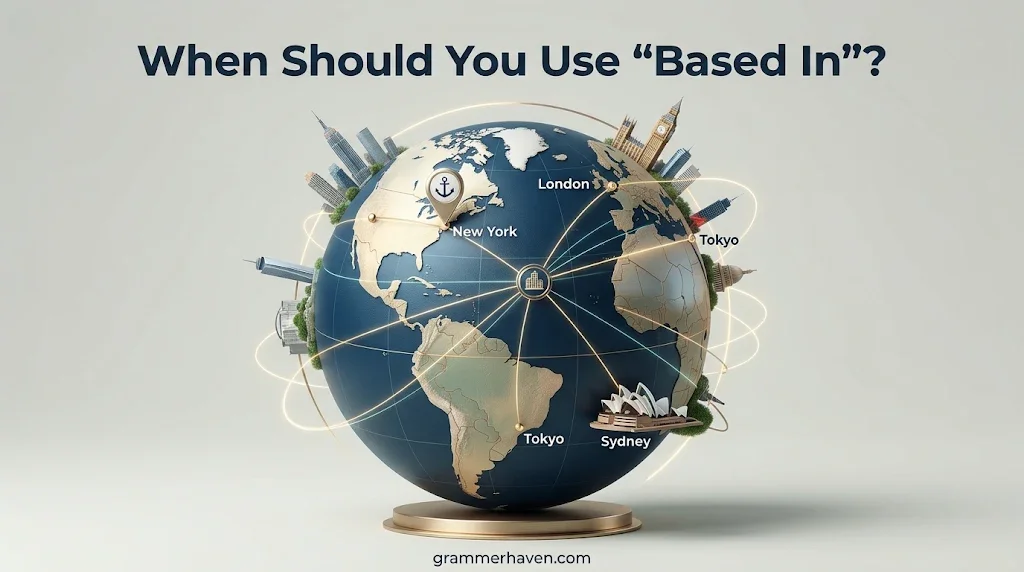
Most professional writers should choose based in.
It works in nearly every situation and rarely attracts criticism.
Ideal Uses for “Based In”
Company Descriptions
Examples:
- We are a software company based in Austin.
- Our agency is based in Los Angeles.
Professional Bios
Examples:
- Sarah is a marketing consultant based in Chicago.
- David is an architect based in New York.
Academic Writing
Researchers, universities, and publications almost always favor “based in.”
Journalism
News organizations typically use “based in” because it is clear and concise.
Why It Sounds More Professional
Many readers associate “based in” with polished communication.
It avoids unnecessary wording and immediately conveys location.
For that reason, businesses often use it in:
- Corporate websites
- Investor reports
- Press releases
- Annual reports
- Media kits
Example Sentences
- Our headquarters are based in San Francisco.
- The startup is based in Berlin.
- The research team is based in London.
- The agency is based in Toronto.
- The company was founded and remains based in Austin.
When Should You Use “Based Out Of”?
Although less common in formal writing, the phrase serves a purpose.
Industries That Frequently Use It
Certain sectors rely heavily on operational hubs.
These include:
- Airlines
- Logistics companies
- Freight carriers
- Military organizations
- Shipping firms
- Transportation providers
- Field service businesses
Situations Where It Makes Sense
Use it when discussing:
- Dispatch centers
- Operational bases
- Fleet management
- Regional service locations
- Transportation hubs
Examples
- Our trucks are based out of Dallas.
- The flight crew is based out of Atlanta.
- Service technicians are based out of Phoenix.
- Emergency response units are based out of Denver.
- The regional fleet operates out of a facility based out of Houston.
In these contexts, the phrase communicates operational activity rather than simple geography.
Common Mistakes People Make
Many writers misuse these expressions because they assume they’re identical.
Let’s look at the most common errors.
Using “Based Out Of” for Simple Location
Example:
❌ Our company is based out of Paris.
Better:
✅ Our company is based in Paris.
Why?
Because the sentence merely identifies location.
No operational meaning exists.
Assuming Both Expressions Always Mean the Same Thing
They overlap considerably.
However, subtle differences often exist.
A company can be:
- Based in New York
- Operating globally
Meanwhile, a transportation fleet may be:
- Based out of New York
- Serving multiple states
The distinction matters when discussing operations.
Overusing Business Jargon
Many businesses choose “based out of” simply because it sounds corporate.
Unfortunately, that can reduce clarity.
Compare these examples:
Less Clear
“Our team is based out of Seattle.”
Clearer
“Our team is based in Seattle.”
In many cases, simpler language wins.
American English vs British English Usage
Regional preferences play a major role.
American English
In the United States, both expressions appear regularly.
You’ll find “based out of” especially common in:
- Logistics
- Aviation
- Transportation
- Corporate speech
Many Americans don’t perceive it as unusual.
British English
British English strongly favors based in.
Writers in the UK often consider “based out of” awkward or unnecessary.
As a result, you’ll see “based in” throughout:
- Newspapers
- Government publications
- Academic writing
- Corporate communications
Global Business Communication
When writing for an international audience, “based in” is usually the safer choice.
It avoids regional misunderstandings and aligns with global business standards.
Regional Comparison Table
| Region | Preferred Usage |
| United States | Based in / Based out of |
| Canada | Mostly based in |
| United Kingdom | Based in |
| Australia | Based in |
| International Business | Based in |
Real-World Business Communication Examples

Let’s examine how organizations use these expressions.
Company Profiles
Most businesses introduce themselves using “based in.”
Examples:
- A fintech company based in New York.
- A law firm based in Chicago.
- A consulting agency based in London.
The focus remains location.
Logistics Companies
Transportation businesses frequently choose “based out of.”
Example:
“Our fleet is based out of Memphis and serves customers across the Southeast.”
Here, Memphis functions as an operational hub.
Employee Biographies
Professional bios almost always use “based in.”
Example:
“Jennifer is a financial advisor based in Dallas.”
The sentence identifies where Jennifer works.
Nothing more.
Case Study: A Technology Startup
Imagine a software company headquartered in Austin.
Version One
“Our company is based out of Austin.”
Version Two
“Our company is based in Austin.”
Which sounds better?
Most editors would select Version Two.
Why?
Because the company’s physical location matters more than operational dispatch.
The second version is cleaner, simpler, and more precise.
Case Study: A Trucking Company
Now consider a freight carrier.
Version One
“Our trucks are based in Dallas.”
Version Two
“Our trucks are based out of Dallas.”
In this situation, Version Two may actually be stronger.
It suggests the trucks operate from Dallas and travel elsewhere.
That operational meaning adds value.
Alternative Phrases You Can Use
Sometimes neither expression is ideal.
Fortunately, English offers several alternatives.
Alternatives to “Based In”
- Located in
- Situated in
- Headquartered in
- Established in
- Operating in
Examples:
- The company is headquartered in Chicago.
- The agency is located in Miami.
- The startup is situated in Austin.
Alternatives to “Based Out Of”
- Operating from
- Working from
- Managed from
- Run from
- Dispatched from
Examples:
- Flights are dispatched from Dallas.
- Services are managed from Atlanta.
- Deliveries operate from Phoenix.
These alternatives often provide greater precision.
Which Phrase Sounds More Professional?
For most professional writing, based in wins.
Why?
Because it is:
- Universally accepted
- Easier to understand
- Less controversial
- Preferred by editors
- Suitable for international audiences
Professional communication values clarity.
“Based in” delivers that clarity consistently.
See also: Understanding the Nuances: “Work Alongside You” vs. “Work Alongside With You”
FAQs:
1. Is “based out of” grammatically correct?
Yes, based out of is widely used and accepted, especially in modern business and professional communication. However, based in is often preferred when you simply want to mention a fixed location.
2. What is the difference between “based in” and “based out of”?
Based in refers to a primary or permanent location where someone lives or works. Based out of usually refers to a place that serves as a starting point or operational center while activities may happen elsewhere.
3. Should I use “based in” for companies?
Yes, based in is commonly used for companies when describing their official location or headquarters. For example, “The company is based in New York” means New York is its main location.
4. Can a person be “based out of” a city?
Yes, a person can be based out of a city when that city acts as their work base or starting point. For example, “She is based out of Silicon Valley but works with clients worldwide.”
5. Which phrase is better for formal writing: “based in” or “based out of”?
For formal writing, based in is usually clearer and more traditional when describing a location. Based out of works well in business conversations and modern professional contexts but may sound less formal in some academic settings.
Conclusion:
Understanding the difference between based in and based out of helps you communicate with greater accuracy and confidence. While based in usually describes a stable location, headquarters, or main place where a person or company operates, based out of often highlights an origin point or a place from which someone manages activities while working in other areas. These phrases may seem similar, but their subtle differences improve your English grammar, professional writing, and everyday communication. By recognizing the correct context, you can avoid confusion and choose the right expression for emails, business documents, academic writing, and conversations.
Latest Post:
- Result In or Result To: Which Is Correct? (With Examples)
- A Dime a Dozen: Meaning, Definition, Origin and Real-Life Usage
- Hooplehead Definition, Meaning, Usage and Examples
- Whole vs Hole: What’s the Difference?
- Acumen vs Acuity vs Acuteness: What’s the Difference?