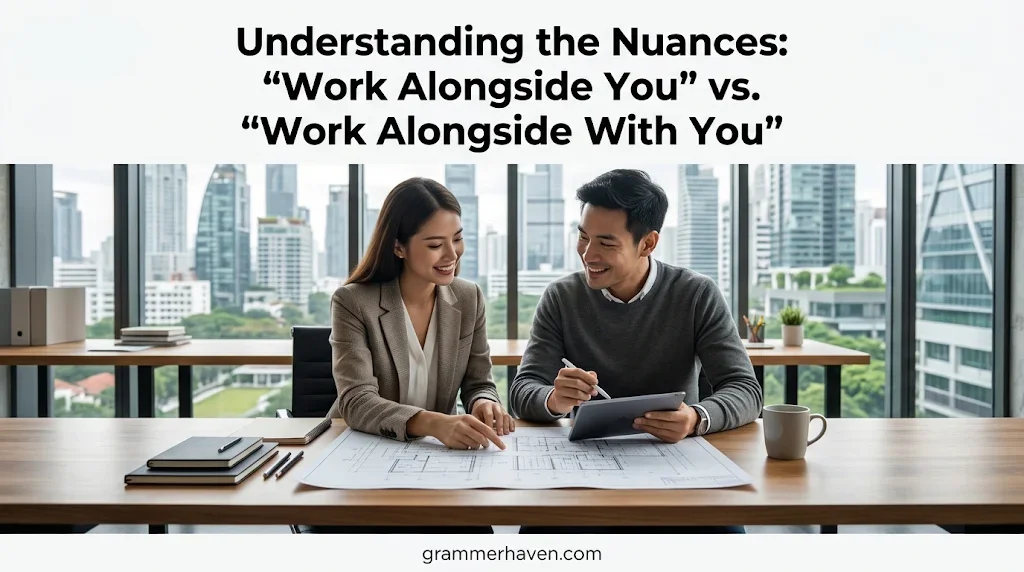
Understanding the Nuances: “Work Alongside You” vs. “Work Alongside With You” explains the correct phrase for clear English writing.
Many learners believe work alongside you and work alongside with you are interchangeable, but English, English grammar, grammar, and standard English treat them differently. The standard phrase is work alongside you because alongside already means being together with someone. Adding with creates redundancy through a double preposition, making the sentence feel awkward and grammatically incorrect. Proper syntax, grammatical structure, grammatical correctness, and correctness support correct usage, while the longer form shows incorrect usage. This phrase comparison helps you understand the contextual meaning, semantic distinction, and subtle distinction that appear when you peel back the layers of the language. A simple reminder like “I will work alongside you” keeps your expression clear in almost every context.
The kicker is that knowing this key unlocks a refined way of expressing ideas. It conveys a strong sense of professionalism in both formal English and informal English, matching natural English used by native speakers. Although idioms, phrases, nuances, and other tricky parts of the language can seem like a beast, leaving people scratching their heads, the battleground becomes easier once the rule is tamed. Think of the two forms as 2 sides of the same coin. One is grammatically correct, widely accepted, and perfectly structured, while the other adds an extra preposition you should avoid. This comparison shows the impact of proper usage across different contexts, bringing new light to your learning journey and helping you make the right decision next time using alongside with or simply alongside.
What Does “Work Alongside You” Mean?
The phrase “work alongside you” means to work together with someone toward a common goal.
It often suggests cooperation, partnership, and mutual involvement. In some situations, it can even imply physical proximity, although modern usage focuses more on collaboration than location.
For example:
- I look forward to working alongside you on this project.
- Our team worked alongside local volunteers during the event.
- She worked alongside experienced engineers to develop the new system.
In each example, the people involved contribute to the same effort. Nobody works in isolation. Instead, they share responsibilities and move toward a common objective.
The Meaning of “Alongside”
The word “alongside” originally referred to something positioned next to another object.
For instance:
- The boat sailed alongside the dock.
- The bicycle stood alongside the fence.
Over time, the word developed a figurative meaning. Today, it frequently describes cooperation between people.
When someone says they worked alongside a colleague, they usually mean:
- They collaborated closely.
- They contributed to the same project.
- They shared responsibilities.
- They supported each other’s efforts.
This evolution explains why the phrase appears so often in modern workplaces.
Is “Work Alongside With You” Grammatically Correct?
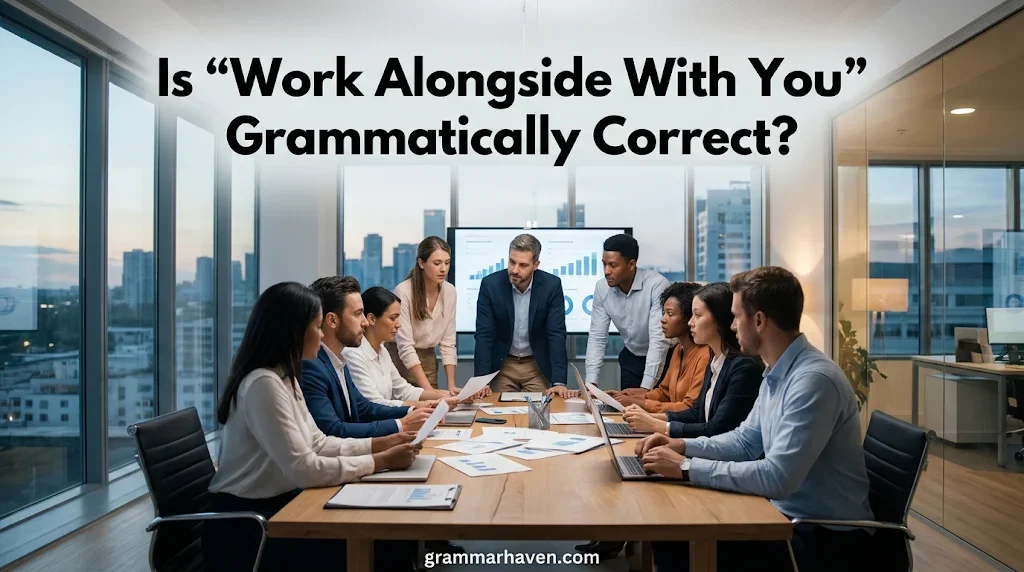
The short answer is no, not in standard English.
Most grammar experts, editors, and native speakers consider “work alongside with you” redundant.
The problem comes from the word “with.”
The term “alongside” already expresses the idea of being next to or working together with someone. Adding another preposition creates unnecessary repetition.
Consider this structure:
| Word | Function |
| Work | Verb |
| Alongside | Preposition |
| You | Object |
The phrase is already complete.
Now look at this version:
| Word | Function |
| Work | Verb |
| Alongside | Preposition |
| With | Additional Preposition |
| You | Object |
The second preposition doesn’t add meaning. Instead, it creates grammatical clutter.
Think of it this way.
Saying “work alongside with you” is similar to saying:
- Return back
- Advance forward
- Repeat again
- End result
While these expressions appear in everyday speech, many style guides consider them redundant because part of the meaning already exists within the original word.
Why “With” Sounds Unnecessary After “Alongside”
English relies heavily on prepositions.
Words such as:
- With
- Beside
- Alongside
- Near
- Behind
- Under
help establish relationships between people, places, and things.
The challenge is that some prepositions already contain meanings that overlap with others.
The word “alongside” inherently suggests companionship, proximity, or cooperation.
As a result, adding “with” becomes unnecessary.
Example
Correct:
I would love to work alongside you.
Less natural:
I would love to work alongside with you.
The first sentence sounds polished and professional.
The second sounds slightly awkward because the extra preposition doesn’t contribute anything meaningful.
Are There Any Exceptions?
Language rarely operates under absolute rules.
You may occasionally encounter “alongside with” in:
- Informal speech
- Regional dialects
- Non-native English writing
- Older documents
However, its existence does not make it standard.
Many expressions appear in conversation even though grammar experts discourage them.
For example:
- Irregardless
- Could care less
- Anyways
People use these phrases regularly. Yet most professional writers avoid them.
The same principle applies here.
If you’re writing for business, academics, publishing, or professional communication, “work alongside you” remains the preferred choice.
Work Alongside You vs. Work With You
Many people assume these phrases are interchangeable.
In reality, there is a subtle difference.
Similarities
Both expressions communicate:
- Cooperation
- Partnership
- Shared goals
- Collaboration
In many situations, either phrase works perfectly.
Key Differences
| Phrase | Meaning | Tone |
| Work with you | General collaboration | Neutral |
| Work alongside you | Closer partnership and involvement | More engaged |
| Collaborate with you | Formal cooperation | Professional |
| Partner with you | Strategic relationship | Business-oriented |
Understanding the Nuance
Imagine two employees working on the same company initiative.
Employee A says:
I worked with the marketing team.
Employee B says:
I worked alongside the marketing team.
The second sentence creates a stronger impression.
It suggests active participation rather than occasional interaction.
That’s why recruiters and hiring managers often respond positively to the phrase “worked alongside.”
It signals hands-on involvement.
Why So Many People Say “Work Alongside With You”
Despite being redundant, the phrase appears frequently online.
There are several reasons.
Influence of Similar Expressions
English includes many legitimate phrases that use “with.”
Examples include:
- Work with you
- Collaborate with you
- Communicate with you
- Coordinate with you
Because these patterns are so common, people naturally assume “alongside” requires the same structure.
Translation From Other Languages
Many languages use multiple prepositions together.
When speakers translate directly into English, they sometimes produce phrases like:
- Alongside with
- Discuss about
- Return back
- Enter into
The intended meaning remains clear. However, the grammar becomes less natural.
Desire to Sound Formal
Interestingly, people often add extra words when they want to sound professional.
Unfortunately, longer doesn’t always mean better.
Professional writing values clarity.
The cleanest version usually wins.
Real Examples From Professional Communication

Let’s examine how professionals actually use these phrases.
Cover Letters
Strong example:
I am excited about the opportunity to work alongside your talented team.
Weak example:
I am excited about the opportunity to work alongside with your talented team.
The first version sounds polished and confident.
The second feels slightly unnatural.
Job Interviews
Candidates frequently discuss teamwork.
Natural responses include:
- I worked alongside senior developers during the migration project.
- I worked alongside department leaders to improve operational efficiency.
- I collaborated closely with cross-functional teams.
These statements sound professional because they emphasize contribution and partnership.
LinkedIn Profiles
Many successful LinkedIn profiles use phrases like:
- Worked alongside executives to implement strategic initiatives.
- Worked alongside product managers to launch new features.
- Worked alongside industry experts on large-scale projects.
Notice the absence of “with.”
Business Emails
Professional email example:
I look forward to working alongside you throughout the implementation process.
The sentence sounds warm, collaborative, and professional.
Common Alternatives to “Work Alongside You”
Sometimes another phrase fits the context even better.
Here are some strong alternatives.
Work With You
This is the safest and most versatile option.
Example:
I look forward to working with you.
Collaborate With You
Ideal for professional and creative environments.
Example:
Our team would be pleased to collaborate with you.
Partner With You
Useful when discussing strategic relationships.
Example:
We hope to partner with you on future initiatives.
Work Closely With You
Highlights frequent interaction.
Example:
The consultant will work closely with you throughout the project.
Coordinate With You
Useful when managing schedules, logistics, or operations.
Example:
We will coordinate with you regarding project timelines.
Comparison Table of Common Alternatives
| Phrase | Formality | Best Use Case |
| Work with you | Medium | General communication |
| Work alongside you | Medium-High | Teamwork and partnership |
| Collaborate with you | High | Professional projects |
| Partner with you | High | Strategic relationships |
| Coordinate with you | High | Operations and planning |
| Work closely with you | Medium-High | Ongoing interaction |
Common Grammar Mistakes Related to “Alongside”
Many writers misuse “alongside” in similar ways.
Understanding these mistakes can improve your overall writing.
Adding Unnecessary Prepositions
Incorrect:
- Alongside with you
- Beside with me
- Near to beside the building
Correct:
- Alongside you
- Beside me
- Near the building
Overcomplicating Sentences
Weak:
I would like to work alongside you in collaboration.
Strong:
I would like to work alongside you.
The stronger version delivers the same message with fewer words.
Confusing Similar Expressions
Several phrases look alike but function differently.
| Phrase | Meaning |
| Alongside | Next to or working together |
| Along with | In addition to |
| Together with | Accompanied by |
| Side by side with | Closely cooperating |
Examples:
- She worked alongside engineers.
- She submitted the report along with supporting documents.
- He attended the meeting together with his manager.
- The organizations worked side by side with local communities.
When Should You Use “Work Alongside You”?
The phrase shines in collaborative environments.
Workplace Teams
Modern organizations rely on teamwork.
The phrase communicates active participation.
Example:
Our specialists will work alongside your staff during implementation.
Project Management
Projects often involve multiple stakeholders.
Example:
The consultants worked alongside internal teams to improve performance.
Client Relationships
Service providers frequently use this wording because it emphasizes partnership rather than hierarchy.
Example:
We work alongside our clients to achieve measurable results.
Volunteer Organizations
Nonprofits often highlight cooperation.
Example:
Volunteers worked alongside local residents after the disaster.
Leadership and Mentorship
The phrase can also communicate supportive leadership.
Example:
Great leaders work alongside their teams instead of directing from a distance.
Case Study: How One Word Changes Perception
Consider two versions of a resume bullet point.
Version A
Worked with engineers to improve product quality.
Version B
Worked alongside engineers to improve product quality.
Both statements are correct.
However, Version B subtly suggests:
- Greater involvement
- Closer teamwork
- Shared responsibility
- Active contribution
Recruiters often notice these nuances.
While the difference is small, wording influences perception.
That’s one reason strong writers pay attention to language choices.
What Professional Editors Recommend
Editors generally favor writing that is:
- Clear
- Direct
- Concise
- Natural
Adding unnecessary words rarely improves a sentence.
A common editorial principle states:
“Every word should earn its place.”
The word “with” fails that test after “alongside.”
Removing it improves readability without changing meaning.
Preferred Style
Instead of:
I look forward to working alongside you.
Use:
I look forward to working alongside you.
Or:
I look forward to working with you.
Both alternatives sound cleaner.
Work Alongside You in Modern Business Communication
Today’s workplace values collaboration more than ever.
Organizations frequently emphasize:
- Cross-functional teamwork
- Shared ownership
- Strategic partnerships
- Employee engagement
As a result, phrases like “work alongside you” appear increasingly often in:
- Job descriptions
- Corporate websites
- Annual reports
- Professional networking platforms
- Business proposals
The phrase signals cooperation rather than authority.
It suggests people are working together rather than simply taking instructions.
That subtle distinction makes it particularly effective in modern professional communication.
See also: Switch vs. Swap: What’s the Difference? (With Real Examples)
FAQs:
1. Is “work alongside you” grammatically correct?
Yes. “Work alongside you” is the grammatically correct and standard expression in English because alongside already means “next to” or “together with.”
2. Is “work alongside with you” incorrect?
Yes. “Work alongside with you” is generally considered grammatically incorrect because it uses a redundant double preposition. Most grammar guides recommend removing with.
3. Why is “with” unnecessary after “alongside”?
The word alongside already expresses the idea of being with someone. Adding another preposition repeats the same meaning without improving the sentence.
4. Can native English speakers still understand “work alongside with you”?
Yes. Most native English speakers will understand what you mean. However, the phrase sounds less natural and is best avoided in professional or formal writing.
5. Which phrase should I use in professional communication?
Use “work alongside you.” It is the preferred choice for emails, workplace communication, business writing, and everyday conversations because it is clear, natural, and grammatically correct.
Conclusion:
Choosing between “work alongside you” and “work alongside with you” is simpler than it may seem. “Work alongside you” is the grammatically correct and widely accepted expression because alongside already includes the idea of being with someone. Adding with creates unnecessary redundancy and makes the sentence sound less natural. By using the correct phrase, you’ll communicate more clearly, write more professionally, and sound more confident in both formal and everyday English.
Latest Post:
- Result In or Result To: Which Is Correct? (With Examples)
- A Dime a Dozen: Meaning, Definition, Origin and Real-Life Usage
- Hooplehead Definition, Meaning, Usage and Examples
- Whole vs Hole: What’s the Difference?
- Acumen vs Acuity vs Acuteness: What’s the Difference?