Switch vs. Swap: What’s the Difference? explains two similar words with simple examples so you can choose the right one every time.
Many learners confuse Switch and Swap because both describe change, but they do not always have the same meaning. This Difference becomes clear when you understand their semantics, grammar, vocabulary, and usage in everyday English. While these verbs are sometimes interchangeable, their linguistic difference depends on the context. As you read this article, you will uncover the subtle distinctions, explore their history, and see a simple comparison that helps build confidence, improve English skills, and use each word correctly in daily conversation and communication.
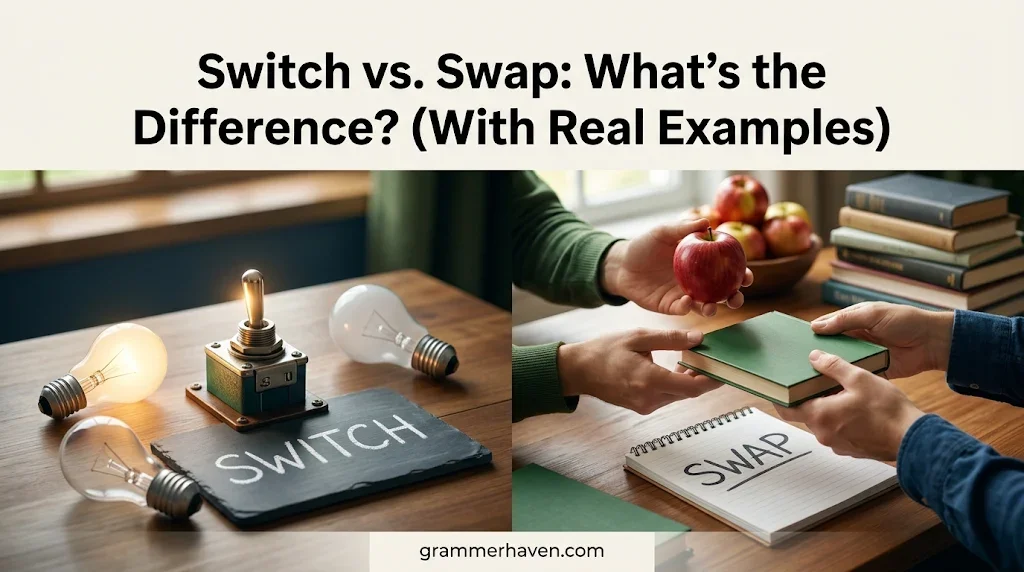
A Switch normally means to replace one thing with another without a mutual exchange. For example, you might switch an Android phone to an iPhone, switch off the TV, change it to silent mode, or switch to a new setting because of a different habit or preference. This action is usually one-directional and may involve a new state, transition, movement, or direction. It can also describe replacement, substitution, convert, convertibility, an alternate or alternative option, and applies to a device, technology, mobile, smartphone, lights, pen, or pencil, where one object simply changes from one state to another.
A Swap always involves a mutual trade, barter, exchange, or transaction in which both sides give, get, return, or transfer items. My sister and I often swap books after reading, while a friend may ask to swap seats for a better position, location, or view of the screen. This interaction creates a shared relationship because each person exchanges an item with someone else. Even though Switch and Swap can be exchangeable in some situations, especially when shifting places, the exact concept, usage, and practice depend on whether you are replacing something or making a physical exchange involving things, place, using, changing, exchanging, takes, gives, and share.
Switch vs. Swap: The Quick Answer
The easiest way to remember the difference is this:
Switch means to change from one thing to another.
Swap means to exchange one thing for another.
A switch doesn’t always require an exchange. A swap almost always does.
For example:
- I switched from Android to iPhone.
- She switched careers last year.
- We swapped books after finishing them.
- The players swapped jerseys after the game.
In the first two examples, nothing was exchanged. A person simply changed from one option to another.
In the last two examples, two items traded places. That’s a swap.
Quick Comparison Table
| Feature | Switch | Swap |
| Primary Meaning | Change | Exchange |
| Requires Two Items? | Not always | Usually |
| Involves Trading? | No | Yes |
| Common in Technology | Very common | Common |
| Common in Daily Speech | Very common | Very common |
| Focus | Movement to a new option | Trading between options |
What Does “Switch” Mean?
The verb switch refers to changing from one thing, method, option, position, or state to another.
The key idea is movement away from one choice and toward another.
You don’t need another person involved. You don’t even need a direct exchange.
The Core Meaning of Switch
When you switch something, you replace one choice with a different choice.
Think of it as:
Option A → Option B
The focus remains on the change itself.
Switching Choices
People switch choices every day.
Examples include:
- Switching banks
- Switching mobile providers
- Switching insurance companies
- Switching workout routines
Examples in sentences:
- I switched banks because the fees were lower elsewhere.
- They switched internet providers last month.
- She switched her major during college.
Notice that no exchange happens here. One option simply replaces another.
Switching Careers
One of the most common uses of switch involves jobs and careers.
Examples:
- He switched careers at age forty.
- Thousands of professionals switch industries every year.
- Many workers switched to remote positions after gaining new skills.
Using swap careers in these examples would sound unnatural because careers aren’t exchanged between people.
Switching Positions
Sometimes switch refers to changing physical positions.
Examples:
- The children switched seats.
- The dancers switched places.
- The twins switched positions for a photo.
This usage creates some overlap with swap, which we’ll discuss later.
Switching Methods
A switch can also involve changing a process or system.
Examples:
- The company switched to cloud storage.
- The school switched to online learning.
- The team switched strategies during halftime.
Again, the emphasis remains on adopting something different.
Switch in Technology
Technology relies heavily on the word switch.
You probably encounter it every day without noticing.
Common examples include:
- Switch accounts
- Switch browsers
- Switch networks
- Switch devices
- Switch users
- Switch modes
Examples:
- Switch your phone to airplane mode.
- Switch accounts to access your work profile.
- Switch browsers if the website isn’t loading correctly.
In technical contexts, switch almost always refers to changing from one state or option to another.
Common Grammar Patterns With Switch
English speakers use switch in several predictable patterns.
Switch To
Examples:
- Switch to a healthier diet.
- Switch to a different plan.
- Switch to electric vehicles.
Switch From A to B
Examples:
- I switched from coffee to tea.
- The company switched from paper records to digital records.
- She switched from marketing to finance.
Switch Between
Examples:
- He switches between English and Spanish.
- The software lets users switch between accounts.
Switch Over To
Examples:
- Many families switched over to streaming services.
- Businesses switched over to digital payments.
What Does “Swap” Mean?
Unlike switch, swap focuses on exchange.
When you swap something, one thing trades places with another.
Think of it as:
A ↔ B
Both sides participate in the exchange.
The Core Meaning of Swap
Swap means giving something and receiving something else in return.
The exchange can be physical, digital, or even abstract.
Swapping Physical Objects
This is the most common use of swap.
Examples:
- Swap books
- Swap cards
- Swap clothes
- Swap toys
Sentences:
- We swapped books after finishing them.
- The children swapped toys for an afternoon.
- They swapped baseball cards at school.
Each person gives something and receives something.
Swapping Positions
Swap can also describe exchanging places.
Examples:
- Let’s swap seats.
- The employees swapped desks.
- The players swapped positions.
Because both people change places, swap feels natural here.
Swapping Information
People don’t only swap objects.
They also exchange knowledge.
Examples:
- Swap ideas
- Swap stories
- Swap advice
- Swap experiences
Sentences:
- Entrepreneurs often swap business tips.
- Travelers love swapping stories.
- The two teams swapped insights after the project.
Swap in Technology
Technology uses swap in several interesting ways.
Examples include:
- Swap files
- Swap components
- Swap batteries
- Swap memory modules
Examples:
- Swap the battery if performance declines.
- You can swap hard drives between systems.
- Technicians swapped defective components.
Here, one item physically replaces another.
Common Grammar Patterns With Swap

Swap A for B
Examples:
- I swapped my old car for a newer model.
- She swapped her ticket for a better seat.
Swap With
Examples:
- Let’s swap with them.
- I swapped books with my friend.
Swap Out
This phrase appears frequently in American English.
Examples:
- Swap out the battery.
- Swap out the old furniture.
- The coach swapped out several players.
Swap Over
Examples:
- Some users swapped over to another platform.
- Businesses swapped over to newer software.
Although this phrase exists, “switch over” remains much more common.
The Key Difference Between Switch and Swap
The distinction becomes easier when you focus on one question:
Is something simply changing, or is something being exchanged?
If something changes, switch often works.
If two things trade places, swap usually works.
Switch Focuses on Change
Examples:
- Switch careers
- Switch schools
- Switch providers
- Switch diets
- Switch strategies
In these cases, no exchange occurs.
You’re simply moving from one option to another.
Swap Focuses on Exchange
Examples:
- Swap tickets
- Swap books
- Swap phones
- Swap jerseys
- Swap recipes
Here, something gets traded for something else.
That’s why swap feels more precise.
Visual Breakdown
Switch:
Old Option → New Option
Swap:
Item A ↔ Item B
This simple visual explains the difference better than most grammar rules.
See also: I Ordered vs. I Have Ordered: What’s the Difference & Using Each Correctly
FAQs:
1. What is the main difference between switch and swap?
A switch means replacing or changing one thing with another, while a swap means exchanging items, places, or positions between two people or parties.
2. Can switch and swap be used interchangeably?
Yes, sometimes. They are often interchangeable when talking about exchanging seats or places, but swap usually emphasizes a mutual exchange.
3. Is “switch phones” correct?
Yes. Saying “I switched phones” means you replaced one phone with another. If two people exchange phones, “swapped phones” is usually more accurate.
4. When should I use swap instead of switch?
Use swap when both sides give and receive something, such as swapping books, seats, or trading items with another person.
5. Why do English learners confuse switch and swap?
Learners often confuse them because both words involve change. The key difference is that switch focuses on replacement or transition, while swap focuses on a mutual exchange.
Conclusion:
Understanding Switch vs. Swap: What’s the Difference? helps you choose the right word in different situations. A switch usually means replacing one thing with another or moving from one state to another, while a swap describes a mutual exchange between two people or parties. Although the two words can sometimes be interchangeable, knowing the difference makes your English sound more natural and accurate. With regular practice and attention to context, you’ll use both terms with greater confidence in speaking and writing.
Latest Post:
- Is It Correct to Say “A Big Congratulations”? The Complete Grammar Guide
- Two Crows Being an Attempted Murder: Meaning, Origins & Real Behavior
- Farther vs. Further: What’s the Difference?
- Result In or Result To: Which Is Correct? (With Examples)
- A Dime a Dozen: Meaning, Definition, Origin and Real-Life Usage