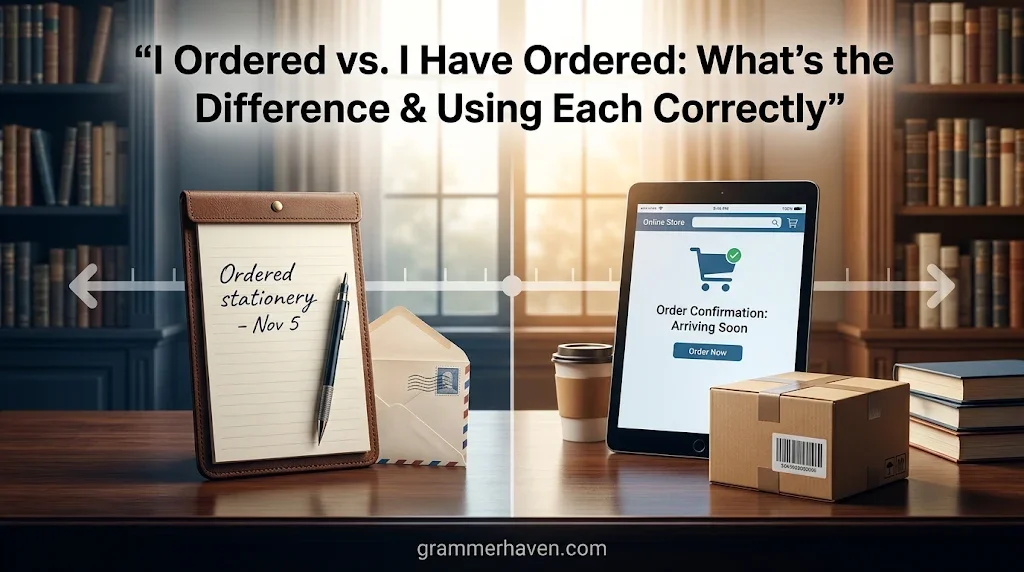
I Ordered vs. I Have Ordered: Understanding the Difference helps you decide which form to use in every exact scenario with confidence.
When you choose between I ordered and I have ordered, focus on the grammar instead of guessing. I ordered uses the simple past or simple past tense for a completed action, completed actions, or an action completed at a specific time in the past. The time reference, time frame, specific moment, temporal reference, or date may be hour ago, last night, Tuesday, yesterday, or 8:00 PM. An example could be ordering a book, dinner, or replacement parts. The action already happened, the past event is completely finished, the event is finished, and the listener can follow the timeline. From my experience, this verb form usually fits best when talking, mentioning, or answering a question about when you did something.
I have ordered uses the present perfect or present perfect tense because it connects a past action to the present. That connection and direct connection implies a current result, present result, current situation, current status, status, order status, ongoing present results, ongoing relevance, present relevance, relevance, and relevance to present. The order has been placed, is active, and you may be waiting or waiting for results. For example, you might say you have ordered equipment, pizzas for lunch, or reply, “yes, I have ordered them.” If someone asks about tickets you bought or a recent accomplishment, the correct tense keeps the focus on the current result instead of the earlier time.
The distinction, difference, comparison, meaning, and explanation become much clearer when you study the context, usage, usage note, usage context, language usage, sentence, sentence pattern, tense, and tense selection rather than memorizing rules. Ask yourself what matters more: when the order happened or what is true right now. That simple choice can tell you whether anything is still linked to the present and improve everyday communication in English grammar.
The Short Answer: I Ordered vs. I Have Ordered
Both phrases are grammatically correct.
However, they belong to different verb tenses.
| Phrase | Tense | Main Focus |
| I ordered | Simple Past | A completed action in the past |
| I have ordered | Present Perfect | A past action connected to the present |
I Ordered
“I ordered” uses the simple past tense.
Example:
I ordered a new phone yesterday.
The sentence tells us exactly when the action happened.
The focus is on the event itself.
I Have Ordered
“I have ordered” uses the present perfect tense.
Example:
I have ordered a new phone.
The exact time isn’t important.
The focus is on the fact that the order has already been placed and that this action matters now.
The Core Difference
A simple way to remember it is:
“I ordered” focuses on when the action happened.
“I have ordered” focuses on the result of the action.
That single distinction explains most situations where these phrases differ.
Understanding the Grammar Behind Each Phrase
Before comparing the phrases in detail, it helps to understand the grammar structure behind them.
What Is the Simple Past Tense?
The simple past tense describes an action that started and finished in the past.
Structure
Subject + Past Tense Verb
Example:
I ordered
She visited
They bought
The action is complete.
The speaker views it as a finished event.
Examples of the Simple Past
- I ordered coffee this morning.
- I ordered a replacement charger yesterday.
- I ordered dinner before the movie.
- I ordered the package last week.
Notice something important.
Each sentence either mentions a specific time or implies a completed period.
That’s one of the strongest signals that the simple past is appropriate.
What Is the Present Perfect Tense?
The present perfect links a past action to the present moment.
Structure
Subject + Have/Has + Past Participle
Examples:
I have ordered
She has visited
They have bought
Unlike the simple past, the present perfect doesn’t focus on when something happened.
Instead, it focuses on the fact that it happened and still matters now.
Examples of the Present Perfect
- I have ordered the tickets.
- I have ordered your replacement device.
- I have ordered everything we need.
- I have ordered the supplies already.
The exact time remains unknown or unimportant.
What matters is the current result.
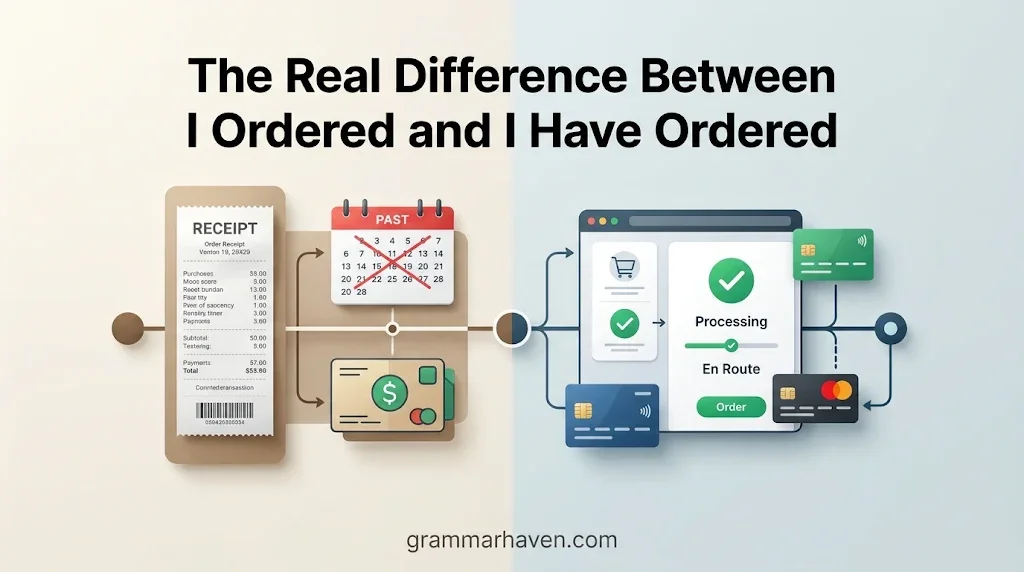
The Real Difference Between I Ordered and I Have Ordered
Many grammar guides stop after defining the tenses.
That explanation helps, but it doesn’t tell you how native speakers actually think.
The real difference comes down to perspective.
I Ordered = Looking Back
When you say:
I ordered a laptop yesterday.
You are looking backward in time.
You’re describing a completed event.
The order happened.
The story moves on.
I Have Ordered = Looking Forward From the Present
When you say:
I have ordered a laptop.
You’re standing in the present.
The action happened before now, but the result still matters.
Maybe you’re waiting for delivery.
Maybe you’re informing someone that the task is complete.
The focus isn’t the event.
The focus is the current situation.
A Side-by-Side Comparison
Example 1
I ordered a laptop yesterday.
Focus:
- The purchase happened yesterday.
I have ordered a laptop.
Focus:
- The laptop has already been purchased.
Example 2
I ordered the office supplies last week.
Focus:
- The timing of the order.
I have ordered the office supplies.
Focus:
- The supplies are already taken care of.
Example 3
I ordered dinner at 6 PM.
Focus:
- The time of the action.
I have ordered dinner.
Focus:
- Dinner arrangements are complete.
Quick Visual Diagram
SIMPLE PAST
Past ——————– Present
I ordered it.
PRESENT PERFECT
Past ——————– Present
I have ordered it.
|
|
Result matters now
This diagram captures the essential difference.
The present perfect creates a bridge between the past and the present.
The simple past does not.
When to Use “I Ordered”
Certain situations almost always require the simple past tense.
When You Mention a Specific Time
Specific time expressions and present perfect generally don’t mix.
Correct examples:
- I ordered it yesterday.
- I ordered it last week.
- I ordered it two hours ago.
- I ordered it on Monday.
These time references point to completed moments in the past.
Examples
I ordered the tickets yesterday.
I ordered the book last month.
All of these sound natural because they focus on a definite point in time.
When Telling a Story
Stories often use the simple past.
Example:
First, I ordered dinner. Then I called a friend. After that, I watched a movie.
The events unfold in sequence.
The simple past is perfect for this purpose.
When Discussing Finished Events
Sometimes timing matters more than current relevance.
Example:
I ordered that product during the holiday sale.
I ordered my first smartphone in college.
The speaker wants to highlight the event itself.
Common Signals for Simple Past
Watch for words like:
- Yesterday
- Last week
- Last year
- Two days ago
- Earlier today
- This morning
- In 2024
- On Monday
These phrases often indicate that “I ordered” is the correct choice.
When to Use “I Have Ordered”
The present perfect appears when the current result matters.
When the Action Affects the Present
Imagine your coworker asks:
Did anyone order the printer ink?
You could answer:
I have ordered it.
The important information isn’t when you placed the order.
The important information is that the task has been completed.
When Announcing Completion
Present perfect works exceptionally well for completed tasks.
Examples:
- I have ordered the equipment.
- I have ordered the materials.
- I have ordered the replacement part.
- I have ordered the uniforms.
The action is complete and relevant now.
When the Time Doesn’t Matter
Sometimes the timing adds nothing useful.
Example:
I have ordered from this company before.
The exact date doesn’t matter.
The experience itself matters.
Common Signals for Present Perfect
Look for words like:
- Already
- Yet
- Recently
- Ever
- Never
- Before
- Just
Examples:
I have already ordered it.
I have just ordered dinner.
Real-Life Situations Where Native Speakers Use Each Phrase

Understanding grammar rules helps.
Seeing them in context helps even more.
Online Shopping
Natural Usage
I ordered the headphones yesterday.
The timing matters.
Natural Usage
I have ordered the headphones already.
The completion matters.
Customer Service
Customer service conversations frequently use both forms.
Example:
I ordered the wrong size.
The issue occurred in the past.
Example:
I have ordered a replacement.
The replacement order affects the current situation.
Workplace Communication
Business settings often favor the present perfect because teams care about task completion.
Example:
I have ordered the supplies.
This tells everyone the job is done.
However:
I ordered the supplies last Friday.
This focuses on timing.
Both are correct.
The purpose changes.
Family Conversations
Imagine someone asks:
Did you take care of dinner?
A natural answer would be:
I have ordered dinner.
The result matters now because everyone is hungry.
Can Both Be Correct?
Yes.
In many situations, both forms are grammatically correct.
However, they don’t emphasize the same thing.
Example
I ordered a new phone.
The event is the focus.
I have ordered a new phone.
The completed purchase is the focus.
Both sentences describe the same reality.
The speaker simply chooses a different perspective.
Case Study: Ordering a Laptop
Consider this conversation.
Situation A
Friend:
When did you buy your laptop?
Answer:
I ordered it last Tuesday.
The timing matters.
The simple past is the best choice.
Situation B
Friend:
Have you bought a laptop yet?
Answer:
Yes, I have ordered one.
The purchase status matters.
Present perfect is the best choice.
Key Lesson
The actual event remains identical.
Only the focus changes.
That subtle shift separates advanced English speakers from intermediate ones.
Common Mistakes to Avoid
Even fluent learners make these errors.
Mistake: Using Present Perfect With a Finished Time
Incorrect:
I have ordered it yesterday.
Incorrect:
I have ordered it last week.
Incorrect:
I have ordered it two days ago.
Correct Versions
I ordered it yesterday.
I ordered it last week.
Why?
Because present perfect generally avoids specific finished times.
Mistake: Ignoring Present Relevance
Suppose a manager asks:
Has anyone ordered the supplies?
This answer works:
I have ordered them.
This answer sounds less natural:
I ordered them.
While not wrong, it shifts attention away from completion.
Mistake: Mixing Time References
Incorrect:
I have ordered it yesterday and have received it today.
Better:
I ordered it yesterday and received it today.
Or:
I have received it today after ordering it yesterday.
Consistency improves clarity.
I Ordered vs. I Have Ordered in American English and British English
This distinction becomes even more interesting when comparing regional usage.
American English
American speakers often prefer the simple past.
Examples:
I already ordered it.
Did you order it yet?
These sentences sound perfectly natural in the United States.
British English
British speakers use the present perfect more frequently.
Examples:
I have already ordered it.
Have you ordered it yet?
This preference reflects traditional British grammar patterns.
Comparison Table
| Situation | American English | British English |
| Recent purchase | I ordered it already. | I have ordered it already. |
| Asking about completion | Did you order it yet? | Have you ordered it yet? |
| Reporting completion | I ordered it. | I have ordered it. |
| Mentioning specific time | I ordered it yesterday. | I ordered it yesterday. |
Notice something important.
Both dialects use the simple past with specific time references.
The main difference appears when discussing recent events without mentioning time.
Which Phrase Sounds More Professional?

Many professionals wonder whether one version sounds more formal.
The answer depends on context.
Business Email Example
I have ordered the replacement equipment and expect delivery next week.
This sounds professional because it highlights completion.
Project Update Example
I ordered the replacement equipment on Tuesday.
This sounds professional because timing matters.
Neither tense is inherently more formal.
Choose the one that matches your purpose.
Quick Decision Guide
Use “I ordered” when:
- A specific time is mentioned
- You’re telling a story
- The event itself matters
- You’re describing completed past actions
Examples:
- I ordered it yesterday.
- I ordered it last month.
- I ordered it during the sale.
Use “I have ordered” when:
- The result matters now
- You’re reporting completion
- The exact time isn’t important
- The action affects the present situation
Examples:
- I have ordered the replacement.
- I have ordered the supplies.
- I have ordered everything needed.
Practice Examples
Choose the correct phrase.
Question 1
___ the tickets yesterday.
Answer:
I ordered the tickets yesterday.
Reason:
“Yesterday” requires simple past.
Question 2
___ the tickets already.
Answer:
I have ordered the tickets already.
Reason:
The focus is completion.
Question 3
___ dinner an hour ago.
Answer:
I ordered dinner an hour ago.
Reason:
A specific pastime appears.
Question 4
___ everything we need.
Answer:
I have ordered everything we need.
Reason:
Current completion matters.
See also: Exploring “In Awe”: The Power of Reverence and Amazement
FAQs:
1. What is the main difference between “I ordered” and “I have ordered”?
“I ordered” is the simple past tense and refers to a completed action at a specific time in the past. “I have ordered” is the present perfect tense and shows that the past action is still connected to the present.
2. Can I use “I have ordered” with a specific time?
Generally, no. The present perfect is not normally used with specific past time expressions such as yesterday, last night, or Tuesday. In those cases, use “I ordered.”
3. When should I use “I ordered”?
Use “I ordered” when you want to tell someone when the action happened. For example: I ordered a new laptop yesterday.
4. When is “I have ordered” the better choice?
Use “I have ordered” when the order is still important now or you are waiting for the result. For example: I have ordered the replacement parts, so they should arrive soon.
5. Which form is more common in everyday conversation?
Both are common, but they are used in different situations. “I ordered” is common when discussing past events, while “I have ordered” is common when talking about the current status or result of an order.
Conclusion:
Choosing between “I ordered” and “I have ordered” becomes much easier once you understand what you want to emphasize. Use “I ordered” when you are talking about a finished action at a specific time in the past. Use “I have ordered” when the order is still relevant to the present or its result matters right now. By paying attention to the time reference and the purpose of your sentence, you can use both forms naturally and communicate more clearly in everyday English.
Latest Post:
- Is It Correct to Say “A Big Congratulations”? The Complete Grammar Guide
- Two Crows Being an Attempted Murder: Meaning, Origins & Real Behavior
- Farther vs. Further: What’s the Difference?
- Result In or Result To: Which Is Correct? (With Examples)
- A Dime a Dozen: Meaning, Definition, Origin and Real-Life Usage