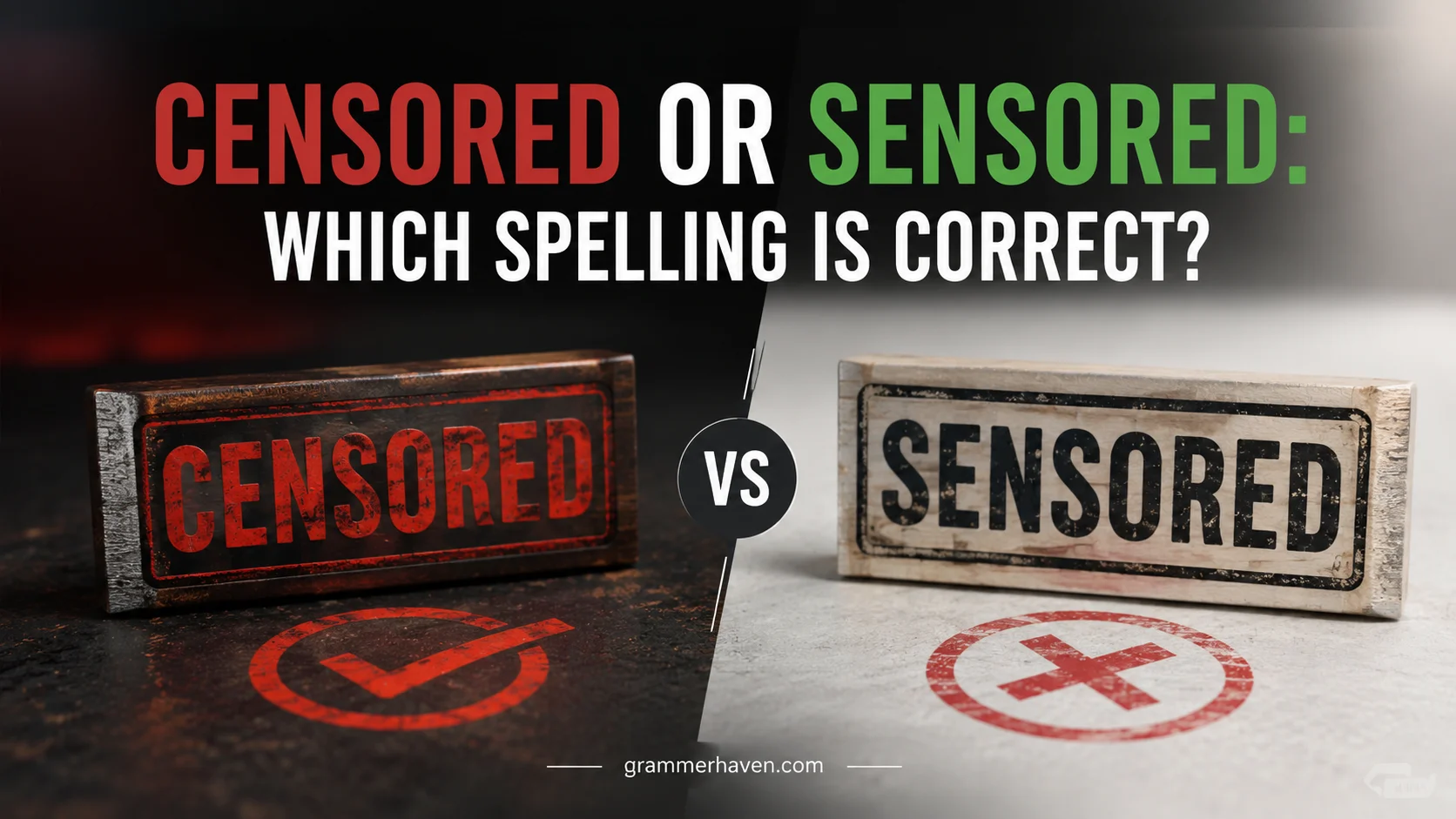
Censored or Sensored: Which Spelling Is Correct? explains the spelling difference between censoring material and sensing changes with a device. Censored is the correct word when someone removes, hides, blocks, or edits information because it contains offensive, inappropriate, private, or restricted material. A censor may review books, movies, broadcasts, letters, websites, documents, or online posts before removing specific content. For example, a movie may have violent scenes censored for younger viewers, while a person may censor their own language during a public conversation. Sensored isn’t the standard spelling for this meaning. The related word sensor refers to a device that detects or responds to something such as smoke, motion, light, temperature, speed, or sound. A smoke sensor can detect smoke and trigger an alarm.
Censer has a completely different meaning. A student, writer, creator, or professional can use this simple connection to avoid confusing censored, sensored, and censer.
Censored vs Sensored: Quick Difference
Before exploring the details, here is the simplest explanation:
| Word | Correct Usage | Meaning | Example |
| Censored | ✅ Correct | Content has been removed, hidden, edited, or restricted | “The video was censored because it contained graphic scenes.” |
| Sensored | ❌ Usually incorrect | Common misspelling of “censored” | “The article was sensored” ❌ |
| Sensor | ✅ Correct | A device that detects or measures something | “The phone uses a fingerprint sensor.” |
The easiest way to remember:
Censor controls content. Sensor detects things.
A censor looks at information and decides what people can see. A sensor collects information from the physical world.
What Does Censored Mean?
Censored Definition and Meaning
The word censored comes from the verb censor, which means to examine information and remove or restrict parts of it.
When something is censored, someone has changed it, hidden it, blocked it, or removed parts of it because they consider the material inappropriate, sensitive, offensive, dangerous, private, or unsuitable for a particular audience.
The word commonly appears in discussions about:
- Movies and television
- Social media
- News reporting
- Government documents
- Books
- Music
- Online platforms
For example:
“The television network censored several scenes before broadcasting the movie.”
This means the network removed or edited certain scenes before showing them.
Understanding Censorship: Why Is Content Censored?
Censorship happens when an organization, government, platform, or individual controls what information becomes available to others.
The reasons behind censorship vary widely.
Common Reasons Content Gets Censored
| Reason | Explanation | Example |
| Offensive language | Removing profanity or inappropriate words | A song edited for radio |
| Violence | Reducing disturbing scenes | A movie with violent scenes edited |
| Privacy protection | Hiding personal details | A legal document with names removed |
| Security concerns | Protecting sensitive information | Government files with classified sections hidden |
| Age restrictions | Making content suitable for children | A film edited for younger viewers |
Censorship is not always about hiding information completely. Sometimes it involves modifying content so it fits a specific audience.
For example, a movie shown on television may have:
- Profanity removed
- Violent scenes shortened
- Adult themes edited
The original version still exists, but the broadcast version has been censored.
Real-World Examples of Censored
Movies and Television
Entertainment is one of the most common areas where people see censorship.
A movie studio may create different versions of the same film:
- The original theatrical version
- A television-friendly version
- A version edited for certain countries
For example:
A streaming platform may remove a scene from a show because it violates local broadcasting rules.
The show itself has been censored in that region.
Music
Songs are frequently censored for radio, television, and public events.
A song may contain:
- Explicit language
- Violent references
- Sexual content
A radio station might replace certain words with:
- Silence
- Sound effects
- Alternative lyrics
Example:
Original:
“The artist used explicit language.”
Censored version:
“The artist released a clean version with edited lyrics.”
Social Media
Online platforms often use moderation systems to restrict certain content.
A platform may censor:
- Hate speech
- Graphic violence
- Illegal content
- Harassment
- Private information
However, the word censored can sometimes become controversial because people disagree about where moderation ends and censorship begins.
One person may view removed content as necessary moderation. Another may view it as unnecessary censorship.
The meaning of the word stays the same: information has been restricted or altered.
What Does Sensored Mean?
Is Sensored a Correct Word?
In most situations, “sensored” is not the correct word.
People usually write sensored when they mean censored.
The mistake happens because:
- Both words sound identical.
- Both contain similar letters.
- The word “sensor” is extremely common in modern technology.
However, sensored does not mean “blocked” or “edited.”
If you write:
“The government sensored the report.”
You probably mean:
“The government censored the report.”
The second sentence is correct.
Why Do People Write Sensored Instead of Censored?
The confusion between censored vs sensored happens because English contains many words that sound identical but have different meanings.
These words are called homophones.
Some common examples include:
| Homophones | Different Meanings |
| Their / There / They’re | Possession, location, contraction |
| To / Too / Two | Direction, also, number |
| Censor / Sensor | Restrict information, detect something |
| Flower / Flour | Plant, baking ingredient |
When people hear “censored,” they often connect the sound with “sensor” because “sensor” is a familiar word.
Modern technology has made this even more common.
People constantly see words like:
- Motion sensor
- Camera sensor
- Temperature sensor
- Touch sensor
- Pressure sensor
Because “sensor” appears everywhere, some writers naturally assume sensored must be the past tense form.
But English does not work that way.
Censored vs Sensored: Understanding the Root Words
To fully understand the difference, you need to look at the original words behind them.
Censor
The word censor refers to someone or something that controls information.
A censor asks:
- Should this information be shown?
- Should this part be removed?
- Is this appropriate for the audience?
A censor deals with ideas, words, images, and information.
Examples:
- A government censors documents.
- A television network censors programs.
- A website censors harmful content.
Sensor
A sensor is completely different.
A sensor is a device that detects changes in the environment.
Sensors can measure:
- Temperature
- Movement
- Light
- Sound
- Pressure
- Distance
- Touch
Examples:
- A smoke detector uses sensors to identify smoke.
- A smartphone uses sensors to detect movement.
- A smartwatch uses sensors to track health-related measurements.
A sensor does not remove information.
It collects information.
Censor vs Sensor: Side-by-Side Comparison
| Feature | Censor | Sensor |
| Main purpose | Controls information | Detects information |
| Related field | Media, communication, government | Technology, engineering |
| Action | Removes or blocks | Measures or identifies |
| Example | Censoring a movie scene | Detecting motion |
| Related word | Censorship | Sensory |
A helpful comparison:
A censor is like an editor with scissors. A sensor is like a detective with a measuring tool.
One removes things. The other discovers things.
The Difference Between Censored and Uncensored
The opposite of censored is uncensored.
Censored
Means:
- Edited
- Restricted
- Hidden
- Removed
Example:
“The censored version removed several scenes.”
Uncensored
Means:
- Original
- Complete
- Not edited
Example:
“The streaming service offers both censored and uncensored versions.”
This distinction appears frequently with:
- Movies
- Music
- Interviews
- News content
- Online discussions
See also: Do To or Due To: Which Is Correct?
FAQs:
1. Is “censored” or “sensored” correct?
Censored is the correct spelling when you mean that information, words, images, or other material has been removed, hidden, or restricted. Sensored isn’t the standard spelling for this meaning.
2. What does “censored” mean?
Censored means that someone has examined content and removed or hidden parts considered offensive, inappropriate, secret, sensitive, or restricted.
3. What does “sensored” mean?
Sensored is generally considered an incorrect spelling when you mean something was restricted or edited. The correct word is censored.
4. What is the difference between “censor” and “sensor”?
A censor is related to examining or restricting information. A sensor is a device that detects something, such as light, smoke, motion, or temperature.
5. Is “censored” a verb?
Yes. Censored is the past tense and past participle of the verb censor. For example, “The network censored the offensive scene.”
6. What is a “censer”?
A censer is a container used for burning incense, especially during religious ceremonies. It has a completely different meaning from censor and sensor.
7. How can I remember the difference between censor and sensor?
A simple way to remember it is: censor cuts, while sensor senses. A censor removes or hides information, while a sensor detects something.
8. Are “censor,” “sensor,” and “censer” pronounced the same?
They have very similar pronunciations, which can cause confusion. Their meanings and spellings are different, so context helps you identify the correct word.
9. Can a person censor themselves?
Yes. Self-censorship happens when someone chooses to avoid, remove, or change certain words, opinions, images, or information before sharing them.
10. What is the correct spelling: “censored” or “sensored”?
The correct spelling is censored when you mean content was restricted, removed, or hidden. Sensored should not be used in this context.
Conclusion:
Censored is the correct word when you mean that information or content has been removed, hidden, or restricted. Sensored is not the standard spelling for this meaning. Remember the simple distinction: a censor cuts, a sensor senses, and a censer holds incense. Once you connect each word with its meaning, these similar-sounding terms become much easier to use correctly.