The phrase Where They Are or Where They Are At: Which Is Correct? helps English language learners understand grammar rules, context, and usage. These phrases may seem interchangeable on the surface, but the truth is connected to how people use words in different situations. English has tricky twists and turns that can become a puzzle for a diligent learner, especially when small changes create a difference in meaning and how a sentence sounds.
The main dilemma comes when deciding which expression is correct in conversations, texts, and casual writing. Many people get tripped up because they have heard both phrases in daily communication. The common rule is that Where They Are is usually preferred in formal spoken English and written English, while Where They Are At can be acceptable in some informal situations when discussing a position, condition, or stage. Understanding these subtle nuances helps students build confidence and avoid sounding awkward.
This article will break down the topic with real-life examples to help you learn, discover, and gain clarity about proper communication. Good Language Resources explain that prepositions often create confusion, but regular practice improves your overall approach to English. Using the right phrases makes your communication more natural and effective while helping you understand the rich and expressive nature of the language.
The Short Answer: Is It “Where They Are” or “Where They Are At”?
If you need a quick answer, here it is:
“Where they are” is the grammatically standard form and the safest choice in virtually every situation.
Example:
We need to know where they are.
However, “where they are at” is extremely common in informal spoken English.
Example:
Do you know where they are at right now?
Most editors, teachers, and style guides prefer “where they are.” Yet many native speakers naturally add “at” when speaking.
The key difference isn’t necessarily correctness versus incorrectness.
Instead, it’s usually a matter of formality, style, and audience expectations.
Why This Grammar Question Confuses So Many People
Part of the confusion comes from the fact that English operates on two levels:
- Formal grammar rules
- Real-world language usage
Many expressions that appear unnecessary from a grammatical perspective survive because millions of speakers continue using them.
Consider these examples:
| Formal Version | Common Spoken Version |
| Where are you? | Where are you at? |
| Where is he? | Where is he at? |
| Where were they? | Where were they at? |
| Where are we? | Where are we at? |
The second versions often sound natural in conversation even though grammar purists criticize them.
This tension between formal rules and everyday speech sits at the center of the debate.
Understanding What “Where” Already Means

To understand why many experts prefer “where they are,” you first need to understand the role of the word “where.”
The word “where” already indicates location.
For example:
Where are they?
The question already asks about location.
Adding “at” creates:
Where are they at?
The meaning remains exactly the same.
Because “where” already expresses location, many grammar authorities view “at” as redundant.
Think about it this way.
If someone asks:
Where is the restaurant?
You immediately understand that they want the location.
Adding “at” doesn’t provide new information.
Why Some Grammarians Consider “At” Unnecessary
Traditional grammar instruction focuses heavily on efficiency and precision.
According to this approach, every word should serve a purpose.
When a word adds no new meaning, many editors recommend removing it.
This principle explains why some people object to phrases such as:
- Repeat again
- End result
- Future plans
- Basic fundamentals
- Where they are at
In each case, one part of the phrase already contains the meaning of the other.
A Simple Illustration
| Phrase | Redundant Element |
| Repeat again | Again |
| End result | End |
| Advance planning | Advance |
| Where they are at | At |
From a purely grammatical perspective, removing the extra word often creates a cleaner sentence.
Does Redundancy Automatically Make Something Wrong?
Not necessarily.
English contains countless redundant expressions that native speakers use every day.
Examples include:
- Safe haven
- Unexpected surprise
- Added bonus
- Free gift
- Final outcome
Strictly speaking, some of these expressions repeat information.
Yet they remain common because they add emphasis, rhythm, or emotional impact.
The same principle often applies to “where they are at.”
Although “at” may be unnecessary from a technical standpoint, speakers frequently use it for emphasis or conversational flow.
The Difference Between Prescriptive and Descriptive Grammar
One of the biggest misunderstandings in grammar discussions involves two competing approaches.
Prescriptive Grammar
Prescriptive grammar tells people how they should use language.
It focuses on established rules.
Teachers, editors, and style guides often follow this approach.
Under prescriptive grammar:
“Where they are” is preferred.
Descriptive Grammar
Descriptive grammar studies how people actually use language.
Linguists typically adopt this perspective.
Instead of judging usage, descriptive grammar documents it.
Under descriptive grammar:
“Where they are at” is recognized as a common feature of informal English.
Neither approach is inherently wrong.
They simply serve different purposes.
Is “Where They Are At” Grammatically Incorrect?
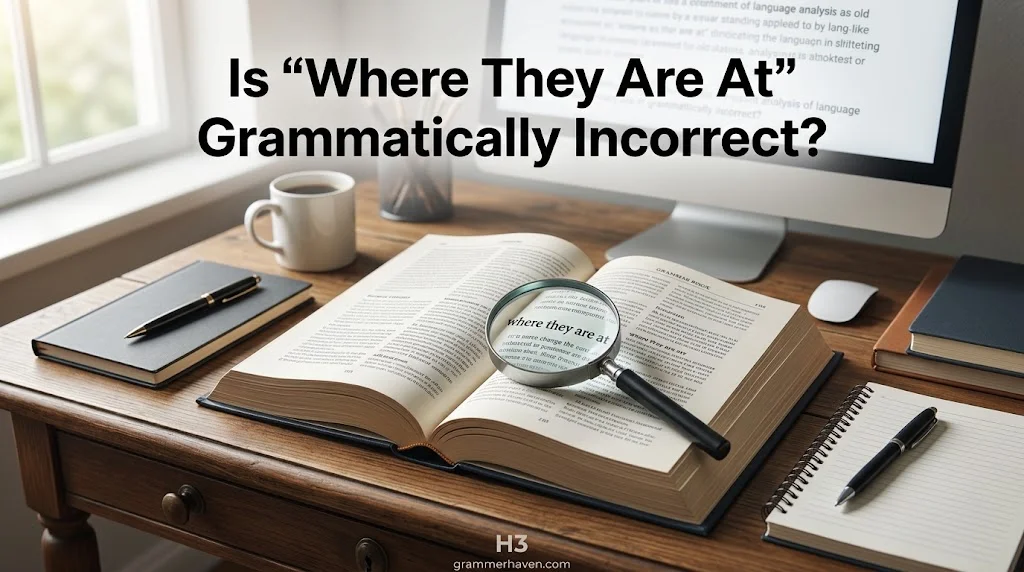
This question deserves a more detailed answer.
The Traditional Grammar View
Traditional grammar authorities generally recommend avoiding the phrase.
Their reasoning is straightforward:
- “Where” already expresses location.
- “At” adds no essential meaning.
- The sentence works perfectly without it.
Therefore:
Where they are
is preferred over:
Where they are at
in formal writing.
The Modern Linguistic View
Modern linguists often reach a different conclusion.
Many argue that a phrase used consistently by millions of native speakers cannot simply be dismissed as “wrong.”
Instead, they classify it as:
- Informal
- Conversational
- Dialectal
- Context-dependent
From this perspective, the phrase functions as a legitimate feature of spoken English.
The Practical Verdict
For most situations:
Use “where they are” in formal writing.
Use “where they are at” only when a conversational tone feels appropriate.
The Historical Origins of “Where … At”
Many people assume “where … at” is a modern mistake.
History tells a different story.
Versions of this construction have appeared in English speech for centuries.
Linguistic research has found examples of terminal prepositions and similar structures dating back hundreds of years.
In spoken English, expressions such as:
- Where are you at?
- Where is he at?
- Where were they at?
became especially common in regional dialects.
Over time, these expressions spread throughout various parts of the United States.
Today, they appear regularly in:
- Casual conversations
- Sports interviews
- Television dialogue
- Radio broadcasts
- Social media discussions
The phrase survived because speakers found it useful and natural.
Language often follows usage patterns rather than strict logic.
Why People Add “At” in the First Place
A fascinating question remains:
If “at” isn’t necessary, why do people keep using it?
Several reasons explain its popularity.
Emphasis
The added word can place greater focus on location.
Compare:
Where are they?
with:
Where are they at?
Many speakers perceive the second version as slightly more emphatic.
Rhythm
Speech follows patterns of sound and cadence.
Sometimes a sentence simply feels more complete with an extra syllable.
Human communication often prioritizes rhythm over strict grammatical efficiency.
Habit
Language habits develop over years.
People often adopt expressions from:
- Family members
- Friends
- Communities
- Local dialects
Once a phrase becomes familiar, speakers rarely analyze its grammar.
Regional Influence
Some regions use “where … at” far more frequently than others.
As a result, many speakers grow up hearing it constantly.
When You Should Use “Where They Are”
In most professional situations, this version remains the better choice.
Academic Writing
Professors and academic editors generally expect standard grammar.
Examples:
Researchers tracked where they are located.
The study identifies where they are currently residing.
Academic writing values clarity and precision.
The extra “at” provides no advantage.
Professional Communication
Business writing should remain concise.
Examples:
Please confirm where they are.
We need an update regarding where they are now.
These sentences sound professional and polished.
Journalism
News organizations typically follow strict style standards.
Most editors remove unnecessary words during editing.
As a result, journalists overwhelmingly choose:
where they are
rather than:
where they are at
Publishing
Books, magazines, and professional publications generally follow the same convention.
Formal Usage Examples
| Situation | Recommended Phrase |
| Business email | Where they are |
| Academic paper | Where they are |
| News article | Where they are |
| Research report | Where they are |
| Legal document | Where they are |
| Corporate presentation | Where they are |
In formal settings, simplicity wins.
When “Where They Are At” May Be Acceptable

Despite criticism, the phrase still has legitimate uses.
Casual Conversation
Everyday speech follows different rules.
You might hear:
Do you know where they are at?
Very few listeners would find this unusual.
Creative Writing
Authors often prioritize authenticity.
If a character naturally speaks this way, preserving the phrase may strengthen realism.
Example:
“I don’t know where they’re at right now,” Jake said.
The dialogue sounds natural because it reflects actual speech patterns.
Interviews
Athletes, entertainers, and public figures frequently use conversational language.
A direct quote should usually remain unchanged.
Example:
“We’re evaluating where the team is at right now.”
Editing the quote could alter the speaker’s voice.
Social Media
Informal platforms encourage conversational writing.
Users rarely worry about strict grammatical conventions.
Real-World Comparison
| Context | Better Choice |
| College essay | Where they are |
| Business proposal | Where they are |
| Research paper | Where they are |
| Casual conversation | Either |
| Text message | Either |
| Fiction dialogue | Often where they are at |
| Social media caption | Either |
| Interview transcript | Usually preserve original wording |
Common Myths About “Where They Are At”
Myth: It’s Always Wrong
Reality:
Many native speakers use it naturally.
It may be informal, but that doesn’t automatically make it incorrect in every context.
Myth: Educated People Never Use It
Reality:
Highly educated speakers often switch between formal and informal language depending on the audience.
Context matters.
Myth: Informal Means Bad Grammar
Reality:
Informal language serves important communication purposes.
Many accepted expressions began as informal speech.
Myth: Nobody Uses It Anymore
Reality:
Millions of English speakers continue using it daily.
The phrase remains widespread throughout North America.
Case Study: How Editors Handle the Phrase
Imagine a magazine editor receives the following sentence:
The report explains where they are at currently.
Most editors would revise it to:
The report explains where they are currently.
Why?
The revised version:
- Uses fewer words
- Reads more smoothly
- Follows standard style guidelines
- Eliminates redundancy
Now consider a novel containing dialogue:
“Nobody knows where they are at,” Sarah whispered.
An editor may leave the phrase untouched because it reflects natural speech.
This example highlights an important lesson:
Good writing depends on context, not rigid rules.
Similar Expressions That Create the Same Debate
The controversy extends beyond “where they are at.”
Many related phrases spark similar discussions.
Where Is He or Where Is He At?
Formal:
Where is he?
Informal:
Where is he at?
Where Are You or Where Are You At?
Formal:
Where are you?
Informal:
Where are you at?
Where Were They or Where Were They At?
Formal:
Where were they?
Informal:
Where were they at?
Where Are We or Where Are We At?
This variation often appears metaphorically.
Example:
Let’s discuss where we are at as a company.
In this context, speakers may refer to progress rather than physical location.
Why “Where We Are At” Is Especially Common in Business Speech
Interestingly, business professionals often use:
Where we’re at
when discussing status or progress.
Examples:
Let’s review where we’re at with the project.
Here’s where we’re at financially.
Although some editors dislike the phrase, it remains common in meetings and presentations.
The expression functions almost like an idiom.
Its popularity demonstrates how language evolves according to practical usage.
How Major Style Guides View the Phrase
Most major style authorities favor conciseness.
Their recommendations generally align with the following principle:
If removing a word doesn’t change the meaning, remove it.
Applying this rule leads to:
| Preferred | Less Preferred |
| Where they are | Where they are at |
| Where are you? | Where are you at? |
| Where is he? | Where is he at? |
Professional editors frequently follow this approach.
Quick Rules to Remember
If you’re unsure which phrase to use, these guidelines can help.
Use “Where They Are” When:
- Writing essays
- Creating reports
- Publishing articles
- Sending professional emails
- Producing academic content
- Writing business documents
“Where They Are At” May Work When:
- Speaking casually
- Writing dialogue
- Posting on social media
- Preserving authentic speech
- Quoting someone directly
When in Doubt
Choose:
Where they are
You’ll rarely face criticism for using the standard form.
FAQs:
1. Is “Where They Are” grammatically correct?
Yes, Where They Are is grammatically correct and is the preferred choice in formal writing, academic contexts, and professional communication. It clearly asks about a location, situation, or condition.
2. Is “Where They Are At” incorrect?
No, Where They Are At is not always incorrect. It is commonly used in informal spoken English, especially when people talk about someone’s current position, progress, or situation. However, some grammar experts consider the extra “at” unnecessary.
3. When should I use “Where They Are” instead of “Where They Are At”?
You should use Where They Are in formal situations, such as essays, reports, emails, and professional conversations. It sounds more polished and follows traditional grammar preferences.
4. Why do people say “Where They Are At”?
People use Where They Are At because it feels natural in everyday speech. The phrase often emphasizes a person’s current stage, condition, or progress rather than only their physical location.
5. Can “Where They Are At” be used in writing?
Yes, but it depends on the type of writing. It can work in casual messages, dialogue, blogs, or informal content. For formal writing, Where They Are is usually the better choice.
Conclusion:
Understanding Where They Are and Where They Are At becomes easier when you focus on context, grammar rules, and everyday usage. While Where They Are is the more standard choice for formal writing and professional communication, Where They Are At can still appear in casual conversations when referring to someone’s situation, position, or progress. Knowing the difference helps you communicate more clearly, avoid awkward phrasing, and use English with greater confidence.
Latest Post:
- Is It Correct to Say “A Big Congratulations”? The Complete Grammar Guide
- Two Crows Being an Attempted Murder: Meaning, Origins & Real Behavior
- Farther vs. Further: What’s the Difference?
- Result In or Result To: Which Is Correct? (With Examples)
- A Dime a Dozen: Meaning, Definition, Origin and Real-Life Usage