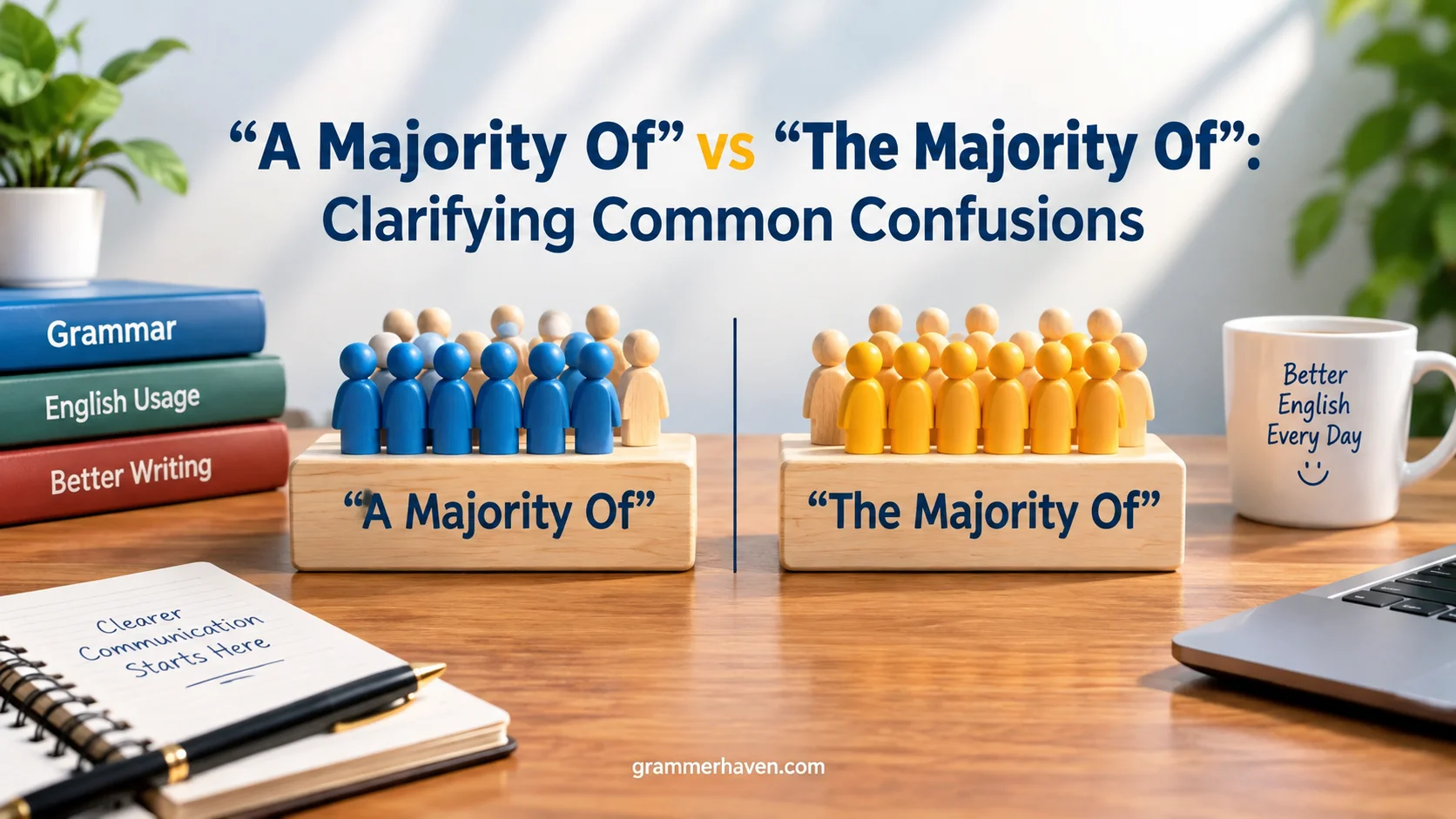
Understanding “A Majority Of” vs “The Majority Of” explains how English phrases change through context, meaning, and usage for clearer writing. During my learning journey with English, I discovered that phrases like a majority of and the majority of may appear identical, but their meaning depends on the context. This comparison becomes an interesting trip through language, grammar, and expressions because the difference comes from how we describe a group. In everyday English, selecting the right phrase improves clarity and helps your message get received correctly by readers.
In professional writing, this small usage choice creates a major impact on communication. For example, the majority of the studies point toward a specific group or known collection, such as students in a research project, while a majority can describe an unspecified group. These nuances are a game-changer for improving English skills because they reduce grammar problems. Knowing the main difference between a specific and general reference, along with agreement rules, supports better sentence accuracy and stronger writing.
With practice, mastering these expressions makes correct usage feel like second nature. A simple NLP approach shows how words, majority phrase patterns, and sentence structure connect through meaning. Using practical examples, general statements, and a clearly defined idea helps you find the immediate answer without unnecessary fluff. Paying attention to details can help prevent a wrong choice and complete the correct job of creating effective sentences, improving professional communication, and developing stronger language skills.
Understanding “A Majority Of” vs “The Majority Of”: The Core Idea in Plain English
Let’s get straight to the point.
Both phrases mean more than half of a group. That part never changes. The difference lies in how specific or definite you want to sound.
Here’s the simplest way to see it:
- The majority of = a specific, known group (more definite, slightly more formal)
- A majority of = a general statement about a group (softer, slightly less formal)
Quick examples:
- The majority of students in this class passed the exam.
- A majority of students pass this exam every year.
Same idea. Different tone. Different focus.
Think of it like zooming in versus zooming out with a camera. One shows a specific scene. The other shows a general trend.
What “Majority” Really Means in Grammar and Everyday Use
Before we go deeper, you need to understand the word majority itself.
At its core, majority means:
More than 50% of a group
That group can be people, objects, votes, opinions, or anything countable.
Key fact:
The word “majority” always refers to proportion, not exact numbers.
So when someone says:
- “The majority agreed”
They mean:
- More than half agreed, not necessarily how many.
Grammar behavior of “majority”:
- Works as a noun: The majority is/are…
- Often followed by “of + plural noun”
- Can take singular or plural verb depending on context
Example:
- The majority of the team is ready. (collective sense)
- The majority of the players are ready. (individual focus)
This flexibility is where most confusion begins.
Understanding “The Majority Of”: When Precision Matters
Now let’s break down “the majority of.”
This is the more common and slightly more formal version, especially in writing.
Use “the majority of” when:
- You refer to a specific, defined group
- You want clarity and precision
- You’re writing reports, academic content, or news-style statements
Examples:
- The majority of employees at the company support hybrid work.
- The majority of voters in the district rejected the proposal.
- The majority of research participants reported improvement.
What it really does in a sentence:
It signals that the speaker or writer sees the group as known and identifiable.
Think of it like pointing at a group and saying, “this group here.”
Understanding “A Majority Of”: When Generalization Works Better

Now let’s talk about “a majority of.”
This version feels slightly softer and more conversational.
It still means more than half. But it doesn’t always lock the group into something specific.
Use “a majority of” when:
- You make a general claim or observation
- You describe trends or typical behavior
- You speak in a broader, less formal tone
Examples:
- A majority of people prefer streaming over cable TV.
- A majority of users abandon apps within the first week.
- A majority of adults report feeling stressed during the workweek.
What changes in tone:
It sounds less like a formal report and more like a general truth you’ve observed.
If “the majority of” points at a specific group, “a majority of” describes a pattern.
Do “A Majority Of” and “The Majority Of” Mean the Same Thing?
Short answer: yes and no.
They overlap heavily in meaning but differ in tone and emphasis.
Where they match:
Both mean:
- More than half
- A dominant portion of a group
Where they differ:
| Phrase | Meaning Strength | Tone | Best Use |
| The majority of | More precise | Formal, factual | Reports, academic writing |
| A majority of | Slightly general | Neutral, conversational | Everyday writing |
Important insight:
In real-world writing, people often swap them without confusion. But careful writers adjust based on tone.
Case Study: How Tone Changes Meaning in Real Writing
Let’s look at a practical example.
Scenario: Workplace report
You write:
- The majority of employees prefer remote work.
This sounds:
- Specific
- Data-driven
- Confident
Now change it:
- A majority of employees prefer remote work.
This sounds:
- More general
- Slightly softer
- Less anchored to a specific dataset
Same fact. Different impressions.
That difference matters in business writing, journalism, and research.
A manager reading the first sentence might think:
“We have clear internal survey results.”
The second version feels more like:
“This is generally true across similar companies.”
Countable vs Uncountable Nouns: Where Writers Get Confused
Now let’s tackle a subtle but important issue: noun types.
Both phrases usually pair with plural countable nouns.
Correct usage:
- The majority of people
- The majority of students
- The majority of votes
Problem area:
Uncountable nouns don’t always work smoothly.
Awkward example:
- ❌ The majority of water is polluted
Better alternatives:
- Most of the water is polluted
- A large portion of the water is polluted
Key takeaway:
“Majority” works best with groups you can count or divide into units.
Common Mistakes with “A Majority Of” and “The Majority Of”
Even fluent writers slip here. Let’s fix the most common errors.
Mistake: Verb agreement confusion
- ❌ The majority of people is happy
- ✔ The majority of people are happy
Why? Because “people” is plural, so the verb must agree.
Mistake: Overusing “majority”
Repeating it too often makes writing stiff.
Weak writing:
- The majority of students passed. The majority of teachers agreed. The majority of parents attended.
Better version:
- Most students passed. Teachers agreed. Parents attended.
Mistake: Using it where “most” sounds better
In modern English, “most” often sounds more natural.
Compare:
- The majority of people prefer coffee. ❌ (formal)
- Most people prefer coffee. ✔ (natural)
Formal vs Informal Writing: Choosing the Right Phrase

Your choice depends heavily on context.
Formal writing (reports, research, news):
Prefer:
- The majority of
Why? It sounds precise and structured.
Informal writing (blogs, speech, casual content):
Prefer:
- A majority of
- Or even better: “most of”
Why? It feels more natural and less rigid.
Quick guide:
| Context | Best Choice |
| Academic paper | The majority of |
| Business report | The majority of |
| Blog post | Most of / A majority of |
| Casual speech | Most of |
Style Tips: How to Sound Natural, Not Robotic
Let’s make your writing smoother and more human.
Tip 1: Mix your phrasing
Don’t repeat “majority” too often. Switch it up.
Use:
- Most
- Over half
- A large portion
- More than half
Tip 2: Keep sentences varied
Instead of:
- The majority of users like the app.
Try:
- Most users like the app, especially because it loads fast and feels simple.
Tip 3: Use transitions naturally
- However, context matters here.
- For example, tone changes the meaning slightly.
- In real writing, flexibility matters more than rigid rules.
Quick Decision Guide: Which One Should You Use?

Use this mental shortcut when writing:
Choose “the majority of” when:
- You refer to a specific group
- You want formal tone
- You’re writing reports or structured content
Choose “a majority of” when:
- You want a general statement
- You keep tone neutral or conversational
- You describe trends
Or better yet:
Ask yourself:
“Am I pointing at a known group or describing a general pattern?”
That answer usually decides it for you.
Practice Section: Test Your Understanding
Try filling in the blanks:
1.
___ students in the class passed the exam.
2.
___ people prefer online shopping today.
3.
___ employees in the company support the change.
Answers:
- The majority of students in the class passed the exam.
- A majority of people prefer online shopping today.
- The majority of employees in the company support the change.
Why:
- (1) and (3) refer to specific groups
- (2) describes a general trend
See also: Sun vs. Son – Homophones, Meaning & Spelling Explained
FAQs:
1. What is the main difference between “a majority of” and “the majority of”?
The main difference is specificity. A majority of refers to more than half of a group without clearly identifying the group, while the majority of refers to more than half of a specific or known group.
2. Is “a majority of” always followed by a plural noun?
Usually, yes. A majority of is commonly followed by plural countable nouns, such as “a majority of students” or “a majority of voters.” The verb agreement depends on the noun that follows.
3. When should I use “the majority of” in a sentence?
Use the majority of when you are talking about a particular group that the reader already knows about. For example, “The majority of the employees agreed with the new policy” refers to a specific set of employees.
4. Can “a majority of” and “the majority of” be used interchangeably?
Not always. Although both phrases mean more than half, replacing one with the other can change the meaning. The choice depends on whether you are referring to a general group or a defined group.
5. How can I remember the difference between these two phrases?
Remember that “the” points to something specific, while “a” introduces something general. If the group is already identified, use the majority of. If the group is not specified, use a majority of.
Conclusion:
Understanding “A Majority Of” vs “The Majority Of” becomes easier when you focus on the difference between a general group and a specific, defined group. A majority of usually refers to more than half of an unspecified group, while the majority of points to a known or previously mentioned group. Paying attention to context, grammar, and sentence structure helps you choose the correct phrase and improve your English communication. With regular practice and real examples, using these expressions becomes natural and helps your writing sound more accurate and professional.