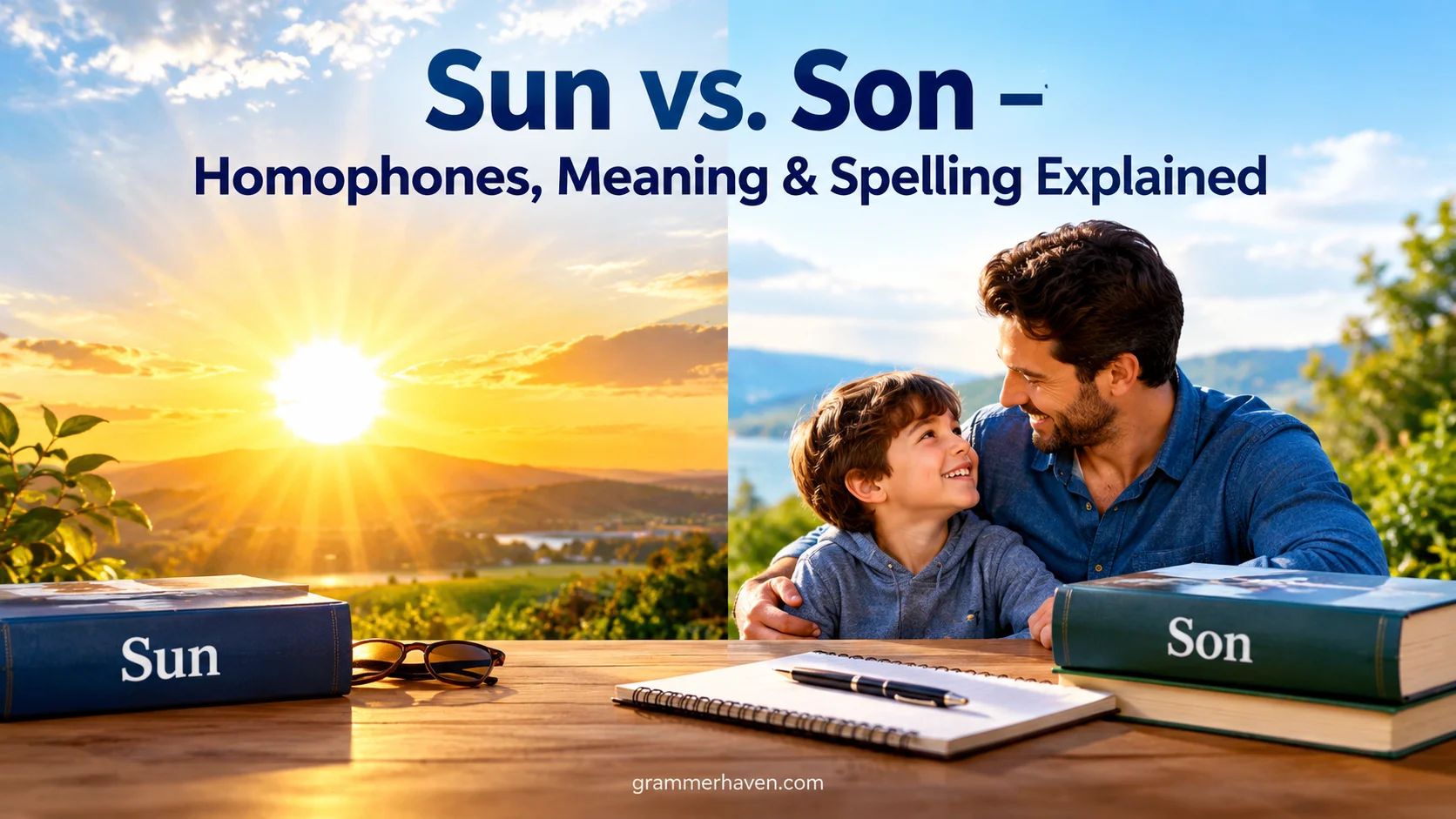
Sun vs. Son – Homophones, Meaning & Spelling Explained in Simple helps English learners understand homophones, word differences, and correct usage. These two words create confusion because they have the same sound but completely different meanings and spelling. Many beginners and inexperienced users find this mixed-up pair tricky while preparing for English test preparation or standardized admissions tests. Through my experience teaching English learners, I have noticed that clear context awareness, regular practice, and better understanding make these word pairs easier to master.
The son refers to a male offspring or child connected to a parent and family relationship. It represents human identity, role, generation, lineage, heritage, birth, and sonship. On the other hand, the sun is a star located at the center of the solar system. It provides light, daylight, heat, and energy that support life on Earth. The Earth and other planets revolve around it in orbit, while gravity, astronomy, space, and science explain its importance in the universe.
To avoid misspell and misuse, learners should focus on pronunciation, pronouncing, vowel, and vowel sounds. Using linguistic examples, example sentences, and comparing words helps improve grammar, vocabulary, vocabulary builder, language learning, and semantics. These concepts also connect with NLP, NLP terms, and linguistic understanding because language depends on meaning and context. Practicing daily through studying, reading in a library, and checking correct word choices builds confidence, improves effective writing, and develops better communication skills in subjects like Social Sciences and everyday language.
What Are Homophones in English? (And Why “Sun vs. Son” Is a Classic Example)
Homophones are words that sound the same but have different meanings and spellings. English has thousands of them because it evolved from many languages like Latin, French, and Germanic roots.
That mix created words that share pronunciation but split in meaning.
Here are a few everyday homophones:
- To / Too / Two
- There / Their / They’re
- Flower / Flour
- Sea / See
- Sun / Son
The problem? Your brain hears sound first. Spelling comes later. That’s why mistakes happen so easily.
A linguist once summed it up perfectly:
“English spelling preserves history, not simplicity.”
That’s exactly why “sun” and “son” exist as separate words even though they sound identical.
Understanding “Sun” – Meaning, Usage, and Real Context

The word “sun” refers to one of the most important objects in our universe.
It is the star at the center of our solar system, and it provides Earth with light, heat, and energy.
Without the sun, life on Earth would not exist.
Core Meaning of Sun
- A massive star made mostly of hydrogen and helium
- Source of heat and light for Earth
- Central body in our solar system
Simple Usage in Sentences
- The sun rises every morning.
- The sun feels extremely hot in summer.
- Clouds blocked the sun today.
Scientific Facts About the Sun
Here are some clear, accurate facts you can trust:
- The sun is about 4.6 billion years old
- It contains 99.86% of the solar system’s total mass
- Light from the sun takes about 8 minutes and 20 seconds to reach Earth
- Surface temperature: around 5,500°C (9,932°F)
These facts help you understand how powerful the sun really is. It is not just a word—it is the engine of life on Earth.
Words Connected to “Sun”
- Sunshine
- Sunlight
- Sunrise
- Sunset
- Sunbeam
Figurative Use of Sun
Writers often use “sun” in a symbolic way:
- Hope → “A new sun rises after every storm.”
- Warmth → “Her smile felt like the sun on a cold day.”
- Energy → “He brought sun into the room.”
Understanding “Son” – Meaning, Usage, and Real Context
Now let’s shift from the sky to family.
The word “son” refers to a male child in relation to his parents.
It belongs to the world of relationships, identity, and family structure.
Core Meaning of Son
- A male offspring
- A child in a family relationship
- A legal and social family role
Simple Usage in Sentences
- My son starts school next year.
- He is the youngest son in the family.
- Their son lives abroad.
Real-Life Context of “Son”
The word appears in many situations:
- Family conversations
- Legal documents (birth certificates, inheritance papers)
- School forms
- Cultural identity discussions
Common Expressions with “Son”
- Like father, like son
- A proud son
- Eldest son
- Only son
Social and Emotional Meaning
Unlike “sun,” which is physical, “son” carries emotional weight. It connects people through family identity, expectations, and tradition.
In many cultures, the word “son” also carries responsibility. It often reflects legacy, inheritance, and family pride.
Sun vs Son – Key Differences You Should Remember Instantly

Even though they sound identical, their meanings are worlds apart.
Here’s a simple breakdown:
| Feature | Sun | Son |
| Category | Astronomy / Nature | Family / Relationships |
| Meaning | Star that lights Earth | Male child |
| Context | Weather, science, nature | Family, identity |
| Emotional tone | Neutral / symbolic | Personal / emotional |
| Spelling clue | Contains “u” like “up in the sky” | No “u”, represents a person |
Quick Summary Rule
- Sun = sky, light, heat
- Son = family, child, people
That single rule solves 90% of confusion instantly.
Why People Confuse Sun and Son So Easily
This mistake doesn’t come from carelessness. It comes from how language works.
Reason 1: Identical pronunciation
Both words sound exactly the same in most accents.
Reason 2: Fast communication
When typing quickly, your brain prioritizes sound over spelling.
Reason 3: Speech-to-text errors
Phones often auto-type the wrong word based on context.
Reason 4: Weak context awareness
If you don’t read the sentence carefully, both words “fit” grammatically.
Example of confusion in real life
- “My sun is 10 years old” → incorrect
- “The son is very bright today” → incorrect
Both sentences sound fine when spoken, but they collapse in meaning when written.
Memory Tricks to Never Mix Up Sun and Son Again
Let’s make this simple. You don’t need grammar rules. You need memory hooks.
Visual Trick
- Sun = sky above you → think “u” = up
- Son = human being → think family tree
Story Trick
Imagine this:
You look at the sky and say,
“Wow, the sun is strong today.”
Then you turn to your family and say,
“My son is playing outside.”
Now the difference sticks naturally.
Word Shape Trick
- Sun → has “u” (like upward sky view)
- Son → no “u” (grounded in human relationships)
One-Line Shortcut
If it shines in the sky, it’s the sun. If it belongs to a family, it’s a son.
Common Mistakes People Make With Sun vs Son
Even fluent English speakers slip up sometimes.
Here are the most frequent mistakes:
Spelling Errors
- “My sun is studying in school” ❌
- “The son is very hot today” ❌
Caption Mistakes on Social Media
- “Enjoying time with my sun ❤️”
- “Beautiful son today 🌞”
Email and Formal Writing Errors
In professional communication, mistakes like this can look careless:
- “Our sun exposure policy” (wrong context)
- “Employee son benefits” (nonsense phrase)
Why These Errors Matter
A small spelling mistake can:
- Change meaning completely
- Confuse readers
- Reduce writing credibility
Case Study: How One Small Word Changed Meaning
A teacher once shared a real classroom example.
A student wrote:
“The sun of my uncle came to visit.”
The student meant:
“The son of my uncle came to visit.”
The entire sentence shifted meaning. Instead of a family visit, it sounded like astronomy entered the conversation.
The teacher used it as a learning moment:
“One letter didn’t just change spelling. It changed reality.”
That’s the power of homophones.
Why English Has So Many Words Like Sun and Son
English did not grow in a straight line. It absorbed words from multiple languages over centuries.
This created:
- Similar sounds with different spellings
- Old spellings that never got simplified
- Words that evolved separately but sound identical today
For example:
- “Sun” comes from Old English sunne
- “Son” comes from Old English sunu
They started differently but merged in pronunciation over time.
That’s why modern English feels inconsistent.
Practice Section – Test Your Understanding
Try these exercises. Say the answers out loud first, then write them.
Fill in the blanks
- The ___ is shining very bright today.
- My ___ is learning how to ride a bicycle.
- The ___ sets in the west.
- He is the youngest ___ in the family.
Correct the sentences
- My sun loves playing cricket.
- The son feels very hot today.
- I saw my sun at school today.
Answer Key
- sun
- son
- sun
- son
Corrections:
- My son loves playing cricket.
- The sun feels very hot today.
- I saw my son at school today.
Expert Tips to Master Homophones Quickly
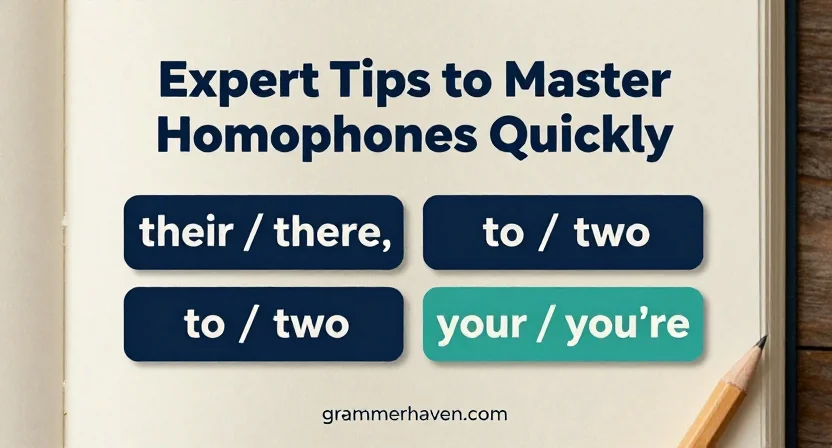
If you want to improve fast, focus on habits instead of memorization.
Tip 1: Read out loud
Your ear catches mistakes your eyes miss.
Tip 2: Focus on context
Ask yourself:
- Is this about nature or family?
Tip 3: Write short daily sentences
Practice builds automatic accuracy.
Tip 4: Group similar words
Learn homophones together instead of separately.
Tip 5: Slow down while typing
Most mistakes happen when you rush.
Sun vs Son – Final Clarity You Should Keep in Mind
Let’s simplify everything into one strong mental picture:
- The sun sits in the sky and gives light to the world
- A son sits in a family and gives meaning to relationships
They sound the same, but they live in completely different worlds.
One belongs to nature. The other belongs to people.
Once you anchor that idea, spelling becomes automatic.
See also: Lifetime vs Life Time: What’s the Difference?
FAQs:
1. What is the main difference between sun and son?
The main difference is their meaning. Sun refers to the star that gives Earth light and heat, while son refers to a male child or offspring in a family.
2. Are sun and son homophones?
Yes, sun and son are homophones because they have the same pronunciation but different spellings and meanings.
3. How can I remember the difference between sun and son?
You can remember that sun relates to the sky, space, and solar system, while son relates to a family member, child, or offspring.
4. Why do English learners confuse sun and son?
English learners often confuse them because both words sound exactly alike. The difference becomes clear only by looking at the sentence context and spelling.
5. Can sun and son be used interchangeably?
No, sun and son cannot be used interchangeably. Using the wrong word changes the meaning of the sentence completely. For example, “My son is playing outside” and “The sun is shining brightly” describe two different ideas.
Conclusion:
Understanding Sun vs. Son – Homophones, Meaning & Spelling Explained in Simple helps you avoid common spelling and meaning mistakes in English. Although sun and son have the same pronunciation, their meanings are completely different. The sun is a star that provides light, heat, and energy to Earth, while a son refers to a male child in a family relationship. By focusing on context, spelling differences, and proper usage, you can easily recognize which word fits in a sentence. Regular practice with examples, pronunciation, and vocabulary exercises will improve your English communication and writing accuracy.