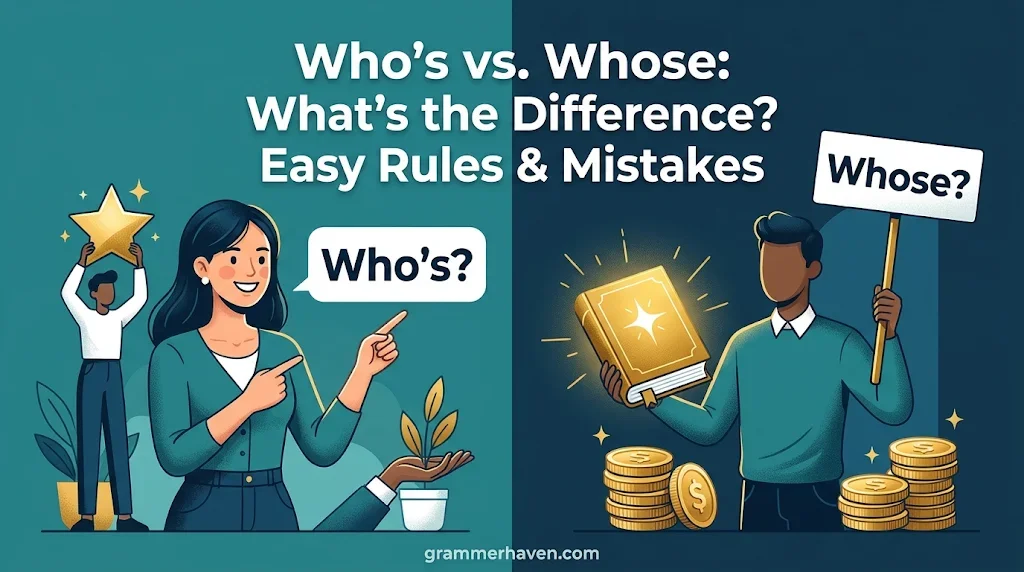
Who’s vs. Whose: What’s the Difference? explains a key English language difference where small details create big meaning changes today too. Many words create common mistakes and confusion, but this difference becomes easier when you learn the right trick for getting it correct. At first glance, this mix-up happens often because the twist can catch you off guard and move your writing down a slippery slope. Learning and mastering these forms helps you write and speak better.
Who’s is a contraction where who combines with is or has to create a shorter form using an apostrophe because of missing letters. For example, Who’s going to the store means Who is going to the store, while Who’s got the keys means Who has got the keys. This form is used when you talk about a person’s identity, current action, or status. The easiest way to check is to replace the word and see if the sentence makes sense.
Whose has a different role because it is a possessive form that shows ownership or association. It works as a possessive pronoun or adjective to determine who something belongs to. When asking whom something belongs to, you can use whose in a question or instance, such as Whose book is this or Whose jacket is on the chair. It explains that someone owns something, like the woman whose car was towed and who called the office. A simple tip is to remember that whose shows ownership, while who’s means who is or who has.
Who’s vs. Whose: Quick Answer
If you’re in a hurry, here’s the simplest explanation:
| Word | Meaning | Example |
| Who’s | Who is or who has | Who’s coming tonight? |
| Whose | Belonging to whom | Whose jacket is this? |
The Rule in One Sentence
Use “who’s” when you can replace it with “who is” or “who has.” Use “whose” when you’re talking about ownership, possession, or relationships.
For example:
- Who’s ready to leave?
- Whose car is parked outside?
One asks about a person.
The other asks about ownership.
That’s the core difference.
Why People Confuse Who’s and Whose
English contains many words that sound identical but have different meanings and spellings. These words are called homophones.
Examples include:
- Their, there, and they’re
- Your and you’re
- Its and it’s
- Who’s and whose
Because people hear these words more often than they see them written, many writers choose the wrong version by instinct.
The apostrophe adds another layer of confusion.
Many people learn that apostrophes indicate possession. While that’s often true, who’s is actually a contraction rather than a possessive word.
That’s where mistakes begin.
What Does “Who’s” Mean?
The word who’s is a contraction.
A contraction combines two words into one by removing letters and replacing them with an apostrophe.
In this case:
- Who’s = Who is
- Who’s = Who has
Those are the only meanings of who’s.
Examples of “Who Is”
Let’s expand the contraction.
Who’s waiting outside?
Becomes:
Who is waiting outside?
The sentence still makes sense.
That means who’s is correct.
More examples:
- Who’s speaking right now?
- Who’s responsible for this report?
- Who’s available this weekend?
- Who’s leading the meeting?
- Who’s knocking on the door?
In each sentence, you can substitute “who is.”
Examples of “Who Has”
Sometimes who’s stands for “who has.”
Examples:
- Who’s completed the assignment?
- Who’s seen this movie before?
- Who’s already submitted the paperwork?
- Who’s finished reading the book?
Expanded versions:
- Who has completed the assignment?
- Who has seen this movie before?
Again, the sentence remains logical.
Therefore, who’s is correct.
When You Should Never Use “Who’s”
Never use who’s to show possession.
Incorrect:
❌ Who’s backpack is on the floor?
Correct:
✅ Whose backpack is on the floor?
Why?
Because the sentence asks about ownership.
The backpack belongs to someone.
Whenever ownership appears, choose whose.
What Does “Whose” Mean?
Whose is a possessive pronoun.
It shows ownership, possession, association, or connection.
Simply put, it asks:
“To whom does this belong?”
Examples of Ownership
Consider these examples:
- Whose phone is ringing?
- Whose house is that?
- Whose shoes are by the door?
- Whose keys are missing?
- Whose wallet was found?
Each sentence asks who owns something.
That’s why whose is correct.
Examples Beyond Physical Ownership
Ownership isn’t always physical.
Whose can also describe responsibility, ideas, decisions, and relationships.
Examples:
- Whose idea was this?
- Whose responsibility is the project?
- Whose turn is next?
- Whose fault caused the delay?
- Whose opinion matters most?
Nothing tangible is being owned.
Still, a relationship exists.
That’s enough for whose.
Why Doesn’t “Whose” Have an Apostrophe?
This question causes more confusion than almost any other grammar rule.
Many writers assume possessive words require apostrophes.
However, possessive pronouns don’t follow that pattern.
Look at these examples:
| Possessive Pronoun | Apostrophe? |
| His | No |
| Hers | No |
| Yours | No |
| Theirs | No |
| Ours | No |
| Whose | No |
Notice the pattern.
None of these words use apostrophes.
That’s because they’re already possessive pronouns.
Adding an apostrophe would create an entirely different grammatical structure.
Who’s vs. Whose: Side-by-Side Comparison
The table below highlights the major differences.
| Feature | Who’s | Whose |
| Meaning | Who is or who has | Belonging to whom |
| Grammar Type | Contraction | Possessive Pronoun |
| Uses Apostrophe | Yes | No |
| Indicates Ownership | No | Yes |
| Can Be Expanded | Yes | No |
| Common Usage | Questions and statements | Ownership and relationships |
This comparison alone solves most grammar problems involving these words.
The Easiest Way to Know Which One to Use

Fortunately, you don’t need advanced grammar knowledge.
You only need one simple test.
Use the “Who Is” Test
Whenever you’re uncertain, replace the word with who is.
Let’s test it.
Sentence:
Who’s calling?
Replacement:
Who is calling?
The sentence works.
Use who’s.
Now try another.
Sentence:
Whose laptop is this?
Replacement:
Who is laptop is this?
The sentence makes no sense.
Therefore, whose is correct.
Quick Decision Formula
Ask yourself:
Can I replace the word with “who is” or “who has”?
- Yes → Use who’s
- No → Use whose
This trick works almost every time.
Common Mistakes People Make
Understanding the most common errors helps you avoid them.
Mistake: Using Who’s for Ownership
Incorrect:
- Who’s jacket is hanging here?
- Who’s dog keeps barking?
- Who’s laptop was stolen?
Correct:
- Whose jacket is hanging here?
- Whose dog keeps barking?
- Whose laptop was stolen?
The reason is simple.
Ownership always requires whose.
Mistake: Thinking Apostrophes Always Show Possession
Many grammar learners hear this rule:
“An apostrophe means ownership.”
While often true, it’s not universally true.
Consider these examples:
| Word | Function |
| Sarah’s | Possession |
| Dog’s | Possession |
| It’s | Contraction |
| Who’s | Contraction |
| You’re | Contraction |
The apostrophe in who’s doesn’t indicate ownership.
Instead, it replaces missing letters.
Mistake: Writing the Way You Speak
When speaking, who’s and whose sound identical.
Because of that, many people rely on sound rather than grammar.
Unfortunately, pronunciation won’t help.
You must determine the meaning of the sentence.
Only then can you choose the correct spelling.
Real-World Examples of Who’s and Whose
Grammar becomes easier when you see it in everyday situations.
In Emails
Professional communication requires precision.
Examples:
- Who’s available for a meeting tomorrow?
- Whose approval do we need?
- Who’s handling the client account?
- Whose department oversees compliance?
A small grammar mistake can affect credibility.
That’s why understanding the distinction matters.
In Academic Writing
Students often encounter whose in research papers and essays.
Examples:
- The scientist whose research transformed medicine.
- The author whose work influenced generations.
- The student whose thesis won the award.
Academic writing frequently uses whose in relative clauses.
In Business Communication
Companies use these words regularly.
Examples:
- Who’s leading the project?
- Whose budget covers this expense?
- Who’s responsible for implementation?
- Whose signature is required?
Business writing values clarity.
Using the correct word helps avoid misunderstandings.
On Social Media
Social platforms contain countless examples of this error.
Common mistake:
❌ Who’s excited for the weekend?
Actually, this one is correct because it means:
✅ Who is excited for the weekend?
Common mistake:
❌ Who’s phone was left here?
Correct:
✅ Whose phone was left here?
Even short posts benefit from accurate grammar.
Who’s vs. Whose in Questions
Questions reveal the difference clearly.
Questions About Identity
Use who’s.
Examples:
- Who’s speaking?
- Who’s calling?
- Who’s at the door?
- Who’s joining us later?
These questions ask about a person.
Questions About Ownership
Use whose.
Examples:
- Whose bicycle is parked outside?
- Whose notebook is on the desk?
- Whose account was hacked?
- Whose ticket was selected?
These questions ask about possession.
Using Whose in Relative Clauses
This is one of the most important advanced uses of whose.
Many grammar guides mention it briefly.
Professional writers use it frequently.
What Is a Relative Clause?
A relative clause adds information about a noun.
Example:
The teacher whose class won the competition received an award.
The clause:
whose class won the competition
provides additional information about the teacher.
More Relative Clause Examples
- The company whose products dominate the market.
- The athlete whose performance broke records.
- The student whose essay impressed the judges.
- The musician whose album topped the charts.
Notice something important.
Whose doesn’t always refer to ownership in the traditional sense.
Sometimes it indicates a relationship or connection.
Grammar Rules Behind Who’s and Whose
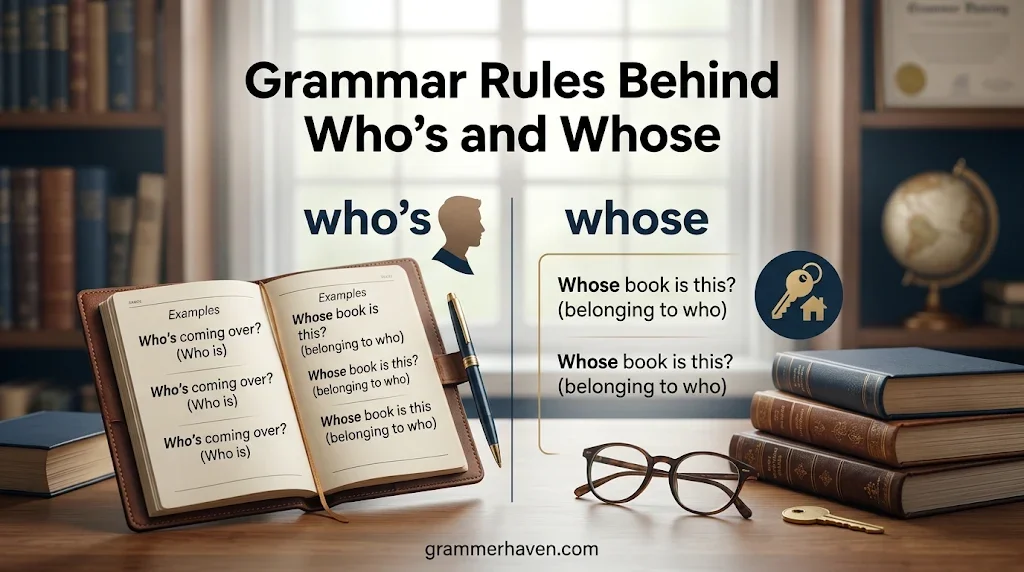
Understanding the grammar makes the distinction easier to remember.
Understanding Contractions
Contractions shorten two words into one.
Examples include:
| Contraction | Full Form |
| Don’t | Do not |
| Can’t | Cannot |
| It’s | It is |
| Who’s | Who is |
| You’re | You are |
The apostrophe replaces missing letters.
Nothing more.
Nothing less.
Understanding Possessive Pronouns
Possessive pronouns show ownership.
Examples:
- Mine
- Yours
- His
- Hers
- Ours
- Theirs
- Whose
These words function independently.
Because they’re already possessive, they don’t need apostrophes.
Similar Grammar Pairs That Cause Confusion
Who’s and whose belong to a larger family of commonly confused words.
It’s vs. Its
- It’s = It is
- Its = Possessive form
Examples:
- It’s raining.
- The company changed its logo.
You’re vs. Your
- You’re = You are
- Your = Possessive form
Examples:
- You’re late.
- Your appointment starts soon.
They’re vs. Their
- They’re = They are
- Their = Possessive form
Examples:
- They’re arriving tonight.
- Their flight lands at six.
Understanding these pairs reinforces the who’s versus whose rule.
Practice Sentences
Try filling in the blanks.
Exercise
- _____ ready to begin?
- _____ backpack is this?
- _____ completed the training?
- _____ responsibility is customer support?
- _____ attending the conference?
- _____ proposal received approval?
- _____ been working on this project?
- _____ office is located downtown?
Answers
- Who’s
- Whose
- Who’s
- Whose
- Who’s
- Whose
- Who’s
- Whose
If you answered correctly, you’ve likely mastered the distinction.
Quick Memory Tricks for Who’s vs. Whose
Sometimes a simple shortcut helps more than a grammar lesson.
Memory Trick: Expand the Contraction
Whenever you see who’s, mentally expand it.
Example:
Who’s here?
Becomes:
Who is here?
Works perfectly.
Memory Trick: Look for Ownership
Ask:
“Does something belong to someone?”
If yes, use whose.
Examples:
- Whose car?
- Whose house?
- Whose decision?
- Whose responsibility?
Ownership equals whose.
Memory Trick: Ignore the Apostrophe
Many people get distracted by punctuation.
Instead, focus on meaning.
The apostrophe doesn’t indicate ownership here.
It indicates a contraction.
That distinction solves the problem.
A Real-Life Editing Example
Consider this sentence from a workplace email:
Who’s report should be submitted first?
At first glance, it may look acceptable.
Apply the test:
Who is report should be submitted first?
The sentence fails immediately.
Now ask the ownership question.
Whose report?
The report belongs to someone.
Therefore, the correct version is:
Whose report should be submitted first?
This simple process takes only a few seconds.
Yet it prevents one of the most common grammar mistakes in English.
See also: Crews vs. Cruise: Understanding the Difference, Meaning, Spelling & Usage
FAQs:
1. What is the difference between who’s and whose?
Who’s means who is or who has, while whose shows ownership or asks who something belongs to. For example, “Who’s coming?” means “Who is coming,” while “Whose bag is this?” asks about ownership.
2. Is who’s a possessive word?
No, who’s is not a possessive word. It is a contraction made by combining who with is or has. The possessive form is whose.
3. How can I easily remember when to use whose?
Use whose when you are talking about ownership or association. If the sentence asks who owns something, whose is usually the correct choice.
4. Can who’s mean who has?
Yes, who’s can mean who has. For example, “Who’s got the keys?” means “Who has got the keys?”
5. Why do people confuse who’s and whose?
People often confuse them because they sound the same when spoken. The apostrophe in who’s represents missing letters, while whose does not use an apostrophe because it already shows possession.
Conclusion:
Understanding the difference between who’s and whose helps you avoid a common English language mistake. While who’s is a contraction of who is or who has, whose is a possessive form that shows ownership or association. A simple way to remember the difference is to check whether you can replace the word with who is or who has. If it works, use who’s; if you are talking about something that belongs to someone, use whose. Mastering this small grammar detail can make your writing and speaking clearer.
Latest Post:
- Is It Correct to Say “A Big Congratulations”? The Complete Grammar Guide
- Two Crows Being an Attempted Murder: Meaning, Origins & Real Behavior
- Farther vs. Further: What’s the Difference?
- Result In or Result To: Which Is Correct? (With Examples)
- A Dime a Dozen: Meaning, Definition, Origin and Real-Life Usage