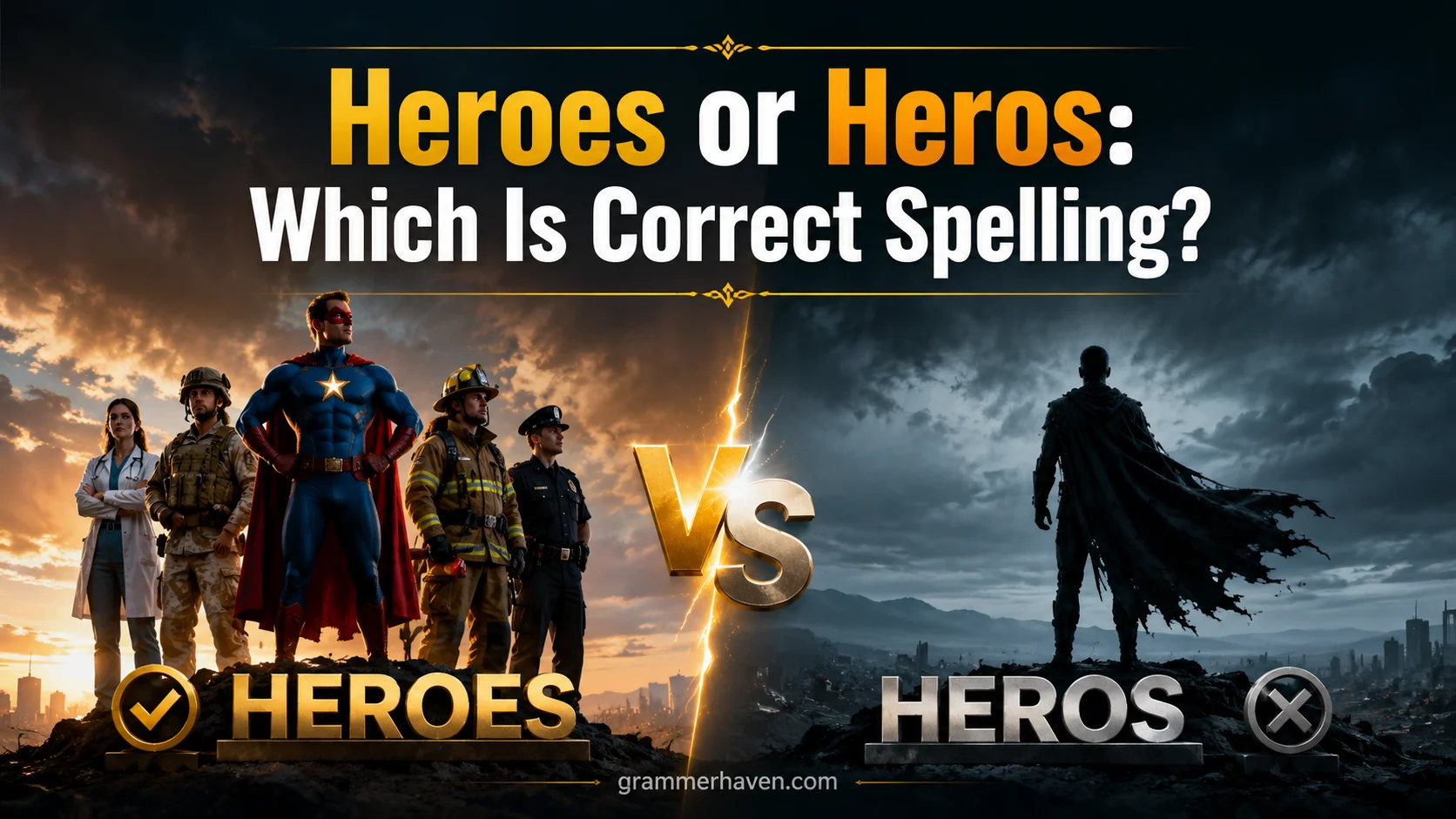
Heroes or Heros: heroes is the correct plural of hero, while heros is incorrect in ordinary English grammar and usage in English.
Hero is the singular noun used for one person admired for courage, noble qualities, or an outstanding achievement. Heroes is the plural form used for two or more people or fictional characters. The spelling follows standard English grammar and plural usage. Examples include firefighters, soldiers, doctors, teachers, famous figures, protagonists, and fictional characters.
Heroes is the standard spelling in ordinary English. Heros is generally a spelling mistake when you mean the plural of hero. The plural rule relates to nouns ending in o. Some nouns take es, including potatoes, tomatoes, and echoes, while others take s, such as pianos and photos. English has exceptions, so each word requires its accepted form.
Heroes can describe people admired for courage, heroic behavior, a heroic act, outstanding achievements, or noble qualities. Books, films, plays, myths, movies, and news stories often feature heroes as protagonists or fictional characters. The word also appears in song titles, including Holding Out for a Hero by Bonnie Tyler and I Need a Hero.
Heros can appear as a valid proper name or scientific term. Heros Notatus is a genus associated with a cichlid family of fish native to South America. Ichthyology, the study of fish, may therefore use Heros as a scientific name. This specialized context differs from ordinary English grammar.
Use heroes when referring to multiple heroic people or characters. Reserve Heros for a specific proper name or scientific term. A dictionary reference such as the Oxford Dictionary can confirm meaning, definition, spelling, and usage. Reference materials, books, exercises, and examples can help you remember the correct form and avoid common spelling mistakes.
Heroes or Heros: Which Spelling Is Correct?
The correct spelling is heroes.
The word heros is considered a spelling mistake when you mean more than one hero. Standard English dictionaries recognize heroes as the plural form.
| Word | Correct or Incorrect | Meaning |
| Hero | ✅ Correct | One person admired for courage or achievements |
| Heroes | ✅ Correct | More than one hero |
| Heros | ❌ Incorrect | Common misspelling of heroes |
The confusion happens because many English words ending in -o simply add -s when they become plural.
Examples:
- Photo → Photos
- Piano → Pianos
- Radio → Radios
Because of those examples, many writers assume:
Hero + s = Heros
However, English does not always follow one simple pattern. The correct plural form developed as:
Hero + es = Heroes
Why Is It Heroes Not Heros?
The reason is connected to English pluralization rules.
When some nouns end with a consonant sound followed by -o, English traditionally adds -es instead of only -s.
The extra e helps create a smoother pronunciation and follows older spelling conventions.
Here are some examples:
| Singular Word | Correct Plural |
| Hero | Heroes |
| Tomato | Tomatoes |
| Potato | Potatoes |
| Echo | Echoes |
| Volcano | Volcanoes |
These words use -es because English speakers have historically treated them differently from words like “photo” or “radio.”
However, English plural rules are not perfectly predictable.
Consider these examples:
| Singular Word | Plural Word |
| Hero | Heroes |
| Photo | Photos |
| Video | Videos |
| Zoo | Zoos |
| Piano | Pianos |
The best approach is to learn common patterns while remembering important exceptions.
What Does Hero Mean?
The word hero describes a person admired for courage, achievements, kindness, or outstanding actions.
Traditionally, a hero was someone who showed exceptional bravery, especially during dangerous situations.
For example:
A firefighter who runs into a burning building to rescue someone may be called a hero.
Today, the meaning has expanded. A hero does not need to perform a dramatic rescue. People often use the word for individuals who make a meaningful difference in everyday life.
Modern examples of heroes include:
- Teachers who dedicate years to helping students succeed
- Doctors and nurses who care for patients
- Volunteers who support their communities
- Parents who sacrifice for their families
- Scientists who solve important problems
A hero is often someone whose actions create a positive impact on others.
Heroes Meaning: Examples and Real-Life Usage
The word heroes refers to multiple people who are admired for their actions, character, or accomplishments.
Here are different ways the word appears in sentences.
Everyday Examples
- The firefighters who rescued the family became local heroes.
- Her parents have always been her biggest heroes.
- Community volunteers became heroes after helping families during the storm.
Historical Examples
Throughout history, many people have been remembered as heroes because they changed societies, defended others, or created progress.
Examples include:
- Civil rights leaders who fought for equality
- Humanitarian workers who helped vulnerable communities
- Explorers who expanded human knowledge
Fictional Examples
Stories often feature heroes who represent courage and justice.
Examples:
- Superheroes fighting villains
- Fantasy heroes completing dangerous quests
- Characters overcoming impossible challenges
A fictional hero does not need superpowers. Many memorable characters become heroes because of their choices.
Common Reasons People Write Heros Instead of Heroes
The mistake “heros” happens for several reasons.
English Plural Rules Are Confusing
English contains many different plural patterns. Even native speakers sometimes make mistakes.
For example:
- Child → Children
- Person → People
- Mouse → Mice
Words ending in -o create similar confusion.
Someone may remember:
- Photo → Photos
Then they incorrectly apply the same rule:
- Hero → Heros ❌
The correct spelling requires remembering that hero belongs with words like tomato and potato.
The Extra E Is Easy to Miss
When people hear the word spoken aloud, they may not notice the spelling difference.
Compare:
- Hero
- Heroes
The pronunciation changes slightly, but the written difference is easier to see than hear.
The plural form contains:
Hero + es = Heroes
Fast Typing Creates Mistakes
Online writing encourages speed. A missing letter can happen easily.
Common examples include:
- Their → There
- Your → You’re
- Heroes → Heros
Spell-check tools catch many errors, but not every mistake appears immediately, especially in informal writing.
Heroes vs Hero’s vs Heroes’: Understanding the Difference
Many people confuse heroes, hero’s, and heroes’ because they look similar.
They have different meanings.
| Word | Meaning | Example |
| Hero | One person | The firefighter is a hero. |
| Heroes | More than one person | The firefighters are heroes. |
| Hero’s | Something belonging to one hero | The hero’s story inspired people. |
| Heroes’ | Something belonging to multiple heroes | The heroes’ achievements were celebrated. |
Examples Explained
Hero
Use hero when talking about one person.
She became a hero after saving the child.
Only one person is being discussed.
Heroes
Use heroes when discussing multiple people.
The rescue workers were heroes after the earthquake.
Several people earned admiration.
Hero’s
Use hero’s when something belongs to one hero.
The hero’s decision changed the outcome.
The decision belongs to one hero.
Heroes’
Use heroes’ when something belongs to multiple heroes.
The heroes’ stories continue to inspire future generations.
The stories belong to several heroes.
Is Heros Ever Correct?
In normal English writing, heros is not the correct plural form of hero.
However, the word may appear in unusual situations where it is part of a name, title, username, or brand.
For example:
- A company might intentionally use “Heros” as a brand name.
- A fictional location might have a unique spelling.
In those cases, the spelling is part of a specific name rather than a grammar rule.
When writing about multiple courageous people, achievements, or fictional characters, use:
heroes
How to Remember the Correct Spelling of Heroes
Remembering heroes not heros becomes easier with a few simple tricks.
Trick One: Break the Word Apart
Think of it as:
Hero + es = Heroes
The word keeps the original spelling and adds -es.
Trick Two: Remember Similar Words
Group these words together:
- Hero → Heroes
- Potato → Potatoes
- Tomato → Tomatoes
They all use -es.
Trick Three: Use a Sentence Memory Trick
Try remembering:
“My heroes need an extra E.”
The phrase itself reminds you that heroes contain an extra e.
Examples of Heroes in Popular Culture
The idea of heroes appears across books, movies, history, and everyday life.
Superheroes
Characters such as superheroes often represent courage, responsibility, and justice.
Common examples include:
- Characters who protect cities
- Individuals who fight injustice
- People who use special abilities to help others
The word superheroes follows the same spelling rule:
- Superhero → Superheroes
Not:
- Superheros ❌
Everyday Heroes
Many heroes never appear in newspapers or movies.
Examples include:
- A neighbor helping during an emergency
- A teacher changing a student’s future
- A volunteer supporting people in need
Heroism often comes from ordinary actions performed with extraordinary care.
Heroes Not Heros: Common Grammar Mistakes to Avoid
Here are some related mistakes writers often make.
| Incorrect | Correct |
| Heros | Heroes |
| Superheros | Superheroes |
| Zeroes (sometimes written incorrectly as zeros depending on context) | Depends on usage |
| Potato’s | Potatoes |
Remember:
- Apostrophes do not create plurals.
- Adding -s does not work for every word.
- Always check unusual plural forms.
See also: Every Day or Everyday? Meaning, Usage & Examples
FAQs:
1. Is Heroes or Heros correct?
Heroes is the correct plural form of hero in standard English. Heros is generally incorrect when referring to more than one heroic person or character.
2. What is the plural of hero?
The plural of hero is heroes. For example: “The firefighters were heroes.”
3. Why is heros incorrect?
English uses -es to form the plural of hero. Therefore, hero becomes heroes, not heros.
4. What does heroes mean?
Heroes refers to more than one person admired for courage, bravery, noble qualities, or outstanding achievements.
5. Is Heros ever a correct word?
Yes. Heros can appear as part of a proper name or scientific name, such as Heros, a genus of cichlid fish. It isn’t the normal plural of hero.
6. Is heroes used in both UK and US English?
Yes. Heroes is the standard plural form in both UK and US English.
7. What is the singular form of heroes?
The singular form is hero. One person is a hero, while two or more people are heroes.
8. How can I remember the spelling of heroes?
Remember this simple pattern: hero → heroes. The plural adds -es, not just -s.
9. Can heroes refer to fictional characters?
Yes. Heroes can describe fictional characters in books, movies, plays, myths, and other stories.
10. Is “They are my heroes” grammatically correct?
Yes. “They are my heroes” is grammatically correct because they refers to more than one person, making heroes the appropriate plural form.
Conclusion:
Heroes is the correct plural form of hero, while heros is normally a spelling mistake in standard English. The rule is simple: hero → heroes. Use heroes when talking about more than one person admired for courage, bravery, or noble qualities. Remembering this form will help you write with greater confidence in essays, articles, academic work, and everyday communication.