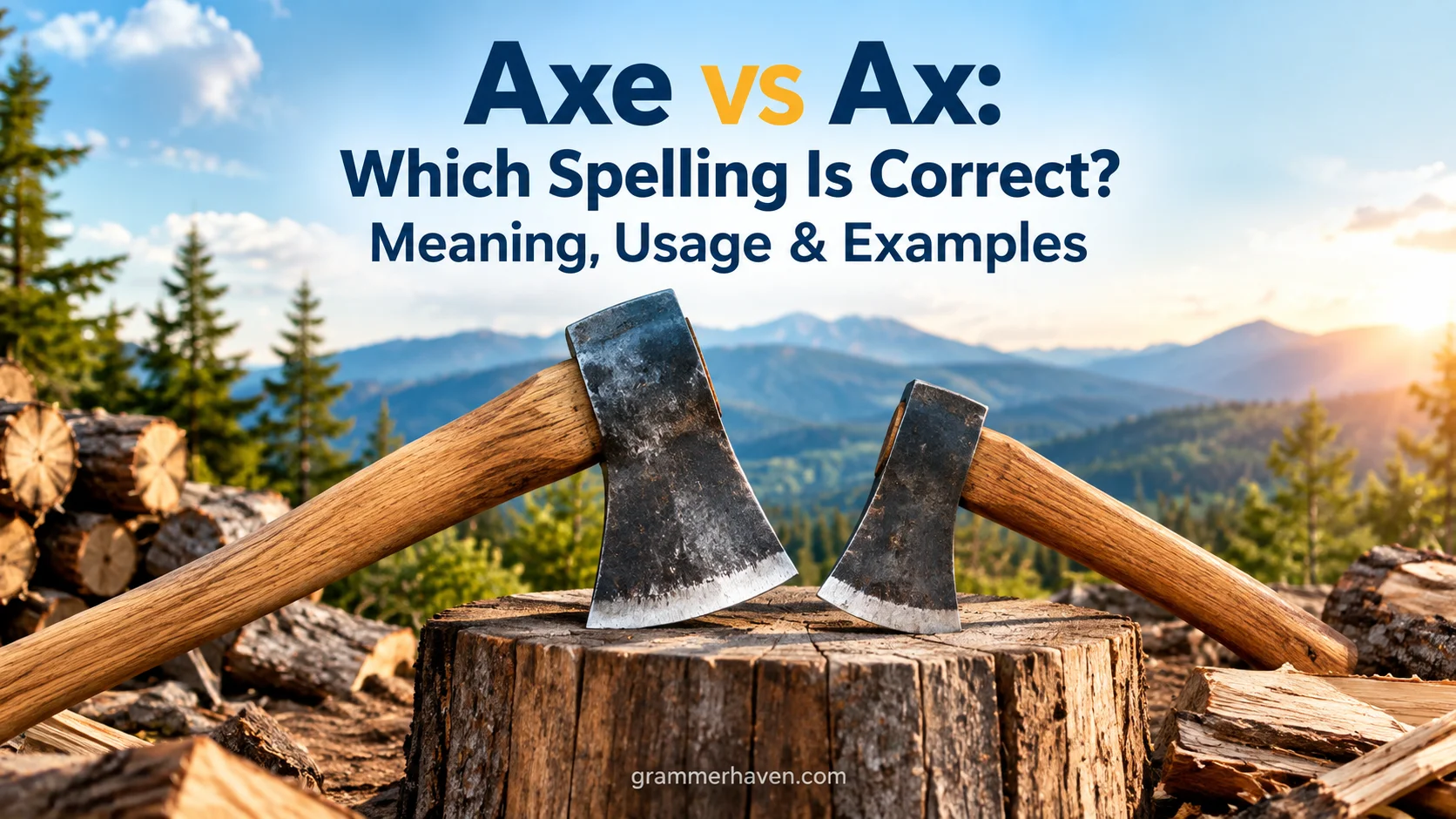
Axe vs Ax are both correct spellings for the same word, with the main difference being regional preference rather than meaning or pronunciation. In American English, ax is a common form, while axe is also accepted by major American dictionaries.
In British English, axe is more familiar. Both forms describe the same tool and can work as a noun or verb, so neither is a misspelling. The choice depends on your style, audience, and regional writing preference. Writers, students, and professionals can avoid confusion by choosing one form and using each consistently.
Both spellings also appear in familiar expressions, including have an axe to grind and get the axe. The truth is that both spellings are right in standard usage, and understanding this small difference helps readers understand the real usage without becoming confused.
Axe vs Ax: Quick Answer
Axe and ax are both correct.
They have the same basic meaning, pronunciation, and grammatical functions. The main difference is spelling preference, particularly across different varieties of English.
| Question | Answer |
| Is axe correct? | Yes |
| Is ax correct? | Yes |
| Do they mean the same thing? | Yes |
| Are they pronounced differently? | No |
| Is axe used in British English? | Yes, commonly |
| Is ax used in American English? | Yes |
| Is axe also used in American English? | Yes |
| Can both work as verbs? | Yes |
| Is the plural of both axes? | Yes |
Merriam-Webster specifically identifies ax as a variant spelling of axe and states that both forms are correct. It also notes that axe is more common in the United States as well as elsewhere.
Cambridge similarly lists axe with ax as an alternative US form and gives the same pronunciation for both.
In other words, the extra e doesn’t turn one word into another. It’s simply part of an accepted spelling variation.
What Does Axe or Ax Mean?
At its most literal, an axe or ax is a cutting tool with a heavy blade attached to a handle. People traditionally use it to cut, chop, split, or shape wood.
For example:
- He used an axe to chop firewood.
- She picked up an ax from the shed.
- The carpenter sharpened his axe before working.
- The woodsman carried an ax over his shoulder.
All four sentences are grammatically correct.
The word can also have broader meanings. Dictionaries recognize figurative uses involving dismissal, cancellation, and drastic reduction.
For example:
The company axed several unnecessary projects.
Here, axed doesn’t mean someone literally chopped a project with a tool. It means the company eliminated or canceled those projects.
That figurative sense has become especially common in business, journalism, politics, and entertainment.
Is Ax a Correct Spelling?
Yes. Ax is a completely legitimate English spelling.
You don’t need to add an e to make it a real word. Merriam-Webster lists ax as a variant spelling of axe, with definitions covering the physical tool as well as figurative meanings such as dismissal and elimination.
This sometimes surprises readers because axe looks more familiar. However, familiarity isn’t the same thing as correctness.
Consider these examples:
- He swung the ax at the fallen branch.
- The ax was hanging beside the fireplace.
- The company gave 300 workers the ax.
- The committee decided to ax the proposal.
Each sentence uses ax correctly.
Why Does Ax Look Shorter?
The shorter form simply removes the final e. English has many spelling variants that developed through different historical and editorial preferences.
In this case, the shorter form has a particularly interesting American connection. Noah Webster, whose dictionaries strongly influenced American spelling, preferred ax. Merriam-Webster notes that his 1828 dictionary included ax and described axe as an improper spelling.
Webster’s preference fits a broader pattern in his approach to American spelling. He often favored shorter forms when he believed they were more efficient or better suited to American usage.
Interestingly, axe didn’t disappear. The longer spelling remained widespread and eventually became more common overall.
Is Axe Correct in American English?
Absolutely.
One of the most persistent myths about axe vs ax is that axe is British and ax is American. That’s too simple.
American English accepts both forms.
Merriam-Webster explicitly says that axe is more common both in the United States and elsewhere. Its dictionary entry lists ax as a variant.
Cambridge’s American dictionary information also recognizes axe and ax.
So you can write:
The firefighter carried an axe.
You can also write:
The firefighter carried an ax.
Neither sentence contains a spelling error.
Which Form Should Americans Use?
If you’re writing for an American audience, you can use either spelling. However, consistency matters.
If your article starts with ax, don’t randomly switch to axe several paragraphs later unless you’re discussing the spelling difference itself.
For professional writing, follow the relevant house style or editorial guide. If no particular style applies, choose the form that best fits your audience and maintain it throughout the piece.
Is Axe the British English Spelling?
Yes. Axe is the standard form in British English.
Cambridge lists axe as the main entry and identifies ax as the US form. Its pronunciation information gives both versions the same sound: /æks/.
Oxford’s Advanced Learner’s Dictionary likewise gives axe as the British English form while identifying ax with US English.
Therefore, if you’re writing specifically in British English, axe is usually the safer choice.
For example:
- The workers used an axe to cut the wood.
- The government plans to axe several programs.
- Hundreds of employees are facing the axe.
These forms fit standard British usage.
Why Are There Two Spellings: Axe vs Ax?
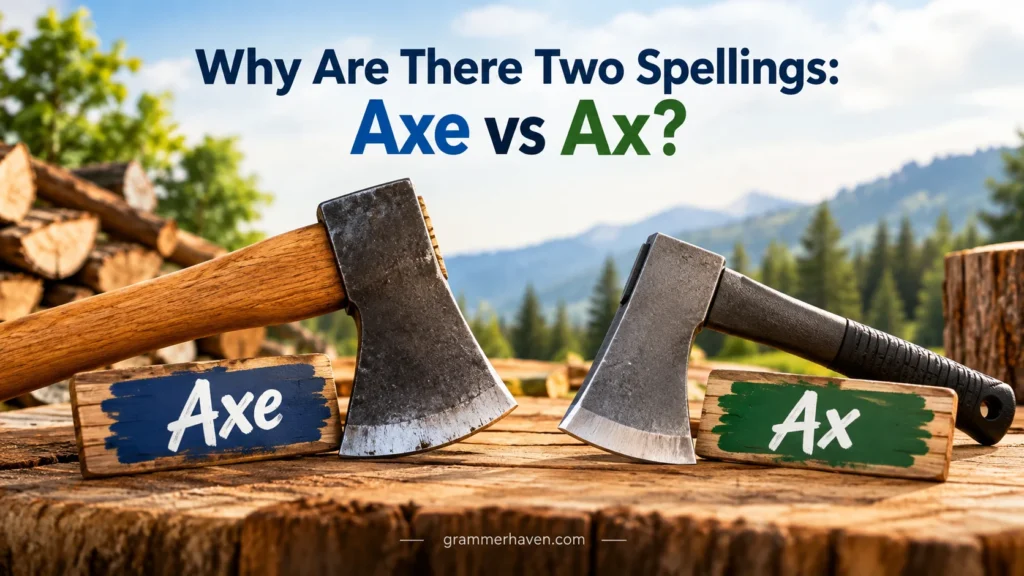
The story goes back much further than modern American and British English.
The word has ancient Germanic roots. Merriam-Webster traces axe to Middle English and Old English forms, while Oxford’s etymological discussion connects the word with Old English æx and related forms found across Germanic languages.
The spelling has changed over centuries. English spelling wasn’t always standardized in the way it is today, so historical texts contain several related forms.
Oxford’s discussion points to Old English forms such as æx and eax, alongside related forms in other Germanic languages.
The modern distinction between ax and axe, therefore, isn’t a case of one form being invented recently. Both belong to a long history of variation in English spelling.
Noah Webster and the Spelling Ax
The American spelling story becomes especially interesting with Noah Webster.
In his 1828 dictionary, Webster included ax and criticized axe as an unnecessary spelling. Merriam-Webster documents this directly in its discussion of the two forms.
His reasoning reflected his broader interest in simplifying American English spelling.
Yet language doesn’t always follow the plans of dictionaries. Despite Webster’s preference, axe remained firmly established, and it is now the more common spelling overall according to Merriam-Webster.
That’s an important lesson about English: dictionaries record usage, but writers and speakers ultimately shape that usage.
Axe vs Ax Pronunciation
There is no pronunciation difference between axe and ax.
Both are pronounced:
/æks/
The sound is roughly the same as the word “acts” without the t.
Cambridge gives both UK and US pronunciations of axe as /æks/.
The final e in axe doesn’t create another syllable.
A Simple Pronunciation Breakdown
axe → /æks/
- /æ/ as in cat
- /k/ as in cat
- /s/ as in say
So don’t pronounce axe as two syllables. It’s a single-syllable word.
The spelling may differ, but your mouth doesn’t have to change gears.
Axe vs Ax as a Noun
As a noun, axe and ax refer to the same physical tool.
An axe typically consists of:
- A handle, traditionally made from wood or another durable material
- A heavy head
- A sharpened cutting edge
- A design suited to chopping, splitting, cutting, or felling
Different axe designs serve different purposes. A small hatchet, for example, works well for lighter cutting tasks, while larger felling axes are designed for cutting down trees.
The exact shape and size vary according to the job.
Examples of Axe or Ax as a Noun
- The ax was too heavy for the child to lift.
- He sharpened his axe before cutting the logs.
- An old axe hung above the fireplace.
- She bought a new ax for splitting firewood.
Again, the spelling doesn’t change the meaning.
Axe vs Ax as a Verb
Both axe and ax can also function as verbs.
In the literal sense, the verb means to cut, chop, or sever with an axe or ax.
For example:
The workers axed the branches from the tree.
The word has also developed a common figurative meaning: to eliminate, cancel, dismiss, or drastically reduce something.
Cambridge defines the verb in this sense as reducing or ending services, jobs, payments, or similar things, often suddenly.
Common Figurative Uses
You might see either spelling in expressions involving:
- Axing jobs
- Axing employees
- Axing a television show
- Axing a project
- Axing a service
- Axing a budget
- Axing unnecessary expenses
- Axing a proposal
For example:
The network axed the show after one season.
Or:
The network axed several expensive programs.
Both sentences are natural.
Oxford also records axe as a verb meaning to get rid of a service, system, or job, particularly in British English.
What Is the Plural of Ax and Axe?
Here’s where another spelling question often appears.
The plural of both ax and axe is axes.
So:
- one ax → two axes
- one axe → two axes
Merriam-Webster lists axes as the plural of axe.
Why Is “Axes” Confusing?
Because axes has another meaning.
In mathematics, geometry, and related fields, axes is also the plural of axis.
For example:
The graph has two axes.
Here, axes means the horizontal and vertical reference lines.
Compare that with:
The lumberjack carried two axes.
Here, axes means two cutting tools.
The spelling is identical, but context reveals the meaning.
| Singular | Plural | Meaning |
| ax | axes | Cutting tools |
| axe | axes | Cutting tools |
| axis | axes | Reference lines or rotational lines |
This is a classic example of English allowing one spelling to carry multiple meanings.
Common Expressions With Axe and Ax
The word appears in several familiar expressions.
Have an Axe to Grind
“Have an axe to grind” means to have a personal motive, grievance, or hidden interest in a matter.
For example:
She clearly has an axe to grind against the company.
The phrase can suggest that someone isn’t arguing purely from principle. They have something personal at stake.
The shorter spelling works too:
He seems to have an ax to grind.
Both are correct.
Get the Axe or Get the Ax
“Get the axe” or “get the ax” means to lose a job or face cancellation.
For example:
Several employees got the axe after the company announced major cuts.
It can also refer to programs, services, projects, or plans:
The television series got the axe after declining ratings.
Cambridge specifically documents get the axe and get the ax for situations involving job loss or the cancellation of services and plans.
Take an Axe to Something
“Take an axe to something” means to make severe cuts or reductions.
For example:
The new administration took an axe to unnecessary spending.
The expression is figurative. Nobody needs to bring an actual chopping tool into the budget meeting.
Axe vs Ax: A Practical Usage Guide
The best spelling depends partly on your audience and partly on the style you’re following.
| Situation | Best choice |
| British English | Axe |
| American English | Ax or axe |
| International English | Axe is widely recognizable |
| Formal professional writing | Follow your style guide |
| Journalism | Follow the publication’s style |
| Academic writing | Follow the required style |
| Casual writing | Either form is correct |
| SEO content | Choose a primary form and mention the variant naturally |
The important point is that correctness and preference aren’t the same thing.
A publisher may prefer ax. That doesn’t make axe wrong. Likewise, a British editor may strongly prefer axe. That doesn’t make ax an invalid English word.
Should You Use Ax or Axe in American English?
If you’re writing American English, either form is acceptable.
However, ax has a distinctly American spelling tradition, while axe remains common in the United States. Merriam-Webster specifically warns against assuming that ax is simply the American equivalent of British axe.
A practical approach is simple:
Use the spelling your publication or organization prefers. If there isn’t a style requirement, choose one and stay consistent.
For example, if an American publication uses ax, write:
The carpenter grabbed his ax.
Don’t switch unnecessarily to:
The carpenter sharpened his axe.
Consistency makes writing look deliberate rather than accidental.
Common Mistakes With Axe vs Ax
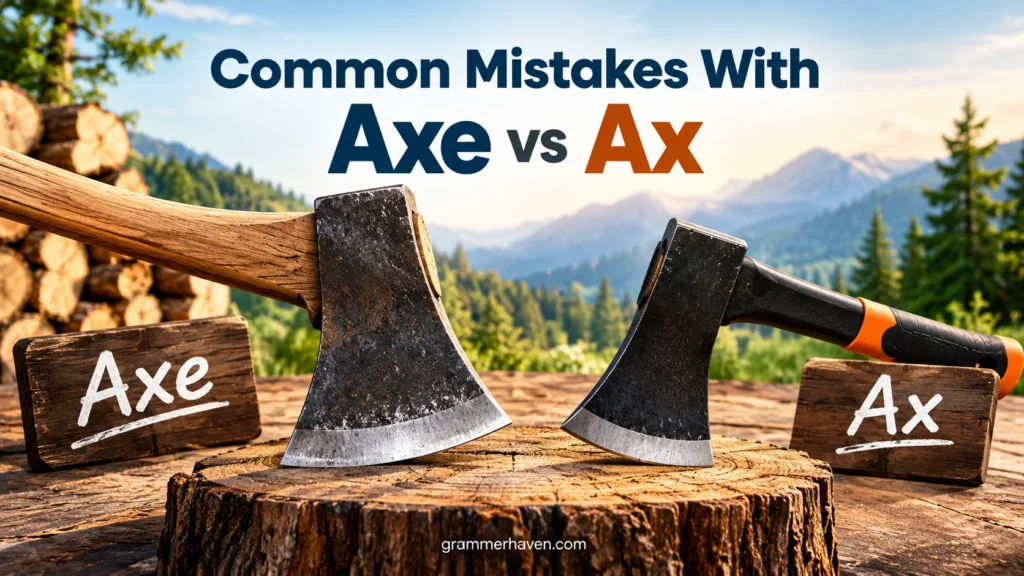
Mistake: Saying “Ax” Is Incorrect
This is the biggest error.
Ax is correct. Major dictionaries recognize it as a legitimate variant.
Mistake: Saying “Axe” Is Only British
That’s also incorrect.
Axe is used in American English, and Merriam-Webster says it is actually more common overall than ax.
Mistake: Assuming They Have Different Pronunciations
They don’t.
Both are pronounced /æks/.
Mistake: Treating Them as Different Tools
An ax isn’t a special American version of an axe.
The two spellings refer to the same basic tool.
Mistake: Switching Between Them Randomly
Using both forms in the same article can make your spelling look inconsistent.
If you’re not specifically discussing the difference between the forms, pick one and stick with it.
Mistake: Confusing Axes With Axis
Remember:
- axes = plural of ax/axe
- axes = plural of axis
Context determines which meaning applies.
Axe vs Ax: Examples in Sentences
Seeing both forms side by side makes the distinction easier.
Literal Examples
- He used an axe to split the logs.
- He used an ax to split the logs.
- The old axe had a wooden handle.
- The old ax had a wooden handle.
- She stored the axe in the shed.
- She stored the ax in the shed.
Figurative Examples
- The company axed several unprofitable projects.
- The company axed several unprofitable projects.
- Many employees feared they would get the axe.
- Many employees feared they would get the ax.
- The network gave the show the axe.
- The network gave the show the ax.
The examples demonstrate an important point: the meaning remains unchanged when the spelling changes.
Axe vs Ax: Key Differences at a Glance
| Feature | Axe | Ax |
| Correct spelling | Yes | Yes |
| Same meaning | Yes | Yes |
| Pronunciation | /æks/ | /æks/ |
| Noun | Yes | Yes |
| Verb | Yes | Yes |
| British English | Common standard form | Less common |
| American English | Accepted | Accepted |
| Plural | Axes | Axes |
| Figurative meaning | Yes | Yes |
| Historical roots | Old English/Germanic | Old English/Germanic |
| Main distinction | Spelling | Spelling |
Dictionary evidence supports the basic conclusion: these aren’t two different words competing for the same definition. They’re accepted spelling variants of the same word.
A Note About “Axe” as a Musical Instrument
There’s another interesting meaning worth knowing.
In informal English, axe or ax can refer to a musical instrument, particularly a guitar or saxophone.
Cambridge lists this slang meaning and gives examples involving electric guitars and saxophones.
For example:
The guitarist picked up his axe before the performance.
This usage has nothing to do with chopping wood. It’s a piece of music slang that developed around the idea of an instrument as a musician’s primary tool.
So the word can move from the forest to the stage without changing its spelling rules.
Final Verdict: Axe or Ax?
Both “axe” and “ax” are correct.
If you’re writing British English, axe is the standard choice. If you’re writing American English, ax and axe are both accepted, although ax has a particularly strong American spelling tradition. Merriam-Webster notes that axe is more common overall, including in the United States.
The two forms:
- Mean the same thing
- Have the same pronunciation
- Can function as nouns
- Can function as verbs
- Have the plural axes
- Work in figurative expressions
- Differ primarily in spelling preference
So, when should you use each one?
Choose “axe” if you’re following British English or simply prefer the more widely familiar form.
Choose “ax” if you’re following an American style that favors the shorter spelling.
Above all, be consistent.
Whether you write axe or ax, the word still describes the same tool. The only thing getting chopped is the extra letter.
See also: Has or Have: Which Is Correct? Rules, Examples & Mistakes
FAQs:
Is “ax” a correct spelling?
Yes. Ax is a correct English spelling and is recognized by major dictionaries as a variant of axe.
Is “axe” a correct spelling?
Yes. Axe is completely correct and remains the more common spelling overall according to Merriam-Webster.
Is ax American or British?
Ax is strongly associated with American English, although it isn’t exclusively American. British English generally favors axe.
Is axe American English?
Yes. Axe is used in American English and isn’t a British-only spelling.
Which is more common, ax or axe?
Axe is more common overall, according to Merriam-Webster’s comparison of the two forms.
Do ax and axe mean the same thing?
Yes. They refer to the same cutting tool and share the same major figurative meanings.
Are ax and axe pronounced differently?
No. Both are pronounced /æks/.
What is the plural of ax?
The plural is axes.
What is the plural of axe?
The plural is also axes.
Can ax be used as a verb?
Yes. Ax can mean to cut with an ax or to eliminate something abruptly.
Can axe be used as a verb?
Yes. Axe can mean to cut, eliminate, cancel, dismiss, or drastically reduce something.
Is “have an ax to grind” correct?
Yes. “Have an ax to grind” is a valid spelling of the idiom. “Have an axe to grind” is also correct.
Is “get the axe” correct?
Yes. “Get the axe” means to lose a job or have something canceled. The American variant “get the ax” is also correct.
Which spelling should you use?
Use axe for standard British English. In American English, either ax or axe works. If a publication, employer, school, or style guide specifies one form, follow that preference.
Conclusion:
In conclusion, Axe vs Ax is mainly a matter of regional spelling, not meaning. Both axe and ax are correct spellings for the same word, with ax commonly used in American English and axe more common in British English. Choose the form that matches your audience or writing style, then use it consistently. Understanding this simple difference helps writers, students, and professionals avoid unnecessary confusion.