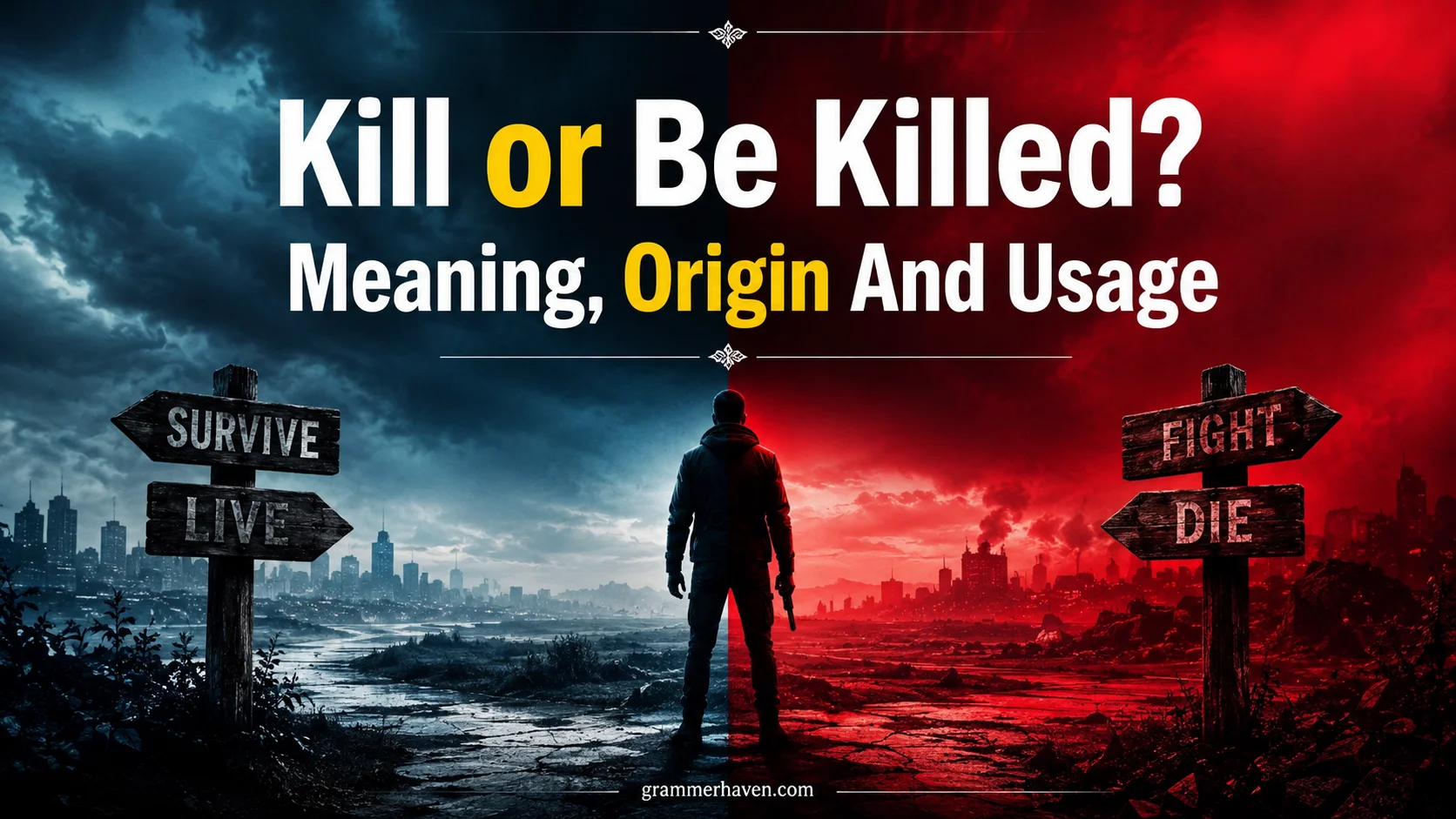
Kill or Be Killed? Meaning, Origin And Usage explains a strong, intense, dramatic English phrase about survival, danger, competition, pressure, and defeat.
Kill or Be Killed describes a situation where someone must act, survive, win, or avoid complete defeat. Its literal meaning involves real danger, death, and survival. Its figurative meaning appears more often in everyday English. As a metaphorical idiom, it can describe pressure, fierce competition, conflict, struggle, or a ruthless environment. Readers may encounter the phrase in movies, books, news articles, essays, blogs, and discussions. The origin and history of the expression relate to life or death, danger, threat, urgency, and the human survival instinct. Its purpose can describe a competitive environment where people must perform well under extreme pressure. The difference between literal and figurative use matters for interpretation and clarity.
For correct use, consider the grammar, meaning, and context. The expression can describe survival and winning through surrounding ideas, comparison, and a descriptive phrase. This helps readers understand the correct usage and use the expression naturally and appropriately. Literal language makes the distinction clear. The expression’s meaning depends on its context, setting, and intended interpretation.
What Does Kill or Be Killed Mean?
“Kill or be killed” means that a person, group, or organization must succeed in a difficult situation because failure could lead to serious consequences.
You either overcome the challenge or the challenge defeats you.
The expression comes from the basic idea of survival:
If you do not protect yourself, someone or something else may overpower you.
In modern conversations, people rarely use the phrase literally. Instead, they use it to describe intense competition, high-pressure decisions, and situations where adaptation becomes necessary.
For example:
- A startup company fighting for customers in a crowded market may describe the industry as kill or be killed.
- A professional athlete competing for a championship may enter a kill-or-be-killed mindset.
- A student preparing for a highly competitive exam may feel like they must give everything they have to succeed.
The phrase creates a picture of urgency. It tells people that standing still may not be enough.
The Literal Meaning of Kill or Be Killed
At its most direct level, “kill or be killed” refers to a survival situation where one side must defeat another to survive.
Throughout history, humans have faced situations where survival depended on:
- Defense against threats
- Competition for resources
- Strategic decisions
- Physical strength
- Quick reactions
In these situations, hesitation could have serious consequences.
For example, soldiers in combat have historically faced life-or-death choices. Hunters in dangerous environments had to understand risks. Communities competing for limited resources often needed strategies to survive.
The literal meaning focuses on physical survival.
However, everyday speakers usually use the phrase in a completely different way.
The Figurative Meaning of Kill or Be Killed
Today, “kill or be killed” usually describes competitive pressure rather than actual violence.
People use it when they want to emphasize that a situation is extremely demanding.
The phrase often appears in areas such as:
| Area | Example of Usage |
| Business | “The smartphone market is a kill-or-be-killed industry.” |
| Sports | “The playoffs are a kill-or-be-killed situation.” |
| Career | “The job market feels like kill or be killed right now.” |
| Education | “Medical school admissions can feel like a kill-or-be-killed competition.” |
| Personal growth | “Building a business requires a kill-or-be-killed level of commitment.” |
The expression highlights a competitive reality:
People who adapt, improve, and respond quickly often have an advantage over those who refuse to change.
Think of it like a race where everyone keeps improving their speed. If one runner stops training, they do not stay in the same position. They fall behind.
That is the idea behind the phrase.
The Psychology Behind the Kill or Be Killed Mindset
The phrase connects with a powerful human instinct: survival.
When people face uncertainty, their brains naturally focus on protection and problem-solving.
This mindset often includes:
- Strong motivation
- Increased focus
- Greater willingness to take risks
- Determination to overcome obstacles
- A desire to improve
For example, an entrepreneur launching a new company may feel intense pressure. Competitors already exist. Customers have limited attention. Money may run out.
That pressure can create two different outcomes:
- The entrepreneur becomes more creative and disciplined.
- The entrepreneur becomes overwhelmed and makes poor decisions.
The mindset itself is not automatically good or bad. The results depend on how someone uses it.
Origin and History of Kill or Be Killed
The exact origin of the phrase “kill or be killed” is difficult to trace to one specific person or moment. Similar ideas have existed throughout human history because survival competition is a universal concept.
The idea appears in many forms:
- Ancient warfare strategies
- Survival philosophies
- Political conflicts
- Economic competition
- Natural selection discussions
Humans have long understood that adaptation often determines survival.
The phrase became more common in modern language because it effectively summarizes intense competition.
It captures a simple but powerful idea:
When circumstances become difficult, those who adapt often have the best chance of moving forward.
How the Phrase Evolved Over Time
Originally, expressions about killing and survival often referred to literal danger.
Over time, people began applying survival language to everyday challenges.
For example:
Earlier Meaning:
A warrior facing an enemy on a battlefield.
Modern Meaning:
A company fighting to stay relevant in a changing industry.
The technology industry provides a clear example.
Companies that once dominated markets have disappeared because they failed to adapt.
Examples include:
| Company | Industry Change | Lesson |
| Blockbuster | Streaming services replaced video rentals | Businesses must adapt to new technology |
| Kodak | Digital photography changed the market | Innovation matters more than past success |
| Nokia | Smartphone competition transformed mobile phones | Market leadership can disappear quickly |
These examples show why people use survival language when discussing business.
Similar Phrases to Kill or Be Killed
Many expressions share a similar idea but carry different meanings and emotional tones.
| Phrase | Meaning | Tone |
| Survival of the fittest | Those who adapt succeed | Scientific |
| Sink or swim | You must succeed independently | Motivational |
| Dog eat dog | Extremely competitive environment | Negative |
| Eat or be eaten | Act before others take advantage | Aggressive |
| Adapt or fall behind | Change is necessary for success | Professional |
| Rise to the challenge | Face difficulties positively | Encouraging |
Understanding these differences helps you choose the right phrase for the situation.
For example, saying:
“The startup world is kill or be killed.”
sounds much more intense than:
“The startup world requires constant adaptation.”
Both communicate competition, but the emotional impact is different.
Kill or Be Killed vs. Survival of the Fittest
Although these phrases sound similar, they are not exactly the same.
Kill or Be Killed
This phrase focuses on:
- Immediate competition
- Direct conflict
- High pressure
- Winning or losing
Example:
“The final tournament match felt like kill or be killed.”
The focus is on defeating an opponent.
Survival of the Fittest
This phrase focuses on:
- Long-term adaptation
- Natural selection
- Ability to adjust
- Environmental changes
Example:
“In the business world, survival of the fittest often means companies must innovate.”
The difference is simple:
Kill or be killed focuses on the battle. Survival of the fittest focuses on adaptation.
Kill or Be Killed vs. Sink or Swim
These phrases both describe challenging situations, but their emotional meanings differ.
Sink or Swim
This phrase means:
You must succeed through your own effort because nobody will rescue you.
Example:
“After graduating, she entered the workforce and had to sink or swim.”
It does not necessarily involve competition.
Kill or Be Killed
This phrase suggests:
- An opponent exists
- Competition is intense
- Failure feels unavoidable
Example:
“The company entered a kill-or-be-killed market.”
The phrase creates a more aggressive image.
Kill or Be Killed in Business and Entrepreneurship
The business world frequently uses “kill or be killed” language because companies constantly compete for:
- Customers
- Market share
- Investors
- Talent
- Innovation
Modern industries change quickly. A company that ignores trends can lose its position.
Consider artificial intelligence.
Companies investing heavily in AI technology are racing to build better tools, improve efficiency, and attract users. Organizations that fail to adapt may struggle to compete.
However, successful businesses do not simply destroy competitors. Many succeed by:
- Creating better products
- Understanding customers
- Improving operations
- Building strong teams
- Solving real problems
The healthiest interpretation of the phrase is not:
“Destroy everyone else.”
It is:
“Keep improving because the world will continue changing.”
Kill or Be Killed in Sports
Sports provide one of the clearest examples of this mindset.
Athletes train for years because competition rewards preparation.
A championship match often creates a situation where:
- One team advances
- One team goes home
- One athlete wins
- One athlete loses
This creates a natural kill-or-be-killed atmosphere.
However, elite athletes understand something important:
The best competitors do not only focus on defeating others. They focus on improving themselves.
Examples:
- Better training routines
- Stronger mental preparation
- Improved strategies
- Recovery methods
- Performance analysis
The phrase represents intensity, but excellence comes from discipline.
See also: To That Effect or Affect: Which One Is Correct?
FAQs:
1. What does “Kill or Be Killed” mean?
“Kill or Be Killed” means you must act to survive, succeed, or avoid defeat. It can describe literal danger or intense competition.
2. Is “Kill or Be Killed” literal or figurative?
It can be both. The literal meaning involves actual danger or death, while the figurative meaning describes pressure, competition, or conflict.
3. Is “Kill or Be Killed” an idiom?
Yes. It often works as an idiomatic expression when used to describe a competitive or difficult situation rather than actual violence.
4. What is the origin of “Kill or Be Killed”?
The expression comes from the basic idea of survival in a dangerous conflict: one side survives while the other faces defeat or death.
5. Is “Kill or Be Killed” grammatically correct?
Yes. The structure uses two contrasting clauses, kill and be killed, to show that someone must act or face the consequences.
6. Can “Kill or Be Killed” describe competition?
Yes. People often use it figuratively for sports, business, careers, and other situations where competition feels extremely intense.
7. Does “Kill or Be Killed” always sound violent?
No. The phrase has a naturally aggressive tone, but speakers often use it metaphorically to describe pressure or fierce competition.
8. Can I use “Kill or Be Killed” in formal writing?
You can, but consider the context. The phrase may sound dramatic or aggressive, so a more neutral expression may work better in some formal settings.
9. What is an example of “Kill or Be Killed”?
You might say, “The final match felt like kill or be killed,” meaning both teams were determined to win and avoid defeat.
10. What is the difference between “Kill or Be Killed” and “Survival of the Fittest”?
Both can describe survival and competition, but Kill or Be Killed emphasizes immediate conflict or pressure, while Survival of the Fittest focuses more broadly on competition and adaptation.
Conclusion:
Kill or Be Killed is a powerful expression with both literal and figurative uses. It can describe real danger, but it often refers to fierce competition, extreme pressure, conflict, or the need to succeed. Understanding the context, tone, and intended meaning helps you use the phrase naturally and avoid making your writing sound unnecessarily aggressive.