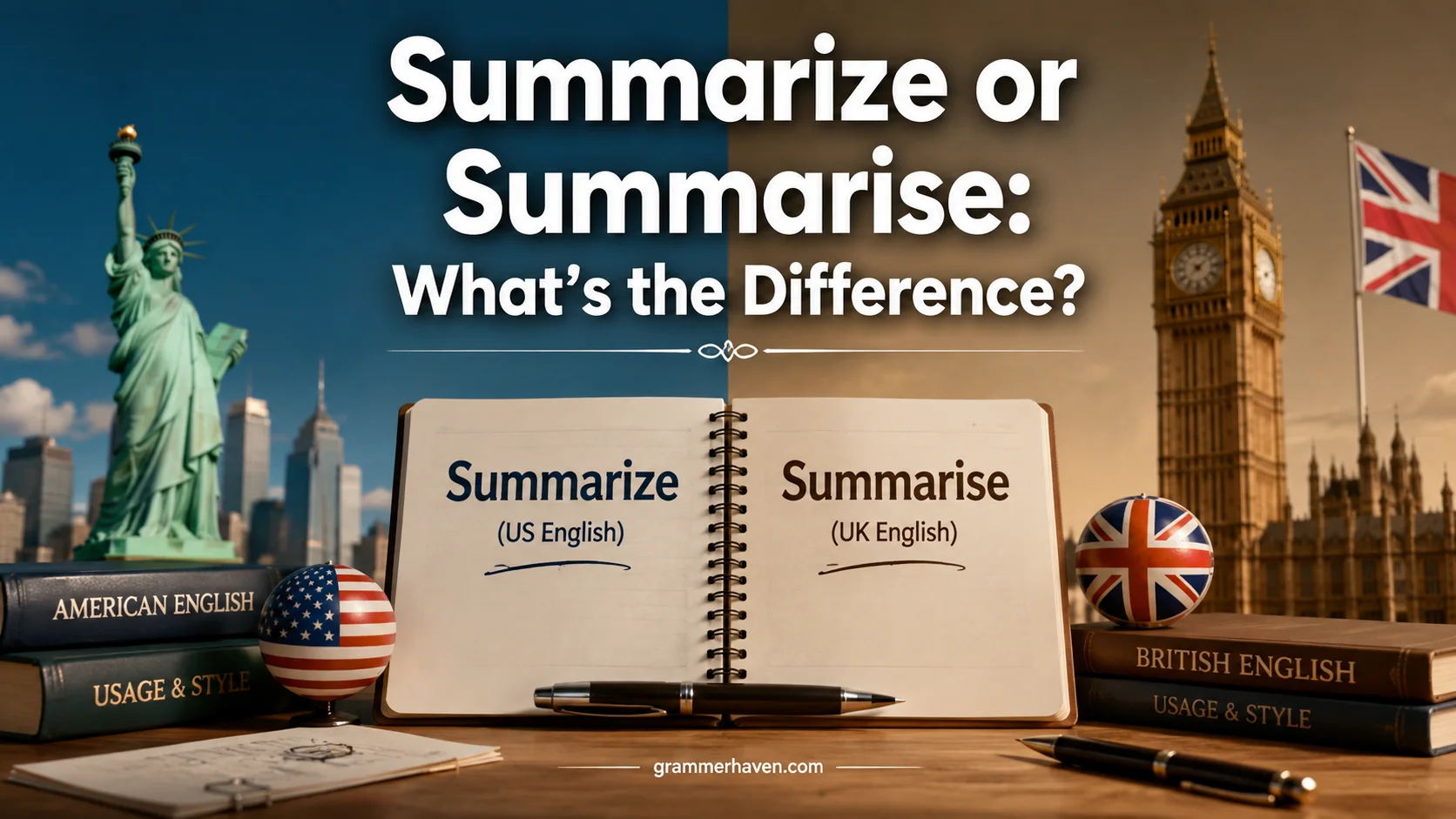
Summarize or Summarise: What’s the Difference? explains why both spellings are correct in English, with usage shaped by regional spelling rules. Summarise and summarize are correct forms with the same meaning, sound, and grammatical function. The difference comes from the variety of English used. American English uses summarize as the standard spelling and usual form. British English uses summarise. This spelling difference appears across countries, affecting people, students, teachers, writers, bloggers, and office workers who see these spellings in books, websites, emails, and school work. English writing, usage, and regional language patterns determine which form fits a particular audience.
Summarize and summarise have the same pronunciation in spoken language. The United States generally uses the -ize ending, producing summarize. The United Kingdom generally uses -ise, producing summarise. UnitedKingdom, and States identify the regional pattern. English includes different varieties of English, and actual usage can differ by region. Neither spelling changes the meaning, pronunciation, or grammatical function. The standard choice depends on the type of English used.
A practical guide is to select one regional form and use it consistently throughout your writing. American English favors summarize; British English favors summarise. Clear rules and examples make the distinction easier. You can summarize a report for a US-based company or summarise a chapter for a UK audience. The key words are summarise, summarize, correct, same meaning, standard spelling, usual, form, simple examples, clear rules, -ize, and -ise. Grammar, spelling, and regional usage should remain consistent.
Summarize or Summarise: The Quick Answer
The simplest answer is:
| Word | Correct Spelling? | Used In |
| Summarize | ✅ Yes | American English |
| Summarise | ✅ Yes | British English, Australian English, New Zealand English, and other regions |
Both words mean:
To give a shorter version of something by keeping only the most important information.
When you summarize or summarise something, you remove unnecessary details while keeping the central ideas.
Think of it like creating a movie trailer.
A full movie may last two hours, but the trailer highlights the most important moments in only a few minutes. A summary works the same way. It gives readers the main message without requiring them to read or watch everything.
Example:
Original information:
The company launched a new product after two years of research and testing. The product uses advanced technology, improves efficiency, reduces costs, and helps customers complete tasks faster.
Summary:
The company launched a new technology-based product designed to improve efficiency and reduce costs.
The summary keeps the important points but removes extra details.
What Does Summarize Mean?
Summarize means to shorten information while preserving the main ideas.
The word is commonly used when someone needs to explain a long piece of information quickly.
You might summarize:
- A book
- A research paper
- A meeting
- A conversation
- A news story
- A presentation
- A video
- A report
In American English, summarize is the preferred spelling.
Examples of Summarize in Sentences
Education:
Students must summarize the chapter before writing their essays.
Business:
The manager asked Sarah to summarize the client feedback.
Technology:
Artificial intelligence tools can summarize long documents within seconds.
Daily conversation:
Can you summarize what happened at the meeting?
In each example, the goal is the same: reduce a large amount of information into a shorter and clearer version.
What Does Summarise Mean?
Summarise has the exact same meaning as summarize.
The difference is spelling preference.
Writers in countries that follow British English conventions usually choose summarise.
Common regions that use this spelling include:
- United Kingdom
- Australia
- New Zealand
- South Africa
- Many international organizations that follow British spelling standards
Examples of Summarise in Sentences
The report summarises the company’s financial performance.
Please summarise the main arguments from the article.
The teacher asked students to summarise the story in 100 words.
Notice that the meaning does not change. Only the spelling changes.
Summarize vs Summarise: Complete Comparison
Understanding the difference becomes easier when you compare both words directly.
| Feature | Summarize | Summarise |
| Meaning | To create a short version of information | To create a short version of information |
| Spelling style | American English | British English |
| Pronunciation | Same | Same |
| Formal writing | Accepted | Accepted |
| Informal writing | Accepted | Accepted |
| Root word | Summary | Summary |
| Main difference | Uses “z” | Uses “s” |
The biggest mistake people make is assuming one spelling is correct and the other is wrong.
That is not true.
English has many regional spelling differences. Color and colour, favorite and favourite, and organize and organise follow the same pattern.
Why Do Summarize and Summarise Have Different Spellings?
The difference comes from the history of English.
English developed differently in various parts of the world. As countries created their own dictionaries, educational systems, and writing standards, some spelling preferences changed.
American English often adopted simplified spelling patterns, especially during the 18th and 19th centuries.
British English kept many traditional spelling forms.
One major difference appears in words ending with -ize and -ise.
Examples:
| American English | British English |
| Organize | Organise |
| Realize | Realise |
| Recognize | Recognise |
| Analyze | Analyse |
| Summarize | Summarise |
American English generally prefers -ize endings.
British English commonly uses -ise endings.
However, the history is slightly more complicated. British dictionaries also accept some -ize spellings, especially in formal contexts. The difference is mainly about common usage and regional preference.
Why Does American English Use Summarize?
American English generally follows the spelling pattern of using z in words ending with -ize.
Examples:
- Organize
- Recognize
- Modernize
- Prioritize
- Summarize
The z spelling is common in:
- American schools
- US newspapers
- American companies
- Government documents
- Academic writing in the United States
For example:
The researcher will summarize the findings in the final report.
A US reader would consider this completely standard.
Why Does British English Use Summarise?
British English often prefers the -ise spelling.
Examples:
- Organise
- Recognise
- Modernise
- Prioritise
- Summarise
This spelling appears frequently in:
- UK universities
- British publications
- Government writing
- Professional documents
Example:
The researcher will summarise the findings in the final report.
A British reader would see this as the natural spelling choice.
Summarize vs Summarise Pronunciation Difference
Many people wonder whether the pronunciation changes.
It does not.
Both words are pronounced the same way:
Summarize / Summarise
Pronunciation:
SUM-uh-rise
The spelling changes, but the sound remains identical.
This differs from some English words where spelling changes pronunciation.
For example:
- Read (present tense) → read (past tense)
- Lead → lead
However, summarize and summarise sound exactly alike.
How to Use Summarize Correctly in American English
If you write using American English rules, use summarize.
This applies to:
- Essays
- Articles
- Emails
- Reports
- Presentations
- Academic papers
Common American English Examples
I need to summarize the research findings.
The introduction summarizes the main argument.
Can you summarize this document for me?
The software automatically summarizes customer reviews.
The word works naturally in both formal and casual situations.
How to Use Summarise Correctly in British English
If you follow British English standards, choose summarise.
This applies to:
- University assignments
- Workplace communication
- Publications
- Professional documents
Common British English Examples
The article summarises recent scientific discoveries.
The report summarises the project’s progress.
Students should summarise each chapter.
Again, the meaning remains unchanged.
Common Mistakes With Summarize and Summarise
Although these words seem simple, writers often make a few mistakes.
Mistake 1: Mixing Both Spellings
A document should follow one spelling system.
Incorrect:
The report summarizes the results and summarises the recommendations.
Correct:
The report summarizes the results and summarizes the recommendations.
Or:
The report summarises the results and summarises the recommendations.
Mixing styles makes writing look inconsistent.
Mistake 2: Thinking Summarise Is Wrong
Some American writers assume summarise is a spelling mistake.
It is not.
It is a legitimate British English spelling.
The same applies in reverse. British writers should not consider summarize incorrect.
Mistake 3: Ignoring Your Audience
Your spelling should match your readers.
Examples:
| Audience | Better Choice |
| US university professor | Summarize |
| UK university professor | Summarise |
| American company | Summarize |
| British publication | Summarise |
| International audience | Follow the chosen style guide |
Good writing considers the reader, not just the writer.
See also: Kill or Be Killed? Meaning, Origin And Usage
FAQS:
1. Is summarize or summarise correct?
Both summarize and summarise are correct. The choice depends on the variety of English you use.
2. What is the difference between summarize and summarise?
There is no difference in meaning, pronunciation, or grammatical function. The difference is simply the spelling used in different varieties of English.
3. Is summarize American English?
Yes. Summarize is the standard spelling in American English.
4. Is summarise British English?
Yes. Summarise is the usual spelling in British English and is also common in other English varieties that follow British spelling conventions.
5. Do summarize and summarise sound the same?
Yes. Both words have the same pronunciation when spoken.
6. Which spelling should students use?
Students should follow the spelling convention required by their school, teacher, or regional form of English. American English uses summarize, while British English uses summarise.
7. Why does one spelling end in -ize and the other in -ise?
The -ize and -ise endings reflect different spelling conventions. American English generally prefers -ize, while British English commonly uses -ise.
8. Can I use summarize in British English?
Yes, summarize is recognized in British English, although summarise is generally the more usual spelling in British usage.
9. Should I use both spellings in the same piece of writing?
It’s better to choose one spelling system and use it consistently. Mixing summarize and summarise can make your writing look inconsistent.
10. Which one should I remember?
Remember the simple rule: summarize is associated with American English, while summarise is associated with British English. Both have the same meaning.
Conclusion:
Summarize and summarise are both correct spellings of the same word. The main distinction is regional: summarize is preferred in American English, while summarise is more common in British English. Neither form changes the meaning or pronunciation. The best approach is to identify your intended audience and follow the appropriate spelling consistently throughout your writing.