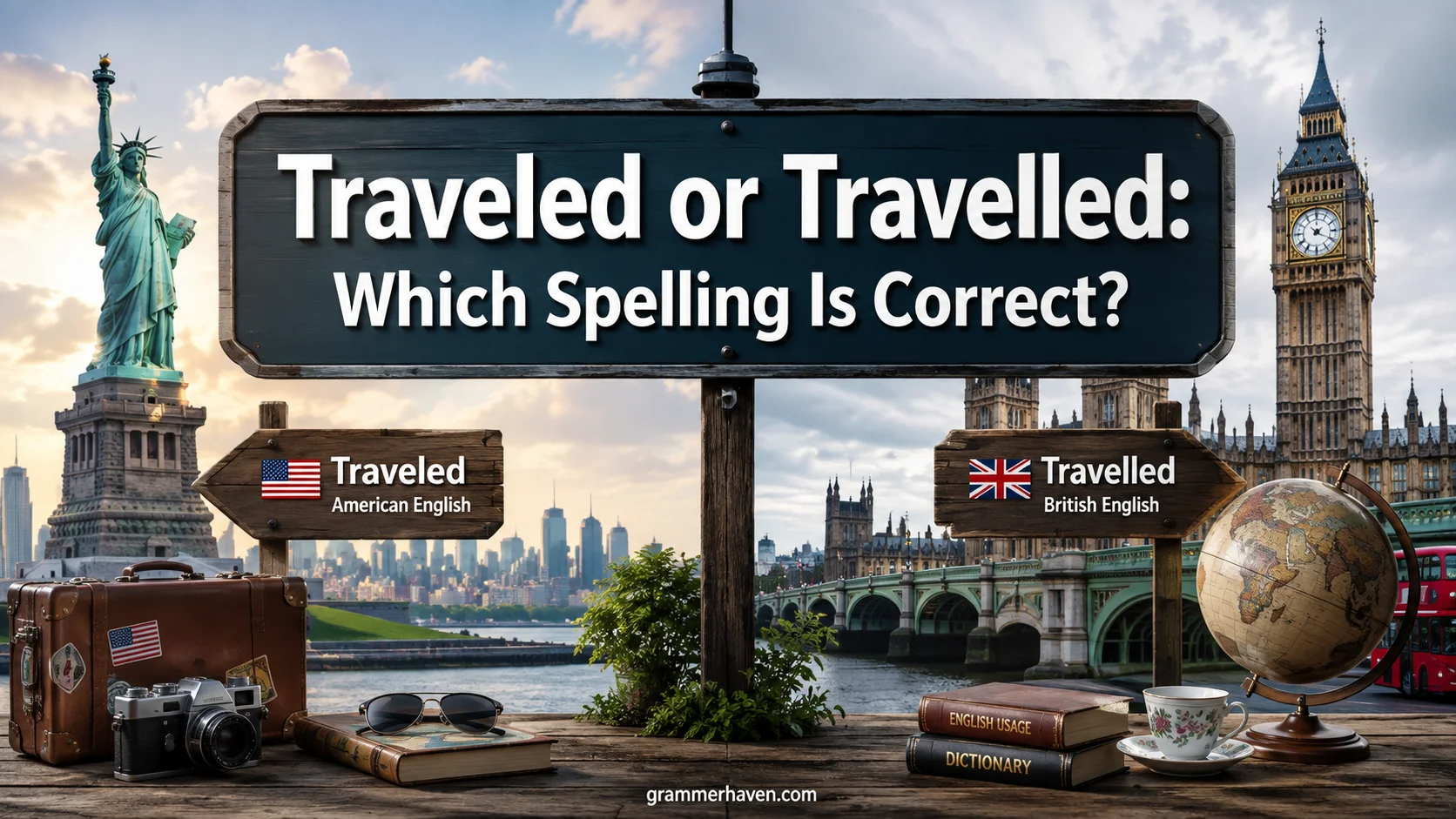
Traveled or Travelled: Which Spelling Is Correct? explains how Travel changes across American English and British English usage. Travel is a simple, common English word, but its derivative forms may be written with a single l or two ls. Traveled and traveling use the single-l pattern in American English, while travelled and travelling use the double-l pattern in British English. The correct spelling depends on regional spelling preferences, so these variations aren’t errors. Similar differences appear in color and colour, along with organize and organise. These regional spelling variations reflect established differences between the two forms of English.
The origin of the word adds useful context. Travel originated in Middle English as a variant of travail, originally carrying a related sense. Its meanings and usage changed over time, while different spelling practices became established. As a result, the spelling difference is openly discussed by writers, students, professionals, and native speakers. In everyday writing, choosing one regional style consistently can prevent confusion and make your work clearer. Understanding this history also makes the different spellings easier to recognize when you encounter them in books, websites, or other forms of English.
For clarity, your choice should suit your audience and where they are located. When you write emails, essays, or formal documents, consistent spelling makes your work look more polished, natural, and professional. A keyword can also matter in online writing because readers may search for a particular spelling. Real-world examples, usage data, and basic spelling rules can provide a quick answer when you’re unsure which form fits best. These details improve your understanding of the subtle difference and help you use the spelling that matches your audience. A tailored approach keeps your writing clear and appropriate for its intended readers.
Traveled or Travelled: The Quick Answer
The simple answer:
- Traveled ✅ = American English spelling
- Travelled ✅ = British English spelling
Neither spelling is wrong.
The choice depends on your audience and the style of English you follow.
| Feature | Traveled | Travelled |
| Correct spelling | Yes | Yes |
| Used in American English | ✅ Common | Less common |
| Used in British English | Less common | ✅ Common |
| Used in Canada | Sometimes | Common |
| Used in Australia | Rare | Common |
| Pronunciation | Same | Same |
| Meaning | Same | Same |
For example:
American English:
I traveled to Italy last summer.
British English:
I travelled to Italy last summer.
Both sentences mean exactly the same thing.
What Does Traveled Mean?
Traveled is the past tense and past participle form of the verb travel in American English.
The verb travel means to move from one place to another. This movement can happen for many reasons, including:
- Vacation
- Work
- Education
- Exploration
- Relocation
- Personal experiences
Examples:
- She traveled across Europe after graduating.
- They have traveled to more than 20 countries.
- He traveled three hours every day to reach his workplace.
The word does not only refer to international trips. You can travel within your own city, state, or country.
For example:
I traveled from New York to California.
and:
I traveled across town to visit my friend.
Both uses are correct.
What Does Travelled Mean?
Travelled has the same meaning as traveled. The only difference is the spelling.
British English typically doubles the final “l” when adding endings to certain words.
Examples:
- She travelled through France by train.
- They have travelled around the world.
- He travelled thousands of miles for the conference.
The extra “l” does not change pronunciation.
You pronounce both words like:
TRAV-uhld
Not:
- ❌ travel-led
- ❌ trav-ell-ed
The spelling changes, but the sound remains identical.
Is There Any Difference Between Traveled and Travelled?
Many people assume these words might have slightly different meanings. They don’t.
The differences are only related to spelling conventions.
Meaning Difference
There is no meaning difference.
Both words describe movement from one place to another.
Example:
- I traveled to Japan.
- I travelled to Japan.
Both sentences communicate the same idea.
Grammar Difference
There is no grammar difference.
Both versions work as:
Past tense
She traveled yesterday.
She travelled yesterday.
Past participle
She has traveled extensively.
She has travelled extensively.
Pronunciation Difference
There is no pronunciation difference.
Native speakers pronounce both forms the same way.
Why Does American English Use Traveled?
The spelling traveled became common in American English because of efforts to simplify English spelling.
One major influence came from Noah Webster, who promoted simpler spelling systems in the United States.
His goal was to create a more independent American form of English.
Some examples of American spelling changes include:
| American English | British English |
| Color | Colour |
| Center | Centre |
| Theater | Theatre |
| Traveling | Travelling |
| Traveled | Travelled |
American English often removes extra letters when they do not affect pronunciation.
That is why many American spellings use one l:
- traveled
- canceled
- labeled
- modeled
Why Does British English Use Travelled?
British English follows traditional spelling patterns that often preserve doubled consonants.
When adding endings like -ed, -ing, or -er, British English frequently keeps the extra letter.
Examples:
- travel → travelled
- travel → travelling
- travel → traveller
The doubled l helps maintain the original spelling pattern.
British English does not consider the extra letter unnecessary. It reflects older spelling traditions.
The Spelling Rule Behind Traveled vs Travelled
The difference comes from how English handles words ending in consonants.
Generally, English may double the final consonant before adding a suffix.
However, the exact rule depends on:
- Number of syllables
- Stress pattern
- Regional spelling rules
The word travel creates differences because:
- British English usually doubles the l
- American English usually keeps one l
Examples:
| Word | American English | British English |
| Travel + ed | Traveled | Travelled |
| Travel + ing | Traveling | Travelling |
| Travel + er | Traveler | Traveller |
Why Do American and British English Have Different Spellings?
English did not develop in only one place.
Over hundreds of years, different regions created their own spelling preferences.
Several factors influenced these differences:
Historical Development
English changed differently in Britain and North America.
When English speakers moved across the Atlantic, their language continued evolving separately.
Dictionaries and Education
Dictionaries helped standardize spelling.
In the United States, dictionaries promoted simplified spellings.
In Britain, traditional spelling systems remained stronger.
Publishing Standards
Books, newspapers, schools, and businesses often follow regional spelling rules.
For example:
- American publishers use traveled
- British publishers use travelled
Which Countries Use Traveled and Which Use Travelled?
English-speaking countries do not all follow the same spelling system.
| Country | Common Preference |
| United States | Traveled |
| United Kingdom | Travelled |
| Australia | Travelled |
| New Zealand | Travelled |
| Canada | Usually Travelled |
| Ireland | Travelled |
| South Africa | Usually Travelled |
Canada can be interesting because Canadian English often combines American and British influences.
A Canadian writer might use:
- colour instead of color
- travelled instead of traveled
However, some Canadian businesses and publications use American-style spelling.
Traveled vs Travelled in Academic Writing
Academic writing requires consistency.
A professor usually will not reject your work because you wrote traveled instead of travelled. However, switching between both forms can make your writing look careless.
For example:
❌ Incorrect style:
I traveled across Europe. During my journey, I travelled through five countries.
The meaning is clear, but the spelling is inconsistent.
Better:
I traveled across Europe. During my journey, I traveled through five countries.
or:
I travelled across Europe. During my journey, I travelled through five countries.
Pick one style and follow it.
Traveled vs Travelled in Business Writing
Businesses often communicate with international audiences.
Choosing the right spelling helps maintain professionalism.
For example:
An American travel company might write:
We have traveled to more than 50 destinations worldwide.
A British travel company might write:
We have travelled to more than 50 destinations worldwide.
Neither company is incorrect.
The important thing is maintaining brand consistency.
Traveled vs Travelled in Creative Writing
Authors choose spelling based on their readers.
A novel published in the United States will usually use:
The character traveled across the desert.
A novel published in the United Kingdom will usually use:
The character travelled across the desert.
Writers want the language to feel natural for their audience.
Common Mistakes With Traveled and Travelled
Mixing American and British Spellings
This is the most common mistake.
Example:
She travelled to America and traveled through Europe.
The sentence is understandable, but the spelling style changes halfway through.
Assuming One Version Is Incorrect
Some writers believe:
- “Traveled is wrong.”
- “Travelled is old-fashioned.”
Both ideas are incorrect.
Both spellings are accepted.
Using a Regional Spelling for the Wrong Audience
If you write for American readers, traveled usually feels more natural.
If you write for British readers, travelled feels more familiar.
Traveled vs Travelled Examples
American English Examples
- I traveled to Spain last year.
- She has traveled around the world.
- They traveled by train across the country.
- He traveled frequently for work.
- We traveled together during college.
British English Examples
- I travelled to Spain last year.
- She has travelled around the world.
- They travelled by train across the country.
- He travelled frequently for work.
- We travelled together during college.
The sentences look different, but the meaning remains identical.
Other Forms of Travel
The spelling difference does not only appear in traveled/travelled.
It also affects related words.
| Word Form | American English | British English |
| Present verb | Travel | Travel |
| Third person | Travels | Travels |
| Past tense | Traveled | Travelled |
| Present participle | Traveling | Travelling |
| Person | Traveler | Traveller |
Examples:
American:
The traveler is traveling across Asia.
British:
The traveller is travelling across Asia.
Similar American and British Spelling Differences
The traveled/travelled difference follows a larger pattern.
Here are other examples:
| American English | British English |
| Canceled | Cancelled |
| Labeled | Labelled |
| Modeled | Modelled |
| Signaled | Signalled |
| Fueled | Fuelled |
| Dialed | Dialled |
| Counseling | Counselling |
These differences appear often in everyday writing.
Memory Trick: How to Remember Traveled vs Travelled
A simple trick:
One country uses one L.
Think:
- American English = Traveled
- British English = Travelled
The United States often removes extra letters.
The United Kingdom often keeps them.
This shortcut works for many similar words.
How to Choose Between Traveled and Travelled
Use this simple guide:
| Situation | Best Choice |
| Writing for Americans | Traveled |
| Writing for British readers | Travelled |
| Writing a US business document | Traveled |
| Writing a UK publication | Travelled |
| Following a style guide | Follow that guide |
| Unsure about audience | Choose one style and stay consistent |
Consistency matters more than choosing one “correct” version.
See also: Laid Out or Layed Out: Which Is Correct?
FAQs:
1. Is “traveled” or “travelled” correct?
Both traveled and travelled are correct. Traveled is the standard American English spelling, while travelled is preferred in British English.
2. Is “traveled” American or British English?
Traveled is the standard American English spelling. It uses one l before the -ed ending.
3. Is “travelled” British English?
Yes. Travelled is the standard British English spelling. It uses two ls before the -ed ending.
4. Which spelling should I use in formal writing?
Use the spelling that matches your chosen form of English. For American audiences, use traveled. For British audiences, use travelled.
5. Are “traveling” and “travelling” also different?
Yes. Traveling is standard in American English, while travelling is standard in British English. The difference follows the same single-l and double-l pattern.
Conclusion:
Traveled and travelled are both correct spellings, but they belong to different regional forms of English. Use traveled when following American English conventions and travelled when following British English conventions. The key is consistency. Once you know your audience and preferred style, choosing the right spelling becomes straightforward.