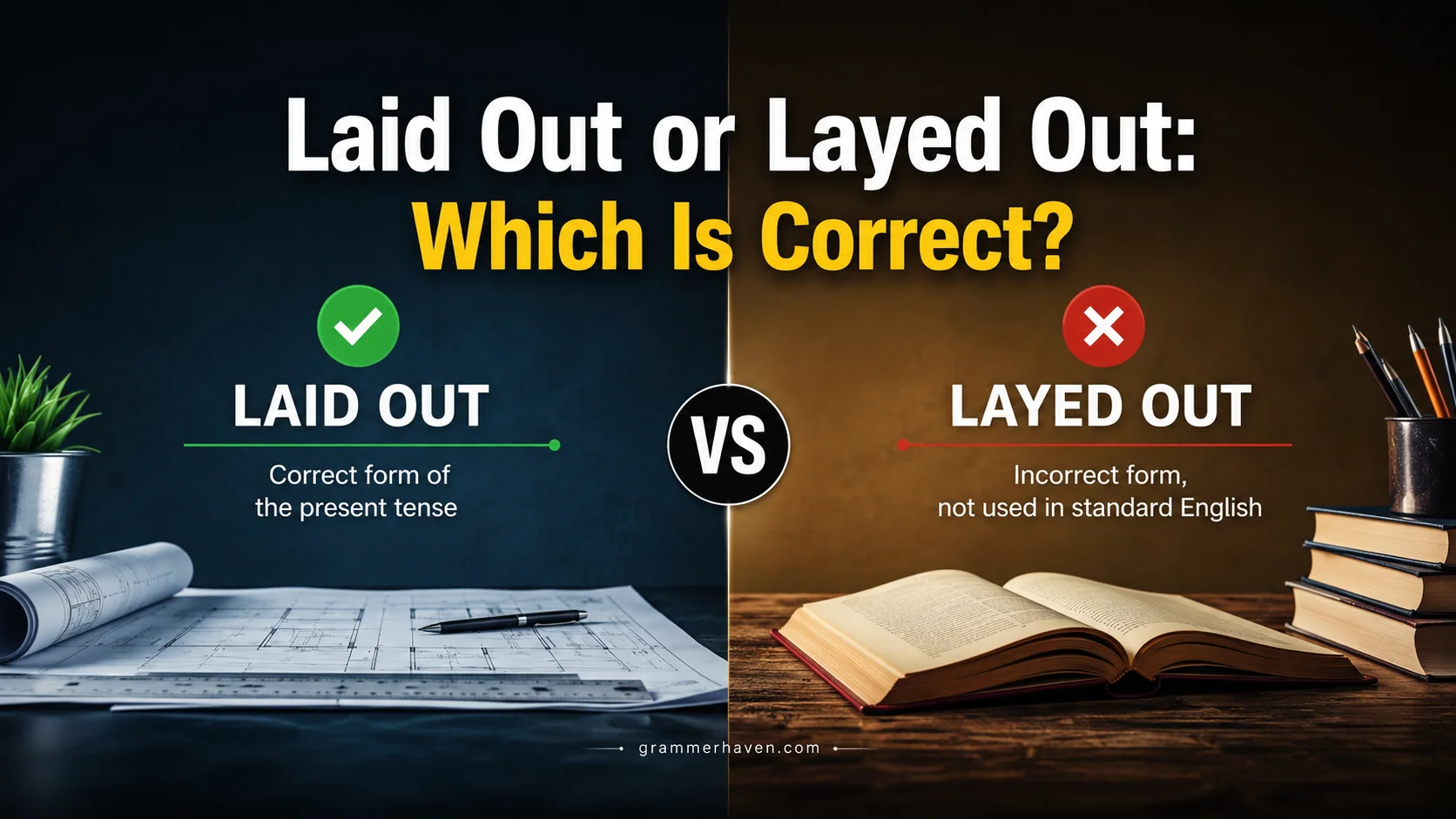
Laid Out or Layed Out: Which Is Correct? is a common spelling question, but laid out is the correct form in English writing every time for you. The difference between laid out and layed out isn’t simply a spelling variation. The core difference comes from a fundamental misunderstanding of English verbs. Laid out is the correct past tense and past participle form of the phrasal verb lay out, while layed out is grammatically incorrect. The irregular verb lay follows a correct irregular conjugation of lay, laid, laid, so laid is the proper past tense form and the only acceptable choice. Using the wrong form can create an error in writing and may even hurt your professional credibility in emails, essays, captions, or a formal post. Once you learn this pattern, you can use the correct form confidently every time.
The confusion often grows because lay and lie are challenging verb patterns that even native speakers sometimes mix up. Mastering them strengthens your basic grammar foundations, supports sophisticated language control, and helps competent communicators avoid sloppy writing. Layed out is a false regularization that occurs when speakers unconsciously try to regularize an irregular verb with a regular -ed ending. This linguistic phenomenon happens because people expect standard rules to cover every verb, but lay has maintained its irregular pattern throughout English’s evolution. As a result, layed out is a non-existent form, not another accepted spelling. If you’re wondering which version to choose, this guide can explain it simply: laid out is sharp, while layed out can look sloppy. Avoiding this mix helps people write a clear sentence without unnecessary confusion.
Laid Out or Layed Out: Which Is Correct?
The correct spelling is “laid out.”
Laid is the past tense and past participle of the verb lay.
The word “layed” is not the standard past tense form of lay.
| Phrase | Correct or Incorrect | Explanation |
| I laid out the documents. | ✅ Correct | Past tense of lay |
| She laid out her clothes before bed. | ✅ Correct | Shows something was placed or arranged |
| They layed out the plan yesterday. | ❌ Incorrect | “Layed” is not the standard form |
| He has laid out all the details. | ✅ Correct | Past participle usage |
A simple way to remember it:
Yesterday, you laid something out. You never layed it out.
Why “Laid Out” Is Correct
To understand why laid out works, you first need to understand the verb lay.
The verb lay means to put something somewhere, usually in a flat or organized position.
For example:
- You lay a book on a table.
- You lay your clothes on the bed.
- You lay the foundation for a building.
The important thing about lay is that it needs an object.
An object is the thing receiving the action.
Example:
She laid the phone on the desk.
Here:
- Subject: She
- Verb: laid
- Object: the phone
The phone receives the action.
The Verb Forms of Lay
The verb lay is irregular, which means it does not form the past tense by simply adding -ed.
| Verb Form | Word |
| Present | Lay |
| Past | Laid |
| Past Participle | Laid |
| Present Participle | Laying |
Examples:
Present:
I lay the keys beside the door every evening.
Past:
I laid the keys beside the door yesterday.
Past participle:
I have laid the keys beside the door many times.
Continuous form:
I am laying the keys beside the door now.
What Does “Laid Out” Mean?
The phrase laid out has several meanings depending on the situation.
It can mean:
- arranged something
- explained something clearly
- displayed something
- planned something
- defeated someone physically (informal)
The surrounding words usually tell you the meaning.
Laid Out Meaning: To Arrange Something
The most common meaning of laid out is to arrange or place something in a specific way.
Examples:
She laid out the dinner plates before the guests arrived.
This means she arranged the plates on the table.
Another example:
The designer laid out the website structure.
The designer organized how the website would look.
Common things people lay out:
- Clothes
- Documents
- Tools
- Food
- Furniture
- Plans
- Maps
- Designs
Laid Out Meaning: To Explain Something Clearly
Sometimes laid out means explaining information in a clear, organized way.
For example:
The manager laid out the new company policies during the meeting.
The manager did not physically place policies on a table. Instead, the manager explained them.
You often see this meaning in:
- Business meetings
- Presentations
- Reports
- Arguments
- Instructions
Examples:
The lawyer laid out the evidence for the jury.
The teacher laid out the steps for completing the assignment.
The coach laid out the team’s strategy before the game.
Laid Out Meaning: To Display Something
Another meaning involves showing something so people can see it.
Examples:
The artist laid out her paintings across the room.
The store laid out new products near the entrance.
Think of it like putting something on a stage. The goal is visibility.
Laid Out Meaning: To Plan or Organize
When someone creates a detailed plan, they often lay out that plan.
Examples:
The company laid out its five-year growth strategy.
The architect laid out the design for the new building.
The government laid out a plan to improve transportation.
In these examples, laid out means “presented in an organized way.”
Laid Out Meaning in Informal Slang
In casual conversations, laid out can also describe someone being knocked down or unconscious.
Example:
The boxer was laid out after a powerful punch.
This usage appears mostly in:
- Sports conversations
- Movies
- Informal speech
It has nothing to do with arranging objects.
The meaning comes entirely from context.
Difference Between Lay and Lie
The biggest reason people write “layed out” is confusion between lay and lie.
They look similar, but their meanings are different.
| Verb | Meaning | Present | Past | Past Participle |
| Lay | Put something down | Lay | Laid | Laid |
| Lie | Recline or rest | Lie | Lay | Lain |
This table causes confusion because the past tense of lie is lay.
That creates this pattern:
- I lay the book down. (present)
- I laid the book down yesterday. (past)
But:
- I lie on the sofa. (present)
- I lay on the sofa yesterday. (past)
Easy Trick to Remember Lay vs Lie
Use this simple rule:
Lay = Place something
If you can answer “what?” after the verb, use lay.
Example:
I lay the blanket on the floor.
What did I lay?
The blanket.
Correct.
Lie = Rest Yourself
If no object receives the action, use lie.
Example:
I lie on the couch.
You are not placing anything. You are resting.
Why People Write “Layed Out”
The mistake happens for several reasons.
People Apply Regular Verb Rules
Many learners think:
Lay + ed = layed
That logic works with regular verbs, but English has many exceptions.
Examples:
- Go → went (not goed)
- Buy → bought (not buyed)
- Teach → taught (not teached)
- Lay → laid (not layed)
Pronunciation Creates Confusion
“Lay” and “laid” sound similar.
When people hear:
She laid out the plan.
They may assume the spelling should match the sound:
She layed out the plan.
However, spelling does not always follow pronunciation in English.
Social Media Spreads Informal Mistakes
Online writing often ignores grammar rules. When people repeatedly see “layed out,” the incorrect version can start to look normal.
Frequency does not always equal correctness.
How to Use “Laid Out” Correctly in Sentences
Here are examples across different situations.
Daily Life Examples
I laid out my clothes before going to sleep.
She laid out the ingredients before cooking.
He laid out the tools needed for the repair.
Workplace Examples
The director laid out the company’s goals for the next quarter.
The report laid out several solutions to the problem.
The manager laid out clear expectations for the team.
Academic Examples
The researcher laid out the main arguments in the introduction.
The professor laid out the requirements for the final project.
Creative Writing Examples
The village was laid out across the valley like a painting.
The author laid out the mystery piece by piece.
Common Expressions Using “Laid Out”
The phrase appears in many everyday expressions.
| Expression | Meaning |
| Laid out the plan | Explained or created a plan |
| Laid out the facts | Presented information clearly |
| Laid out the rules | Explained expectations |
| Laid out the evidence | Presented proof |
| Laid out the schedule | Organized timing |
| Laid out the options | Explained choices |
| Laid out the strategy | Presented a method |
Examples:
The coach laid out the strategy before the championship game.
The teacher laid out the rules on the first day of class.
Common Mistakes With “Laid Out”
Mistake: Using “Layed Out”
Incorrect:
The manager layed out the instructions.
Correct:
The manager laid out the instructions.
Mistake: Confusing “Laid Out” and “Lay Out”
The difference depends on tense.
Present tense:
I will lay out the plan tomorrow.
Past tense:
I laid out the plan yesterday.
Mistake: Confusing “Laid Out” and “Laying Out”
These forms describe different times.
| Form | Example |
| Lay out | Present or future action |
| Laid out | Completed action |
| Laying out | Action happening now |
Examples:
She is laying out the documents.
She laid out the documents earlier.
Is “Layed Out” Ever Correct?
For the normal verb lay, no.
Standard English does not use “layed” as the past tense.
The correct form remains:
- Lay
- Laid
- Laid
- Laying
Some specialized fields may use similar-looking words with different meanings, but those uses do not make “layed out” correct in everyday grammar.
For normal writing, schoolwork, professional communication, and conversations:
✅ Use laid out.
What Dictionaries Say About “Laid Out”
Major English dictionaries list laid as the past form of lay.
| Dictionary | Past Form of Lay |
| Merriam-Webster | Laid |
| Cambridge Dictionary | Laid |
| Oxford English Dictionary | Laid |
| Collins Dictionary | Laid |
These references confirm that “layed out” is not the standard form.
Similar Grammar Mistakes Like “Layed Out”
Many English mistakes happen because people apply regular rules to irregular verbs.
| Incorrect | Correct |
| Buyed | Bought |
| Teached | Taught |
| Runned | Ran |
| Choosed | Chose |
| Goed | Went |
| Layed | Laid |
Learning irregular verbs helps you avoid dozens of similar errors.
Memory Tricks for “Laid Out”
Here are a few simple ways to remember it.
Trick One:
Lay yesterday, laid today? No.
The past tense is always:
Yesterday, I laid it down.
Trick Two:
Think of the word laid as a completed action.
Something has already been placed, arranged, or explained.
The plan was already laid out.
Trick Three:
Remember:
You lay something down, but you lie down yourself.
Quick Quiz: Laid Out or Layed Out?
Choose the correct answer.
1. She ____ the documents on the table.
A) layed out
B) laid out
✅ Answer: B) laid out
2. The teacher ____ the assignment instructions.
A) laid out
B) layed out
✅ Answer: A) laid out
3. He is ____ his clothes for tomorrow.
A) laying out
B) laid out
✅ Answer: A) laying out
See also: Fliers or Flyers: Which Spelling Is Correct?
FAQs:
1. Is “laid out” correct?
Yes. Laid out is the correct form. It is the past tense and past participle of the phrasal verb lay out.
2. Is “layed out” ever correct?
No. Layed out is not a standard English form. It results from treating the irregular verb lay like a regular verb.
3. Why do people write “layed out”?
People often write layed out because they expect verbs to take the regular -ed ending. However, lay follows the irregular pattern lay, laid, laid.
4. What does “laid out” mean?
Laid out can mean arranged, displayed, explained, or spread out. For example, “She laid out the documents on the table.”
5. How can I remember “laid out”?
Remember the verb pattern lay, laid, laid. Since the past form is laid, the correct phrase is always laid out, not layed out.
Conclusion:
Laid out is the correct spelling, while layed out is incorrect in standard English. The easiest way to remember the difference is to learn the irregular verb pattern lay, laid, laid. Whether you’re writing an email, essay, caption, or professional document, choose laid out to keep your writing clear and grammatically correct.