What Is a Subordinate Clause? (With Examples, Rules, and Real Usage) explains how a subordinate clause supports a sentence instead of standing alone.
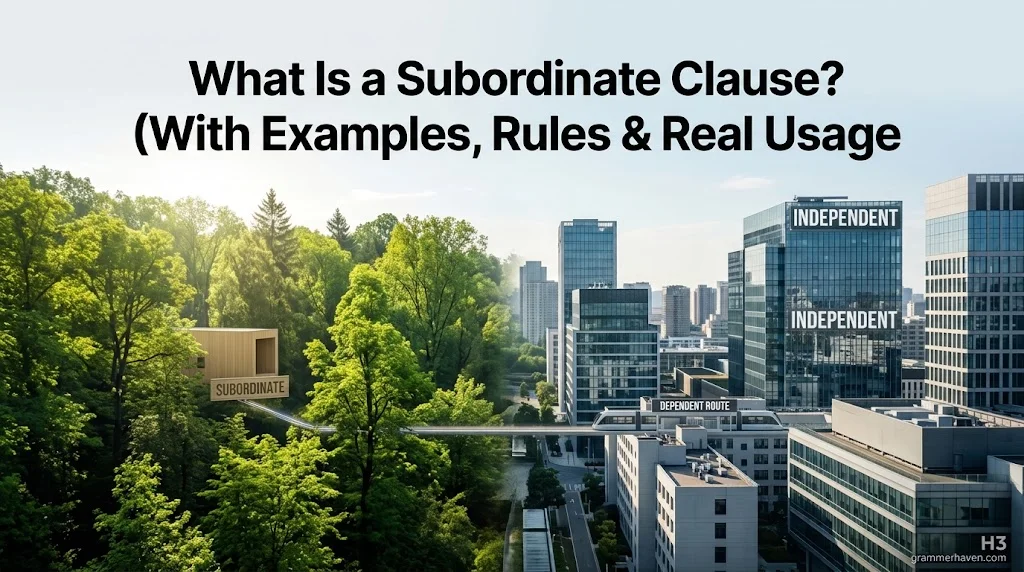
A subordinate clause, also known as a dependent clause, is a clause that cannot stand alone as a complete sentence because it must depend on a main clause or an independent clause. These clauses usually begin with subordinating conjunctions or relative pronouns and provide additional information that strengthens the main idea. A simple example is “because the lights were off,” which only makes sense when connected to another sentence. From my experience teaching English grammar, comparing it to a best friend in a support role instead of the lead role helps learners quickly understand the relationship, differences, meaning, syntax, sentence structure, and correct punctuation.
In real usage, clause usage improves communication, language, storytelling, every story, and every narrative you create. A dependent clause will always rely, relies, or keep relying on another clause to work correctly, while an independent clause can stand alone. This connection explains why and how writers use these patterns in sentences. Through examples, an example sentence, and practical rules, you will notice that not all clauses are created equal. Some simply provide, providing, or add more information, while others carry the central message.
As your writing skills improve, this concept becomes a powerful tool for effective writing. Rather than creating straightforward, robotic, or lackluster text, you can transform ordinary writing into rich, layered ideas that weave magic into your work. Learning the structure of clauses helps you flesh out ideas by adding details, detail, and depth, resulting in stronger sentence construction. Unlike a standalone sentence, subordinate clauses play an important role, matter in every context, and help unlock better expression. As you keep unlocking new skills, you’ll hear these terms often because they all point to the same thing—the unsung heroes of the world of language and the art of compelling storytelling. As your confidence grows, your works improve, your ideas transforms naturally, and your writing becomes clearer.
What Is a Subordinate Clause in English Grammar? (Clear Definition)
A subordinate clause (also called a dependent clause) is a group of words that has a subject and a verb but cannot stand alone as a complete sentence.
It depends on another clause to give it meaning.
Simple definition
A subordinate clause is:
- A group of words with a subject + verb
- Not a complete thought
- Dependent on an independent clause
Example
- ❌ “Because I was tired” (incomplete)
- ✔ “I went home because I was tired” (complete sentence)
That small word “because” changes everything. It turns a complete idea into a dependent one.
What Is a Clause in English Grammar? (Before Understanding Subordinate Clauses)
Before we go deeper, you need to understand what a clause actually is.
A clause is:
- A group of words
- Contains a subject and a verb
There are two main types:
Independent clause
- Can stand alone
- Expresses a complete idea
Example:
- “She left early.”
- “The phone rang.”
Subordinate (dependent) clause
- Cannot stand alone
- Needs support from another clause
Example:
- “When she left early”
- “Because the phone rang”
What Makes a Subordinate Clause Different?

Here’s the key idea:
A subordinate clause always leaves you waiting for more information.
It feels incomplete because it is incomplete.
Example comparison
- Independent: “I stayed home.”
- Subordinate: “Because I was sick”
Now combine them:
- ✔ “I stayed home because I was sick.”
The second clause explains the first. It cannot survive alone.
How Subordinate Clauses Work in Real Sentences
Subordinate clauses act like “supporting actors” in a sentence. They don’t lead the sentence, but they give it meaning, detail, and depth.
Three positions they can take
At the beginning
- “Although it was raining, we went outside.”
In the middle
- “The man, who was very tired, sat down.”
At the end
- “We went outside although it was raining.”
All three are correct. The meaning stays the same. Only the emphasis changes.
Types of Subordinate Clauses (With Clear Examples and Usage)
Subordinate clauses fall into three main categories. Each one behaves differently in a sentence.
Adverbial Subordinate Clauses
These clauses act like adverbs. They modify verbs by explaining time, reason, condition, or contrast.
Common subordinating words
- because
- although
- if
- when
- since
- while
Examples
- “I left because I was tired.”
- “We will go if it stops raining.”
- “Although he was late, he still joined the meeting.”
What they answer
- Why?
- When?
- Under what condition?
Adjective (Relative) Subordinate Clauses
These clauses describe nouns. They give extra information about a person, place, or thing.
Introduced by
- who
- which
- that
- whose
- where
Examples
- “The book that I borrowed was helpful.”
- “The teacher who taught us is very experienced.”
- “The city where I grew up is peaceful.”
Key idea
They act like adjectives, but they are full clauses instead of single words.
Noun Subordinate Clauses
These clauses act like nouns. They can be a subject, object, or complement.
Introduced by
- what
- that
- whether
- how
Examples
- “What he said surprised me.”
- “I don’t know whether he will come.”
- “That she passed the exam made everyone happy.”
Important insight
You can replace these clauses with a single noun in many cases:
- “What he said” → “his statement”
Subordinate Clause vs Independent Clause (Key Difference Explained Simply)
This is where most confusion disappears.
| Feature | Independent Clause | Subordinate Clause |
| Meaning | Complete thought | Incomplete thought |
| Grammar | Can stand alone | Cannot stand alone |
| Example | “I went home.” | “Because I was tired” |
| Function | Main idea | Supporting idea |
Simple rule
If it can stand alone as a sentence, it is independent. If not, it is subordinate.
Common Subordinating Conjunctions and Their Roles
Subordinate clauses usually begin with specific words called subordinating conjunctions.
Time
- when
- before
- after
- while
Example:
- “I called you when I arrived.”
Cause
- because
- since
- as
Example:
- “He left because he was tired.”
Condition
- if
- unless
Example:
- “You will succeed if you try.”
Contrast
- although
- though
- even though
Example:
- “Although it was difficult, she finished the task.”
Purpose
- so that
- in order that
Example:
- “She studied hard so that she could pass.”
Where Subordinate Clauses Can Appear in a Sentence
Sentence flexibility is one of the most powerful parts of English grammar.
Beginning position
- “Because it was late, I went home.”
Middle position
- “The man, who was angry, left the room.”
End position
- “I went home because it was late.”
Why placement matters
- Beginning = emphasis on reason
- End = emphasis on result
- Middle = extra descriptive detail
Common Mistakes with Subordinate Clauses
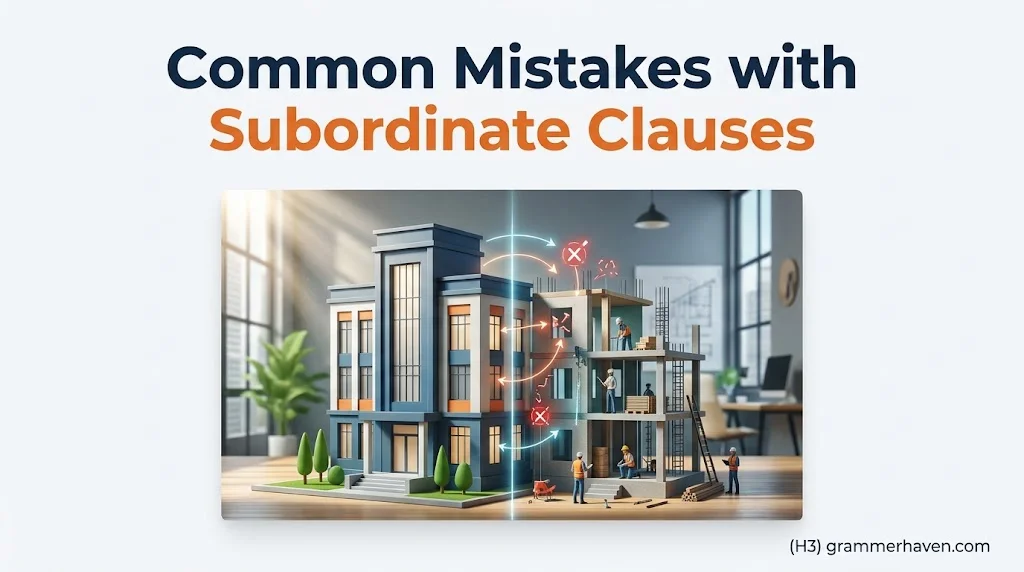
Even advanced learners make these errors.
Sentence Fragment Error
Wrong
- “Because I was tired.”
Why it’s wrong
It doesn’t form a complete thought.
Correct
- “I went home because I was tired.”
Run-on Sentence Error
Wrong
- “I was tired I went home because I had work tomorrow.”
Correct
- “I was tired, so I went home because I had work tomorrow.”
Comma Misuse
Wrong
- “I went home, because I was tired.” (sometimes unnecessary)
Correct
- “I went home because I was tired.”
Rule of thumb
- Use a comma when the subordinate clause comes first
- Avoid it when it comes at the end
Why Subordinate Clauses Matter in Real Writing
Subordinate clauses are not just grammar theory. They shape how natural your writing sounds.
Benefits
- Improve sentence flow
- Add detail without repetition
- Show relationships between ideas
- Make writing sound professional
Where they are used heavily
- Academic essays
- News articles
- Business reports
- Legal documents
- Formal emails
Without subordinate clauses, writing feels flat and robotic.
Real-World Examples of Subordinate Clauses
Let’s look at how they appear in real communication.
Conversation example
- “I didn’t come because I was busy.”
This shows a reason behind an action.
Academic example
- “The study shows that students perform better when they sleep well.”
This connects research findings with conditions.
Journalism example
- “The policy, which was introduced last year, has sparked debate.”
This adds background detail without breaking flow.
How to Identify a Subordinate Clause Quickly
Here’s a simple test you can use.
Step 1: Look for signal words
- because
- although
- if
- when
- who
- that
Step 2: Try reading it alone
- If it sounds incomplete → it’s a subordinate clause
Example
- “When I arrived” ❌ incomplete
- “When I arrived, the meeting had started” ✔ complete
Subordinate Clauses in Complex Sentences
Now let’s go one level deeper.
A complex sentence contains:
- One independent clause
- One or more subordinate clauses
Example
- “I stayed home because I was sick, although I wanted to go out.”
Breakdown
- Independent: I stayed home
- Subordinate 1: because I was sick
- Subordinate 2: although I wanted to go out
This structure allows layered meaning.
Signal Words That Introduce Subordinate Clauses
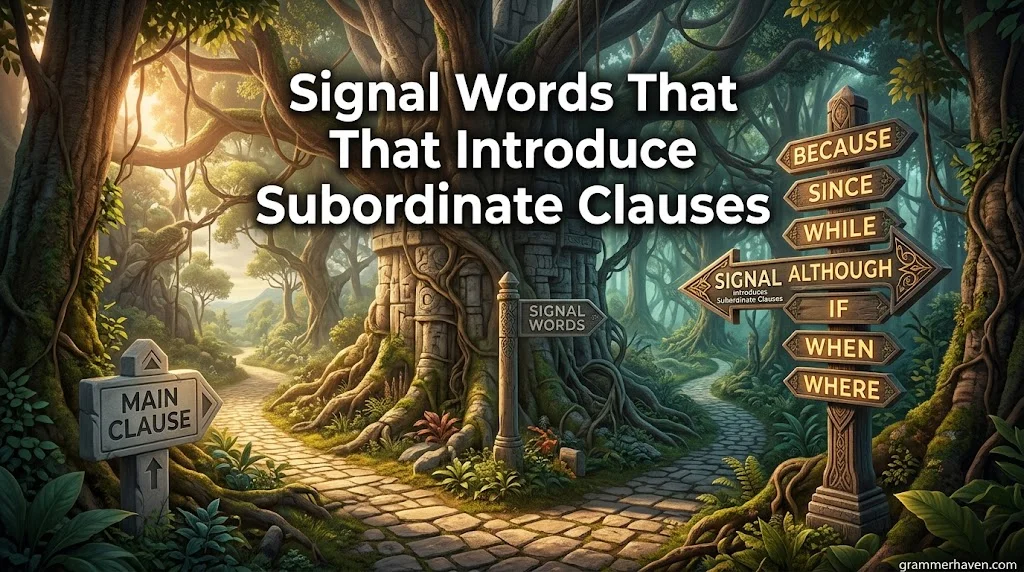
Here’s a practical grouping:
Time
- when, while, after, before
Cause
- because, since, as
Condition
- if, unless
Contrast
- although, though, even though
Relative
- who, which, that, whose
Case Study: Subordinate Clauses in Action
Scenario: University writing assignment
A student writes:
“The experiment failed.”
Simple. But incomplete in depth.
Now improved with subordinate clauses:
“The experiment failed because the temperature changed unexpectedly.”
Even better:
“The experiment, which was designed to test chemical stability, failed because the temperature changed unexpectedly.”
What changed?
- More detail
- Clear cause
- Richer explanation
- Professional tone
This is the real power of subordinate clauses.
Memory Trick to Remember Subordinate Clauses
Here’s a simple way to lock it in:
“If it depends on another part to make sense, it’s subordinate.”
Or even shorter:
“Subordinate = cannot stand alone.”
See also: Intelligent vs Intellectual: What’s the Difference? A Deep, Real-World Guide
FAQs:
1. What is a subordinate clause in simple words?
A subordinate clause is a group of words that has a subject and a verb but cannot stand alone as a complete sentence. It must be connected to an independent clause.
2. What is the difference between a subordinate clause and an independent clause?
An independent clause expresses a complete thought and can stand alone. A subordinate clause depends on an independent clause to complete its meaning.
3. How do you identify a subordinate clause?
Look for a group of words that begins with a subordinating conjunction (such as because, although, or if) or a relative pronoun (such as who, which, or that) and cannot form a complete sentence by itself.
4. Do subordinate clauses always need a comma?
No. A comma is usually needed when a subordinate clause comes before the main clause. If it comes after the main clause, a comma is often unnecessary unless the sentence requires it for clarity.
5. Why are subordinate clauses important in writing?
Subordinate clauses add detail, explain relationships between ideas, and make writing more varied and engaging. They help create smoother, more meaningful sentences.
Conclusion:
Understanding what is a subordinate clause makes it easier to write clear, natural, and engaging sentences. Although a subordinate clause cannot stand alone, it adds meaning, detail, and context to a main clause. By learning how subordinate clauses work, when to use them, and how to punctuate them correctly, you can improve both your grammar and your writing. With regular practice, using subordinate clauses will become a natural part of creating stronger and more effective sentences.
Latest Post:
- Result In or Result To: Which Is Correct? (With Examples)
- A Dime a Dozen: Meaning, Definition, Origin and Real-Life Usage
- Hooplehead Definition, Meaning, Usage and Examples
- Whole vs Hole: What’s the Difference?
- Acumen vs Acuity vs Acuteness: What’s the Difference?