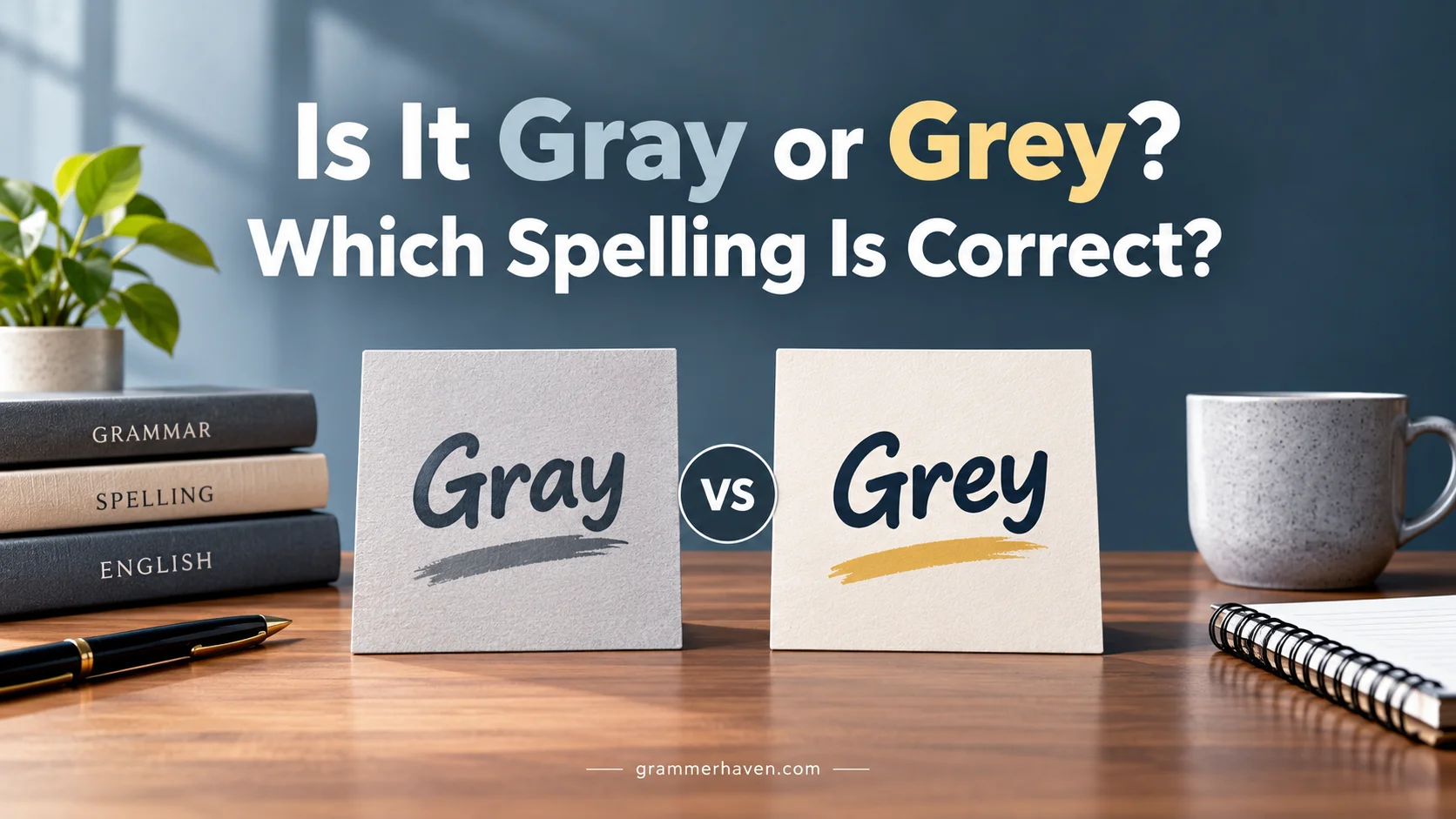
Is It Gray or Grey? uses two correct spellings for the same meaning: gray in American English and grey in British English. Both describe an intermediate color, the color between black and white. The main difference is spelling, not meaning. Gray is the standard American spelling in the United States, and grey is common in Britain and other countries that follow British English. Both are correct spelling, and your preference can depend on the country, audience, or writing style. Writers should keep their preferred spelling consistent in books, articles, and design content.
The word can function as an adjective, noun, or verb. You can write gray color or grey color, describe gray as a neutral color, or discuss hair that turns gray or grey. The color spelling shows a regional spelling and geographical preference, not a different meaning. For an American audience, gray is the preferred spelling and standard spelling. British spelling generally uses grey. This spelling variation appears in everyday usage, including skies, clothing, hair color, emotions, and an unclear situation called a gray area.
Useful tips include matching your spelling to your readers and using one form consistently. Common examples include walls painted soft gray, an old dog with gray fur, and a storm beneath a gray sky. These examples show how the word appears in everyday English. Gray and Grey remain accepted forms shaped by regional preference and English spelling. The form used predominantly depends on where you are situated and which English variety you follow. American English uses gray, and British English favors grey. Both are established spellings.
Is It Gray or Grey? Quick Answer
Both “gray” and “grey” are correct.
Use gray when you’re following American English spelling conventions.
Use grey when you’re following British English conventions. The spelling is also common in Canadian English and appears in other varieties influenced by British usage.
| Spelling | Most common usage | Example |
| Gray | American English | She wore a gray coat. |
| Grey | British English | She wore a grey coat. |
| Gray/Grey | Both forms | His hair is turning gray/grey. |
Here’s the easiest rule to remember:
American English → gray
British English → grey
Neither spelling is inherently wrong. What matters most is regional convention and consistency.
What Does Gray Mean?
Gray describes a color that falls between black and white. Depending on the amount of black, white, or another color mixed into it, gray can range from very pale silver-like tones to deep charcoal shades.
Cambridge defines gray as the color produced by a mixture of black and white. It also uses the word for hair that has become gray or white and for cloudy, dull weather.
You might use gray to describe:
- A gray sweater
- Gray hair
- A gray sky
- Gray eyes
- A gray building
- Gray clouds
- Gray paint
- Gray stone
- A gray suit
For example:
The gray clouds gathered over the city before the storm.
Here, gray refers directly to the color.
Gray as a noun
The word can also function as a noun when you talk about the color itself.
- Gray works well with almost every neutral color.
- She painted the walls gray.
- Gray is often associated with balance and neutrality.
- The designer used several shades of gray.
Merriam-Webster defines gray as a series of neutral colors between black and white.
Gray as a verb
Less commonly, gray can function as a verb. It means to become gray or to make something gray.
For example:
His hair began to gray in his forties.
You’ll encounter this use less often than the adjective or noun. However, it’s a legitimate grammatical use.
What Does Grey Mean?
Grey means the same thing as gray.
The major difference is spelling rather than meaning. Cambridge identifies grey as mainly the UK spelling of gray.
British English commonly uses expressions such as:
- grey hair
- grey eyes
- grey clouds
- grey suit
- grey walls
- grey sky
- grey area
For example:
The grey sky made the afternoon feel unusually quiet.
An American writer would normally write:
The gray sky made the afternoon feel unusually quiet.
The sentence means exactly the same thing.
Gray vs. Grey: What’s the Actual Difference?
The most important difference is where the spelling is commonly used.
American English generally favors gray, while British English generally favors grey. Merriam-Webster also identifies gray as more frequent in American English and grey as more common in Canada, the UK, and elsewhere.
Think of the difference like this:
Meaning: same
Pronunciation: same
Color: same
Grammar: same
Spelling: different
Regional preference: different
That distinction clears up most of the confusion.
Gray vs. Grey by English variety
| Variety | Common form |
| American English | gray |
| British English | grey |
| Canadian English | grey is common |
| Australian English | grey is common |
| New Zealand English | grey is common |
These are useful generalizations rather than absolute rules. English usage varies across regions, publishers, organizations, and individual writers.
How Do You Pronounce Gray and Grey?
Here’s another reason this spelling question can be confusing: gray and grey are normally pronounced exactly the same way.
Both are pronounced /ɡreɪ/. Cambridge lists the same UK and US pronunciation for both spellings.
The pronunciation rhymes with words such as:
- day
- say
- way
- play
- stay
So if someone says the word aloud, you can’t tell whether they would write gray or grey.
That’s why spelling conventions matter.
A simple pronunciation example
Gray → /ɡreɪ/
Grey → /ɡreɪ/
There is no standard pronunciation distinction that separates the two.
Why Are There Two Spellings of Gray and Grey?
The story goes back much further than modern American and British English.
Both gray and grey descend from the Old English word grǣg. Over time, English spelling developed regional variations, and both forms survived.
English doesn’t have one single historical source controlling every spelling. Instead, its vocabulary developed through layers of Old English, Norse, French, Latin, Greek, and other influences.
Spelling also changed as English spread geographically.
Eventually, gray became the dominant American form, while grey remained the usual British form. Neither spelling represents a newly invented word. They’re two established descendants of the same historical form.
That’s an important point because people sometimes assume that grey is simply a British “version” of an American word. The reality is older and more interesting.
Are Gray and Grey Different Colors?
No.
In ordinary modern English, gray and grey don’t represent two different shades.
You might see color discussions that attempt to assign subtle distinctions to the two spellings. However, those distinctions aren’t part of normal English usage.
If a clothing company sells a gray shirt and another company sells a grey shirt, the spelling doesn’t tell you anything reliable about the actual shade.
A color can be:
- light gray
- dark gray
- blue-gray
- warm gray
- cool gray
- charcoal gray
- silver-gray
The spelling depends mainly on the variety of English being used.
The important takeaway
Don’t choose “gray” or “grey” based on the shade. Choose it based on your spelling convention.
Gray or Grey in Common Expressions
The spelling difference doesn’t disappear when the word becomes part of an expression.
Instead, the same regional pattern usually continues.
Gray area vs. grey area
A gray area is a situation where the rules, boundaries, or answer aren’t clear.
American English:
The law leaves a gray area that courts still need to address.
British English:
The law leaves a grey area that courts still need to address.
Both are correct.
Cambridge specifically gives gray area as an example of an unclear situation where the applicable rules aren’t known or aren’t definite.
Gray matter vs. grey matter
The anatomical term also follows regional spelling conventions.
American English:
The brain’s gray matter plays an important role in processing information.
British English:
The brain’s grey matter plays an important role in processing information.
Merriam-Webster notes that the gray/grey variation extends beyond ordinary color descriptions into specialized terms such as gray/grey matter and animal names.
Gray hair vs. grey hair
Again, both forms work:
She started noticing gray hair in her thirties.
She started noticing grey hair in her thirties.
The first fits standard US English. The second fits standard British English.
Gray or Grey in American English
If you’re writing for readers in the United States, gray should usually be your choice.
You’ll see it in American dictionaries, newspapers, books, educational materials, and everyday writing.
Examples include:
- gray hair
- gray eyes
- gray sky
- gray sweater
- gray area
- gray matter
- gray whale
- gray wolf
For American English content, consistency matters. If an article begins with gray, switching randomly to grey can make the writing look careless.
That’s especially important in professional writing.
Example of inconsistent usage
The gray walls contrasted with the grey furniture.
There’s nothing grammatically impossible about that sentence. However, unless the different spellings reflect official names or another specific reason, the variation looks unnecessary in standard American prose.
A consistent version would be:
The gray walls contrasted with the gray furniture.
Gray or Grey in British English
British English generally favors grey.
So a British writer would typically write:
The grey sky stretched across the horizon.
rather than:
The gray sky stretched across the horizon.
The same pattern applies to many related phrases.
| American English | British English |
| gray hair | grey hair |
| gray eyes | grey eyes |
| gray sky | grey sky |
| gray area | grey area |
| gray matter | grey matter |
| gray market | grey market |
The difference doesn’t mean one variety has better English. It simply reflects different spelling conventions.
Gray vs. Grey in Canada, Australia, and New Zealand
The English-speaking world doesn’t divide neatly into “America uses gray” and “everywhere else uses grey.”
Canadian English commonly favors grey, while Australian and New Zealand English also generally follow British-influenced spelling conventions.
However, actual usage can vary by organization, publication, personal preference, and proper-name conventions.
Merriam-Webster summarizes the broad pattern by noting that gray is more frequent in American English while grey is preferred in Canada, the UK, and elsewhere.
If you’re writing for an international publication, check its style guide before deciding which form to use.
Important Exceptions: When Americans Use “Grey”
Here’s where the simple America = gray rule needs a little refinement.
American English uses grey in certain established names and titles.
Examples include:
- Grey’s Anatomy
- Fifty Shades of Grey
- Grey Poupon
- Grey Goose
These aren’t spelling mistakes.
They’re proper names or established names, so changing Grey to Gray would change the official name.
Merriam-Webster specifically highlights several cultural and brand references that retain Grey even in American contexts.
Why proper names are different
Suppose an American article discusses the television series Grey’s Anatomy.
It wouldn’t make sense to rewrite the title as Gray’s Anatomy merely because American English normally prefers gray.
Names have their own spelling rules.
The same principle applies to people. If someone’s surname is Grey, you don’t change it to Gray because you’re writing in American English.
The Special Case of Greyhound
Greyhound looks like it should be another example of the British spelling of the color.
It isn’t that simple.
The word greyhound has a different historical origin. Merriam-Webster explains that its grey doesn’t come from the Old English color word grǣg. Instead, the word traces back to grīghund, with a different etymological history.
That means greyhound shouldn’t be casually rewritten as grayhound.
Correct:
The greyhound is known for its speed and slender build.
Incorrect:
The grayhound is known for its speed.
This is a useful reminder that spelling isn’t always predictable from modern word associations.
Gray as a Scientific Unit
There’s another fascinating use of gray that has nothing to do with color.
The gray (Gy) is an SI unit of absorbed dose for ionizing radiation.
The International Bureau of Weights and Measures (BIPM) states that the gray is the SI unit of absorbed dose and defines it as one joule per kilogram. Its symbol is Gy.
In simplified form:
1 gray (Gy) = 1 joule per kilogram (J/kg)
This unit is used in fields such as:
- Radiation therapy
- Medical physics
- Radiology
- Radiation protection
- Nuclear science
- Dosimetry
This is a technical term, not another spelling of the color.
Gray vs. grey in scientific writing
The scientific unit is officially spelled gray, with the symbol Gy.
So:
The treatment delivered a dose measured in gray (Gy).
You wouldn’t substitute grey simply because you’re using British English.
That makes the scientific unit an important exception to the ordinary regional spelling pattern.
Gray vs. Grey: Examples in Sentences
Seeing the two forms side by side makes the difference much easier to remember.
American English examples
- The gray clouds covered the entire sky.
- He bought a gray suit for the wedding.
- Her hair is beginning to turn gray.
- The proposal falls into a legal gray area.
- The house has gray stone walls.
- Scientists study changes in brain gray matter.
- The artist used several shades of gray.
British English examples
- The grey clouds covered the entire sky.
- He bought a grey suit for the wedding.
- Her hair is beginning to turn grey.
- The proposal falls into a legal grey area.
- The house has grey stone walls.
- Scientists study changes in brain grey matter.
- The artist used several shades of grey.
Notice what stays the same.
The meaning, grammar, and pronunciation remain unchanged. Only the preferred spelling changes.
A Practical Case Study: Choosing the Right Spelling
Imagine that you’re writing an article for a US-based website.
You write:
The gray market has expanded rapidly, and consumers are increasingly interested in grey products.
The sentence isn’t necessarily grammatically wrong. However, the inconsistent spelling can distract readers.
If the intended audience is American, a cleaner version would be:
The gray market has expanded rapidly, and consumers are increasingly interested in gray products.
Now imagine that you’re writing for a British publication:
The grey market has expanded rapidly, and consumers are increasingly interested in grey products.
The second version follows British convention.
The lesson
Choose a regional spelling before you start writing, then stick with it.
That tiny editorial decision can make an article feel much more polished.
Common Mistakes With Gray and Grey
Mistake: Thinking “grey” is incorrect
It’s not.
Grey is a standard English spelling, particularly in British English and several other varieties.
Mistake: Thinking “gray” is incorrect in Britain
That’s also too strong.
Gray exists in British English, although grey is generally the preferred spelling.
Mistake: Treating them as different colors
They aren’t normally different colors.
The distinction is primarily orthographic and regional.
Mistake: Changing a proper name
Don’t change Grey’s Anatomy to Gray’s Anatomy.
Don’t change a person’s surname from Grey to Gray.
Official names retain their established spelling.
Mistake: Writing both forms randomly
If you’re writing standard American English, prefer gray throughout your own prose.
If you’re writing British English, prefer grey.
Consistency keeps your writing clean.
Gray or Grey: An Easy Memory Trick
Here’s a quick mnemonic:
America has A → grAy
England has E → grEy
It’s not a linguistic law. It’s simply an easy memory device.
If you’re writing for a US audience and you’re stuck between the two, remember:
US → grAy
If you’re writing for a UK audience:
UK → grEy
That one-letter trick solves most everyday spelling questions.
Gray vs. Grey: Side-by-Side Comparison
| Feature | Gray | Grey |
| Basic meaning | Color between black and white | Same |
| Pronunciation | /ɡreɪ/ | /ɡreɪ/ |
| American English | Preferred | Less common |
| British English | Less common | Preferred |
| Canadian English | Used | Common |
| Australian English | Used | Common |
| New Zealand English | Used | Common |
| Different color? | No | No |
| Used in proper names? | Yes | Yes |
| Radiation unit | gray | Not the standard unit name |
| Common expression | gray area | grey area |
Which Spelling Should You Use?
The answer depends on your audience.
Use “gray” when writing American English
Choose gray for ordinary US English writing:
The walls are painted gray.
Use “grey” when writing British English
Choose grey when following British conventions:
The walls are painted grey.
Follow the publication’s style guide
Professional publications often have house styles that settle questions like this.
If a style guide says to use grey, follow it even if you personally prefer gray.
Preserve official names
Don’t alter an established name merely to match your regional spelling.
For example:
- Grey’s Anatomy
- Grey Poupon
- Grey Goose
- Fifty Shades of Grey
- Surnames such as Grey
The name takes priority.
See also: Acknowledgment or Acknowledgement: Which Spelling Is Correct?
FAQs:
Is it gray or grey?
Both are correct. American English generally prefers gray, while British English generally prefers grey.
Is “grey” wrong in American English?
No. Grey is recognized in American English, but gray is the more common US spelling.
Is “gray” wrong in British English?
No. British English generally prefers grey, but gray isn’t inherently incorrect.
Do gray and grey mean the same thing?
Yes. In ordinary usage, both refer to the same range of neutral colors between black and white.
Are gray and grey pronounced differently?
No. Both are normally pronounced /ɡreɪ/.
Which spelling should Americans use?
Gray is the standard choice for American English.
Which spelling should British writers use?
Grey is the standard preferred form in British English.
Is “gray area” or “grey area” correct?
Both are correct. Use gray area in American English and grey area in British English.
Why are there two spellings?
Both forms developed from the same Old English word, grǣg, and different spelling traditions eventually became established in different varieties of English.
Is the scientific unit spelled gray or grey?
The SI unit is gray, abbreviated Gy. One gray equals one joule per kilogram of absorbed dose.
Conclusion:
Gray and grey are both correct spellings of the same color. Choose gray when following American English and grey when following British English. The choice reflects regional spelling preferences, not a difference in meaning.