Do You Ask or Pose a Question? Understanding the Difference Between “Ask a Question” and “Pose a Question” in Real English improves English.
When learning English, I found that small details can change the meaning of a sentence. Ask a Question and Pose a Question both help you communicate, but your choice depends on context, tone, purpose, and the audience. In spoken English, people usually asking in a casual conversation because it sounds natural and direct, while written English often uses posing in academic, professional articles, presentations, and discussions. This subtle difference in English grammar and English usage reflects your intent, expression, clarity, precision, and overall communication.
Many learners, advanced speakers, and native speakers use these words interchangeably, which is common in real life. If you think, know your situation, and keep paying attention to sentence structure, you will make a better choice. An Ask often signals a simple request, desire, or query, while a Pose introduces a more deliberate, structured inquiry to explore or clarify an idea. From my experience, observing how people speak and improve their speech and writing helped me unravel this intriguing nuance and understand the distinction and perceived meaning more clearly.
The devil is in stringing words together, not only in choosing the right verb, phrase, or phrasing. A careful form ensures your message reaches the listener and reader, prevents mistakes, and improves every action. Whether you Question, give, Ask, or Pose, the same actions can create a different effect between formal and informal language. Keep knowing proper usage, connect with people effectively, let your Understanding of Real English shine a light, and remember that Machine Learning and Artificial Intelligence cannot replace human judgment when it comes to meaning, perceived, the thin line, and the small change that makes your article more correct.
Do You Ask or Pose a Question? Understanding the Difference in Real Communication
At the core, both phrases deal with the same thing: a question.
But they don’t treat the question the same way.
- Ask a question = direct interaction
- Pose a question = present or introduce an idea
That difference sounds small, but it changes how your sentence feels, how formal it sounds, and how people interpret your intent.
Think of it like this:
You ask when you want an answer.
You pose when you want people to think.
Simple idea. Big impact.
What “Ask a Question” Actually Means in English
When you ask a question, you directly request information from someone. It’s active, conversational, and personal.
You’re not framing philosophy or introducing debate. You just want an answer.
Core definition
To ask a question means:
- You direct a query at someone
- You expect a response
- You engage in communication
Everyday examples
- “I asked her what time the meeting starts.”
- “He asked a question during the lecture.”
- “Can I ask you something real quick?”
Where it shows up most
You’ll hear “ask a question” in:
- Conversations
- Interviews
- Classrooms
- Meetings
- Customer service interactions
It’s the default phrase in English.
Why it feels natural
English speakers prefer “ask” because it matches real-life interaction. It’s immediate. It’s personal. It moves information back and forth.
If you’re talking to someone, you almost always ask, not “pose.”
What “Pose a Question” Actually Means in English
Now let’s shift gears.
When you pose a question, you’re not just asking someone something. You’re introducing a question into a space where people can think about it.
It feels more structured. More reflective. Sometimes even intellectual.
Core definition
To pose a question means:
- You present a question for consideration
- You frame an idea or issue
- You invite reflection rather than immediate answers
Everyday examples
- “The speaker posed a question about climate responsibility.”
- “This research poses an interesting question about human behavior.”
- “The article poses a challenge to traditional thinking.”
Where it shows up most
You’ll see “pose a question” in:
- Academic writing
- Essays
- Speeches
- Journalism
- Research papers
It often signals depth or analysis.
Why it sounds formal
The word “pose” carries a sense of placement. You’re not tossing a question into a conversation. You’re setting it in front of people like an object to examine.
That’s why it feels more polished or academic.
Ask a Question vs Pose a Question: The Real Difference
Let’s make this crystal clear.
| Feature | Ask a Question | Pose a Question |
| Purpose | Get an answer | Present an idea |
| Direction | Person-to-person | Idea-to-audience |
| Tone | Casual, direct | Formal, reflective |
| Setting | Conversations, interviews | Essays, speeches |
| Response | Expected immediately | May or may not be required |
| Focus | Action | Framing |
Now here’s the key takeaway:
You ask people. You pose ideas.
That one sentence eliminates most confusion.
Why People Confuse “Ask” and “Pose”
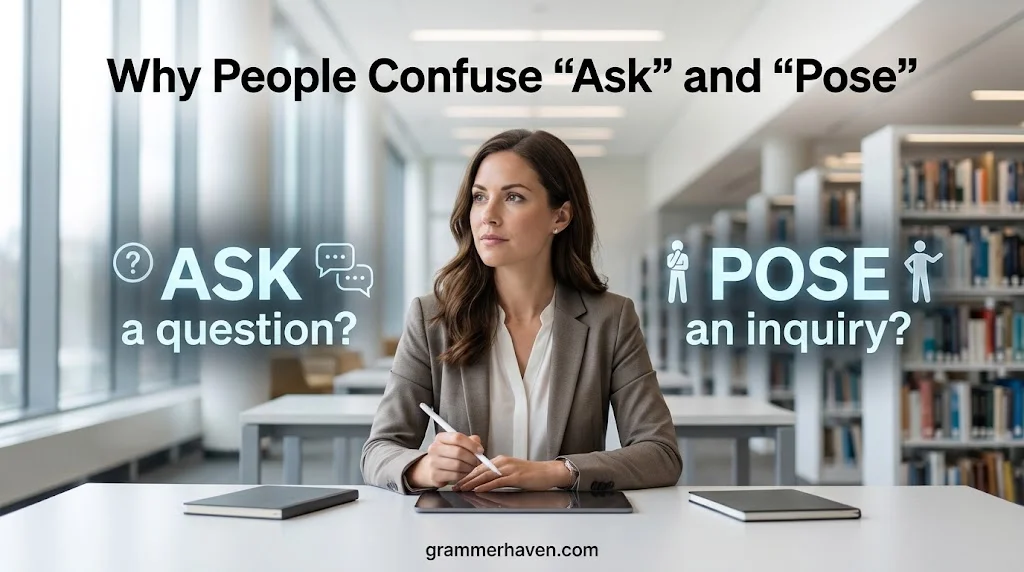
This confusion doesn’t happen randomly. It comes from how English blends formal and informal usage.
Reason 1: “Pose” sounds fancy
Many learners assume “pose” is just a more advanced version of “ask.”
So they try sentences like:
- “I posed him a question”
But native speakers rarely say that.
Instead, they naturally say:
- “I asked him a question”
Reason 2: Academic writing influence
School essays often use “pose a question” because it sounds analytical.
Students then carry that into everyday speech and mix it up.
Reason 3: Translation habits
In many languages, one word covers both meanings. English splits them.
That creates confusion when translating directly.
Reason 4: Formality overlap
Both phrases involve “questions,” so they feel interchangeable on the surface. But they behave differently underneath.
Grammar and Collocation Rules That Actually Matter
English doesn’t just care about meaning. It cares about pairing.
Let’s look at how native speakers naturally combine these phrases.
How “ask” behaves in sentences
“Ask” usually connects with:
- A person: ask someone
- A question: ask a question
- An object: ask a favor
Natural patterns:
- I asked her a question.
- He asked me for help.
- She asked the teacher about homework.
How “pose” behaves in sentences
“Pose” usually connects with:
- Abstract ideas
- Issues
- Questions in general sense
Natural patterns:
- This poses a problem.
- The report poses a question about ethics.
- The situation poses a challenge.
Important insight
You rarely hear:
- ❌ “I posed him a question” (sounds unnatural)
But you frequently hear:
- ✔ “The film poses a question about identity”
That difference is collocation, not grammar rules.
Tone and Context: When Each Phrase Works Best
Let’s make this practical.
Use “ask a question” when:
- You’re talking to someone directly
- You want information
- You’re in casual or neutral settings
Example:
You’re in a meeting:
“Can I ask a question about the budget?”
This sounds natural and expected.
Use “pose a question” when:
- You’re writing or speaking formally
- You’re introducing a topic
- You want reflection instead of immediate answers
Example:
In an article:
“This study poses a question about how memory works.”
This feels thoughtful and structured.
Real-World Examples That Show the Difference Clearly

Let’s ground this in real situations.
Conversation example
You walk into a classroom and say:
“Can I ask a question?”
This signals interaction. Someone will respond immediately.
Academic example
A researcher writes:
“This paper poses a question about social inequality.”
This signals analysis. The reader reflects on it.
Media example
A documentary states:
“The film poses a question about justice and fairness.”
It doesn’t expect an answer right away. It invites thought.
Business meeting example
Manager says:
“I want to pose a question about our strategy.”
This opens discussion rather than demanding an immediate answer.
Why “Pose a Question” Exists in English at All
Here’s something interesting.
English didn’t need “pose a question.” It already had “ask.”
So why does “pose” exist here?
Because English loves metaphorical structure.
Meaning of “pose”
Originally, “pose” means:
- To place
- To position
- To set something forward
We still use it in phrases like:
- pose a problem
- pose a threat
- pose a challenge
So when we say “pose a question,” we’re not asking directly. We’re placing the question in front of people like an object for inspection.
Think of it like this
- Asking = throwing a ball to someone
- Posing = placing a board on the table and pointing at it
One demands action. The other invites reflection.
Common Mistakes People Make (And How to Fix Them)
Let’s fix real errors people often make.
Mistake 1
❌ “I posed him a question.”
✔ Better:
“I asked him a question.”
Mistake 2
❌ “She asked a question about philosophy in her essay.”
✔ Better:
“She posed a question about philosophy in her essay.”
Mistake 3
❌ “The teacher posed us a question.”
✔ Better:
“The teacher asked us a question.”
Quick rule that saves you every time
- If someone responds directly → use ask
- If you’re introducing an idea → use pose
Quick Memory Trick You’ll Actually Remember
Here’s a simple mental shortcut:
Ask = Action
Pose = Presentation
Or even shorter:
You ask people.
You pose ideas.
Say it a few times and it sticks.
Case Study: How This Shows Up in Real Communication
Let’s look at a realistic scenario.
Scenario: University lecture
A professor talks about artificial intelligence.
Student interaction:
“Can I ask a question about neural networks?”
This is direct. The student expects clarification.
Professor’s explanation:
“This research poses a question about machine consciousness.”
Now the professor isn’t asking anyone directly. He’s framing an intellectual problem.
What changed?
Same word: question
Different function: interaction vs reflection
That’s the real distinction in action.
Another Case Study: Journalism vs Conversation
News article
“The report poses a question about data privacy in modern apps.”
Readers think about it. No response required.
Street conversation
“Can I ask you a question about this app?”
The person responds immediately.
Same concept. Different communication style.
See also: Mine as Well or Might as Well Difference: The Complete Guide to the Real Meaning
FAQs:
1. Is it correct to say “ask a question” and “pose a question”?
Yes. Both are grammatically correct. Ask a question is more common in everyday English, while pose a question is often used in formal or academic writing.
2. What is the main difference between “ask a question” and “pose a question”?
The main difference is tone and context. Ask a question sounds direct and conversational, whereas pose a question sounds more thoughtful, structured, and formal.
3. When should I use “pose a question”?
Use pose a question in academic papers, business presentations, professional discussions, or when introducing an idea for deeper thinking.
4. Is “ask a question” better for spoken English?
Yes. In most everyday conversations, native speakers naturally say ask a question because it sounds simple, friendly, and clear.
5. Can I use these phrases interchangeably?
In many situations, yes. However, choosing the expression that matches the audience and setting makes your English sound more natural and appropriate.
Conclusion:
Understanding the difference between Ask a Question and Pose a Question helps you sound more natural and confident in Real English. While both expressions are correct, ask a question is the better choice for everyday conversations, and pose a question works well in formal, academic, or professional settings. Once you understand the context, tone, and purpose behind each phrase, choosing the right one becomes easy and improves both your spoken and written English.
Latest Post:
- Result In or Result To: Which Is Correct? (With Examples)
- A Dime a Dozen: Meaning, Definition, Origin and Real-Life Usage
- Hooplehead Definition, Meaning, Usage and Examples
- Whole vs Hole: What’s the Difference?
- Acumen vs Acuity vs Acuteness: What’s the Difference?