Not a Problem vs No Problem: A Clear, Practical Guide helps you understand why these two common phrases sound similar but create different impressions in conversations, workplaces, and social settings. Both expressions are universally used as a polite way to accept a request, respond to an apology, or answer a thank you. Like “you’re welcome,” they reassure the other person when you are assisting them. However, language nuances, emotional meaning, and context create subtle distinctions that affect communication, clarity, and understanding.
Not a Problem usually gives a polished and neutral professionalism that provides polite reassurance in formal corporate settings, workplace communication, and professional language. It creates a confident tone in a business environment where attitude, perception, and style matter. No Problem, however, carries a more relaxed and upbeat tone that feels friendly in casual situations. Depending on usage and delivery, it can sometimes sound slightly dismissive when the situation requires more formality.
Knowing when to use which phrase determines how your message lands. Not a Problem usage works well in formal workplace emails and client-facing interactions, such as replying after a report review. No Problem usage fits friends, coworkers, casual chat, quick text messages, and everyday conversations. These examples show how communication choices, appropriate phrases, professional settings, casual settings, and social context influence the right response.
In strict business environments, senior professionals often prefer Professional Alternatives such as Happy to help, My pleasure, and Of course. These expressions sound more intentional and can project greater confidence in business communication, formal replies, and professional expressions across different career fields. Understanding grammar rules, full sentences, exact replies, communication skills, workplace language, English phrases, spoken English, word choice, phrase comparison, and usage differences helps you master vocabulary, language evolution, and effective communication in an interconnected world.
Not a Problem vs No Problem: What These Phrases Really Mean
At first glance, both phrases respond to gratitude or acknowledgment. Someone says “thank you,” and you reply with one of them.
Simple, right?
Not exactly.
The difference sits in tone, structure, and how speakers frame the situation.
- “No problem” → Focuses on the absence of trouble
- “Not a problem” → Focuses on reassurance that something is not an issue
Both are correct. But they carry slightly different emotional signals.
Let’s break them down.
What “No Problem” Actually Means in Real Conversation
“No problem” is one of the most common informal responses in English today. You hear it in shops, offices, restaurants, and casual conversations.
At its core, it means:
“What I did for you did not cause any difficulty.”
But speakers rarely think in full sentences. They use it as a quick, friendly response.
Where “No Problem” Comes From
English often shortens ideas into compact expressions. “No problem” likely evolved from phrases like:
- “It’s no problem”
- “There is no problem”
- “That’s no problem at all”
Over time, people dropped the extra words. The phrase became a stand-alone response.
When People Use “No Problem”
You’ll hear it in situations like:
- Someone thanks you for holding the door
- A coworker asks for help with a task
- A customer appreciates assistance
- Friends exchange small favors
Examples in Real Life
- “Thanks for the ride!” → “No problem.”
- “I appreciate your help.” → “No problem.”
- “Sorry for asking again.” → “No problem.”
Tone of “No Problem”
The tone usually feels:
- Casual
- Friendly
- Efficient
- Relaxed
But here’s the twist. Some people think it can sound a bit too casual in formal settings.
Still, in modern English, especially American English, it is widely accepted.
What “Not a Problem” Actually Means
“Not a problem” feels slightly longer and more deliberate. It carries a different rhythm when spoken.
At its core, it means:
“What I did for you should not be considered a problem at all.”
Unlike “no problem,” this phrase often feels more like reassurance.
Why “Not a Problem” Sounds Different
The structure is a full implied sentence:
- “It is not a problem.”
- “That is not a problem.”
Because of this, it often sounds:
- More thoughtful
- Slightly more formal
- More reassuring in tone
When People Use “Not a Problem”
Common scenarios include:
- Customer service conversations
- Workplace communication
- Situations involving reassurance
- Professional email responses
Examples in Real Life
- “Thanks for adjusting the schedule.” → “Not a problem.”
- “Sorry for the extra work.” → “Not a problem.”
- “Can you handle this request?” → “Not a problem.”
Tone of “Not a Problem”
This phrase often feels:
- Polite
- Calm
- Reassuring
- Slightly formal
It signals emotional steadiness. You’re telling the listener everything is fine without making it sound too casual.
Not a Problem vs No Problem: Side-by-Side Comparison
Sometimes the fastest way to understand language is to compare it directly.
| Feature | No Problem | Not a Problem |
| Structure | Fragment | Implied full sentence |
| Tone | Casual, friendly | Polite, reassuring |
| Formality | Low to medium | Medium |
| Emotional feel | Light and quick | Calm and steady |
| Common in workplaces | Yes | Yes |
| Customer service use | Very common | Very common |
| Risk of sounding rude | Slight in formal settings | Very low |
The Real Difference: It’s About Framing, Not Meaning
Here’s the key insight most explanations miss.
These phrases don’t differ in meaning. They differ in how they frame the same idea.
“No Problem” Frame
This frame removes difficulty.
- Focus: “There was no issue.”
- Emotional tone: light and fast
- Energy: minimal effort
It’s like brushing off dust from your shoulder.
“Not a Problem” Frame
This frame reassures the listener.
- Focus: “You don’t need to worry.”
- Emotional tone: steady and supportive
- Energy: calm reassurance
It’s like handing someone a glass of water after they worry too much.
Same idea. Different delivery.
Grammar Behind Both Phrases
Let’s clear something up quickly.
Neither phrase is incorrect.
Is “No Problem” Grammatically Correct?
Yes. It is an idiomatic expression. English often drops full sentences in conversation.
Other examples:
- No worries
- No thanks needed
- No big deal
These are all grammatically elliptical expressions.
Is “Not a Problem” Grammatically Correct?
Yes again. It is simply a shortened version of:
- “That is not a problem.”
- “It is not a problem.”
This version keeps more structure intact.
Why Both Exist in English
English thrives on flexibility. Speakers prioritize:
- Speed
- Tone
- Social context
Grammar bends to communication needs.
Tone Matters More Than Grammar in Real Life
In real conversation, people don’t analyze grammar. They react to tone.
How “No Problem” Can Be Heard
Positive:
- Friendly
- Chill
- Efficient
Negative (in some formal contexts):
- Slightly dismissive
- Too casual
How “Not a Problem” Can Be Heard
Positive:
- Reassuring
- Respectful
- Professional
Negative (rare cases):
- Slightly stiff
- Overly careful
Tone depends heavily on:
- Relationship between speakers
- Workplace culture
- Country or region
Which One Sounds More Professional?
This depends on context, not rules.
In Office Settings
Both are acceptable, but:
- “Not a problem” often feels safer in formal emails
- “No problem” works well in quick internal chats
In Customer Service
Many companies prefer:
- “Not a problem”
- “Happy to help”
- “You’re welcome”
Why? Because these phrases feel more polished and reassuring.
Better Professional Alternatives
Sometimes neither is ideal. Consider:
- “Happy to help.”
- “My pleasure.”
- “Certainly.”
- “Glad I could assist.”
These often sound more refined.
Regional Differences in Usage
Language changes depending on where you are.
American English
- “No problem” is extremely common
- Used across both casual and semi-formal settings
- Seen as friendly and efficient
British English
- “No problem” is common but slightly less dominant
- “No worries” is more popular in informal speech
- “Not a problem” feels polite and safe
Australian English
- Heavy use of casual reassurance phrases
- “No worries” often replaces both expressions
Global English Trend
Modern English is becoming more relaxed overall. “No problem” has grown globally due to media, workplaces, and internet communication.
Not a Problem vs No Problem vs You’re Welcome
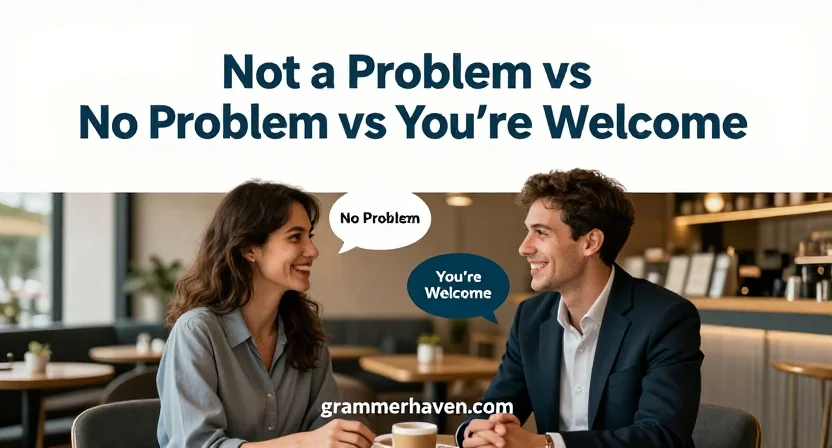
This comparison matters because many people think “no problem” replaces “you’re welcome.”
“You’re Welcome”
Traditional and formal. It directly acknowledges gratitude.
“No Problem”
Modern and casual. It downplays effort.
“Not a Problem”
Balanced. It reassures without being overly formal.
Quick Comparison
| Phrase | Formality | Tone |
| You’re welcome | High | Polite and traditional |
| No problem | Low to medium | Casual and friendly |
| Not a problem | Medium | Reassuring and balanced |
Real-World Case Studies
Let’s look at how these phrases behave in real situations.
Case Study: Retail Interaction
A customer thanks a cashier.
- Cashier A: “You’re welcome.”
- Cashier B: “No problem.”
- Cashier C: “Not a problem.”
Customer reaction:
- “You’re welcome” feels formal
- “No problem” feels quick and friendly
- “Not a problem” feels calm and polite
All three work. But tone shapes perception.
Case Study: Workplace Email
Employee receives a request for urgent help.
Response options:
- “No problem.” → short and efficient
- “Not a problem.” → professional reassurance
- “Happy to help.” → polished and polished tone
Most managers prefer “not a problem” or “happy to help” in written communication.
Case Study: Friend Conversation
Friend apologizes for asking a favor.
Responses:
- “No problem.” → natural and fast
- “Not a problem.” → slightly more thoughtful
- “Don’t worry about it.” → very casual reassurance
Here, “no problem” often wins because speed and ease matter more than formality.
Common Mistakes People Make
Assuming One Is More “Correct”
Both are valid. English does not assign strict correctness here.
Overthinking Tone in Casual Settings
Friends rarely judge “no problem” vs “not a problem.”
Using Formal Language in Casual Chats
Saying “not a problem” to friends can sometimes feel overly careful.
Using Casual Tone in Serious Contexts
“No problem” in formal apologies or serious workplace issues may feel too light.
Quick Usage Guide
Use “No Problem” When:
- Talking to friends
- Replying quickly
- Keeping things casual
- Working in relaxed environments
Use “Not a Problem” When:
- Speaking professionally
- Reassuring someone
- Writing polite messages
- Handling customer interactions
See also: To Use Your Loaf Meaning: A Complete Guide to Usage & Origin
FAQs
1. Are “Not a Problem” and “No Problem” the same?
Yes, both phrases generally express that something is acceptable or not causing difficulty. However, they differ slightly in tone and context. “Not a Problem” often sounds more professional, while “No Problem” feels more casual.
2. Is “Not a Problem” more polite than “No Problem”?
In many professional situations, “Not a Problem” may sound more polished and reassuring. However, “No Problem” is still considered polite in everyday conversations when used with the right tone.
3. When should I use “No Problem”?
Use “No Problem” in informal situations such as conversations with friends, coworkers, quick messages, or casual interactions where a relaxed and friendly tone is appropriate.
4. What are better alternatives to “Not a Problem” and “No Problem”?
Professional alternatives include phrases like “Happy to help,” “My pleasure,” and “Of course.” These expressions can sound more intentional and confident, especially in workplace communication.
5. Can “No Problem” sound rude?
Yes, depending on the tone and situation, “No Problem” may sometimes sound slightly dismissive if delivered flatly or used in a formal setting where a more professional response is expected.
Conclusion:
Understanding the difference between Not a Problem and No Problem helps you choose the right phrase for every situation. While both expressions show politeness and acceptance, their tone, context, and usage can create different impressions. Not a Problem often fits professional communication because it sounds more polished and reassuring, while No Problem works better in relaxed conversations with friends, coworkers, and casual settings. By paying attention to language nuances, you can improve your communication style, confidence, and ability to respond naturally in both personal and professional interactions.