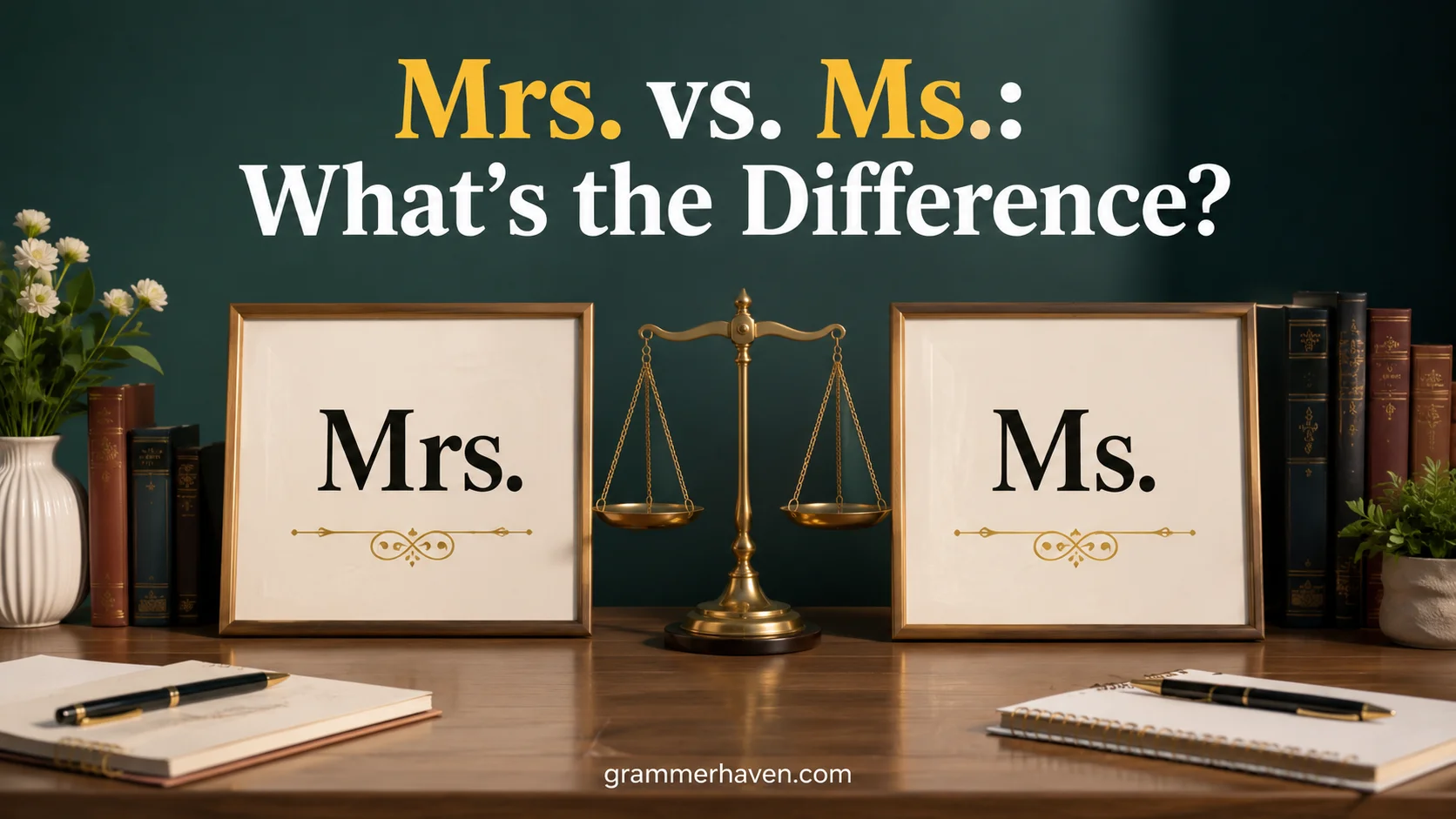
Mrs. vs. Ms depends on context, respect, preference, titles, courtesy titles, formal use, married woman, neutral option, any woman, and marital status.
Miss refers to an unmarried woman, girls, teenagers, and students, while Ms. suits an adult woman of any age, regardless of marital status.
Ms., Mrs., and Miss are feminine terms; Mr. is the male equivalent, Master the male counterpart for a boy, and Mx. avoids gender. Personal identity, individual’s preference, preferred form, and modern standard guide the choice.
Words, prefixes, and terms can precede a surname or last name when you address, addressing, or refer to someone formally in formal contexts, formal settings, and professional settings.
Business, professional correspondence, an official form, formal letter, start of an email, and meeting with someone for the first time require etiquette and attention to person’s preference, status, age, and appearance to avoid offense.
Ms. is pronounced miz, Mrs. as miss-iz, and Miss as miss; Miss has no period, while Mrs. and Ms. normally use one in American English.
British English often omits the period, and all three titles are capitalized; traditionally, usage depended on whether a woman was married or unmarried, while today modern usage is flexible.
Normally, these titles are less common in informal speech but remain useful in formal communication, professions, and teaching; major publishers and publishers may avoid them except in a direct quotation or quotation.
Mrs. can reflect a woman’s choice and preferred form, while Ms. can remain appropriate when marital status is unknown, private, or irrelevant, keeping formal communication respectful.
Quick Answer: Mrs. vs. Ms.
Mrs. is traditionally used for a married woman, while Ms. is a neutral title that doesn’t indicate whether a woman is married or unmarried.
| Title | Traditional meaning | Marital status revealed? | Pronunciation | Example |
| Mrs. | Married woman | Yes | “MISS-iz” | Mrs. Carter |
| Ms. | Woman regardless of marital status | No | “MIZ” | Ms. Carter |
| Miss | Unmarried girl or woman | Yes | “MISS” | Miss Carter |
So, if you know that a woman prefers Mrs., use it. If she prefers Ms., use that instead. When you don’t know her preference and need a courtesy title, Ms. is generally the safest neutral choice. Official writing guidance similarly recommends Ms. when a woman’s marital status or preferred title is unknown.
What Does Mrs. Mean?
Mrs. is a traditional courtesy title used before a married woman’s name. Merriam-Webster traces the title to an abbreviation of mistress, with its modern courtesy-title use dating back to around the late 16th century.
For example:
- Mrs. Johnson
- Mrs. Sarah Johnson
- Mrs. Carter will attend the meeting.
- Please send the letter to Mrs. Wilson.
Traditionally, Mrs. tells the reader that the woman is married or was married. However, the title doesn’t automatically tell you what surname she uses.
That’s an important distinction.
Does Mrs. Mean She Uses Her Husband’s Last Name?
No.
A married woman may use Mrs. with her maiden name, married surname, or another surname according to her personal circumstances and preference.
For example:
- Mrs. Grant can be a married woman who kept the surname Grant.
- Mrs. Johnson can be a married woman who uses Johnson after marriage.
- Mrs. Cheryl Grant can identify a married woman who retained her surname.
Canadian government language guidance specifically notes that Mrs. can appear before a married woman’s maiden name or married name.
So don’t use someone’s surname as proof of whether she is married. Names and titles aren’t quite that tidy.
How Do You Pronounce Mrs.?
In American English, Mrs. is commonly pronounced “MISS-iz.” Merriam-Webster also records pronunciation variations, including forms that occur in rapid speech or particular regional varieties.
For everyday use, though, “MISS-iz” is the pronunciation most readers will recognize.
What Does Ms. Mean?
Ms. is a courtesy title for a woman that doesn’t specify her marital status. You can use it for a married woman, an unmarried woman, or a woman whose marital status simply isn’t relevant.
Examples include:
- Ms. Parker
- Ms. Emily Parker
- Ms. Parker will contact you tomorrow.
- Dear Ms. Parker,
The key idea is simple:
Ms. identifies a woman without making her marital status part of the introduction.
That’s why Ms. works especially well in professional communication. You don’t need to know someone’s personal circumstances just to address her respectfully.
How Do You Pronounce Ms.?
Ms. is pronounced “MIZ.”
It isn’t pronounced like Miss.
| Written form | Pronunciation | Traditional meaning |
| Miss | “MISS” | Unmarried woman or girl |
| Ms. | “MIZ” | Marital status unspecified |
| Mrs. | “MISS-iz” | Married woman |
Merriam-Webster gives Ms. the pronunciation “miz” and explains that the title can replace Miss or Mrs. when marital status is unknown or irrelevant.
Mrs. vs. Ms.: The Main Difference
The easiest way to remember the Mrs. vs. Ms. difference is to ask one question:
Does the title communicate marital status?
- Mrs. → Traditionally yes
- Ms. → No
Consider these two sentences:
Mrs. Adams will speak at the conference.
Ms. Adams will speak at the conference.
The first sentence traditionally tells you that Adams is married or was married. The second sentence gives you no information about her marital status.
That difference may seem small, but it explains why Ms. became so useful in modern professional communication.
A Simple Comparison
| Feature | Mrs. | Ms. |
| Used before a woman’s name | Yes | Yes |
| Traditionally indicates marriage | Yes | No |
| Can be used for a married woman | Yes | Yes |
| Can be used for an unmarried woman | Traditionally no | Yes |
| Useful when marital status is unknown | Less suitable | Yes |
| Common in professional settings | Yes | Very common |
| Pronounced “MIZ” | No | Yes |
The most important rule isn’t complicated: follow the woman’s stated preference whenever you know it. Modern official guidance recognizes that people can choose among titles and that their choice should be respected.
Mrs. vs. Ms. vs. Miss
You can’t fully understand Mrs. vs. Ms. without looking at Miss too. All three titles have traditionally carried different meanings.
Mrs.
Traditionally identifies a married woman.
Example:
Mrs. Thompson will meet us at noon.
Ms.
Doesn’t indicate marital status.
Example:
Ms. Thompson will meet us at noon.
Miss
Traditionally identifies an unmarried girl or woman.
Example:
Miss Thompson won the scholarship.
For adult women, Ms. has become especially common because it doesn’t require you to identify whether the woman is married. Canadian government guidance describes Ms. as the more usual title for adult single women and notes that it can be used for women regardless of marital status.
Mrs. vs. Ms. vs. Miss Table
| Title | Traditional use | Marital status | Modern neutral option? |
| Mrs. | Married woman | Married | No |
| Miss | Unmarried girl or woman | Unmarried | No |
| Ms. | Woman regardless of marital status | Not specified | Yes |
Can a Married Woman Use Ms.?
Absolutely.
A married woman can use Ms. if that’s her preferred title.
This point causes one of the most common misunderstandings about Ms. People sometimes assume that Ms. means “unmarried.” It doesn’t.
The entire purpose of Ms. is to avoid making marital status part of the title.
For example, these can both refer to married women:
- Mrs. Anderson
- Ms. Anderson
The difference is that Mrs. Anderson traditionally identifies her as married, while Ms. Anderson doesn’t.
Merriam-Webster notes that Ms. is increasingly used for women whether married or unmarried when marital status isn’t a factor.
Why Might a Married Woman Prefer Ms.?
There are several practical reasons:
- She may prefer not to identify herself through marital status.
- She may use Ms. consistently in professional settings.
- She may have used Ms. before marriage and continued using it afterward.
- She may simply prefer how the title sounds.
- Her workplace or publication may use Ms. as its standard title.
The title belongs to the person being addressed. Preference matters more than assumptions.
Can an Unmarried Woman Use Mrs.?
Traditionally, Mrs. identifies a married woman, so it isn’t normally the appropriate choice for an unmarried woman.
However, titles aren’t legal labels that outsiders should police. Modern etiquette places greater weight on personal preference. If someone explicitly tells you how she wants to be addressed, follow that preference rather than imposing an old rule.
For ordinary situations, though:
- Unmarried woman + neutral title → Ms.
- Married woman + traditional married title → Mrs.
- Known personal preference → Follow the preference
That approach keeps the traditional meanings clear without pretending that language never changes.
When Should You Use Ms.?
Ms. is particularly useful when marital status isn’t known, isn’t relevant, or shouldn’t be assumed.
Consider using Ms. when:
- You’re writing a professional email.
- You’re contacting someone for the first time.
- You don’t know whether she is married.
- You don’t know whether she prefers Mrs. or Miss.
- Marital status has nothing to do with the subject.
- You’re addressing an adult woman in a formal setting.
- Her professional profile uses Ms.
- You want to avoid making an assumption.
For example:
Dear Ms. Reynolds,
That’s a perfectly natural opening when you know the recipient’s surname but don’t know her preferred title.
The Federal Highway Administration’s correspondence guidance explicitly recommends Ms. when you’re uncertain whether to use Mrs. or Miss.
What Should You Use When You Don’t Know a Woman’s Marital Status?
Here’s the practical answer: use Ms. when a title is necessary and you don’t know her preference.
Better yet, if the context doesn’t require a courtesy title, use her name.
For example:
Formal but neutral:
Dear Ms. Taylor,
Simple and professional:
Dear Jordan Taylor,
The second option avoids the title entirely.
Official writing guidance doesn’t always require titles in every context. GOV.UK’s style guidance, for example, recommends using a person’s full name on first reference and including personal titles only when they’re relevant.
A Useful Rule
Don’t know the preference? Don’t guess.
Check:
- An email signature
- A company profile
- An official biography
- Previous correspondence
- The person’s stated preference
- The organization’s directory
If none of those sources helps and you need a title, Ms. is generally the most neutral choice.
Mrs. vs. Ms. in Professional Emails
Workplace communication is where the difference matters most.
Suppose you’re contacting a client named Taylor Morgan. You don’t know whether Taylor is married.
Better choice
Dear Ms. Morgan,
Riskier choice
Dear Mrs. Morgan,
Why is the second option riskier? Because it makes an assumption about marital status and possibly about the person’s preferred title.
You might also skip the title:
Dear Taylor Morgan,
That’s often perfectly professional, especially when you already have an established relationship.
Professional Email Examples
Using Ms.:
Dear Ms. Davis,
Thank you for reviewing the proposal. I’d appreciate your feedback by Friday.
Using Mrs. when the preference is known:
Dear Mrs. Davis,
Thank you for confirming your availability for the meeting.
Using the person’s name:
Dear Sarah Davis,
Thank you for getting back to us.
The right choice depends on context. There isn’t a universal rule saying every professional email must contain Ms.
Mrs. vs. Ms. in Formal Letters and Invitations
Formal correspondence often makes title choices more visible because names appear prominently.
Business Letters
If the recipient’s preference is known, use it.
Dear Mrs. Bennett,
If you don’t know the preference:
Dear Ms. Bennett,
Or, where appropriate:
Dear Alex Bennett,
Invitations
Invitations can follow more traditional conventions, especially for weddings and formal social events. However, personal preference still matters.
For instance, a woman who normally uses Ms. doesn’t automatically become a Mrs. simply because she is married.
The safest approach is to check how she identifies herself.
Should You Write Ms. or Ms Without a Period?
In US English, Ms. with a period is a standard form and is widely used.
However, punctuation conventions can vary by style guide and organization.
The Chicago Manual of Style recommends Ms. with a period even though the title isn’t technically an abbreviation in the same way as some traditional titles. Chicago follows Merriam-Webster’s treatment of the form as a shortened combination associated with Miss and Mrs.
So, for general US English writing:
Preferred: Ms. Taylor
You may encounter Ms Taylor in styles that omit periods from certain abbreviations. That doesn’t mean the writer has misunderstood the word. It usually reflects a different editorial convention.
What About Mrs.?
In US English, the standard form is:
Mrs. Taylor
The period is standard in traditional American usage.
The History Behind Mrs. and Ms.
The difference between Mrs. and Ms. makes more sense when you look briefly at their history.
Where Did Mrs. Come From?
Mrs. developed as an abbreviation of mistress. Merriam-Webster dates its first known use as a courtesy title to around 1574.
Over time, Mrs. became closely associated with married women.
The modern title therefore carries a historical connection between a woman’s form of address and her marital status.
When Did Ms. Become Popular?
Ms. has a much more complicated history than many people realize. Merriam-Webster records a first known use dating to 1901, while its widespread modern adoption occurred much later.
The title became especially prominent in North America during the 1970s, when women increasingly sought a form of address that didn’t define them through marriage.
That distinction gave Ms. a practical advantage.
A man could traditionally use Mr. without revealing whether he was married. Ms. offered women a comparable neutral option.
Common Mrs. vs. Ms. Mistakes
Understanding the definitions is useful. Knowing what not to do is even better.
Mistake: Assuming Every Married Woman Uses Mrs.
Marriage doesn’t automatically determine someone’s preferred title.
A married woman may prefer Ms.
Better approach: Use the title she uses herself whenever you know it.
Mistake: Thinking Ms. Means Unmarried
This is simply incorrect.
Ms. doesn’t communicate whether the woman is married.
Mistake: Assuming a Surname Reveals Marital Status
A surname isn’t enough evidence.
A married woman may keep her surname. Another woman may change hers. Someone else may use a different professional name altogether.
Don’t connect the dots unless the person has given you the information.
Mistake: Confusing Ms. With Miss
They’re pronounced differently:
- Ms. → “MIZ”
- Miss → “MISS”
That single vowel sound changes the word and its traditional meaning.
Mistake: Using Mrs. Because Someone Looks Married
Never do this.
Appearance doesn’t establish marital status, and marital status doesn’t establish title preference.
Mistake: Using a Title When You Don’t Need One
Sometimes the cleanest option is simply the person’s name.
For example:
Hello, Taylor Morgan,
may be more natural than:
Hello, Ms. Morgan,
especially in modern workplace communication.
Mrs. vs. Ms. Examples in Real Sentences
Seeing the titles in context makes the distinction easier to remember.
Examples With Mrs.
- Mrs. Carter will join us for lunch.
- I spoke with Mrs. Wilson yesterday.
- Please forward the documents to Mrs. Adams.
- Mrs. Johnson requested a copy of the report.
In each example, Mrs. traditionally identifies the woman as married.
Examples With Ms.
- Ms. Carter will join us for lunch.
- I spoke with Ms. Wilson yesterday.
- Please forward the documents to Ms. Adams.
- Ms. Johnson requested a copy of the report.
Here, the title tells you nothing about marital status.
The Difference in One Pair
Mrs. Brown is attending the conference.
This traditionally tells the reader Brown is married.
Ms. Brown is attending the conference.
This tells the reader nothing about whether Brown is married.
That’s the heart of the Mrs. vs. Ms. difference.
Mrs. vs. Ms. in Different Situations
| Situation | Best approach |
| You know she prefers Mrs. | Use Mrs. |
| You know she prefers Ms. | Use Ms. |
| You don’t know her marital status | Ms. is generally neutral |
| You don’t know her title preference | Use Ms. or her full name |
| Professional email | Ms. is often appropriate |
| Formal letter | Follow her known preference |
| Marital status is relevant | Use the appropriate title based on known preference |
| Title isn’t necessary | Use her name |
| She has a professional title such as Dr. | Use the relevant professional title when appropriate |
One important principle cuts through all the complexity:
The person’s preference outranks your assumption.
A Practical Decision Guide for Mrs. vs. Ms.
When you’re staring at an email draft and wondering which title belongs there, use this simple process.
Do You Know Her Preferred Title?
Yes → Use it.
No → Continue.
Is a Title Necessary?
No → Use her name.
Yes → Continue.
Do You Know That She Uses Mrs.?
Yes → Use Mrs.
No → Use Ms. as the neutral option.
This approach works because Ms. doesn’t force you to make a personal assumption.
Case Study: Choosing the Right Title in a Business Email
Imagine a hiring manager needs to contact Lauren Parker about an interview.
The manager knows her name but doesn’t know whether she’s married or which courtesy title she prefers.
Option A: Dear Mrs. Parker
This assumes she uses Mrs. and traditionally communicates that she is married.
Option B: Dear Ms. Parker
This avoids making a marital-status assumption.
Option C: Dear Lauren Parker
This avoids the courtesy-title issue altogether.
Best choice: Either Ms. Parker or Lauren Parker, depending on the company’s communication style and how formal the relationship is.
The lesson is straightforward: don’t create a problem by trying to sound more formal than necessary.
Facts About Mrs. and Ms.
- Mrs. is traditionally associated with married women.
- Ms. doesn’t indicate marital status.
- Ms. is pronounced “MIZ.”
- Mrs. is commonly pronounced “MISS-iz.”
- Merriam-Webster records the first known use of Ms. in the relevant title sense as 1901.
- Merriam-Webster dates the first known use of Mrs. as a courtesy title to about 1574.
- Ms. became widely established in North America during the 1970s.
- Ms. can be used for both married and unmarried women.
- Chicago style recommends Ms. with a period in American English.
- Official government guidance commonly recommends respecting a person’s stated title preference.
See also: More Then or More Than: Which Is Correct?
FAQs:
What is the difference between Mrs. and Ms.?
Mrs. traditionally refers to a married woman, while Ms. doesn’t reveal whether a woman is married or unmarried. If you don’t know someone’s preferred title, Ms. is generally the more neutral choice.
Does Ms. mean married or unmarried?
Neither. Ms. deliberately leaves marital status unspecified. A married or unmarried woman can use Ms. depending on her personal preference.
Is Mrs. only used for married women?
Traditionally, yes. Mrs. is the conventional title associated with married women. However, personal preferences can vary, so it’s best to use the title a person chooses for herself.
Can a married woman use Ms.?
Yes. A married woman can absolutely use Ms. The title doesn’t mean that she is unmarried. It simply avoids stating her marital status.
Can an unmarried woman use Mrs.?
Traditionally, Mrs. is associated with married women. If an unmarried woman has a specific preference for how she should be addressed, however, that preference should be respected.
How do you pronounce Ms.?
Ms. is pronounced “MIZ.” It sounds different from Miss, which is pronounced “MISS.”
How do you pronounce Mrs.?
Mrs. is commonly pronounced “MISS-iz.” The pronunciation can vary slightly depending on accent and speech patterns.
Should I use Ms. when I don’t know if a woman is married?
Yes. Ms. is generally the safest neutral title when you don’t know a woman’s marital status or title preference. You can also use her full name without a title when the situation allows.
Is Ms. more professional than Mrs.?
Neither title is inherently more professional. However, Ms. is often convenient in professional settings because it doesn’t make marital status part of the introduction.
Is Ms. the same as Miss?
No. Ms. and Miss have different meanings and pronunciations. Ms. is pronounced “MIZ” and doesn’t indicate marital status, while Miss traditionally refers to an unmarried girl or woman.
Conclusion:
Understanding Mrs. vs. Ms. comes down to one simple distinction: Mrs. traditionally identifies a married woman, while Ms. doesn’t specify marital status. Both are correct titles, but they communicate different information.
When you know someone’s preferred title, use it. If you don’t know and need a courtesy title, Ms. is usually the safest neutral option. And when a title isn’t necessary, using the person’s name can be even simpler. The goal isn’t to guess someone’s personal circumstances. It’s to address them respectfully and accurately.