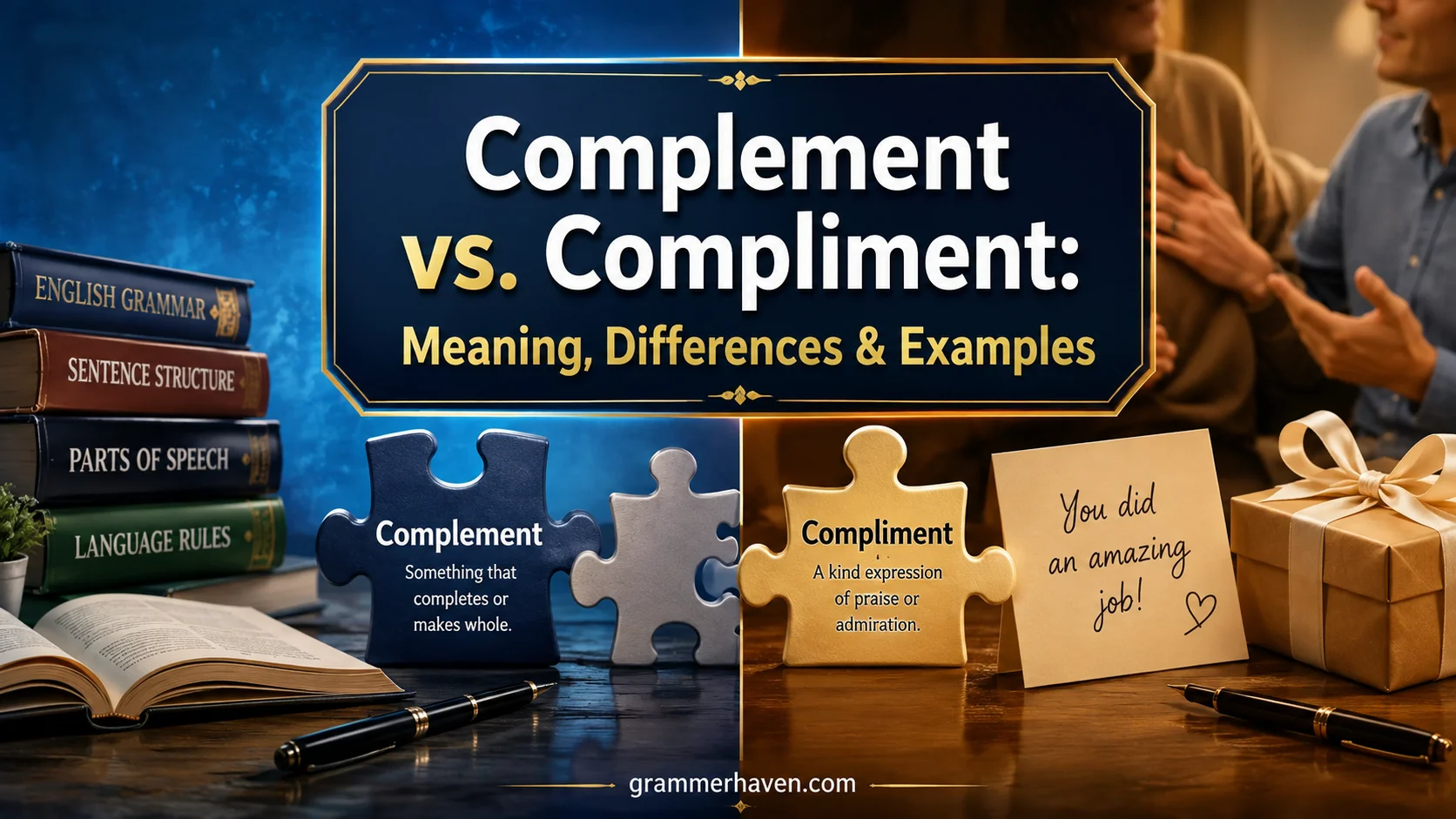
Complement vs. Compliment can confuse you because both words sound the same, but they have different meanings. Complement means something that completes or improves something else. Compliment means a kind or polite remark that shows praise, admiration, or approval. For example, chocolates and flowers can complement each other on a first date, while saying “You look awesome” is a compliment. A new friend may give you compliments about your skills, background, or expertise. Kind words, flattering remarks, positive feedback, and words of praise can make someone feel good. A supermodel may receive a compliment about her appearance, while teenagers may give compliments to friends.
Complement is linked to complete, completion, completing, completed, complementing, complementary, and addition. A supplement can add something to make a whole more complete. Compliment is linked to complimenting, flattering, praise, admiration, and approval. The two words are spelled differently but pronounced the same. Their spelling, pronunciation, usage, and meaning can cause confusion.
A complement can improve an existing thing. For example, skills can complement a background, and different areas of expertise can work together. Control measures can complement existing measures in mosquito technology. In a dance, different dance moves, a moonwalk, good footwork, and a waltz can work together to create a perfect performance.
You can see these words in sentences, everyday usage, and examples about Golf Digest, Ms. Clinton, IAC, New York Times, GM, Scientific American, and Washington Post. Rob, Judge Len Goodman, or a guy on a show might receive praise for a performance.
Quick Answer: Complement vs. Compliment
Complement means to complete, improve, enhance, or go well with something.
Compliment means to praise or express admiration or approval.
The easiest memory trick is:
Complement = Complete
Compliment = Praise
For example:
- “The blue shoes complement her dress.”
→ The shoes enhance or complete the outfit. - “He complimented her on her dress.”
→ He praised her dress.
Merriam-Webster makes the same core distinction: complement concerns completion or enhancement, while compliment concerns admiration and praise.
| Word | Meaning | Example |
| Complement | Complete, improve, enhance, or pair well | “The sauce complements the dish.” |
| Compliment | Praise or admiration | “She complimented the chef.” |
So, if you’re wondering whether to write complement or compliment, look at the meaning first.
What Does “Complement” Mean?
Complement has meanings connected to completion, enhancement, or something that makes another thing better or more complete.
As a noun, it can describe something that completes or improves another thing. As a verb, it means to complete or enhance something by adding another element.
Think of two puzzle pieces. They don’t have to look identical. They simply need to fit together in a useful way. That’s the basic idea behind complement.
Complement as a Noun
As a noun, complement refers to something that completes, enhances, or suits something else.
Consider these examples:
- “The scarf is a perfect complement to her coat.”
- “Fresh herbs are a wonderful complement to the soup.”
- “The photographs are an excellent complement to the article.”
- “His technical experience is a valuable complement to the team.”
In each sentence, the word describes something that adds value or completeness.
The added element doesn’t necessarily duplicate the original. Instead, it brings something useful to the combination.
Complement as a Verb
As a verb, complement means to complete or enhance something.
For example:
- “The blue curtains complement the gray walls.”
- “The sauce complements the grilled vegetables.”
- “The illustrations complement the written explanation.”
- “Her leadership skills complement his technical expertise.”
Cambridge defines the verb as helping make something more complete, effective, or attractive when combined with something else.
Complement Doesn’t Mean “Exactly Match”
This is an important distinction.
When something complements something else, it doesn’t have to be identical or perfectly matched.
For example:
“The dark wood complements the light walls.”
The wood and walls aren’t the same color. Their contrast actually makes the room more visually appealing.
So remember:
Match = be similar or coordinate closely.
Complement = enhance or improve the overall combination.
What Does “Compliment” Mean?
Compliment is about praise, approval, admiration, or respect.
If you tell someone that their presentation was excellent, you’re giving them a compliment. If you tell a chef that the meal was delicious, you’re complimenting the chef.
Compliment as a Noun
A compliment is a positive remark or expression of admiration.
Examples include:
- “She gave me a wonderful compliment.”
- “His comment was a thoughtful compliment.”
- “I received several compliments after my presentation.”
- “That was one of the nicest compliments I’ve ever received.”
A compliment can focus on someone’s:
- Appearance
- Personality
- Skills
- Work
- Achievement
- Character
- Style
- Creativity
- Performance
For instance:
“Your explanation made a difficult topic easy to understand.”
That’s a compliment because it expresses approval of someone’s ability.
Compliment as a Verb
As a verb, compliment means to praise someone or something.
The usual construction is compliment someone on something.
Examples:
- “She complimented me on my presentation.”
- “The customer complimented the chef on the meal.”
- “The manager complimented the team on its performance.”
- “He complimented her on her new haircut.”
Cambridge defines the verb as expressing admiration or praise toward someone.
Complement vs. Compliment: The Main Difference
The clearest way to understand complement vs. compliment is to focus on what each word does.
Complement describes a relationship between things. One thing adds to, improves, or completes another.
Compliment involves communication. Someone expresses praise or admiration.
Here’s the distinction in action:
“The necklace complements her dress.”
The necklace enhances the dress.
“Her friend complimented her on the necklace.”
Her friend praised the necklace.
One letter changes the word. The meaning changes completely.
| Situation | Correct Word | Example |
| Something enhances an outfit | Complement | “The shoes complement the outfit.” |
| Someone praises an outfit | Compliment | “She complimented my outfit.” |
| Two flavors work well together | Complement | “The lemon complements the fish.” |
| Someone praises the food | Compliment | “The guests complimented the chef.” |
| Two skills work well together | Complement | “Their skills complement each other.” |
| Someone praises someone’s skills | Compliment | “The manager complimented her skills.” |
Complement or Compliment? A Simple Rule
When you’re unsure, replace the word mentally.
If you can replace it with complete, enhance, or improve, choose complement.
If you can replace it with praise, choose compliment.
Use “Complement” When You Mean:
- Complete
- Enhance
- Improve
- Add to
- Suit
- Pair well with
- Fill a need
- Form a useful combination
Use “Compliment” When You Mean:
- Praise
- Admire
- Approve
- Express respect
- Say something positive
This quick substitution test works surprisingly well.
“The red wine ___ the steak.”
Could you say “enhances the steak”? Yes.
Therefore:
“The red wine complements the steak.”
Now try:
“The customer ___ the steak.”
Could you say “praised the steak”? Yes.
Therefore:
“The customer complimented the steak.”
Complement vs. Compliment Examples
Seeing the two words side by side makes the difference much easier to recognize.
Clothing and Fashion
Complement:
“Her silver earrings complement her black dress.”
The earrings enhance the appearance of the dress.
Compliment:
“Everyone complimented her on her black dress.”
Everyone praised her dress.
Food and Cooking
Complement:
“The garlic sauce complements the roasted chicken.”
The sauce works well with the chicken.
Compliment:
“The guests complimented the chef on the chicken.”
The guests praised the chef.
Workplace
Complement:
“His analytical skills complement her creativity.”
Their different strengths work well together.
Compliment:
“The director complimented her creative approach.”
The director praised her.
Writing and Design
Complement:
“The illustrations complement the article.”
The illustrations enhance the written material.
Compliment:
“The editor complimented the writer’s clear style.”
The editor praised the writer.
Relationships
Complement:
“Their personalities complement each other.”
Their differences work well together.
Compliment:
“She complimented him on his patience.”
She praised his quality.
Common Mistakes With Complement and Compliment
These words frequently appear in the wrong places, particularly when writers rely on sound rather than meaning.
Mistake: “She Complemented My Dress”
If you mean that she praised your dress, this spelling is wrong.
❌ “She complemented my dress.”
✅ “She complimented my dress.”
Why? Because she expressed admiration.
Mistake: “The Shoes Compliment the Outfit”
If you mean that the shoes enhance the outfit, use complement.
❌ “The shoes compliment the outfit.”
✅ “The shoes complement the outfit.”
The shoes aren’t speaking. They’re simply working well with the outfit.
Mistake: “The Flavors Compliment Each Other”
When two flavors work well together, choose a complement.
❌ “The flavors compliment each other.”
✅ “The flavors complement each other.”
Mistake: “He Complemented Her Work”
This sentence changes meaning depending on the spelling.
- He complimented her work. → He praised it.
- Her work complemented the presentation. → Her work enhanced it.
That’s why context matters more than pronunciation.
Complementary vs. Complimentary
The confusion doesn’t stop with complement vs. compliment. Their adjective forms create another common spelling trap.
What Does “Complementary” Mean?
Complementary means completing, enhancing, or working well together.
Examples:
- “The two colors are complementary.”
- “Their skills are complementary.”
- “The flavors have a complementary balance.”
Merriam-Webster also uses complementary for things that mutually supply what the other lacks.
What Does “Complimentary” Mean?
Complimentary has two major everyday meanings.
First, it can mean expressing praise.
“The review was highly complimentary.”
Second, it can mean given free of charge.
“The hotel offers complimentary breakfast.”
Cambridge lists both the praise-related sense and the phrase with your compliments for something given freely.
The Four Words Compared
| Word | Meaning | Example |
| Complement | Complete or enhance | “The sauce complements the meal.” |
| Compliment | Praise | “She complimented the chef.” |
| Complementary | Completing or enhancing | “The colors are complementary.” |
| Complimentary | Praising or free | “The hotel provides complimentary breakfast.” |
A useful memory system is:
E → Complement → Enhance
I → Compliment → Admiration
-ary → Complementary → Works together
-ary → Complimentary → Praise or free
Complement in Grammar: What Does It Mean?
The word complement has a specialized meaning in grammar.
A grammatical complement is a word or phrase that completes or adds essential information to another part of the sentence. Cambridge describes complements as one of the major elements of English clause structure.
For example:
“Maria is a doctor.”
The phrase a doctor gives us information that completes the meaning of the linking verb is.
Another example:
“They elected Maria president.”
The word president functions as an object complement because it identifies what Maria became through the action.
Subject Complement
A subject complement gives information about the subject.
“The weather is beautiful.”
“James became a teacher.”
Here, beautiful and a teacher describe or identify the subject.
Object Complement
An object complement provides information about the object.
“They painted the door red.”
The word red describes the object, the door.
The grammar meaning still fits the central idea of completion. The complement supplies information that helps complete the sentence’s meaning.
Other Meanings of Complement
Although everyday English usually uses complement for enhancement or completion, the word has several specialized meanings.
Mathematics
In mathematics, the complement of an angle is the amount needed to bring that angle to 90 degrees.
For example:
- A 30° angle has a 60° complement.
- A 45° angle has a 45° complement.
The concept follows the same broad idea: one quantity completes another to reach a specified whole. Merriam-Webster also lists mathematical meanings involving angles and sets.
Staffing and Personnel
A full complement can mean the complete number of people or things required.
For example:
“The research team now has a full complement of specialists.”
This means the team has the complete number needed.
Music
In music, complement can refer to an interval that completes an octave.
These technical meanings may seem unrelated at first. However, they retain the central idea of completion.
Common Expressions With Compliment
“Pay Someone a Compliment”
This means to praise someone.
“She paid her colleague a compliment after the presentation.”
“Take It as a Compliment”
This means you should interpret a remark as praise.
“If someone says you look like your mother, take it as a compliment.”
“Return the Compliment”
This means responding to someone’s praise with praise or another positive gesture.
“He complimented her work, and she returned the compliment.”
“My Compliments to the Chef”
This is a traditional way to express praise for a meal.
“My compliments to the chef. Everything was excellent.”
Merriam-Webster and Cambridge both recognize established uses involving compliments to the chef and expressions of admiration.
Common Expressions With Complement
“A Perfect Complement”
This phrase describes something that adds exactly what another thing needs.
“The lemon sauce is a perfect complement to the fish.”
“Complement Each Other”
This means two people or things work especially well together.
“Their different skills complement each other.”
“Full Complement”
This means the full number or quantity required.
“The vessel departed with a full complement of crew.”
These expressions all connect to the central meaning of completion or enhancement.
Complement vs. Compliment: A Real-World Case Study
Imagine a restaurant launching a new dinner menu.
The chef creates a rich grilled chicken dish and adds a light citrus sauce.
You might say:
“The citrus sauce complements the chicken.”
That’s a relationship between two elements. The sauce enhances the dish.
After dinner, you tell the chef:
“I complimented the chef on the excellent meal.”
That’s praise.
Notice how naturally the two words can appear in the same situation:
The sauce complements the food. The customer compliments the chef.
That’s the distinction in a nutshell.
Complement vs. Compliment Pronunciation
One reason these words cause so much trouble is pronunciation.
In American English, complement and compliment are pronounced essentially the same. Cambridge gives the American pronunciation of complement as /ˈkɑːm.plə.ment/ and compliment as /ˈkɑːm.plə.mənt/.
That means you can’t always solve the problem by listening.
You have to use context.
When speaking, the listener normally understands the intended word from the surrounding sentence:
“The colors complement each other.”
versus:
“She complimented the colors.”
The spelling only becomes visible when you write the sentence.
Why Are Complement and Compliment So Similar?
Their similarity isn’t random.
Both words ultimately trace back to the Latin complēre, meaning “to complete.” However, they reached English through different historical paths and developed distinct modern meanings.
Complement stayed closely connected to the idea of completion.
Compliment developed toward courtesy, admiration, and praise.
Modern English now treats them as distinct words with distinct meanings. Merriam-Webster notes that their similar spelling and pronunciation make them especially easy to confuse.
So although their family history overlaps, their modern jobs are different.
Complement or Compliment: Quick Decision Chart
Use this chart whenever you’re stuck.
Does the word mean “complete” or “enhance”?
→ Use complement.
Does it mean “praise” or “admire”?
→ Use compliment.
Does it describe things that work well together?
→ Use complementary.
Does it mean something is given free or expresses praise?
→ Use complimentary.
The Fastest Memory Trick
Complement has E for Complete.
Compliment has I for admiration.
You don’t need to memorize a complicated grammar rule. Just connect the spelling with the meaning.
Complement vs. Compliment Practice Quiz
Choose complement or compliment for each sentence.
- The blue curtains ___ the furniture.
- She ___ him on his excellent presentation.
- The herbs ___ the flavor of the soup.
- He gave me a lovely ___.
- Their different skills ___ each other.
- The manager ___ the employee on her work.
- The photographs ___ the written content.
- I took his comment as a ___.
Answers
- complement
- complimented
- complement
- compliment
- complement
- complimented
- complement
- compliment
The pattern is straightforward: things complement one another, while people compliment one another when they express praise.
Complement vs. Compliment: Forms You Should Know
| Word Form | Meaning | Example |
| Complement | Complete or enhance | “The colors complement each other.” |
| Complements | Completes or enhances | “The sauce complements the meal.” |
| Complemented | Completed or enhanced | “The design complemented the room.” |
| Complementing | Completing or enhancing | “The colors complement the design.” |
| Compliment | Praise | “She gave him a compliment.” |
| Compliments | Expressions of praise | “She received several compliments.” |
| Complimented | Praised | “He complimented her work.” |
| Complimenting | Praising | “They were complimenting the chef.” |
| Complementary | Completing or enhancing | “Their skills are complementary.” |
| Complimentary | Praising or free | “Breakfast is complimentary.” |
Knowing these forms helps because the spelling difference doesn’t disappear when the words change tense or become adjectives.
See also: Mrs. vs. Ms.: What’s the Difference?
FAQs:
What is the difference between complement and compliment?
Complement means to complete, improve, enhance, or work well with something. Compliment means to praise or express admiration. For example, “The shoes complement the outfit” means they enhance it, while “She complimented my outfit” means she praised it.
Is it “complement your outfit” or “compliment your outfit”?
Both phrases can be correct, but they have different meanings. Complement your outfit means something enhances or suits your outfit. Compliment your outfit means someone praises your outfit.
What is an easy way to remember complement vs. compliment?
Use this simple trick: Complement = Complete. If something completes or enhances something else, use complement. If someone gives praise, use compliment.
Is “complement each other” correct?
Yes. Complement each other means two people or things have qualities that work well together. For example, “Their different skills complement each other.”
Is “compliment each other” ever correct?
Yes, but it means something different. Compliment each other means two people praise one another. For example, “The coworkers complimented each other on their successful presentations.”
What does complementary mean?
Complementary means completing, enhancing, or working well with something else. For example, “The two flavors are complementary” means they work well together.
What does complimentary mean?
Complimentary can mean expressing praise or provided free of charge. For example, “The review was complimentary” means it expressed praise, while “The hotel offers complimentary breakfast” means the breakfast is free.
Are complement and compliment pronounced the same?
In standard American English, complement and compliment have essentially the same pronunciation. Because they sound alike, you need to rely on context and spelling when writing.
Can complement and compliment be nouns and verbs?
Yes. Complement can be a noun or verb, as can compliment. For example, “The sauce is a perfect complement” uses the noun, while “The sauce complements the meal” uses the verb. Likewise, “She gave me a compliment” uses the noun, while “She complimented me” uses the verb.
Which is correct: “The colors complement each other” or “The colors compliment each other”?
“The colors complement each other” is correct when you mean the colors look good together or enhance one another. Use compliment only when someone or something is giving praise.
Conclusion:
Understanding complement vs. compliment becomes much easier when you focus on meaning rather than spelling. Complement relates to completing, enhancing, or pairing well with something, while compliment relates to praise and admiration.
Remember the simplest rule: complement completes, while compliment praises. So, a scarf can complement your coat, but someone can compliment you on your scarf. Once you connect these two meanings with their spellings, you’ll have far less trouble choosing the right word in everyday writing.