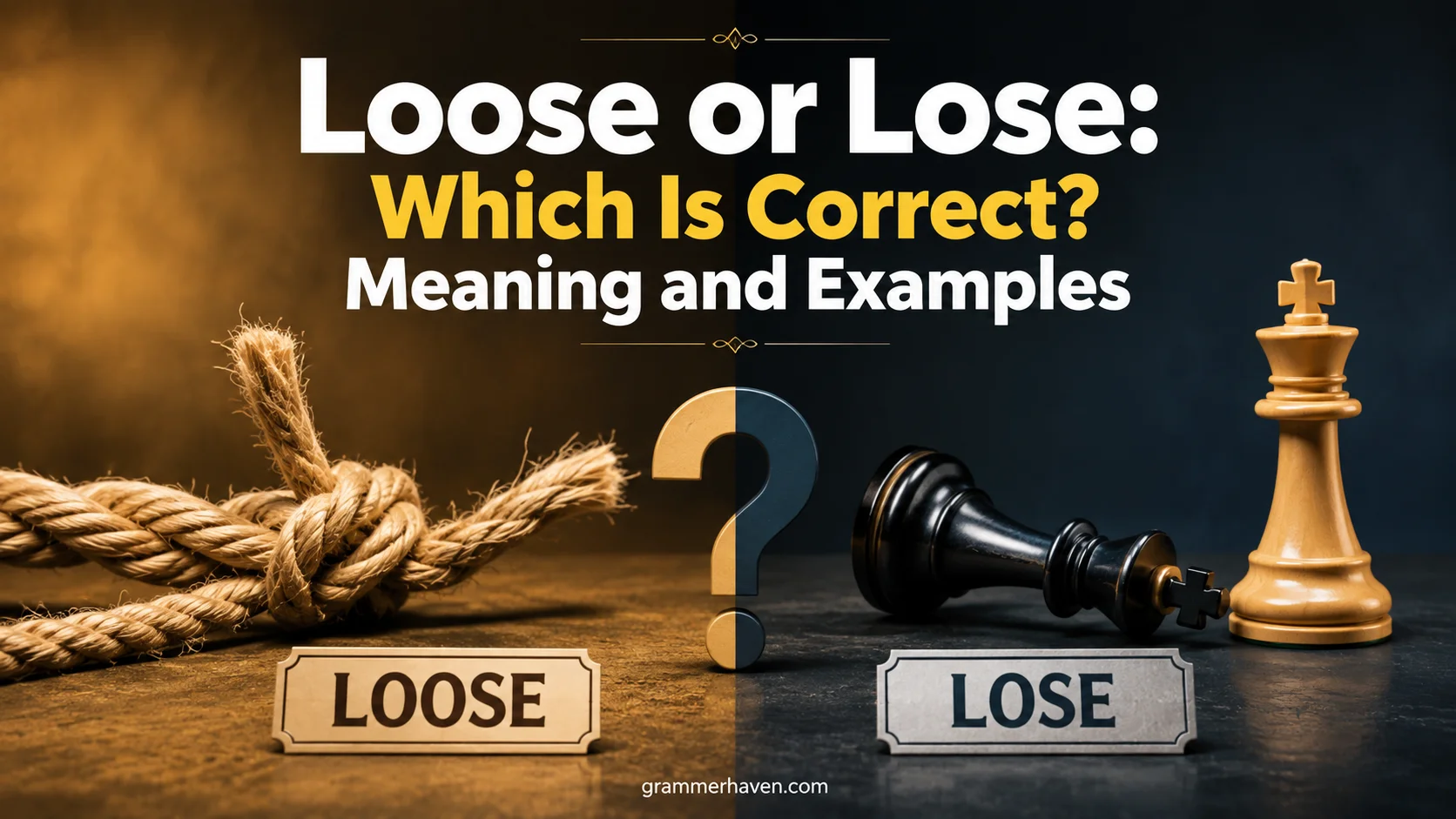
Loose or Lose: Understanding the Difference & Meaning becomes easier when you know that loose means not tight, while lose means to fail to win or no longer have something.
Loose is an adjective used for something not tight or not strict, while lose is a verb. You can lose something when you’re unable to find it, stop having it, or stop owning it. You can also lose when you fail to win. For example, you might lose a game instead of win it, lose sight of someone while swimming at the beach, or walk along the shoreline and realize something is gone. Loose can describe clothing that isn’t tight, as well as rules that aren’t strict. Understanding this difference makes your word choice much easier.
These two words look and sound close and similar, which makes them easily confusing to mix up. Their spelling, pronunciation, and meaning differ, so you might write loose when you mean lose. That would be mistaken or incorrectly used, even if you actually intended the right meaning. In English, they’re commonly confused words, but their usage is simple once you understand the distinction. To explain it in super simple terms, use loose for something that isn’t tight or strict and lose when you no longer have something or fail to win. Clear, one-line examples can help you use both words correctly in daily life, schoolwork, and casual chats.
Good grammar depends on choosing the correct word, so don’t hesitate when you need to choose or pick between loose and lose. Think about what you mean first. These examples make the distinction easier to remember, and by the end, the language behind the choice should feel natural.
Loose or Lose: What Is the Difference?
The biggest difference between loose and lose is their meaning and grammatical role.
| Word | Meaning | Part of Speech | Example |
| Loose | Something that is not tight, fixed, or secure | Usually an adjective | My jacket feels loose. |
| Lose | To misplace something, fail to win, or no longer have something | Verb | I don’t want to lose my wallet. |
Here is the easiest way to remember:
Loose describes something. Lose describes an action.
Think of it like this:
- A loose shoelace has too much space.
- You might lose your shoe if you forget where you put it.
One extra “o” in loose can remind you that something has extra room.
What Does Loose Mean?
The word loose usually means something is not tight, attached, controlled, or limited.
It describes a state or condition rather than an action.
For example:
- The screws are loose.
- She wears loose clothing.
- The dog is loose in the backyard.
- The rope became loose.
In each example, loose explains the condition of something.
Loose Meaning and Common Uses
Loose Means Not Tight
This is the most common meaning.
You use loose when something has extra space or does not fit closely.
Examples:
- These jeans are too loose around my waist.
- The bracelet feels loose on my wrist.
A simple comparison:
| Tight | Loose |
| A fitted jacket | A relaxed jacket |
| A secure knot | A weak knot |
| Shoes tied firmly | Shoelaces hanging freely |
Loose Means Not Firmly Attached
Something can become loose when it separates slightly from where it should be.
Examples:
- The door handle is loose.
- The wheel became loose after the long trip.
This meaning often appears in repair and maintenance situations.
Loose Means Free or Uncontrolled
Sometimes loose means something has escaped or is no longer restricted.
Examples:
- The horse broke loose from the fence.
- The criminal was on the loose.
- The children were let loose in the playground.
Here, loose means free from control.
Loose Means Relaxed or Informal
Loose can also describe rules, structures, or ideas that are not strict.
Examples:
- The company has a loose dress code.
- They follow a loose schedule.
A loose plan gives people flexibility.
What Does Lose Mean?
The word lose is a verb. It describes something happening.
You use lose when something disappears, gets taken away, or you fail to achieve something.
Examples:
- I don’t want to lose my phone.
- Our team could lose the game.
- She wants to lose weight.
Unlike loose, you cannot use lose to describe an object’s condition.
Incorrect:
My shoes are lose.
Correct:
My shoes are loose.
Lose Meaning and Common Uses
Lose Means To Misplace Something
This is one of the most common uses.
Examples:
- I always lose my keys.
- Don’t lose your passport while traveling.
- She lost her phone at the airport.
A useful way to think about it:
Loose = something has extra space.
Lose = something leaves your possession.
Lose Means To Fail to Win
In sports, competitions, games, and challenges, lose means the opposite of win.
Examples:
- Our team lost the championship.
- They lost the match by two points.
- Nobody wants to lose a competition.
A scoreboard shows the difference clearly:
| Result | Word |
| Winning team | Win |
| Losing team | Lose |
Lose Means To No Longer Have Something
You can lose physical things, emotions, opportunities, or abilities.
Examples:
- He lost his job.
- She lost interest in the project.
- They lost confidence after the mistake.
- The company lost money.
The thing you lose does not always need to be something you can touch.
Lose Means To Reduce Something
Lose can also mean decreasing something.
Examples:
- She wants to lose weight.
- The company lost customers.
- The engine is losing power.
Loose vs Lose Pronunciation: Why They Sound Similar
Many people confuse these words because their spelling looks nearly identical.
| Word | Pronunciation | Ending Sound |
| Loose | /luːs/ | “s” sound |
| Lose | /luːz/ | “z” sound |
Try saying them:
- Loose → sounds like “juice” with an L
- Lose → sounds like “choose” with an L
The vowel sound stays almost the same. The ending sound creates the difference.
Why Do People Confuse Loose and Lose?
Several factors make this mistake common.
Similar Spelling
Both words begin with lo and contain the same letters.
Compare:
- loose
- lose
The only difference is the extra “o.”
Similar Pronunciation
English spelling can be unpredictable. Words that look similar do not always sound different enough to be obvious.
For many learners, hearing the difference between the final s and z sound takes practice.
Fast Typing Mistakes
People often type quickly and choose the wrong spelling without noticing.
Examples:
❌ I always loose my wallet.
✅ I always lose my wallet.
❌ Don’t loose hope.
✅ Don’t lose hope.
Loose or Lose Memory Tricks That Actually Work
Remember: Loose Has Extra Room
The extra o in loose can represent extra space.
Think:
Loose = extra room
Examples:
- Loose pants
- Loose rope
- Loose screw
Remember: Lose Lost an O
The word lose has one less “o.”
You can remember:
“Lose lost an O.”
This small trick helps many learners avoid the mistake.
Remember the Grammar Difference
Ask yourself:
Am I describing something?
Use:
✅ Loose
Example:
My shirt is loose.
Am I talking about something happening?
Use:
✅ Lose
Example:
I might lose my shirt.
Common Loose and Lose Mistakes
These mistakes appear frequently in emails, social media posts, school assignments, and professional writing.
| Incorrect Sentence | Correct Sentence | Reason |
| I always loose my phone. | I always lose my phone. | Losing is an action. |
| My shoes are lose. | My shoes are loose. | Shoes can be tight or loose. |
| Don’t loose your confidence. | Don’t lose your confidence. | Confidence can disappear. |
| The screw is lose. | The screw is loose. | A screw can become unsecured. |
| We don’t want to loose the game. | We don’t want to lose the game. | Games are won or lost. |
Loose or Lose in Everyday Situations
At Work
Professional communication often uses lose.
Examples:
- We could lose an important client.
- Don’t lose track of the deadline.
- The company lost revenue.
Loose appears when discussing structure or flexibility:
- The manager created a loose schedule.
- The team follows loose guidelines.
In Sports
Sports almost always use lose.
Examples:
- The team lost the final match.
- Nobody wants to lose the tournament.
- They lost by one point.
However:
- The player’s shoe became loose.
The shoe has a condition. The player has an action.
In Fitness
You will often see:
- Lose weight
- Lose fat
- Lose muscle
- Lose strength
Examples:
- She wants to lose 10 pounds.
- He lost strength after taking a break.
Not:
❌ Loose weight
Common Expressions With Lose
The word lose appears in many everyday phrases.
Lose Track of Time
Meaning: Forget what time it is.
Lose Your Mind
Meaning: Become extremely upset or excited.
Example:
The fans almost lost their minds when their team scored.
Lose Touch
Meaning: Stop communicating with someone.
Example:
We lost touch after college.
Lose Sleep
Meaning: Worry about something.
Example:
Don’t lose sleep over a small mistake.
Lose Control
Meaning: Stop managing a situation or emotion.
Example:
He lost control of the car on the ice.
Common Expressions With Loose
Loose Ends
Meaning: Unfinished details.
Loose Cannon
Meaning: A person who behaves unpredictably.
Example:
The manager avoided giving the loose cannon important responsibilities.
Loose Change
Meaning: Small coins.
Example:
I found some loose change in my jacket pocket.
Let Loose
Meaning: Relax or allow freedom.
Example:
After finishing the project, they let loose and celebrated.
Can Loose Be Used as a Verb?
Most people know loose as an adjective. However, it can also function as a verb meaning to release something.
Examples:
- The archer loosed an arrow.
- They loosed the animals from the cage.
This usage sounds formal or old-fashioned.
In everyday conversation, people usually say:
- Released the arrow
- Freed the animals
Loose vs Lose Quiz
Test yourself.
Choose the Correct Word
1. I don’t want to ___ my wallet.
A) loose
B) lose
Answer: B) lose
2. These pants are too ___.
A) loose
B) lose
Answer: A) loose
3. Our team might ___ the final game.
A) loose
B) lose
Answer: B) lose
4. The door handle feels ___.
A) loose
B) lose
Answer: A) loose
5. She wants to ___ weight.
A) loose
B) lose
Answer: B) lose
Read also: Breaker or Braker: What’s the Difference?
Loose or Lose: Quick Reference Guide
| If You Mean… | Use |
| Not tight | Loose |
| Not secure | Loose |
| Free or uncontrolled | Loose |
| Misplace something | Lose |
| Fail to win | Lose |
| No longer have something | Lose |
| Reduce something | Lose |
FAQs:
1. What is the difference between loose and lose?
Loose means not tight or not firmly fixed, while lose means to misplace something, stop having it, or fail to win.
2. Is loose an adjective or a verb?
Loose is usually an adjective. For example, “These pants are loose” means the pants aren’t tight.
3. Is lose a verb?
Yes. Lose is a verb. You can lose a game, lose your keys, or lose an opportunity.
4. Why do people confuse loose and lose?
People often confuse them because the words look and sound similar. However, their meanings, pronunciation, and usage are different.
5. How can I remember loose vs. lose?
Remember loose with the extra “o” for something that has extra room or isn’t tight. Use lose when you fail to win or no longer have something.
Conclusion:
Loose and lose may look similar, but they serve different purposes. Use loose when something isn’t tight or strict, and use lose when you misplace something, stop having it, or fail to win. Once you connect each word with its meaning, choosing the correct spelling becomes much easier.