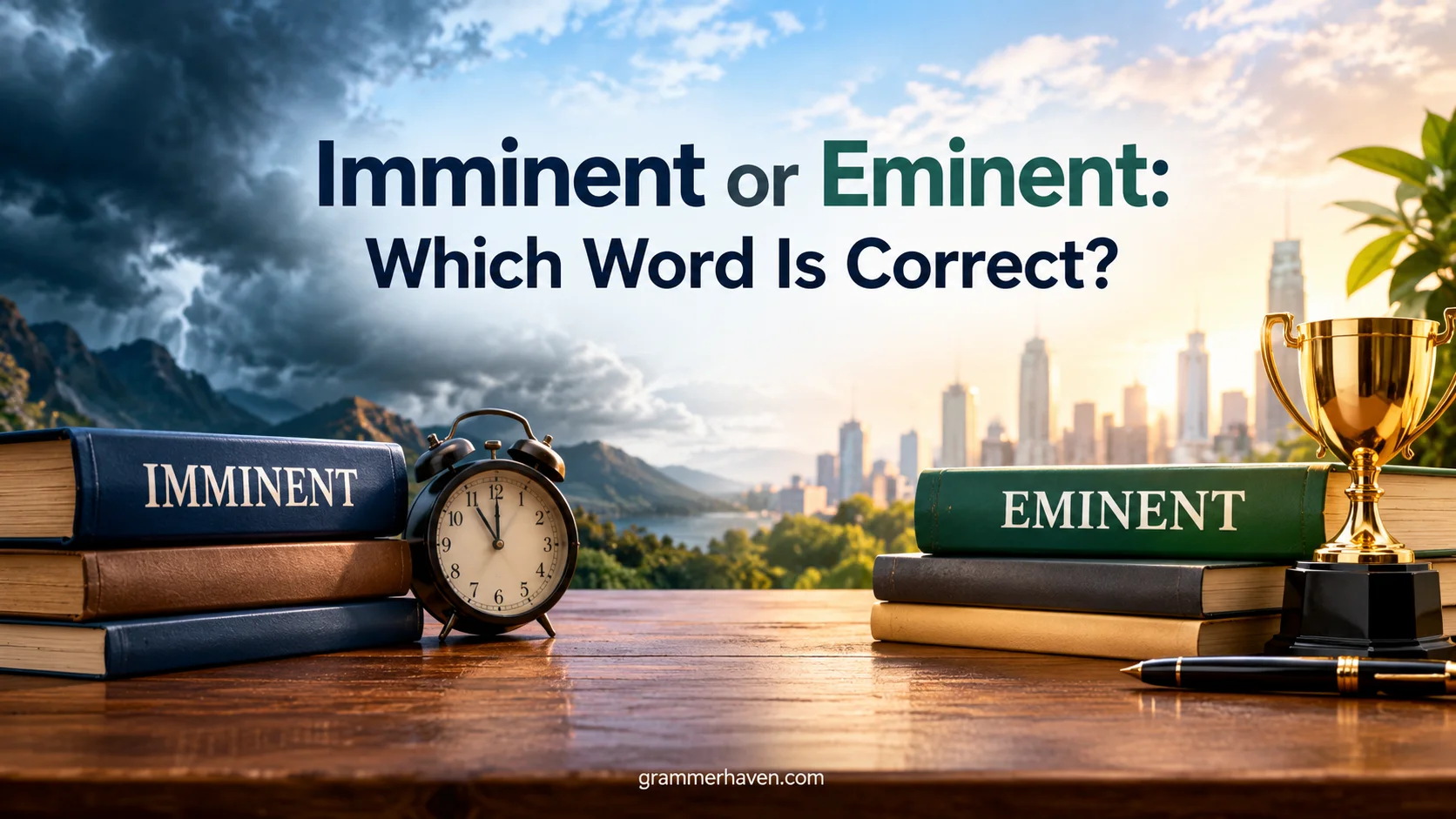
Imminent or Eminent explains two similar words: imminent means about to happen, while eminent describes a respected, important, or prominent person. Imminent and eminent can confuse experienced writers because they sound similar, but their meanings are not identical. The main difference is that imminent describes something about to happen, such as an imminent storm that is approaching and may arrive soon. Eminent describes someone or something distinguished, respected, important, or prominent because of reputation, achievement, status, or importance. Both words are adjectives with different jobs in a sentence.
The spelling of these words can cause confusion when describing a person, event, or situation. Imminent relates to time, while eminent relates to status and importance. This distinction captures the central idea behind the two words. In news articles, emails, and professional writing, choosing the right word matters because the wrong choice can change the meaning of a sentence. Checking what the word describes can make the choice easier.
Writers who struggle with these words can use this quick answer: choose imminent for something about to happen and eminent for someone recognized as distinguished, respected, or prominent. Writers may accidentally make this mistake, so a useful tip is to check whether the word refers to time or reputation. This approach helps avoid errors in writing and communication. A blog using this keyword can provide clear examples, accurate usage, and correct usage to build trust.
Quick Answer: Imminent or Eminent?
Imminent is correct when you mean about to happen or likely to happen very soon.
Eminent is correct when you mean famous, respected, distinguished, or important.
| Word | Meaning | Typical Use | Example |
| Imminent | About to happen soon | Events, situations, threats, changes | A storm is imminent. |
| Eminent | Distinguished, respected, or important | People, experts, figures, authorities | She is an eminent scientist. |
A simple rule makes the difference easy:
Imminent = coming soon.
Eminent = standing out because of achievement or importance.
So, if you’re talking about when something will happen, choose imminent. If you’re talking about how distinguished someone is, choose eminent.
What Does Imminent Mean?
Imminent means that something is about to happen or is likely to happen very soon. It describes something close in time rather than something famous or respected.
Merriam-Webster defines imminent as “ready to take place” or “happening soon.” Cambridge similarly defines it as something coming or likely to happen very soon.
The word often appears with events that create urgency. That’s why you’ll frequently see phrases such as imminent danger, imminent disaster, and imminent arrival.
However, imminent doesn’t automatically mean something bad. The context determines whether the upcoming event is positive, negative, or neutral.
Examples of Imminent in a Sentence
- The storm is imminent, so residents should prepare.
- The baby’s arrival is imminent.
- An important announcement is imminent.
- The company’s expansion is imminent.
- Officials warned of imminent danger.
- The deadline is imminent, so finish your application today.
- Her departure seemed imminent after the meeting.
- Scientists detected signs of an imminent eruption.
Notice what all these examples have in common. Each sentence involves something that is approaching in time.
Common Collocations With Imminent
Some combinations occur especially often in everyday and formal English:
- imminent danger
- imminent threat
- imminent disaster
- imminent arrival
- imminent departure
- imminent death
- imminent change
- imminent decision
- imminent release
- imminent deadline
- imminent collapse
- imminent attack
Merriam-Webster notes that imminent frequently appears with unpleasant or dangerous situations because those events create a sense of something looming nearby.
Still, don’t assume that the word always carries a negative meaning.
Positive:
The baby’s arrival is imminent.
Neutral:
The announcement is imminent.
Negative:
The building faces imminent collapse.
The underlying meaning remains the same: the event is very close in time.
What Does Eminent Mean?
Eminent means famous, respected, distinguished, prominent, or important. It often describes people who have achieved a high level of recognition in a particular field.
Cambridge gives the straightforward definition “famous, respected, or important,” with examples such as an eminent historian. Merriam-Webster similarly explains that eminent describes someone or something that stands above others in quality, position, or distinction.
In other words, eminent has nothing to do with something happening soon.
Consider this sentence:
Dr. Carter is an eminent cardiologist.
The sentence doesn’t tell you when something will happen. Instead, it tells you that Dr. Carter has an exceptional reputation for standing in cardiology.
Examples of Eminent in a Sentence
- She is an eminent historian.
- The university invited several eminent scholars.
- He became an eminent authority on constitutional law.
- The conference attracted eminent scientists from around the world.
- An eminent physician delivered the keynote address.
- The museum honored an eminent artist.
- Several eminent legal experts reviewed the proposal.
- He is regarded as an eminent figure in modern literature.
The word often appears before nouns referring to people, professions, or influential figures.
Common Collocations With Eminent
You’ll often encounter combinations such as:
- eminent scholar
- eminent scientist
- eminent historian
- eminent professor
- eminent physician
- eminent lawyer
- eminent authority
- eminent researcher
- eminent artist
- eminent figure
- eminent leader
- eminent expert
These phrases all point toward recognition, achievement, or distinction.
Imminent vs. Eminent: The Main Difference
The easiest way to separate these words is to ask what the adjective describes.
Imminent describes the nearness of an event.
Eminent describes the standing or distinction of a person or thing.
Think of them as answering two different questions:
Imminent: When is it happening?
Eminent: How distinguished or important is it?
| Question | Correct Word | Example |
| Is something about to happen? | Imminent | The election is imminent. |
| Is someone highly respected? | Eminent | She is an eminent researcher. |
| Is danger approaching? | Imminent | Imminent danger forced an evacuation. |
| Is an expert distinguished? | Eminent | An eminent expert joined the panel. |
| Is an event coming soon? | Imminent | The product launch is imminent. |
| Is a person prominent in a field? | Eminent | He is an eminent surgeon. |
Here’s the key contrast:
An imminent event is close in time. An eminent person stands out in reputation or achievement.
Imminent vs. Eminent Pronunciation
Pronunciation can contribute to the confusion because the words sound remarkably similar.
In US English:
- Imminent: /ˈɪm.ə.nənt/
- Eminent: /ˈem.ə.nənt/
The first vowel provides the main difference. Cambridge lists the US pronunciation of imminent with an initial short i sound and eminent with an initial short e sound.
Try saying these aloud:
The storm is imminent.
Then:
She is an eminent scientist.
The difference becomes more noticeable when you emphasize the first syllable.
Still, pronunciation shouldn’t be your only test. Context provides a much safer clue.
How to Remember the Difference Between Imminent and Eminent

When two words look nearly identical, a simple mental hook can save you from a spelling mistake.
Remember Imminent With “Soon”
Think:
Imminent = something is coming.
A storm can be imminent.
A deadline can be imminent.
An arrival can be imminent.
All of these situations involve something approaching in time.
Remember Eminent With “Excellent Reputation”
Think:
Eminent = someone stands out.
An eminent scientist stands out because of expertise and achievement. An eminent historian has earned distinction in the field.
Merriam-Webster’s explanation of the word’s history also connects eminent with the idea of standing out, while imminent developed from a related idea of something projecting or looming overhead.
A One-Line Memory Trick
Imminent means coming soon; eminent means distinguished.
That’s the distinction worth remembering.
When Should You Use Imminent?
Use imminent when the sentence focuses on something expected to happen very soon.
For example:
The company’s merger is imminent.
The merger hasn’t necessarily happened yet. The point is that it’s expected soon.
Another example:
Officials believe an evacuation is imminent.
Again, the focus is timing. The evacuation is approaching.
Imminent Works Well With:
- Events
- Changes
- Arrivals
- Departures
- Deadlines
- Threats
- Disasters
- Decisions
- Emergencies
- Releases
- Collapses
A useful test is to replace imminent with “about to happen.”
If the sentence still makes sense, you’ve probably chosen the right word.
The storm is imminent.
→ The storm is about to happen.
That works.
When Should You Use Eminent?
Use eminent when you want to emphasize someone’s distinction, reputation, status, or importance.
For example:
The university hired an eminent physicist.
The physicist isn’t necessarily about to do something. The sentence highlights professional achievement and reputation.
Another example:
Several eminent writers attended the ceremony.
The writers are distinguished or highly regarded.
Try replacing eminent with distinguished.
She is an eminent professor.
→ She is a distinguished professor.
The meaning remains close, so eminent works.
Common Mistakes With Imminent and Eminent
These words often get mixed up because their spelling differs by only one letter.
Mistake: “The Storm Is Eminent”
This sentence is usually wrong if you mean that the storm is about to arrive.
Incorrect:
The storm is eminent.
Correct:
The storm is imminent.
Why? A storm can approach soon, but it isn’t usually described as distinguished or respected.
Mistake: “She Is an Imminent Scientist”
This reverses the problem.
Incorrect:
She is an imminent scientist.
Correct:
She is an eminent scientist.
The intended meaning is that she is highly respected or distinguished.
Mistake: Choosing Based Only on Sound
Because the words sound similar, relying on pronunciation can lead you down the wrong path.
Instead, identify the meaning first.
Ask:
Does this sentence describe an approaching event?
Use imminent.
Does it describe a distinguished person or important figure?
Use eminent.
Imminent vs. Impending vs. Immediate
Three words often enter the same conversation: imminent, impending, and immediate.
They overlap, but they aren’t interchangeable in every sentence.
| Word | Core Meaning | Example |
| Imminent | About to happen soon | A storm is imminent. |
| Impending | Approaching or about to happen | The impending storm caused concern. |
| Immediate | Happening now or requiring action without delay | The patient needs immediate care. |
Imminent and impending are particularly close. Cambridge lists impending as a synonym for imminent.
Immediate, however, focuses more strongly on now, without delay, or the present situation.
Compare these:
The deadline is imminent.
The deadline is approaching.
We need immediate action.
Action must happen without delay.
That difference matters.
Imminent vs. Eminent vs. Preeminent
Another word worth separating from these two is preeminent.
Preeminent means exceptionally prominent or outstanding. It belongs to the same family of ideas as eminent, not imminent.
| Word | Meaning | Example |
| Imminent | About to happen | An imminent storm |
| Eminent | Distinguished or respected | An eminent professor |
| Preeminent | More outstanding or prominent than others | A preeminent authority |
For example:
She is an eminent researcher.
This says she’s highly respected.
She is a preeminent researcher.
This makes a stronger claim. It suggests that she ranks among the most outstanding researchers in her field.
The two aren’t identical in strength, even though they overlap.
Is Imminent Always Negative?
No. Imminent doesn’t inherently mean something bad.
The word often appears in negative contexts because danger and disasters naturally create urgency. Merriam-Webster specifically notes this common association with threats and unpleasant events.
However, positive and neutral uses are perfectly valid.
Positive Examples
- The baby’s arrival is imminent.
- The grand opening is imminent.
- The product’s release is imminent.
Neutral Examples
- The announcement is imminent.
- A decision is imminent.
- The next phase of construction is imminent.
Negative Examples
- An earthquake appears imminent.
- The town faces imminent danger.
- The building is in danger of imminent collapse.
So don’t automatically associate imminent with disaster. The word simply tells you that something is very close to happening.
Is Eminent Only Used for People?
Eminent most commonly describes people who have achieved distinction, but its use isn’t limited to people.
Cambridge also records senses involving something noticeable, important, or worthy of remark. Merriam-Webster similarly includes meanings connected with standing out or being conspicuous.
Still, the most familiar use involves people:
an eminent historian
an eminent scientist
an eminent judge
an eminent physician
Don’t confuse eminent with simply famous.
Someone can become famous without being especially distinguished in a particular field. Eminent usually carries a stronger sense of achievement, standing, influence, or respect.
Real-World Examples of Imminent and Eminent

Context makes the distinction much clearer.
Business
Imminent:
The company’s acquisition appears imminent.
The acquisition is expected soon.
Eminent:
An eminent business leader joined the advisory board.
The person’s reputation is the focus.
Education
Imminent:
The final examination is imminent.
The exam is approaching.
Eminent:
The university invited an eminent linguist to speak.
The linguist is distinguished.
Weather
Imminent:
Heavy rainfall appears imminent.
The rain is expected soon.
Eminent:
The phrase eminent storm doesn’t normally express that meaning.
If you’re trying to say that a storm is approaching, imminent is the word you want.
Medicine
Imminent:
The doctors recognized signs of imminent cardiac failure.
The condition appears likely to occur soon.
Eminent:
An eminent cardiologist led the research team.
The adjective describes the doctor’s professional standing.
Law
Imminent:
The government announced an imminent change to the regulations.
The change is expected soon.
Eminent:
The court consulted an eminent constitutional scholar.
The scholar is highly respected.
Can Imminent and Eminent Be Used Interchangeably?
No.
Although the words look and sound similar, they express different concepts.
Consider these two sentences:
The speaker’s arrival is imminent.
This means the speaker will arrive soon.
The speaker is eminent.
This means the speaker is distinguished, important, or respected.
Now imagine switching the words:
The speaker’s arrival is eminent.
That doesn’t communicate the intended meaning of an approaching arrival.
Likewise:
The speaker is imminent.
That doesn’t normally mean the speaker is distinguished.
The words aren’t interchangeable simply because they share similar spelling.
A Simple Decision Guide for Imminent or Eminent
When you’re unsure, follow this quick process.
Step 1: Identify what you’re describing.
Is it an event, situation, change, threat, or arrival?
→ Consider imminent.
Is it a person, expert, authority, leader, or notable figure?
→ Consider eminent.
Step 2: Test the meaning.
Can you replace the word with “about to happen”?
→ Imminent
Can you replace it with “distinguished” or “highly respected”?
→ Eminent
Quick Decision Diagram
Something is approaching in time
↓
IMMINENT
Someone or something stands out in distinction or importance
↓
EMINENT
This simple distinction handles most everyday cases.
Imminent or Eminent: Practice Quiz
Choose imminent or eminent for each sentence.
- The arrival of the guests is ________.
- She is an ________ professor of chemistry.
- Officials warned residents about ________ flooding.
- The university invited several ________ researchers.
- The company’s product launch is ________.
- He consulted an ________ legal scholar.
- The patient’s condition appeared ________.
- The award recognized an ________ physician.
- The deadline is ________.
- The conference featured several ________ scientists.
Answers
- Imminent — the guests are about to arrive.
- Eminent — the professor is distinguished.
- Imminent — the flooding is expected soon.
- Eminent — the researchers are highly respected.
- Imminent — the launch is approaching.
- Eminent — the scholar has distinction or authority.
- Imminent — the condition is likely to occur soon.
- Eminent — the physician is distinguished.
- Imminent — the deadline is approaching.
- Eminent — the scientists are recognized for their work.
The pattern should now be clear: imminent deals with timing, while eminent deals with distinction.
See also: Preform or Perform: Which Word Is Correct?
FAQs:
What is the difference between imminent and eminent?
Imminent means something is about to happen soon. Eminent means someone or something is distinguished, respected, prominent, or important.
Is imminent a negative word?
Not necessarily. Although it often appears with danger or disasters, it can describe positive or neutral events such as an imminent arrival or imminent release.
Does eminent mean famous?
It can mean famous, but eminent usually suggests more than simple fame. It often conveys distinction, respect, importance, or achievement.
Is “imminent danger” correct?
Yes. Imminent danger is a standard and common expression. It means danger is very close or likely to occur soon.
Is “eminent scientist” correct?
Yes. Eminent scientist describes a scientist who has achieved distinction or gained significant respect in the field.
Is imminent a synonym for impending?
Yes. Impending and imminent can often function as synonyms when describing something approaching or likely to happen soon.
Can eminent describe things other than people?
Yes. Although its most familiar use involves distinguished people, eminent can also describe something noticeable, important, or prominent.
What is an easy way to remember imminent?
Connect imminent with coming soon. If something is approaching in time, imminent is usually the right choice.
What is an easy way to remember eminent?
Connect eminent with distinguished. If someone stands out because of achievement or reputation, eminent fits.
Which is correct: “an imminent professor” or “an eminent professor”?
An eminent professor is correct when you mean a respected or distinguished professor. Imminent professor would not express that meaning.
Conclusion:
Understanding imminent or eminent becomes easier when you focus on their meanings. Imminent describes something that is about to happen, while eminent describes someone or something distinguished, respected, or prominent. Although these words look and sound similar, they serve different purposes in a sentence. Remembering this simple difference can help you choose the correct word in emails, professional writing, and everyday communication. When you pause and consider whether you are talking about an approaching event or a respected person or thing, the right spelling becomes much easier to identify.