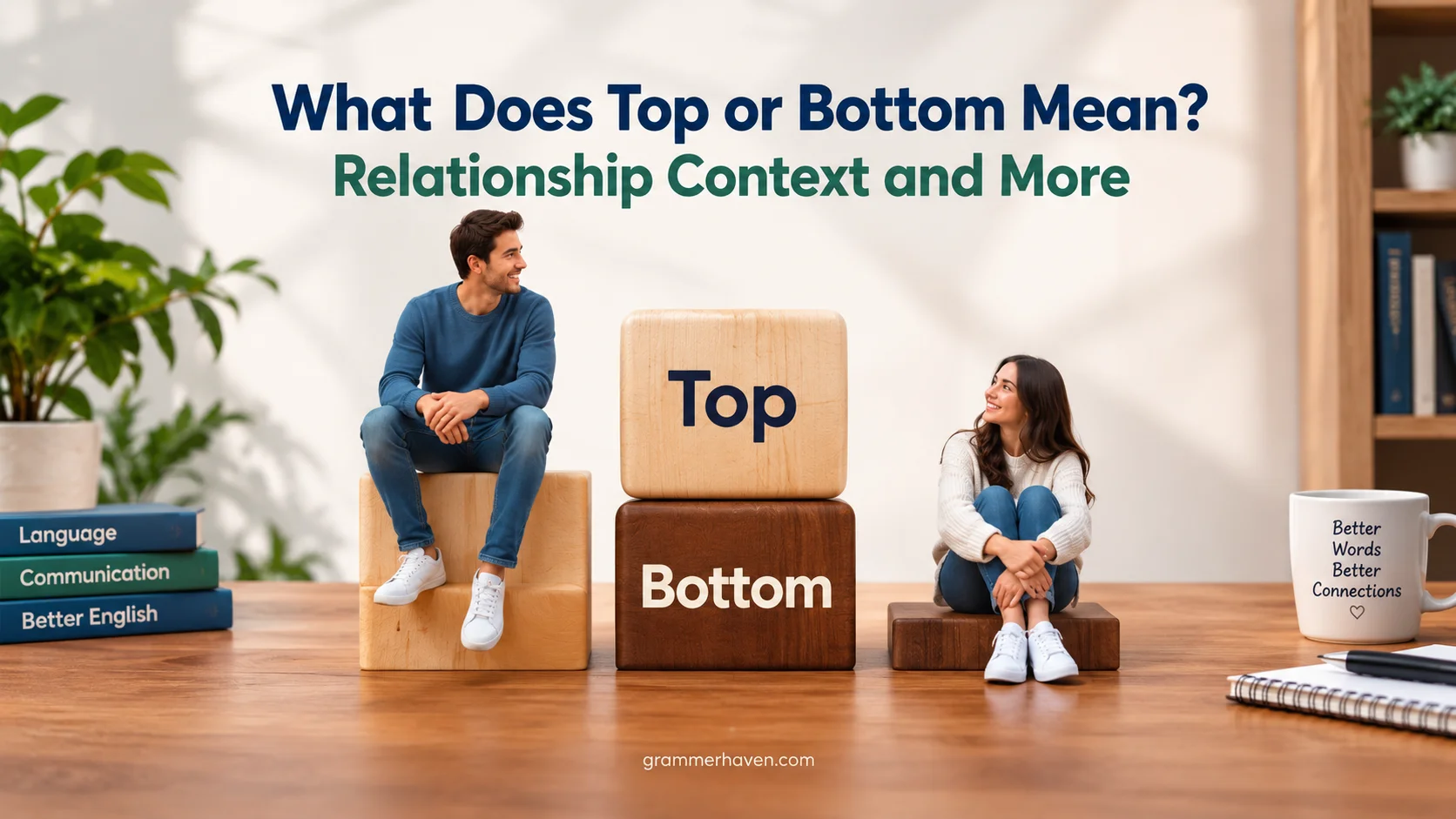
Top or Bottom Mean can describe a sexual role in the queer community, but relationships, romantic interests, and everyday life can show different sides of a person. A Top may be assertive or dominant, while a bottom may prefer receiving or a more passive role.
These labels are multifaceted, so they do not always define someone’s personality or queer dating style. Doms, dominants, Subs, and submissives can describe power dynamics rather than only physical roles. People may prefer giving, receiving, penetrating, or being penetrated, while an emotional role can involve feelings, trust, and communication. The Tri-Top Theory adds another idea to discussions about top identities, though labels can become complicated when linked to someone’s whole lifestyle or romance.
A loaded question about whether someone is domineering, inactive, or passive outside the bed can miss these differences. Hard conversations and consensus can help partners understand their sexual, romantic role, and emotional preferences without assuming that one role explains everything.
Top or Bottom Meaning: Quick Answer
“Top or bottom” generally refers to two opposite positions, roles, or preferences. In ordinary English, top means the upper or highest part, while bottom means the lower or lowest part.
In slang or relationship conversations, however, top and bottom can describe sexual roles. A top generally takes the giving or performing role in a particular activity, while a bottom generally takes the receiving role. A person who is comfortable with both roles may describe themselves as versatile (vers) or, in some contexts, a switch.
Importantly, top doesn’t automatically mean dominant, and bottom doesn’t automatically mean submissive. Top/bottom describes one dimension of an interaction, while dominant/submissive describes another.
So, when someone asks, “Are you a top or bottom?”, the surrounding conversation matters more than the words alone.
What Does Top or Bottom Mean?
At its most basic level, top and bottom represent opposite ends of a physical or figurative scale.
Think of a staircase. The highest step is at the top, while the lowest step is at the bottom. The same basic contrast appears throughout English.
| Context | Top | Bottom |
| Physical location | Higher part | Lower part |
| Ranking | Higher position | Lower position |
| Clothing | Upper-body garment | Lower-body garment |
| Organization | Higher level | Lower level |
| Page layout | Upper section | Lower section |
| Slang | A role or preference | A role or preference |
This basic contrast explains why the words appear in so many unrelated expressions. Cambridge defines bottom as the lowest part of something and also recognizes its use for lower-body clothing. Collins similarly defines top as the highest point or part and uses it for upper-body clothing and high-ranking positions.
The tricky part begins when a conversation moves from physical position to social or sexual terminology.
Top Meaning in Everyday English
The ordinary meaning of top centers on height, position, rank, or importance.
You can use it literally:
- “The keys are on top of the cabinet.”
- “She reached the top of the stairs.”
- “Put your name at the top of the page.”
You can also use it figuratively:
- “He finished at the top of his class.”
- “Safety is our top priority.”
- “She’s one of the top players in the league.”
In these examples, top doesn’t describe a relationship role. It simply indicates something high, leading, important, or superior in position.
Top as Clothing
In clothing, a top refers to an upper-body garment. Shirts, blouses, tank tops, and similar garments can fall into this broad category. Cambridge gives examples such as pajama tops and clothing worn above the waist.
That’s why stores commonly organize clothing into tops and bottoms.
For example:
“I need a new top to go with these pants.”
Here, “top” has nothing to do with slang. It simply means an upper-body garment.
Bottom Meaning in Everyday English
Bottom usually describes the lowest part, base, or lowest position.
You might say:
- “The shoes are at the bottom of the closet.”
- “Write your signature at the bottom of the form.”
- “The boat reached the bottom of the lake.”
- “Our team sits near the bottom of the standings.”
The word can also describe the lower part of clothing. Cambridge notes that bottoms can refer to the lower part of a two-piece outfit, such as bikini bottoms or pajama bottoms.
Merriam-Webster likewise recognizes bottom as the lowest part or point and uses bottoms for clothing worn on the lower part of the body.
Bottom in Rankings
In rankings, bottom often means the lowest position or one of the least successful positions.
For example:
“The team finished at the bottom of the league.”
That doesn’t imply anything sexual. It simply means the team ranked poorly.
Likewise:
“She started at the bottom and worked her way up.”
Here, bottom means a lower position within an organization or career structure.
Why Context Changes the Top or Bottom Meaning
Context acts like a signpost. Without it, “top” and “bottom” can point in several directions.
Consider this sentence:
“Are you a top or bottom?”
If two friends are discussing bunk beds, the question could literally ask which bed someone prefers.
If they’re discussing clothing, the phrase could refer to shirts and pants.
That’s why reading only the words isn’t enough. You need to understand the subject of the conversation.
A Simple Context Test
When you see “top or bottom,” ask:
- Are they talking about physical location?
- Are they discussing clothes?
- Are they talking about rankings or status?
- Is the conversation about dating or relationships?
- Does the surrounding language indicate sexual or BDSM terminology?
That quick check usually reveals the intended meaning.
Top or Bottom Meaning in Slang
In slang, particularly in LGBTQ+ and BDSM-related contexts, top and bottom can describe roles in sexual activity or other intimate activities.
The precise meaning depends on the community and situation. In sexual contexts, top commonly refers to the partner who performs the giving or insertive role, while bottom generally refers to the receiving or receptive role. Research on sexual positioning also identifies versatility as a third commonly used category for people who may take either role.
In BDSM, the terminology can become even more nuanced. A top may perform an activity while a bottom receives it, but neither role automatically determines who holds psychological control.
That distinction matters.
What Does Top Mean in Slang?
In slang, top can describe someone who prefers or takes the active, giving, or performing role in a particular sexual activity.
However, “active” doesn’t necessarily mean aggressive. It also doesn’t tell you anything reliable about someone’s personality.
A person can be calm, shy, confident, outgoing, dominant, submissive, or anything else while identifying as a top.
In other words, a sexual role isn’t a personality test.
What Does Bottom Mean in Slang?
A bottom generally refers to someone who prefers or takes the receptive role in a particular sexual activity.
Again, the label doesn’t automatically describe someone’s personality.
A common stereotype treats bottoms as passive or submissive in every sense. That’s too simplistic. Sexual role and interpersonal authority can exist on separate dimensions.
Does Top Mean Dominant?
No. Top and dominant aren’t the same thing.
This is one of the most important distinctions to understand when interpreting top or bottom meaning.
A top generally describes who performs an activity. A dominant describes someone who takes a position of authority or control within a power dynamic.
Those roles can overlap, but they don’t have to.
For example, someone may perform an activity while following their partner’s detailed instructions. In that case, the person performing the activity can still be the top even though the other partner controls the broader dynamic.
The Journal of Positive Sexuality describes top/bottom as physical or activity-based roles and dominant/submissive as psychological or power-based roles.
Top vs. Dominant
| Term | Main idea |
| Top | Performs or gives an activity |
| Dominant | Holds or directs power within a dynamic |
| Bottom | Receives an activity |
| Submissive | Yields or follows within a power dynamic |
The distinction prevents a lot of unnecessary confusion.
Does Bottom Mean Submissive?
No. Being a bottom doesn’t automatically make someone submissive.
A bottom can receive an activity while still influencing or directing what happens. Similarly, a submissive person can sometimes perform an activity while following the direction of a dominant partner.
This is why the two pairs shouldn’t be treated as perfect synonyms:
Top ≠ Dominant
Bottom ≠ Submissive
The terms describe different aspects of an interaction. Scholarly and educational sources discussing BDSM terminology make the same distinction between physical/action roles and psychological power roles.
What Does “Vers” Mean?
Vers is short for versatile.
In sexual terminology, it generally describes someone who is comfortable taking both top and bottom roles. Research involving young gay men found that versatility was an important third category alongside top and bottom rather than treating the two as an absolute binary.
Being versatile doesn’t necessarily mean someone wants to switch roles equally often.
Preferences can vary.
Someone might prefer one role most of the time but still enjoy another role under certain circumstances. That’s one reason labels work best as descriptions of preference, not rigid boxes.
What Does “Switch” Mean?
Switch usually refers to someone who can move between different roles in BDSM or kink contexts.
Depending on the conversation, a switch may move between top and bottom roles, dominant and submissive roles, or both kinds of dynamics.
The word therefore has a broader meaning than simply “vers.”
A person might use vers specifically for sexual positioning while using switch for changing between dominant and submissive dynamics. Terminology can vary, so the person’s own definition matters.
Top or Bottom Meaning in Dating
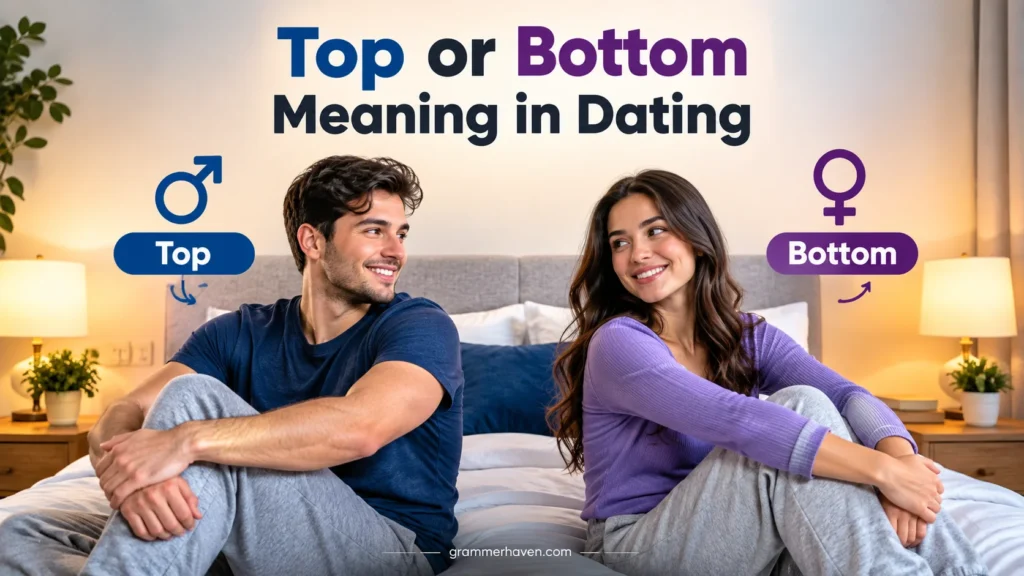
The phrase “top or bottom” frequently appears in dating conversations because people sometimes use these labels to communicate sexual preferences quickly.
A dating profile might contain:
- Top
- Bottom
- Vers
- Versatile
- Side
- No label at all
These labels can help people communicate preferences efficiently. Still, they don’t tell you everything about someone’s desires, boundaries, personality, or relationship style.
For example, two people who both identify as bottoms may have very different preferences and boundaries.
Likewise, two people who identify as tops may approach intimacy in completely different ways.
The label is a shortcut. It isn’t the whole story.
What Does “Are You a Top or Bottom?” Mean?
When someone asks this question in a dating or sexual context, they’re generally asking about your sexual role or preference.
The question can be direct, casual, flirtatious, or intrusive depending on who asks it and where the conversation occurs.
If you don’t know the person’s intent, context can help. So can a simple clarification:
“Do you mean sexually?”
That removes ambiguity without making assumptions.
And if you don’t want to answer, you don’t have to. Personal questions still require personal boundaries.
Top or Bottom in BDSM
The terms become especially nuanced in BDSM.
In a BDSM scene, a top may perform an activity such as tying, striking, restraining, or otherwise applying a negotiated form of sensation. A bottom receives that activity.
However, the person receiving the activity may still exercise substantial control through boundaries, communication, and negotiated limits. Likewise, the person performing an activity isn’t necessarily the person with broader authority.
Research and educational literature consistently distinguish top/bottom roles from dominant/submissive power dynamics.
This gives you a useful mental model:
Top/bottom = What is happening?
Dominant/submissive = Who holds the negotiated power?
Those two questions can have different answers.
Top or Bottom Meaning in Everyday Conversations
The phrase can appear in plenty of ordinary situations that have nothing to do with dating.
Physical Position
“Would you rather have the top bunk or the bottom bunk?”
Here, the meaning is completely literal.
Clothing
“I bought three new tops and two bottoms.”
Here, tops means upper-body clothing while bottoms means lower-body clothing.
Rankings
“Our team moved from the bottom to the top of the table.”
Here, the phrase describes competitive ranking.
Business
“The decision came from the top.”
Here, top refers to senior leadership or people with authority.
Baseball
Baseball provides another interesting example. The top of an inning refers to the first half, while the bottom of an inning refers to the second half. Cambridge specifically recognizes these baseball meanings.
So, one phrase can travel surprisingly far.
Common Phrases With Top and Bottom
The two words also appear in many established expressions.
| Expression | Meaning |
| At the top | In the highest position |
| Top priority | Something considered most important |
| Top-notch | Excellent or high quality |
| Top of the list | Highest priority or ranking |
| At the bottom | In the lowest position |
| Bottom line | The essential result or main point |
| Bottom of the list | Lowest priority or ranking |
| Get to the bottom of it | Discover the real cause or truth |
| From top to bottom | Throughout an entire thing |
| Hit rock bottom | Reach an extremely low point |
For example:
“We need to get to the bottom of the problem.”
Here, bottom means the underlying cause, not a physical location.
That figurative meaning is well established in English dictionaries.
Common Misunderstandings About Top or Bottom
Top Always Means Dominant
It doesn’t.
A top can perform an activity without holding the dominant role in the broader dynamic.
Bottom Always Means Submissive
That isn’t necessarily true either.
A bottom can receive an activity while maintaining significant control or directing preferences.
Top and Bottom Describe Personality
They don’t.
Being a top or bottom doesn’t automatically tell you whether someone is confident, shy, masculine, feminine, assertive, quiet, outgoing, or anything else.
Everyone Must Choose One
Not everyone uses these labels.
Some people identify as top, bottom, or versatile. Others use different terminology, and some don’t label their preferences at all.
The Meaning Is Always Sexual
Definitely not.
“The bottom of the page” is just the bottom of the page. Context does the heavy lifting.
Case Study: How Context Changes the Meaning
Consider three conversations involving the same basic words.
Conversation One: Clothing
Person A: “Did you buy a matching top or bottom?”
Meaning: They’re discussing clothing.
Conversation Two: Sports
Person A: “Our team is near the bottom of the rankings.”
Meaning: The team has a low competitive position.
Conversation Three: Dating
Person A: “Are you a top or bottom?”
Meaning: In a sexual or dating context, the question may refer to sexual role or preference.
The words haven’t changed much.
The context has.
That’s the central lesson behind the top or bottom meaning.
How to Understand “Top or Bottom” in a Text
When you encounter the phrase in a message, don’t immediately jump to the slang interpretation.
Instead, look at the surrounding conversation.
Use these clues:
- Clothing discussion: probably refers to garments.
- Sports discussion: probably refers to ranking or position.
- Work discussion: may refer to hierarchy.
- Location discussion: probably means upper or lower position.
- Dating discussion: may refer to sexual preference.
- BDSM discussion: may refer to activity or role.
- A joke or meme: the phrase may be intentionally ambiguous.
When the context remains unclear, asking a short question is better than guessing.
Is “Top or Bottom” Offensive?
The phrase itself isn’t inherently offensive.
However, context and privacy matter.
Asking someone about the top or bottom meaning of a phrase is harmless. Asking a stranger about their personal sexual role can be much more intrusive.
A respectful approach recognizes that intimate preferences are private information. People can answer, clarify, change the subject, or decline.
That boundary matters particularly in professional or unfamiliar settings, where a sexual interpretation may be inappropriate.
How to Answer “Are You a Top or Bottom?”

If someone asks you this in a relevant personal conversation, the answer depends entirely on what you’re comfortable sharing.
Possible responses include:
- “I’m a top.”
- “I’m a bottom.”
- “I’m versatile.”
- “I don’t really use labels.”
- “I’d rather not get into that.”
- “What do you mean by top or bottom?”
There isn’t a required answer.
The best response is the one that accurately reflects your preference and comfort level.
Can Top or Bottom Preferences Change?
Yes, people can experience preferences differently over time.
A label can describe what someone generally prefers without becoming a permanent rule. Some people consistently prefer one role. Others enjoy flexibility. Still others don’t find labels useful.
Research on sexual roles has documented flexibility and the importance of versatility rather than treating top and bottom as rigid, mutually exclusive identities.
So, there’s no need to treat these terms like permanent job titles.
Top, Bottom, Versa, and Switch: Quick Comparison
| Term | General meaning |
| Top | Usually performs or gives a particular sexual or physical activity |
| Bottom | Usually receives a particular sexual or physical activity |
| Vers | Comfortable with both top and bottom roles |
| Switch | Can move between roles or power dynamics depending on context |
| Dominant | Takes the directing or controlling role in a power dynamic |
| Submissive | Yields or follows within a negotiated power dynamic |
The most important distinction is between action and authority. Top/bottom terminology generally describes what someone does or receives, while dominant/submissive terminology concerns the power relationship.
Key Facts About Top or Bottom Meaning
- Top commonly means the highest or upper part of something.
- Bottom commonly means the lowest or lower part.
- Both words have ordinary meanings unrelated to sexuality.
- Top can mean an upper-body garment.
- Bottoms can mean lower-body clothing.
- In rankings, top indicates a high position while bottom indicates a low position.
- In baseball, top and bottom describe the two halves of an inning.
- In sexual contexts, top and bottom can describe different roles.
- Vers generally means versatile.
- Top doesn’t automatically mean dominant.
- Bottom doesn’t automatically mean submissive.
- Not everyone uses these labels.
- Context determines which meaning the speaker intends.
See also: Imminent or Eminent: Which Word Is Correct?
FAQs:
What does “top or bottom” mean in simple terms?
It usually means upper or lower, but the exact meaning depends on context. In slang and dating conversations, it can refer to sexual roles or preferences.
What does top mean in slang?
In sexual slang, top generally refers to someone who prefers or takes the giving, performing, or insertive role in a particular activity.
What does bottom mean in slang?
Bottom generally refers to someone who prefers or takes the receiving or receptive role in a particular sexual activity.
Does top mean dominant?
Not necessarily. A top performs or gives an activity, while a dominant person holds a particular position of authority within a power dynamic.
Does bottom mean submissive?
Not necessarily. A bottom may receive an activity without taking a submissive role in the broader relationship or dynamic.
What does vers mean?
Vers is short for versatile. It generally describes someone who is comfortable taking both top and bottom roles.
What does switch mean?
A switch is generally someone who can move between different roles, particularly top/bottom or dominant/submissive roles, depending on context.
Is “top or bottom” always a sexual question?
No. It can refer to physical location, clothing, rankings, workplace hierarchy, baseball, and many other ordinary situations.
What does “Are you a top or bottom?” mean in dating?
In a dating or sexual context, it usually asks about someone’s preferred sexual role.
Can someone be both a top and bottom?
Yes. Someone who enjoys both roles may describe themselves as versatile or use another label depending on the community and context.
Are top and bottom personality types?
No. These labels don’t reliably describe personality traits such as confidence, masculinity, femininity, introversion, or extroversion.
What’s the difference between top and bottom?
In ordinary English, top means higher or upper, while bottom means lower or underneath. In sexual contexts, they can describe giving/performing and receiving roles.
Why does context matter so much?
Because top and bottom have several established meanings. A “top” in clothing is completely different from a “top” in a dating conversation.
Can someone choose not to use these labels?
Absolutely. Labels can make communication easier, but nobody has to identify with one.
Conclusion:
The top or bottom meaning depends on where and how the phrase appears. In ordinary English, top describes something higher, upper, leading, or more important. Bottom describes something lower, underneath, foundational, or at the lowest position. These meanings appear everywhere, from clothing and page layouts to sports rankings and business structures.
In slang, dating, and sexual conversations, however, top and bottom can describe intimate roles or preferences. Those terms carry more specialized meanings, yet they still shouldn’t be confused with dominant and submissive. A top isn’t automatically dominant, and a bottom isn’t automatically submissive.