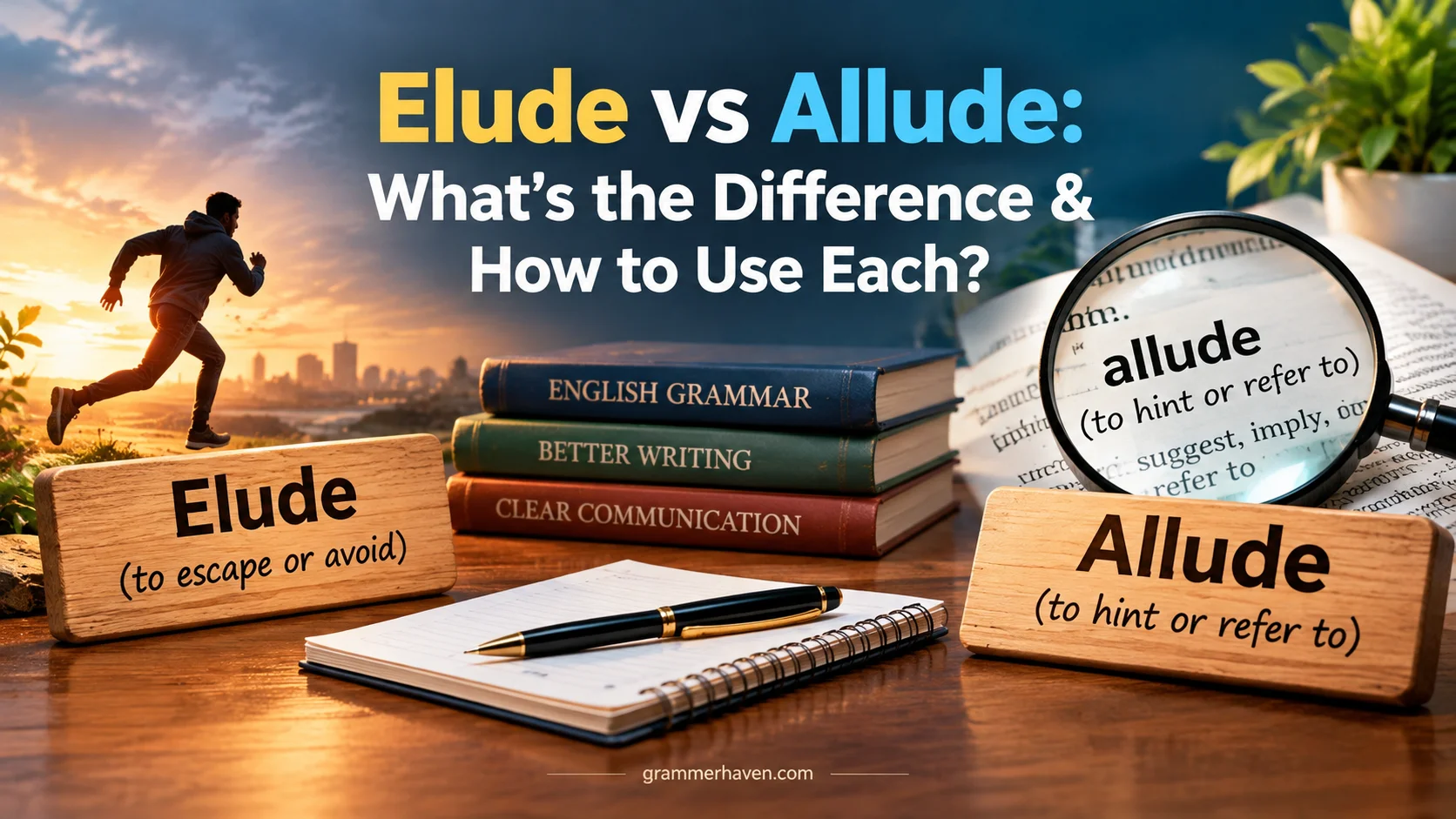
Elude vs Allude can confuse writers because these similar-looking words have different meanings and serve different purposes in English. Elude describes escaping something or remaining out of reach, while allude means to refer to something without stating it directly. Their Latin roots can help explain their history, but the practical difference is easier to remember through usage.
An idea may elude your understanding or memory despite your efforts, while a writer alludes to an event by referring to it indirectly. From my experience with writing, this distinction becomes much clearer when you focus on what each word means rather than how the words sound.
The difference matters in essays, emails, and professional writing, where a usage error can change the meaning of a correct sentence. The phrase “answer eluded me” shows that an answer escaped your grasp, while “she alluded to the problem” shows that she referred to the problem without explaining it fully. “She eluded to the problem” is a wrong choice because elude does not mean “refer to.” People who search for “elude or allude” often need a clear answer, simple explanations, and easy examples. This guide can help you use these words correctly and build confidence when choosing between them.
Quick Answer: Elude vs Allude
The easiest way to remember the difference is this:
- Elude means to escape, evade, or remain beyond someone’s grasp.
- Allude means to refer to or hint at something, usually without discussing it directly.
- Elude commonly takes a direct object: “The suspect eluded the police.”
- Allude is commonly followed by to: “The speaker alluded to the controversy.”
- Think E = Escape for elude.
- Think A = Allusion for allude.
| Word | Core meaning | Common pattern | Example |
| Elude | Escape, evade, or remain beyond reach | elude + object | “The suspect eluded police.” |
| Allude | Refer to or hint at something | allude to + object | “She alluded to the incident.” |
Merriam-Webster defines elude as avoiding or escaping something and also as escaping perception, understanding, or grasp. It defines allude as making an indirect reference and also recognizes the broader sense of simply “refer.”
What Does Elude Mean?
Elude is a verb that describes something escaping, avoiding, or staying beyond someone’s reach. The escape doesn’t always involve a person running away. In fact, some of the most useful modern examples involve ideas, memories, answers, and achievements.
Merriam-Webster gives three major senses: to evade, to escape perception or understanding, and to resist explanation.
Elude Means to Escape or Evade
The most concrete meaning of elude involves avoiding capture or pursuit.
For example:
- “The suspect eluded the police.”
- “The fox eluded the hunters.”
- “The driver eluded the officers.”
- “The fugitive eluded capture for several years.”
In each sentence, someone or something stays out of reach. The word often suggests that the escape requires cleverness, speed, skill, or some other means of avoiding capture.
Cambridge Dictionary similarly defines elude as not being caught by someone and gives examples involving people escaping police pursuit.
Elude Can Describe Something Abstract
Here’s where elude becomes more interesting.
An answer can’t literally sprint out of a room. A memory can’t hide behind a tree. Success doesn’t jump into a getaway car. Yet all three can elude you.
Consider these examples:
- “The answer eluded me.”
- “Her name eluded me during the conversation.”
- “The cause of the problem eluded researchers.”
- “A clear explanation eluded the investigators.”
- “The championship continued to elude the team.”
In these cases, elude means something remains beyond your mental grasp or efforts. Cambridge specifically recognizes uses involving achievement and memory, including situations where success doesn’t happen or a piece of information can’t be remembered.
This broader use is important because many writers associate elude only with physical escape. That’s too narrow.
Common Expressions With Elude
You will often see elude in phrases such as:
- elude capture
- elude the police
- elude detection
- elude understanding
- elude explanation
- elude memory
- elude researchers
- elude success
- elude achievement
The subject can be either concrete or abstract.
“The cause of the disease continues to elude researchers.”
Here, researchers aren’t chasing a physical object. They simply haven’t discovered the answer.
What Does Allude Mean?
Allude means to refer to something without necessarily explaining or naming it fully. It often involves an indirect hint.
For example:
- “The speaker alluded to the scandal.”
- “She alluded to problems at work.”
- “The author alluded to Greek mythology.”
- “He alluded to his earlier comments.”
- “The article alludes to a possible change in policy.”
Cambridge describes allude to as mentioning someone or something without talking about that person or thing directly.
Why “Allude To” Is So Common
The construction allude to appears frequently because the verb normally introduces the subject being referenced.
For example:
- allude to an event
- allude to a person
- allude to a problem
- allude to a statement
- allude to an experience
- allude to a historical event
Compare these sentences:
“The mayor alluded to the budget crisis.”
The mayor referred to the crisis without necessarily discussing every detail.
This sentence has a completely different meaning. It suggests that the mayor somehow escaped or avoided the crisis. That probably isn’t what the writer intended.
Does Allude Always Mean “Indirectly”?
Not quite.
This is an important point that gets lost in simplified grammar explanations. Allude commonly means to refer indirectly, but Merriam-Webster also recognizes a broader meaning of refer. It notes that English speakers have used allude for more direct reference for well over a century.
So the safest everyday rule remains:
Use allude when you mean “refer to” or “hint at.”
When the reference is indirect, the meaning becomes especially clear.
Elude vs Allude: The Core Difference
The difference becomes much easier when you focus on the action involved.
Think “Escape” for Elude
Elude describes something getting away from you or staying beyond your reach.
Ask yourself:
Is something escaping, avoiding capture, or remaining difficult to grasp?
If yes, elude is probably the right word.
Examples:
- “The criminal eluded authorities.”
- “The answer eluded me.”
- “Success eluded the team.”
- “The meaning of the poem eluded readers.”
The word can describe physical escape, mental difficulty, failure to achieve something, or resistance to explanation.
Think “Reference” for Allude
Allude describes pointing toward something through words.
Ask yourself:
Is someone referring to an idea, person, event, or topic?
If yes, allude is the likely choice.
Examples:
- “The author alluded to the war.”
- “She alluded to her previous relationship.”
- “The manager alluded to upcoming changes.”
- “The film alludes to several classic stories.”
There’s no escaping involved. Someone is simply making a reference.
Elude vs Allude Examples
Context makes the distinction much easier to see.
Examples With Elude
- The suspect eluded police during the pursuit.
- The answer eluded me all afternoon.
- The team’s first championship continued to elude them.
- The researchers couldn’t identify the cause because it eluded them.
- His name eluded my memory.
- The subtle meaning of the passage eluded several readers.
- The escaped animal eluded its pursuers.
- A simple explanation eluded the investigators.
Examples With Allude
- The professor alluded to an earlier study.
- She alluded to the disagreement during the meeting.
- The author alludes to several historical events.
- He alluded to his childhood without giving details.
- The journalist alluded to possible changes in the law.
- The speech alluded to recent economic problems.
- The movie alludes to several famous novels.
- The manager alluded to an upcoming announcement.
Side-by-Side Comparison
| Elude | Allude |
| “The suspect eluded police.” | “The suspect alluded to the investigation.” |
| “The answer eluded me.” | “She alluded to the answer.” |
| “Success eluded him.” | “He alluded to his success.” |
| “The meaning eluded readers.” | “The author alluded to the meaning.” |
| “The animal eluded its pursuers.” | “The speaker alluded to the animal.” |
One word describes escaping or remaining beyond reach. The other describes making a reference.
Elude vs Allude in Different Situations

The quickest way to master these words is to see how they behave in real situations.
When Talking About People
Use elude when someone avoids capture or pursuit:
“The suspect eluded police.”
Use allude when someone refers to another person:
“The speaker alluded to his former employer.”
The distinction is sharp. One describes avoidance. The other describes reference.
When Talking About Ideas
An idea can elude you when you can’t understand it:
“The central argument eluded me.”
A writer can allude to an idea when referring to it:
“The author alluded to the same argument in the final chapter.”
This is one of the most useful contrasts because both words can appear around intellectual subjects.
When Talking About Success
Elude works especially well with achievement.
“The gold medal continued to elude her.”
Here, the athlete wants the medal but hasn’t achieved it.
Cambridge specifically lists achievement as one of the established uses of elude, including examples involving medals and success.
You wouldn’t normally use allude to express failure to achieve something.
When Talking About Memory
Memory provides another excellent test.
“Her name eluded me.”
This means the name wouldn’t come to mind.
Now compare:
“She alluded to her childhood.”
This means she referred to her childhood.
One concerns remembering. The other concerns mentioning.
Common Mistakes With Elude and Allude
These words frequently trade places in writing. A few mistakes appear often enough to deserve special attention.
Mistake: Using Allude for Escape
Incorrect:
“The suspect alluded the police.”
Correct:
“The suspect eluded the police.”
The suspect isn’t referring to the police.
Mistake: Using Elude for Reference
Incorrect:
“The speaker eluded to the controversy.”
Correct:
“The speaker alluded to the controversy.”
The speaker referred to the controversy. Therefore, alluded to fits.
Merriam-Webster specifically highlights this kind of confusion as a common misuse of the two words.
Mistake: Writing “Alluded Me”
Suppose you can’t remember someone’s name.
Incorrect:
“Her name alluded me.”
Correct:
“Her name eluded me.”
The name stayed outside your memory. It didn’t make a reference to you.
Mistake: Assuming Elude Only Means Physical Escape
This is another common misunderstanding.
“The answer eluded me.”
Nothing physically escaped. The answer simply remained beyond your understanding.
Likewise:
“Victory eluded the team.”
The team didn’t chase a person who ran away. It failed to achieve the desired result.
These abstract uses are standard dictionary meanings, not unusual literary inventions.
How to Remember the Difference Between Elude and Allude

A simple memory trick can save you from a surprisingly persistent spelling problem.
Elude = Escape
The first letter gives you the clue:
E = Elude = Escape
If something escapes you, avoids you, or stays beyond your grasp, choose elude.
“The answer eluded me.”
Allude = Allusion
Connect allude with allusion.
An allusion refers to another person, event, work, or idea without necessarily explaining it fully.
“The writer alluded to Shakespeare.”
The One-Line Rule
Elude means escape; allude means refer.
That single distinction handles most everyday situations.
Elude vs Allude: Word Origins
The similarity between these words isn’t accidental.
Both developed from Latin roots connected with ludere, meaning “to play.” Merriam-Webster explains that allude comes from Latin alludere, while elude comes from Latin eludere.
Their histories then took different paths.
Allude entered English around 1531, while Merriam-Webster dates the first known use of elude to 1667.
That shared ancestry explains why the words look so similar today. Their modern meanings, however, are distinct enough that substituting one for the other can completely change a sentence.
Elude vs Allude: Synonyms
Looking at synonyms makes the distinction even clearer.
Synonyms for Elude
Depending on context, elude can relate to:
- escape
- evade
- avoid
- dodge
- slip away
- remain beyond reach
- remain beyond understanding
Merriam-Webster notes that elude has a particularly slippery or baffling quality when something escapes someone’s grasp.
Synonyms for Allude
Depending on context, allude can mean:
- refer to
- hint at
- mention
- suggest
- point to
- make reference to
The strongest synonym test is simple: if refer to fits, consider allude. If escape or remain beyond reach fits, consider elude.
Elude vs Allude in Formal and Everyday English
Both words are standard English, although they can sound more formal than everyday alternatives such as escape, mention, or refer to.
Elude frequently appears in:
- journalism
- academic writing
- sports reporting
- investigations
- literary criticism
- discussions of memory
- discussions of achievement
For example:
“The championship has eluded the team for years.”
Allude appears often in:
- essays
- interviews
- journalism
- literary analysis
- speeches
- formal discussions
For example:
“The author alludes to an earlier historical event.”
Neither word is incorrect simply because it sounds formal. The key is whether the meaning fits.
Elude vs Allude: Grammar and Sentence Patterns
Understanding the grammar can prevent mistakes even when the words sound similar.
| Pattern | Example |
| elude + person | “The answer eluded me.” |
| elude + capture | “The suspect eluded capture.” |
| elude + understanding | “The concept eluded him.” |
| elude + object | “The animal eluded its pursuers.” |
| allude to + topic | “She alluded to the issue.” |
| allude to + person | “He alluded to his former manager.” |
| allude to + event | “The speech alluded to the election.” |
One useful grammatical distinction stands out: elude commonly takes a direct object, while allude commonly appears in the construction allude to. Merriam-Webster notes that allude is typically, though not always, followed by to.
A Useful Comparison
“The explanation eluded him.”
Here, him receives the action of elude.
“The explanation was alluded to during the meeting.”
Here, to introduces the subject being referenced.
Once these patterns become familiar, choosing the correct word gets much easier.
Elude vs Allude: A Quick Decision Guide
When you’re unsure, ask one question first:
Is something escaping or staying beyond someone’s grasp?
- Yes → elude
Is someone referring to or hinting at something?
- Yes → allude
A few quick examples make the test practical:
- A criminal escapes police → elude
- A difficult answer remains impossible to understand → elude
- A forgotten name won’t come to mind → elude
- A speaker hints at a controversy → allude
- A writer refers to another novel → allude
- A politician mentions an issue indirectly → allude
The trick works because the two words describe fundamentally different actions.
Elude vs Allude Quiz
Choose elude or allude in each sentence.
- The suspect managed to ______ the police.
- The professor ______ to an earlier study.
- The answer continued to ______ the researchers.
- The speaker ______ to the controversy without naming it.
- Her name ______ me during the introduction.
- The championship continued to ______ the team.
- The author ______ to Greek mythology.
- The escaped animal ______ its pursuers.
- He ______ to his previous comments.
- The meaning of the passage ______ several readers.
Answer Key
- elude — The suspect avoided capture.
- alluded — The professor referred to an earlier study.
- elude — The answer remained beyond the researchers’ grasp.
- alluded — The speaker referred to the controversy.
- eluded — The name couldn’t be remembered.
- elude — The team failed to achieve the championship.
- alluded — The author referenced mythology.
- eluded — The animal escaped its pursuers.
- alluded — He referred to earlier comments.
- eluded — Readers struggled to grasp the meaning.
See also: What Does Top or Bottom Mean? Relationship Context and More
FAQs:
Is it “elude” or “allude”?
Both words are correct, but they have different meanings. Use elude for escaping, evading, or remaining beyond reach. Use allude for referring to or hinting at something.
What is the difference between elude and allude?
Elude means to escape or remain beyond someone’s grasp. Allude means to refer to something, often indirectly.
Does allude mean to hint?
Yes. Allude commonly means to hint at or refer to something without directly discussing it.
Does elude mean to escape?
Yes. Elude can mean to evade or escape capture. It can also describe something that remains beyond understanding, memory, achievement, or explanation.
Is “allude to” grammatically correct?
Yes. Allude to is a standard and very common construction.
Can something abstract elude you?
Absolutely. Answers, memories, explanations, success, understanding, and achievements can all elude someone.
Can a person elude the police?
Yes. This is one of the clearest uses of elude:
“The suspect eluded the police.”
Is “eluded me” correct?
Yes. Eluded me is correct when something remains beyond your grasp or memory.
“Her name eluded me.”
Is “alluded me” correct?
Usually not when you mean that something escaped your memory or understanding. In that situation, use eluded me.
What is the easiest way to remember elude vs allude?
Remember:
Elude = Escape.
Allude = Allusion or reference.
If something gets away from you, elude it. If someone points toward a subject, allude to it.
Conclusion:
Understanding Elude vs Allude becomes easier when you focus on their meanings. Elude describes something that escapes or stays out of reach, while allude means to refer to something without saying it directly. Remembering this simple difference can help you avoid a common usage error in essays, emails, professional writing, and everyday English. When an answer escapes your grasp, it eludes you. When someone indirectly mentions a topic, they allude to it. With these simple examples in mind, you can choose the correct word with greater confidence and make your writing clearer.