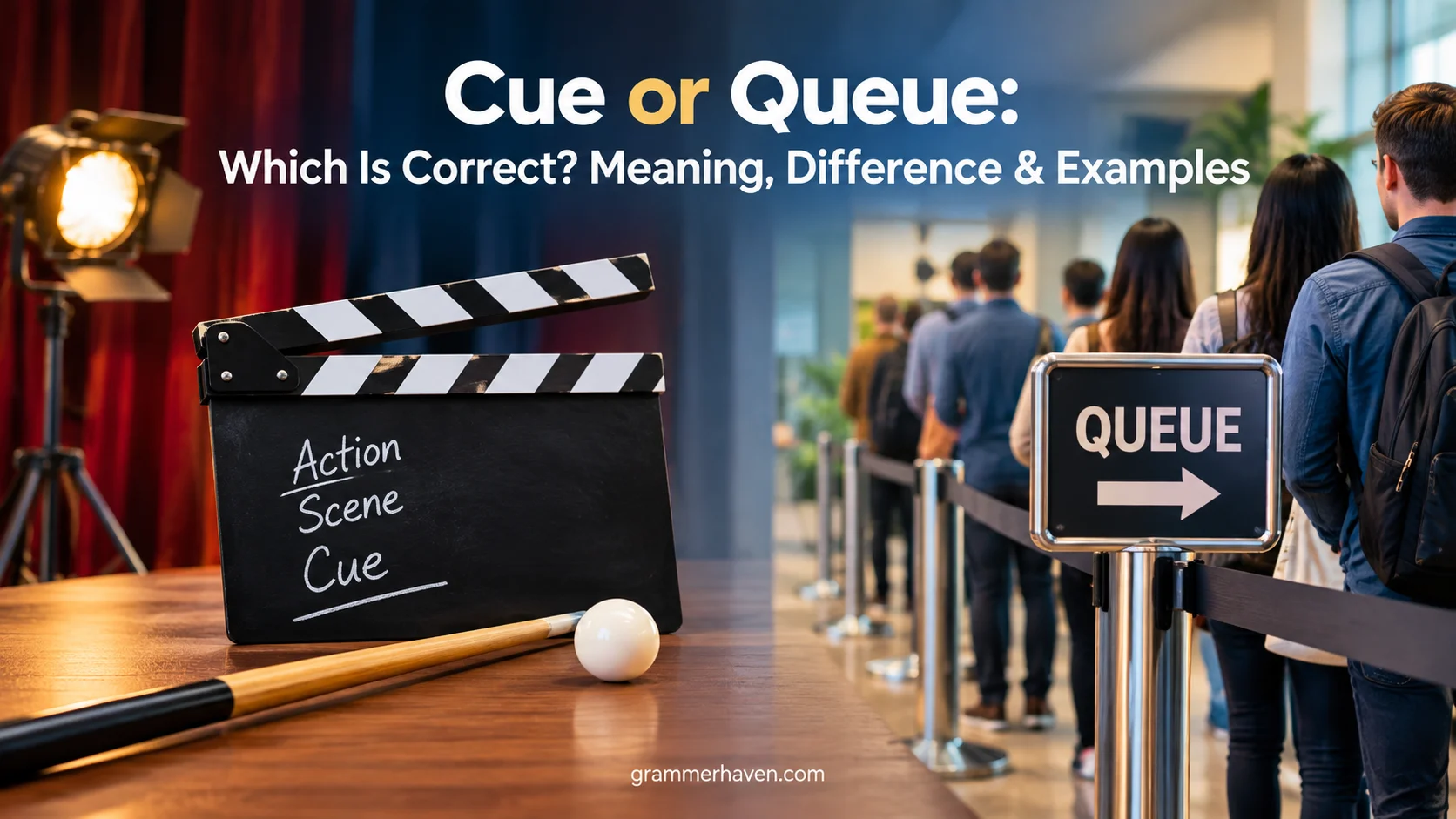
Cue or Queue is an English word pair that can trip you up since cue and queue have different meanings, spellings, and the same sound in American English.
Cue is a signal, indication, or clue that gives you an idea of what to do, such as a cue to leave while talking. Queue means a line of people or things waiting for their turn. People who have waited or are waiting their turn usually form a queue. The pronunciation of both words is /kjuː/, which explains the confusion. The letter Q, spelling, origin, meaning, context, use, and usage help show the difference and distinction.
A simple explanation, quick answer, guide, comparison table, and real examples can make this English word pair easier to remember. A useful method is to connect cue with a signal and queue with a line. This approach helps avoid common mistakes and makes the correct word easier to choose.
Cue or Queue: Quick Answer
Cue is the correct word when you mean a signal, prompt, hint, indication, or a stick used in pool or billiards.
Queue is the correct word when you mean a line or sequence of people, vehicles, tasks, files, calls, or other things waiting their turn. In everyday American English, line is usually more natural when referring to people waiting.
| Word | Meaning | Example |
| Cue | A signal or prompt | “The bell was our cue to leave.” |
| Cue | A hint or indication | “Her expression was a cue that she was uncomfortable.” |
| Cue | A pool or billiards stick | “He picked up his cue.” |
| Queue | A line of people or vehicles | “There was a long queue outside the theater.” |
| Queue | A sequence of waiting tasks | “The file is in the print queue.” |
| Line | Common US term for people waiting | “We stood in line for tickets.” |
The easiest way to remember the distinction is:
A cue tells you when to act. A queue tells you when it’s your turn.
That single rule handles most situations.
What Does “Cue” Mean?
The word cue has several meanings, but its most common uses revolve around the idea of a signal or indication.
A cue can tell you when to speak, move, leave, begin, stop, or respond. It doesn’t have to come from another person, either. A sound, gesture, facial expression, event, or even a change in circumstances can act as a cue.
Cambridge defines cue as a signal that tells someone to do something, particularly in a play or movie. It also recognizes the word as a noun for a billiards stick and as a verb meaning to give someone a signal.
Cue as a Signal or Prompt
The most familiar meaning of cue involves a signal that prompts an action.
Imagine an actor standing backstage. The actor isn’t supposed to enter until another performer delivers a particular line. That line becomes the actor’s cue.
The same idea appears in ordinary life:
- “The alarm was my cue to get out of bed.”
- “Her wave was my cue to cross the street.”
- “The lights going off were our cue to leave.”
- “The teacher’s gesture was a cue for the students to begin.”
- “The music gave the dancers their cue.”
In each example, something provides information about what should happen next.
That’s the central idea behind cue.
Cue as a Hint or Indication
A cue doesn’t always directly command an action. Sometimes it simply provides a hint that helps you interpret a situation.
For example:
“His repeated glances at the clock were a cue that the meeting had gone on too long.”
He didn’t necessarily say, “Please end the meeting.” His behavior gave you an indication.
This sense of cue appears in phrases such as:
- social cues
- visual cues
- verbal cues
- behavioral cues
- audio cues
- contextual cues
A social cue might be someone’s facial expression. A visual cue might be a warning sign. An audio cue might be a sound that tells you something is about to happen.
Merriam-Webster similarly defines cue as a signal, hint, or feature that indicates the nature of something perceived.
Cue in Theater, Film, and Music
The entertainment industry uses cue constantly.
Actors, musicians, stage managers, lighting technicians, and sound engineers all rely on cues to coordinate performances.
A cue might tell someone to:
- enter the stage
- begin speaking
- start playing music
- change the lighting
- trigger a sound effect
- begin a video
- move to a different position
For example:
“The actor waited for her cue before entering the scene.”
The cue doesn’t necessarily have to be spoken. A gesture, light, sound, or movement can provide the signal.
This is why the phrase “That’s your cue” has become common outside entertainment. It simply means, “That’s your signal to do something.”
Cue as a Pool or Billiards Stick
Cue has another common meaning that has nothing to do with signals.
A cue is the long, narrow stick used to strike a ball in pool, billiards, or snooker. Cambridge lists this as a separate noun meaning.
For example:
- “He bought a new pool cue.”
- “She chalked her cue before taking the shot.”
- “The cue ball rolled toward the corner pocket.”
- “His cue slipped as he took the shot.”
Context makes this meaning obvious.
Nobody would normally confuse the sentence “He grabbed his cue and approached the pool table” with a sentence about a signal. The surrounding words do the heavy lifting.
Cue as a Verb
Cue can also function as a verb.
To cue someone means to give that person a signal or prompt.
For example:
- “The director cued the actor to enter.”
- “She cued the band to begin.”
- “The stage manager cued the lights.”
- “He gave me a nod and cued me to start.”
The common verb forms are cued and cueing.
You’ll also see the phrase cue someone in, which means to give someone information.
“Can you cue me in on what happened?”
That’s an informal but useful expression.
What Does “Queue” Mean?
While cue centers on signals, queue centers on waiting and sequence.
A queue can contain people, vehicles, files, calls, messages, print jobs, or other items. The common thread is that the items are waiting to be handled, served, processed, or moved forward.
Cambridge defines queue as a line of people or things waiting for something. It also gives a specialized computing meaning involving data, files, calls, and other items waiting to be processed.
Queue as a Line of People
The most recognizable meaning of queue is a line of people waiting.
For example:
“There was a long queue outside the theater.”
“We joined the queue for tickets.”
“She waited patiently in the queue.”
This usage is strongly associated with British English. Cambridge labels the everyday sense as mainly British and notes that US English usually uses “line.”
So, in American English, you’d generally say:
“There was a long line outside the theater.”
rather than:
“There was a long queue outside the theater.”
The word queue isn’t wrong in the United States. It simply sounds more British in many everyday contexts.
Queue as a Sequence of Things
A queue doesn’t have to contain people.
You can have a queue of:
- cars
- telephone calls
- customer requests
- orders
- emails
- documents
- print jobs
- software tasks
- data
- messages
This broader meaning matters because queue is common in technical American English.
For example:
“The printer has five documents in its queue.”
Here, queue means a collection of jobs waiting to be processed.
That’s completely natural in American English.
Queue in Computing
The computing sense of queue is especially important.
When several tasks arrive at a system, they may need to wait until the system can handle them. Those tasks can be placed in a queue.
Think of it like a bakery with one cashier.
Ten customers arrive at once. The cashier can’t serve everyone simultaneously. The customers form an orderly line and receive service according to the system’s rules.
A computer can do something similar with jobs.
A system might have:
- a print queue
- a message queue
- a job queue
- a request queue
- a call queue
- a processing queue
Cambridge specifically identifies queues in computing and telecommunications as sequences of data, files, calls, or similar items waiting to be handled.
Merriam-Webster also defines a computing queue as a sequence of messages or jobs held temporarily while awaiting transmission or processing.
Queue as a Verb
Queue can also act as a verb.
In British English, people can queue or queue up when they wait in line.
For example:
“Fans queued up outside the stadium.”
“We queued for nearly an hour.”
In American English, line up or stand in line is usually more natural. Cambridge explicitly identifies line and line up as the usual US equivalents for these everyday uses.
The verb also has a technical meaning.
A computer program can queue tasks so that the system handles them in sequence.
For example:
“The software queued the remaining print jobs.”
That’s standard technical usage.
Cue vs. Queue: What’s the Difference?
The simplest way to distinguish cue vs. queue is to identify the concept behind the word.
| Meaning | Correct Word |
| A signal to do something | Cue |
| A prompt for an actor | Cue |
| A hint or indication | Cue |
| A social signal | Cue |
| A pool stick | Cue |
| A line of people waiting | Queue |
| A line of vehicles | Queue |
| A sequence of computer jobs | Queue |
| Files waiting for processing | Queue |
| Calls waiting for service | Queue |
| Everyday waiting line in US English | Line |
Here’s the distinction in plain English:
Cue = signal.
Queue = waiting sequence.
If something tells you what to do, think cue.
If something tells you what’s waiting its turn, think queue.
Why Do Cue and Queue Sound the Same?
Cue and queue are homophones. That means they have different spellings and meanings but the same pronunciation.
Both are pronounced approximately /kjuː/. Merriam-Webster lists cue and queue as homophones, while Cambridge gives the same pronunciation for both words.
The letter Q creates another layer of confusion because its name is also pronounced “cue.”
So you have:
- cue
- queue
- Q
All sounding essentially the same.
Yet their written functions differ dramatically.
| Word | Pronunciation | Meaning |
| cue | /kjuː/ | Signal, hint, prompt, pool stick |
| queue | /kjuː/ | Waiting line or sequence |
| Q | /kjuː/ | Letter of the alphabet |
When you’re speaking, context usually makes the meaning clear. When you’re writing, you have to choose the correct spelling.
That’s why sound alone isn’t enough.
Cue or Queue in American English
American English adds an important wrinkle to this discussion.
Cue is completely ordinary in American English when it means a signal, prompt, indication, or pool stick.
Queue is also an established American English word. However, Americans generally use line when referring to people waiting in an ordinary physical line.
Consider this comparison:
| Situation | American English | British English |
| People waiting for tickets | line | queue |
| People waiting outside | line | queue |
| Wait for your turn | stand in line | queue |
| Form a line | line up | queue up |
| Computer jobs waiting | queue | queue |
| Signal to act | cue | cue |
This distinction matters when you’re writing for a US audience.
For example, an American reader would naturally understand:
“We stood in line for two hours.”
A British reader would be more likely to say:
“We queued for two hours.”
Neither version changes the underlying situation. The difference is regional vocabulary.
Cue or Queue Examples in Sentences
Context is the best teacher when you’re learning cue or queue.
Examples Using “Cue”
- “The bell was our cue to leave.”
- “The director gave the actor his cue.”
- “Her expression was a cue that she wanted to leave.”
- “The music provided the dancers with a cue.”
- “His silence was my cue to stop talking.”
- “The flashing light was a cue for the driver.”
- “The coach used a hand signal as a cue.”
- “The actor missed his cue.”
- “She took his hesitation as a cue to wait.”
- “He picked up his pool cue.”
Examples Using “Queue”
- “There was a long queue outside the store.”
- “We joined the queue for tickets.”
- “Several cars were stuck in the traffic queue.”
- “The printer has three files in its queue.”
- “Your request has entered the processing queue.”
- “The calls are waiting in a customer-service queue.”
- “The software queued the remaining tasks.”
- “Fans queued outside the stadium.”
For an American audience, remember that line will usually replace queue when you’re talking about people physically waiting.
Common Expressions With Cue
The word cue appears in several common expressions.
“On Cue”
The phrase on cue means that something happens at exactly the expected or appropriate moment. Cambridge gives examples where something happens immediately after it has been expected or anticipated.
For example:
“Right on cue, the rain started.”
This phrase can be completely literal in a performance. It can also be humorous in everyday conversation.
If your friend starts complaining about traffic the moment you mention your commute, you might jokingly say:
“Right on cue!”
“Take Your Cue From”
To take your cue from someone means to observe that person’s behavior or words and use them as guidance.
For example:
“Take your cue from the host and wait before eating.”
You’re watching the host to figure out what you should do.
“Cue Someone In”
To cue someone in means to give them information about a situation.
For example:
“Can you cue me in on the new plan?”
This expression is informal and conversational.
“Cue Something Up”
Cue something up means to prepare something so it’s ready to play or happen.
For example:
“Cue up the next song.”
You might hear this phrase when someone manages music, video, presentations, or sound effects.
Common Expressions With Queue
“Queue Up”
Queue up means to form or join a queue.
For example:
“Fans queued up outside the stadium.”
In American English, line up usually sounds more natural:
“Fans lined up outside the stadium.”
“Jump the Queue”
To jump the queue means to move ahead of people who have already been waiting.
For example:
“Someone tried to jump the queue.”
American English generally uses cut the line for the same idea.
“At the Head of the Queue”
Someone at the head of the queue is at the front.
For example:
“She was at the head of the queue when the doors opened.”
In American English, at the front of the line is more common.
“At the Back of the Queue”
Someone at the back of the queue stands at the rear.
For example:
“Please go to the back of the queue.”
In American English:
“Please go to the back of the line.”
Common Mistakes With Cue and Queue
Because these words sound identical, spelling errors are easy to make.
Mistake: “That Was My Queue to Leave”
If you mean a signal or indication, queue is wrong.
Correct:
“That was my cue to leave.”
The situation gave you a reason to act.
Mistake: “We Waited in a Cue”
If you mean a line, cue is incorrect.
Correct:
“We waited in a queue.”
For American English:
“We waited in a line.”
Mistake: “The File Is in the Cue”
When discussing computer processing, use queue.
Correct:
“The file is in the queue.”
The file is waiting for the system to process it.
Mistake: Choosing the Word Based on Pronunciation
This is perhaps the most important mistake to avoid.
You can’t hear the difference between cue and queue because there isn’t a pronunciation difference in standard usage.
Instead, ask yourself:
Is this a signal or a waiting sequence?
If it’s a signal, write cue.
If it’s a waiting sequence, write queue.
Cue or Queue: An Easy Memory Trick
A good memory trick should be short enough to recall instantly.
Try this:
Cue = clue or signal. Queue = people or things waiting.
You can also use this sentence:
A cue tells you when to act; a queue tells you when it’s your turn.
Another useful shortcut for American English is:
- Signal → cue
- People waiting → line
- Things waiting → queue
- Computer tasks waiting → queue
- Pool stick → cue
This approach works because it connects each spelling to an idea rather than an arbitrary letter pattern.
Cue vs. Queue vs. Q
The three terms cue, queue, and Q sound alike, but they aren’t interchangeable.
Cue
Cue can mean a signal, prompt, hint, indication, or pool stick.
“That was my cue to leave.”
Queue
Queue means a waiting line or sequence.
“The request is in the queue.”
Q
Q is simply the seventeenth letter of the English alphabet.
“Q comes after P.”
Merriam-Webster even lists cue as a noun meaning the letter q, although this is a separate lexical sense from the more common meaning of a signal.
The pronunciation doesn’t change the spelling rule. Meaning does.
Why Is “Queue” Spelled With So Many Letters?
The spelling queue looks strange because its history comes from French.
Merriam-Webster traces the noun to French queue, meaning “tail,” which ultimately comes from Latin cauda or coda. The English word originally referred to a long braid of hair and later developed its modern sense of a line of people. Merriam-Webster records the first known English use of queue as a noun in 1724.
The historical connection makes sense when you picture a line of people stretching behind one another like a tail.
That unusual spelling has survived even though English pronunciation has become much simpler.
So, yes, queue looks like it should contain several extra sounds.
It doesn’t.
All those letters collapse into one syllable: /kjuː/.
Cue or Queue: Formal and Everyday Usage
The best word can depend not only on meaning but also on context and audience.
In professional writing, cue works naturally when discussing signals, behavior, presentations, performance, or communication.
Examples include:
- “The visual cue helps users understand the interface.”
- “The presenter received a cue from the stage manager.”
- “The change in tone provided an important social cue.”
Queue works naturally when describing systems, processing, requests, and ordered tasks.
Examples include:
- “The request entered the processing queue.”
- “The printer queue contains several pending jobs.”
- “Customer calls are placed in a queue.”
For physical lines, American readers will generally expect line.
That doesn’t make queue incorrect. It simply makes line the more idiomatic American choice.
A Real-World Comparison: Theater and Ticket Sales
Imagine a busy theater on opening night.
Outside, hundreds of people wait to buy tickets.
In British English, they’re standing in a queue.
In American English, they’re standing in a line.
Inside, an actor waits backstage.
A stage manager signals that it’s time to enter.
That’s the actor’s cue.
One situation involves waiting. The other involves a signal.
This comparison captures the entire distinction.
Queue = waiting your turn. Cue = knowing when to act.
The words sound identical, but their roles couldn’t be more different.
Cue or Queue Practice
Test yourself with these sentences before checking the answers.
- The director gave the actor his ___.
- We waited in ___ for tickets.
- The document is in the print ___.
- Her smile was a ___ that everything was fine.
- The music was the dancers’ ___ to begin.
- Several files are waiting in the processing ___.
- He picked up his pool ___.
- Fans formed a long ___ outside the stadium.
- The alarm was my ___ to leave.
- The software placed the task in the ___.
Answer Key
| Sentence | Correct Answer |
| The director gave the actor his ___ | cue |
| We waited in ___ for tickets | queue / line in US English |
| The document is in the print ___ | queue |
| Her smile was a ___ | cue |
| The music was the dancers’ ___ | cue |
| Files are waiting in the processing ___ | queue |
| He picked up his pool ___ | cue |
| Fans formed a long ___ | queue / line in US English |
| The alarm was my ___ | cue |
| The software placed the task in the ___ | queue |
Notice how consistently the meaning determines the spelling.
See also: Woman or Women: Which Word Should You Use?
FAQs:
Is “cue” or “queue” correct?
Both are correct. They have different meanings. Cue usually means a signal, prompt, hint, indication, or pool stick. Queue means a waiting line or an ordered sequence of things waiting to be handled.
What is the difference between cue and queue?
A cue is a signal or indication that prompts an action. A queue is a line or sequence of people, things, or tasks waiting their turn.
Do cue and queue sound the same?
Yes. Both are pronounced approximately /kjuː/ in standard English.
Is queue an American English word?
Yes. Queue is used in American English, particularly in computing and technical contexts. For an ordinary physical line of people, Americans usually say line.
Should Americans say queue or line?
For people waiting somewhere, line is usually the more natural American English choice. Queue remains standard when referring to computer processes, files, calls, and similar sequences.
What does “on cue” mean?
On cue means something happens at the expected or appropriate moment.
What does “queue up” mean?
In British English, queue up means to form or join a line. In American English, line up is generally preferred for people.
Is “cue” a verb?
Yes. Cue can mean to give someone a signal or prompt them to do something.
Is “queue” a verb?
Yes. Queue can mean to form or wait in a line. In computing, it can also mean to arrange tasks, files, calls, or data for processing in sequence.
Is a computer queue the same as a waiting line?
The concepts are closely related. A computer queue contains tasks or data waiting to be handled, much like people waiting their turn in a physical line.
Conclusion:
Understanding Cue or Queue becomes easier when you remember their meanings. Cue means a signal or indication, while queue means a line of people or things waiting their turn. Although both words sound the same, their spelling and usage are different. Knowing the context helps you choose the right word with confidence.