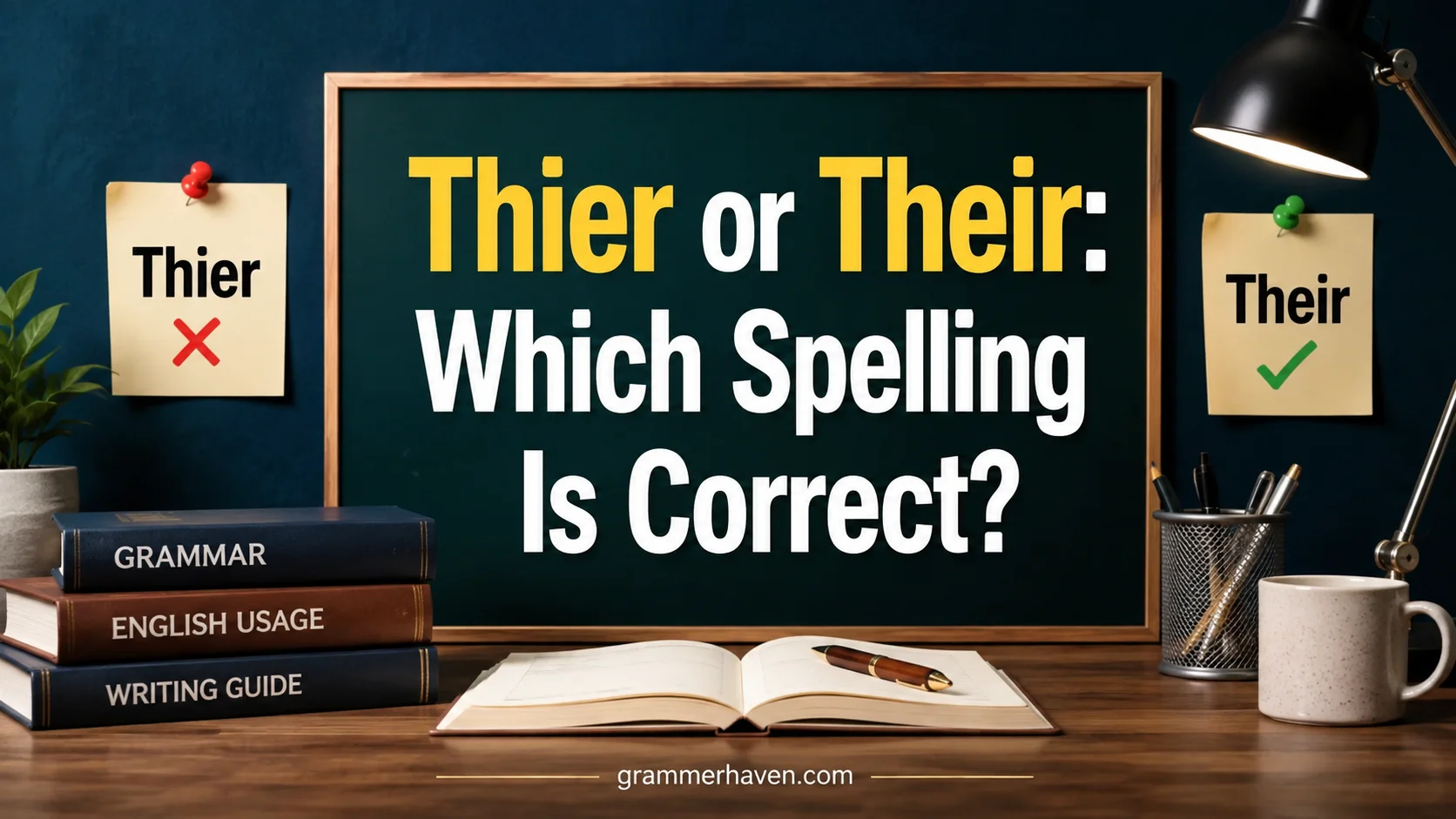
Thier or Their: Which Spelling Is Correct? leaves you unsure after you typed a word, this guide helps you find the correct spelling with ease.
Many learners, native speakers, and even a professional writer have paused, wondering whether Thier or Their is correct. This common mistake can confuse anyone because a small typo or misspelling changes the word completely. This guide will explain the right spelling, provide an easy explanation of why the mistake happens, help you remember it easily, and improve your confidence. Whether you are searching as a student or simply improving your English, English writing, and everyday writing, these simple tips make learning faster.
The correct spelling is Their, while Thier is an incorrect spelling. In English grammar, their is a possessive pronoun. A possessive pronoun shows that something belongs or can belong to a group of people, meaning they own it. It is the plural equivalent of his, her, and its, which are singular forms. This usage improves your language, vocabulary, grammar, and every word or choice of words, making your writing more accurate.
During proofreading and editing, I often notice this error when someone is talking or writing too quickly. A single person should use his, her, or its, while two or more people should use their. For example, she loves her new house, but they love their house. This pattern indicates better communication, supports learning, builds writing skills, improves accuracy, and encourages proper spelling every time.
The Short Answer: Thier or Their?
Let’s answer the question immediately.
| Word | Correct? | Meaning |
| Their | ✅ Yes | Shows possession or ownership |
| Thier | ❌ No | Misspelling of their |
Whenever you’re writing standard English, choose their.
Correct examples
- Their car is parked outside.
- Their children love reading.
- I borrowed their laptop.
- Their solution worked perfectly.
Incorrect examples
- Thier car is parked outside.
- I borrowed thier laptop.
- Thier friends arrived early.
Every example above should use their, not thier.
What Does “Their” Mean?
Understanding the meaning of their makes it much easier to remember the correct spelling.
Their is a possessive determiner. It tells readers that something belongs to someone.
Think of it as answering one simple question:
Who owns it?
If something belongs to they, then you use their.
For example:
- Their house
- Their phone
- Their teacher
- Their company
- Their decision
Ownership doesn’t always mean physical possession. It can also describe relationships, ideas, responsibilities, achievements, or characteristics.
Examples:
- Their opinion matters.
- Their success inspired everyone.
- Their research changed the industry.
- Their kindness made a difference.
Notice how their connects people to something associated with them.
Their Shows Ownership
This is by far the most common use.
Examples include:
- Their books are on the shelf.
- Their office opens at 9 a.m.
- Their project finished ahead of schedule.
- Their vacation starts tomorrow.
Each sentence answers the question:
Whose?
Whose books?
Their books.
Whose office?
Their office.
Their Can Refer to More Than One Person
Traditionally, their referred to multiple people.
Examples:
- Emma and James forgot their tickets.
- The players celebrated their victory.
- Students submitted their assignments.
- Parents attended their children’s graduation.
Each sentence refers to two or more people.
Their Can Also Refer to One Person
Modern English often uses their for a single person when gender is unknown or irrelevant.
Examples:
- Every customer should keep their receipt.
- Each applicant must submit their documents.
- Someone left their umbrella.
- Every employee should update their password.
This usage is now accepted by major dictionaries and style guides.
Why Do People Write “Thier” Instead of “Their”?
One interesting fact about this mistake is that most people already know the correct spelling.
Their fingers simply type something different.
Let’s examine why.
Letter Transposition
The biggest reason is letter transposition.
This happens when two letters accidentally switch places.
Instead of typing:
their
people type:
thier
Your brain knows the correct word.
Your fingers move faster than your brain can monitor them.
This type of error is extremely common with frequently typed words.
Other examples include:
- recieve → receive
- freind → friend
- becuase → because
- seperate → separate
Notice a pattern?
Many involve reversing two letters.
Typing Speed
Fast typing increases mistakes.
When you’re focused on ideas instead of spelling, your fingers rely on muscle memory.
Sometimes muscle memory isn’t perfect.
Professional writers often type thier, notice it later, and immediately correct it during proofreading.
The “I Before E” Rule Causes Confusion
Many people remember the old saying:
“I before E except after C.”
Unfortunately, English loves exceptions.
Words like:
- their
- weird
- foreign
- science
- height
don’t follow that rule.
That’s why relying solely on the rhyme doesn’t always work.
Instead, memorize their as a complete word.
Muscle Memory
Once you’ve typed thier several times, your fingers may continue repeating the mistake.
Fortunately, muscle memory also works in your favour.
The more often you type their correctly, the more natural it becomes.
After enough repetition, your fingers automatically choose the correct spelling.
Autocorrect Doesn’t Catch Every Mistake
Most modern writing tools highlight thier, but not every application behaves the same way.
Possible reasons include:
- Browser extensions interfering
- Spell check turned off
- Custom dictionaries
- Mobile keyboard settings
- Offline editing software
That’s why proofreading remains important.
Never assume technology catches every typo.
Is “Thier” Ever Correct?
For normal English writing, the answer is simple:
No.
You should never intentionally write thier when you mean their.
However, there are a few rare exceptions.
Personal Names
Some families have surnames spelled Thier.
For example:
- John Thier
- Emily Thier
In these cases, Thier is a proper noun rather than an English possessive word.
Business Names
Occasionally a company uses Thier as part of its brand.
Brand names don’t always follow normal spelling rules.
Usernames
Online usernames often include intentional misspellings.
Examples:
- GamerThier
- ThierDesign
- TheRealThier
These aren’t examples of standard English.
They’re simply chosen usernames.
Historical Documents
Very old documents sometimes contain spelling variations because English spelling wasn’t standardized centuries ago.
Today, however, their is the accepted standard.
Their vs There vs They’re
This trio confuses nearly every English learner.
Although the words sound almost identical, they perform completely different jobs.
Understanding the difference eliminates dozens of common writing mistakes.
| Word | Meaning | Example |
| Their | Shows ownership | Their house is beautiful. |
| There | Indicates a place or existence | The keys are over there. |
| They’re | Contraction of “they are” | They’re arriving soon. |
Let’s examine each one.
Their
Shows ownership.
Examples:
- Their lunch is ready.
- Their dog loves swimming.
- Their computer needs updating.
Ask yourself:
Who owns it?
If ownership is involved, choose their.
There
“There” usually refers to location.
Examples:
- Please sit there.
- We stopped there yesterday.
- The restaurant is over there.
It also appears in introductory sentences.
Examples:
- There is a problem.
- There are three options.
- There was a misunderstanding.
Notice that ownership isn’t involved.
They’re
“They’re” simply means:
They are
Replace it with they are.
If the sentence still makes sense, you’ve chosen the correct word.
Example:
They’re coming tomorrow.
↓
They are coming tomorrow.
Perfect.
Another example:
They’re excited about the concert.
↓
They are excited about the concert.
Still works.
Quick Comparison
| Sentence | Correct Word |
| ____ car is parked outside. | Their |
| Please stand over ____. | There |
| ____ planning a vacation. | They’re |
| Everyone brought ____ lunch. | Their |
| Is anyone ____ today? | There |
Their vs Thier: Side-by-Side Comparison
Sometimes a direct comparison makes the answer obvious.
| Feature | Their | Thier |
| Correct English spelling | ✅ Yes | ❌ No |
| Found in dictionaries | ✅ Yes | ❌ No |
| Accepted in school writing | ✅ Yes | ❌ No |
| Accepted in business writing | ✅ Yes | ❌ No |
| Indicates ownership | ✅ Yes | ❌ No |
| Used in published books | ✅ Yes | ❌ No |
| Common typing mistake | ❌ No | ✅ Yes |
| Should you use it? | Always | Never (unless it’s part of a name) |
Quick Memory Trick
Here’s one of the easiest ways to remember the spelling.
Notice the middle of the word:
THEIR
It contains:
HEIR
An heir inherits property.
Property involves ownership.
Ownership reminds you to use their.
Many students remember the spelling with this simple association because it links the word to its meaning instead of relying on an unreliable spelling rule.
See also: Affend or Offend: Which Spelling Is Correct?
FAQS:
1. Is Thier ever the correct spelling?
No. Thier is always a misspelling. The correct word is their, which is a possessive pronoun.
2. What does their mean?
Their shows ownership. It means that something belongs to two or more people or to someone whose gender is unknown or not specified.
3. Why do people write Thier instead of Their?
Most people make this mistake because they type too quickly or accidentally reverse the letters “i” and “e”. It’s a common typing error rather than a grammar mistake.
4. How can I remember the correct spelling of their?
Think of the word heir, which is part of their. Since an heir owns or inherits something, their is the spelling that shows ownership.
5. Can grammar and spell-check tools detect Thier?
Yes. Most modern spell-checkers, grammar tools, and word processors recognize Thier as a misspelling and suggest their as the correct spelling.
Conclusion:
The correct spelling is their, while Thier is always incorrect. Since their is a possessive pronoun, it is used to show that something belongs to people or a group. Understanding this simple rule will help you avoid a common spelling mistake, improve your writing accuracy, and communicate more clearly in both everyday and professional English.