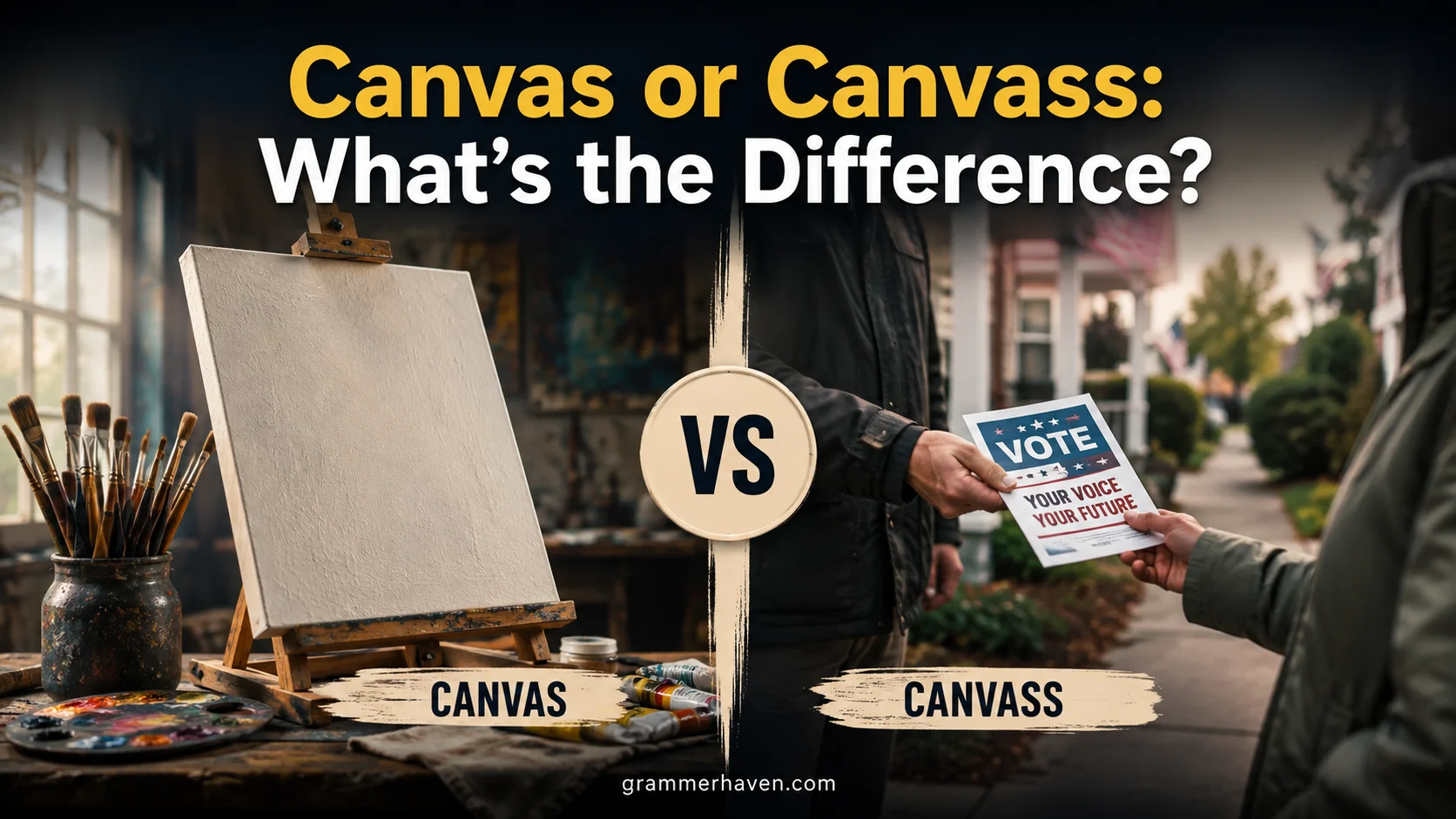
Canvas or Canvass can confuse writers since both words look and sound alike, but each has a different meaning, use and action.
Canvas is a noun for a heavy, coarse, closely woven fabric used for tents and sails, or as a piece for a painting. Artists use canvas as a foundation or background for needlework, and a painting can be executed on its open weave. The word can describe a setting where events unfold. Canvass, with two s’s, is most often a verb, and its noun use is rare. Its main definitions include examine carefully, discuss thoroughly, conduct a survey, or visit an area to solicit votes. A campaign worker may canvass voters and gather votes through questions and discussion.
The problem is common in emails, news writing, school work, and online search. Spellcheck may miss the error since both spellings are correct English words. Canvass shoes changes the meaning; canvas shoes is correct. The extra s creates confusion when mixing the words. Their origins came from different paths, though they look alike. British English and American English use both terms. Knowing the context, spelling, grammar, language, and pronunciation gives a quick answer and helps you learn from real-life examples. Choosing the right word makes your use of English clearer and builds confidence. This article explains the meanings, common mistakes, and differences clearly.
Canvas or Canvass: The Quick Answer
The easiest way to understand the difference is this:
Canvas is something you use. Canvass is something you do.
Here is a quick comparison.
| Word | Meaning | Part of Speech | Example |
| Canvas | A strong fabric, painting surface, or creative workspace | Noun (mostly) | She painted on a blank canvas. |
| Canvass | The act of collecting opinions, votes, or information | Verb or noun | Volunteers canvassed the area. |
A simple memory shortcut:
- Canvas = create
- Canvass = collect
A painter creates something on a canvas.
A researcher or campaign worker collects information through a canvass.
What Does “Canvas” Mean?
The word canvas has several meanings, but they all connect to the idea of a surface or space where something is created.
Most commonly, canvas refers to a strong, durable fabric.
Traditionally, canvas was made from:
- Hemp
- Linen
- Cotton
Today, many canvas products use synthetic fibers such as polyester because they offer extra strength and resistance.
Canvas as a Material
For centuries, people have used canvas because it is tough, flexible, and long-lasting.
Common canvas products include:
- Paintings
- Tents
- Backpacks
- Shoes
- Outdoor covers
- Sails
- Work bags
For example:
The camper packed a canvas tent because it could handle rough weather.
Unlike delicate fabrics, canvas can withstand repeated use. That durability made it valuable in art, transportation, and everyday products.
Canvas as a Painting Surface
When most people hear the word canvas, they think about art.
A canvas is a surface artists use to create paintings. It is usually stretched tightly over a wooden frame before paint is applied.
Artists often choose canvas because it offers several advantages:
| Benefit | Why It Matters |
| Lightweight | Easier to move than wooden panels |
| Durable | Can last for hundreds of years |
| Flexible | Less likely to crack during movement |
| Affordable | Accessible for many artists |
| Versatile | Works well with oil and acrylic paint |
Many famous artists created important works on canvas.
For example:
- Vincent van Gogh created many of his most famous paintings on canvas.
- Claude Monet also frequently used canvas for his artwork.
A painting canvas is more than a piece of fabric. It represents a space where an artist turns an idea into something visible.
Canvas in Modern Technology and Business
The meaning of canvas has expanded beyond physical materials.
Today, people use the word to describe a digital or conceptual workspace.
Examples include:
- Design canvas
- Digital canvas
- Business model canvas
- Learning canvas
The idea remains the same: a place where you organize, build, or develop something.
For example:
A designer opened a blank digital canvas to create a new website layout.
Or:
Entrepreneurs use a business model canvas to map out how their company will operate.
The physical canvas became a metaphor for creativity.
A blank canvas means a fresh opportunity to create something new.
What Does “Canvass” Mean?
Unlike canvas, the word canvass focuses on communication and information gathering.
To canvass means to ask people questions, gather opinions, or seek support.
It often appears in:
- Elections
- Surveys
- Market research
- Fundraising
- Community projects
Examples:
- The campaign workers canvassed voters.
- The company canvassed customers about their experience.
- Researchers canvassed residents about public transportation.
The key idea is interaction.
When you canvass, you reach out to people.
Canvass as a Verb
The most common use of canvass is as a verb.
It describes the action of collecting information.
Common patterns include:
- Canvass voters
- Canvass opinions
- Canvass customers
- Canvass neighborhoods
- Canvass support
Examples:
The organization canvassed residents to learn what improvements the community needed.
The company canvassed thousands of customers before launching the product.
In each case, someone is asking people for information.
Canvass as a Noun
Although less common, canvass can also work as a noun.
A canvass refers to an organized effort to collect information.
Examples:
- The election team completed a voter canvass.
- The nonprofit conducted a community canvass.
Here, the word describes the activity itself.
Compare:
Verb:
Volunteers canvassed the neighborhood.
Noun:
The neighborhood canvass revealed important concerns.
Canvas vs. Canvass: The Main Difference
The difference becomes clear when you compare their purposes.
| Feature | Canvas | Canvass |
| Main meaning | A surface or material | Gathering opinions or information |
| Main purpose | Creating something | Learning something |
| Common use | Art and design | Research and outreach |
| Grammar role | Mostly noun | Verb and noun |
| Example | A blank canvas | A voter canvass |
Here is an easy analogy:
A canvas is where ideas are placed. A canvass is how ideas are gathered.
An artist uses a canvas to express thoughts.
A researcher canvasses people to discover thoughts.
How to Remember Canvas vs. Canvass
Spelling tricks make these words much easier.
Memory Trick: The Extra “S” Means Survey
The word canvass contains two S letters.
Think:
Canvass = Survey
Both words begin with the same sound.
When you are surveying people, asking questions, or collecting opinions, choose canvass.
Examples:
- Canvass voters.
- Canvass customers.
- Canvass opinions.
Memory Trick: Canvas Creates
If you are creating something, think canvas.
Examples:
- Paint on a canvas.
- Design on a canvas.
- Start with a blank canvas.
The word connects with creativity.
Canvas vs. Canvass Examples in Sentences
Seeing these words in context helps you recognize them naturally.
Art Examples
Correct:
The painter prepared a fresh canvas before starting the portrait.
Incorrect:
The painter prepared a fresh canvass before starting the portrait.
The painter needs a surface, not a survey.
Election Examples
Correct:
Campaign volunteers canvassed neighborhoods before voting day.
Incorrect:
Campaign volunteers canvased neighborhoods before voting day.
The volunteers are gathering opinions and support.
Business Examples
Correct:
The startup used a business canvas to organize its strategy.
Correct:
The company canvassed customers to improve its service.
A business can use both words in the same project.
It may create plans on a canvas while canvassing customers for feedback.
Common Mistakes Between Canvas and Canvass
These words cause mistakes because they sound similar.
Here are common errors.
| Incorrect Sentence | Correct Sentence |
| The artist painted on a canvass. | The artist painted on a canvas. |
| Volunteers canvas voters. | Volunteers canvass voters. |
| The company conducted a customer canvass. | The company conducted a customer canvass. |
| She bought a canvass bag. | She bought a canvas bag. |
| They canvassed a business plan. | They created a business canvas. |
A useful test:
Ask yourself:
Am I creating something?
Use:
Canvas
Am I asking people something?
Use:
Canvass
Is Canvas Ever Used as a Verb?
Yes, but it is uncommon.
As a verb, canvas can mean covering something with canvas material.
Example:
Workers canvased the frame to protect it from weather.
However, this usage is rare in modern English.
Most people encounter canvas as a noun.
Common examples:
- A canvas painting
- A canvas bag
- A blank canvas
Is Canvass Ever Used as a Noun?
Yes.
A canvass can describe an organized effort to gather information.
Examples:
- A voter canvass
- A public opinion canvass
- A customer canvass
Although the noun form exists, the verb form appears more frequently.
Canvas vs. Canvass Pronunciation
Interestingly, canvas and canvass are pronounced almost exactly the same.
Both sound like:
CAN-vus
The pronunciation does not usually help you identify the correct word.
Context matters.
For example:
The artist bought a canvas.
You know the meaning because artists create things.
The volunteers started a canvass.
You know the meaning because volunteers gather information.
The spelling difference carries the meaning.
Common Phrases Using Canvas
The word canvas appears in several popular expressions.
| Phrase | Meaning | Example |
| Blank canvas | A fresh opportunity | The new job felt like a blank canvas. |
| Digital canvas | Online creative workspace | Designers use a digital canvas. |
| Canvas bag | Bag made from canvas fabric | He carried a canvas bag. |
| Canvas painting | Artwork created on canvas | The museum displayed a canvas painting. |
Common Phrases Using Canvass
The word canvass appears mainly in communication and research.
| Phrase | Meaning | Example |
| Canvass voters | Ask voters for opinions or support | Workers canvassed voters before the election. |
| Canvass opinions | Collect people’s views | Researchers canvassed opinions online. |
| Canvass customers | Gather customer feedback | The brand canvassed customers after launch. |
| Door-to-door canvassing | Visiting homes to ask questions | Volunteers practiced door-to-door canvassing. |
Real-World Examples of Canvas and Canvass
Case Study: An Artist’s Creative Process
Imagine an artist preparing for an exhibition.
The artist buys several blank canvases. Each canvas becomes a place for new ideas, colors, and designs.
The artist may experiment with different styles before creating the final piece.
Here, canvas represents creation.
Case Study: A Political Campaign
Now imagine an election campaign.
Volunteers visit neighborhoods and speak with residents. They ask questions about important issues and encourage people to participate.
They are canvassing.
Here, canvass represents communication.
Case Study: A Business Launch
A company preparing a new product might use both words.
First:
The team creates a business canvas to organize its strategy.
Then:
Researchers canvass potential customers to understand demand.
The company creates a plan and collects information.
Both words serve different purposes.
Canvas or Canvass Quiz
Choose the correct word.
Questions
- The painter bought a large ______ for the new artwork.
- Volunteers ______ local residents before the election.
- The company created a marketing ______.
- Researchers ______ customers about their preferences.
- She carried a durable ______ backpack.
Answers
- Canvas
- Canvassed
- Canvas
- Canvassed
- Canvas
See also: Winner or Winer: Which Word Is Correct?
Canvas or Canvass: Quick Reference Cheat Sheet
| If You Mean… | Use |
| Painting surface | Canvas |
| Fabric material | Canvas |
| Creative workspace | Canvas |
| Blank opportunity | Canvas |
| Asking for opinions | Canvass |
| Gathering votes | Canvass |
| Surveying people | Canvass |
| Collecting feedback | Canvass |
FAQs:
1. What is the difference between canvas and canvass?
Canvas is usually a noun for a strong fabric or an artist’s surface. Canvass usually means to ask people for opinions, support, or votes.
2. Is canvas a noun or a verb?
Canvas is mainly a noun. It refers to a type of fabric or a surface used for painting.
3. Is canvass a noun or a verb?
Canvass is most often a verb. It means to ask people for information, opinions, support, or votes.
4. What does canvas mean?
Canvas means a strong, closely woven fabric. Artists commonly use it as a surface for paintings.
5. What does canvass mean?
Canvass means to examine, discuss, survey, or ask people for their opinions or votes.
6. Is “canvas shoes” correct?
Yes. Canvas shoes is correct because the shoes are made from canvas fabric.
7. Is “canvass voters” correct?
Yes. Canvass voters is correct when you mean asking voters for their opinions, support, or votes.
8. Why do canvas and canvass get confused?
They have similar spelling and pronunciation, but their meanings are different. The extra s in canvass changes the word and its use.
9. Are canvas and canvass used in American and British English?
Yes. Both American English and British English use canvas and canvass with the same basic meanings.
10. How can I remember the difference between canvas and canvass?
Remember canvas as a material and canvass as an action involving people, questions, opinions, or votes.
Conclusion:
Canvas and canvass look similar, but they have different meanings. Use canvas for fabric, paintings, and related objects. Use canvass when you mean asking people questions, gathering opinions, conducting a survey, or seeking votes. Remembering this simple difference can help you avoid spelling and grammar mistakes.