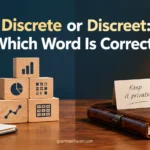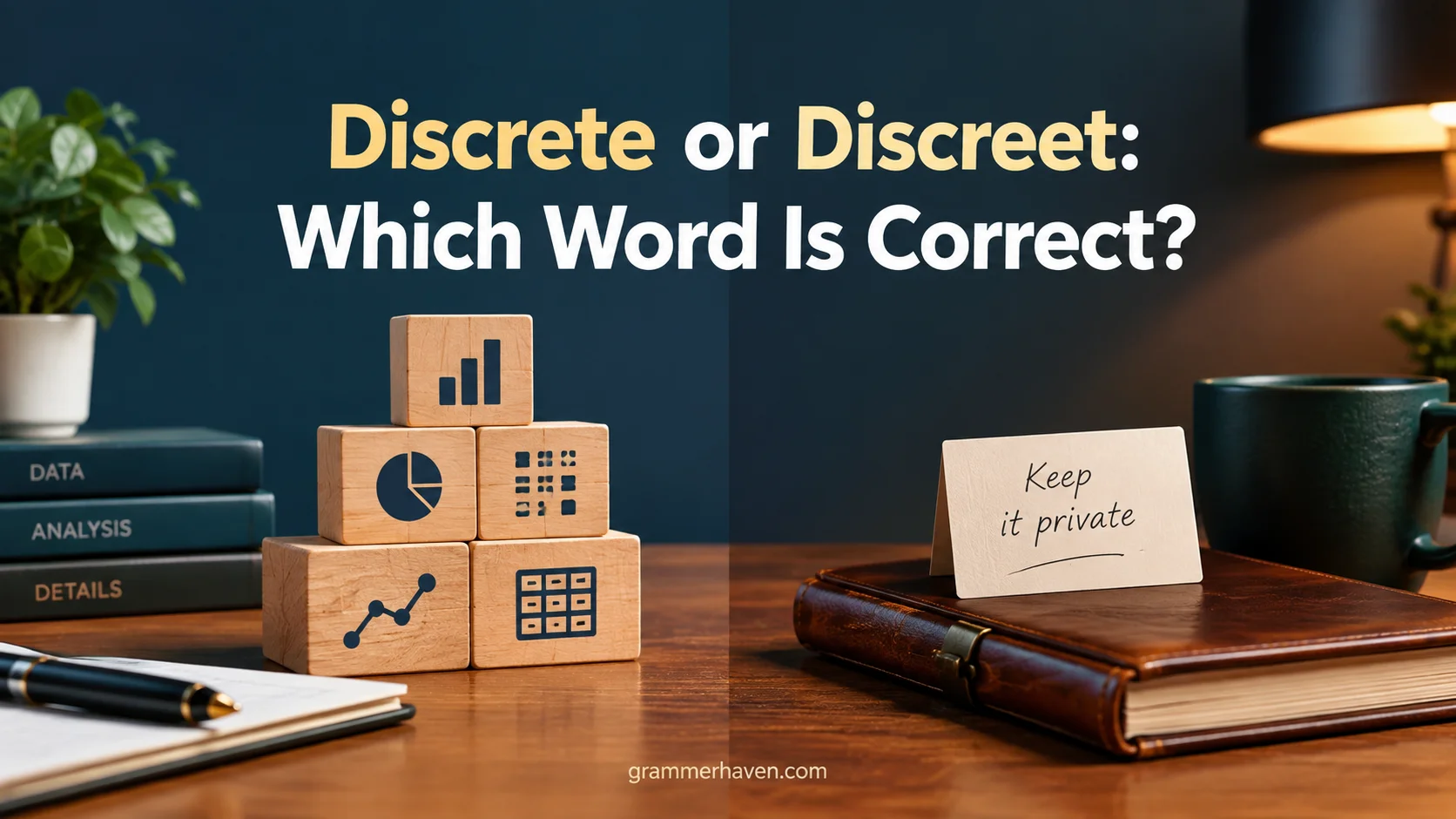
Discrete or Discreet words sound exactly alike, but they mean something different; this tiny spelling difference can completely change a sentence.
Discrete describes things that are separate, distinct, and individually identifiable. Discreet describes someone who acts carefully, tactfully, or privately, without attracting attention. A professional writer or English learner can connect each word with its meaning to make the spelling distinction easier to remember. Discrete can describe separate parts in a report that contains five sections; discreet can describe careful behavior while discussing a confidential matter. The first sentence describes separate parts, while the second describes careful behavior. Checking the contextually and semantically intended meaning can make the distinction easier to remember.
Discrete or Discreet: Quick Answer
Discrete means separate, distinct, individual, or noncontinuous.
Discreet means careful, tactful, restrained, private, or unobtrusive.
| Word | Meaning | Common Uses | Example |
| Discrete | Separate or distinct | Groups, stages, categories, units, events, data | The project has four discrete stages. |
| Discreet | Careful or unobtrusive | People, behavior, questions, conversations, actions | She made a discreet inquiry. |
A useful shortcut is simple:
Discrete = separate.
Discreet = careful.
Merriam-Webster makes essentially the same distinction, defining discrete around separateness and discreet around prudence and unobtrusiveness.
So, if you can replace the word with separate, choose discrete. If you can replace it with tactful, careful, or unobtrusive, choose discreet.
What Does Discrete Mean?
Discrete is an adjective that describes something that exists as a separate or distinct unit.
Cambridge defines discrete as clearly separate or different in shape or form. Merriam-Webster also emphasizes individuality, separation, and lack of connection.
Think of a box of LEGO pieces. Each piece is an individual unit. You can identify one piece separately from another.
That’s the basic idea behind discrete.
Discrete Meaning in Simple Terms
Discrete means:
- separate
- distinct
- individual
- independent
- unconnected
- noncontinuous
- individually identifiable
For example:
The teacher divided the class into three discrete groups.
Here, discrete means the groups are separate from one another.
Another example:
The machine completes the process in five discrete stages.
Each stage represents a distinct part of the overall process.
Examples of Discrete
Here are several natural examples:
- The study identified three discrete populations.
- The course consists of six discrete modules.
- We divided the project into discrete stages.
- The program contains several discrete components.
- The researchers studied two discrete groups.
- Each department handles a discrete function.
- The problem can be divided into several discrete steps.
- The system records events as discrete units.
In every example, the underlying idea is separateness.
What Does Discreet Mean?
Discreet describes someone or something that avoids unnecessary attention, embarrassment, or disclosure.
Cambridge defines discreet as being careful not to cause embarrassment or attract too much attention, especially when keeping something private.
Merriam-Webster gives the word a few closely related senses. A discreet person can show good judgment, exercise restraint when revealing information, or behave in an unobtrusive way.
Think about someone who knows sensitive information but doesn’t gossip about it.
That person is discreet.
Discreet Meaning in Simple Terms
Discreet can mean:
- tactful
- careful
- cautious
- private
- restrained
- unobtrusive
- inconspicuous
- respectful of sensitive information
For example:
Please be discreet about the employee’s situation.
The sentence doesn’t mean the employee’s situation is separate. It means you should handle the information carefully.
Another example:
The photographer remained discreet during the ceremony.
Here, the photographer avoids becoming the center of attention.
Examples of Discreet
- She was discreet about the confidential conversation.
- He made a discreet inquiry about the position.
- The assistant gave her a discreet signal.
- They found a discreet location for the meeting.
- Please be discreet when discussing the matter.
- The photographer was remarkably discreet.
- She made a discreet exit after the meeting.
- He asked a discreet question about the situation.
The common thread is careful conduct, not separation.
Discrete vs. Discreet: What’s the Main Difference?
The easiest way to understand discrete vs. discreet is to stop looking at the spelling for a moment.
Look at the meaning instead.
Discrete = Separate Things
Use discrete when you have separate things, categories, events, stages, or units.
For example:
The company operates through four discrete divisions.
The divisions are distinct from one another.
The experiment involved three discrete phases.
The phases represent separate stages.
Discreet = Careful Behavior
Use discreet when someone behaves carefully or avoids unnecessary attention.
For example:
The manager was discreet about the employee’s complaint.
The manager handled sensitive information carefully.
She gave him a discreet nod.
The nod was subtle and didn’t attract attention.
The One-Question Test
When you’re unsure, ask:
Does the sentence mean “separate”?
If yes, use discrete.
Does it mean “careful,” “tactful,” or “unobtrusive”?
If yes, use discreet.
| If you mean… | Use… |
| Separate | discrete |
| Distinct | discrete |
| Individual | discrete |
| Noncontinuous | discrete |
| Careful | discreet |
| Tactful | discreet |
| Private | discreet |
| Unobtrusive | discreet |
Why Do Discrete and Discreet Sound the Same?
Here’s where the confusion really begins.
Discrete and discreet are pronounced the same in standard English. Cambridge gives both words the pronunciation /dɪˈskriːt/.
That makes them homophones: words that sound alike while having different spellings and meanings.
You can’t reliably distinguish them by hearing someone say the word.
Instead, you have to use context.
Imagine someone says:
“The study identified several ___ categories.”
You hear the pronunciation, but you don’t know the spelling. The meaning gives you the answer.
The categories are separate, so the correct spelling is:
discrete categories
Now consider:
“She was very ___ when discussing the case.”
This sentence describes careful behavior. Therefore:
discreet
The sound stays the same. The meaning changes.
Discrete vs. Discreet Memory Trick
A good memory trick can save you from repeatedly checking a dictionary.
Remember the T in Discrete
Look closely at the spelling:
discrETe
The T separates the two E’s.
That’s your clue:
Discrete = separate.
Merriam-Webster specifically recommends this mnemonic for distinguishing the two words.
You can picture the T as a little divider standing between the two E’s.
Separate → discrete.
Connect Discreet With Discretion
The second word has a useful word-family connection:
- discreet
- discretion
- discreetly
If someone uses discretion, they show good judgment about what to say or do.
For example:
She handled the sensitive issue with discretion.
Therefore:
She was discreet about the issue.
This isn’t a substitute for understanding the meaning, but it’s an excellent spelling cue.
Examples of Discrete in Different Contexts
The word discrete appears far beyond everyday conversation. You’ll encounter it frequently in academic, scientific, technical, and business writing.
Discrete in Business
The company has three discrete business units.
The units operate as distinct parts of the organization.
The project contains several discrete objectives.
Each objective can be identified separately.
Discrete in Education
The course is divided into discrete lessons.
Each lesson represents an individual unit.
Students completed the assignment in several discrete steps.
The steps are distinct parts of the process.
Discrete in Science
Researchers identified two discrete populations.
The populations are distinguishable groups.
Discrete in Technology
The application processes requests through several discrete stages.
Each stage performs a distinct function.
Discrete in Mathematics
Discrete mathematics studies structures that are fundamentally separate or countable rather than continuous. Common topics include:
- logic
- graph theory
- combinatorics
- algorithms
- sets
- discrete probability
- number theory
The word also appears in phrases such as discrete variable and discrete probability distribution.
In this technical sense, discrete still carries the same underlying idea: distinct individual values rather than a continuous range. Merriam-Webster includes finite or countably infinite values among its technical meanings of discrete.
Examples of Discreet in Different Contexts
Unlike discrete, discreet usually focuses on behavior, communication, appearance, or handling sensitive matters.
Discreet in Conversation
Please be discreet when discussing the complaint.
The speaker wants careful communication.
Discreet at Work
The manager made a discreet inquiry about the candidate.
The inquiry was handled tactfully rather than publicly.
Discreet in Social Situations
He gave her a discreet signal to leave.
The signal communicated something without attracting attention.
Discreet in Photography
A good event photographer knows when to remain discreet.
The photographer doesn’t want to interrupt the event or become part of the spectacle.
Discreet in Design
The word can also describe something that doesn’t attract much attention.
The security camera has a discreet design.
Here, discreet means unobtrusive or inconspicuous.
Merriam-Webster recognizes this broader sense, including things that are unobtrusive or unnoticeable.
Discrete vs. Discreet Examples Side by Side
Sometimes seeing the words next to each other makes the distinction click.
| Sentence | Correct Word | Reason |
| The study identified four ___ groups. | discrete | The groups are separate. |
| She was ___ about the investigation. | discreet | She was careful with information. |
| The machine has five ___ components. | discrete | The components are distinct units. |
| He made a ___ inquiry. | discreet | The inquiry was tactful. |
| The report contains three ___ sections. | discrete | The sections are separate. |
| She gave him a ___ signal. | discreet | The signal avoided attention. |
| The process occurs in ___ stages. | discrete | The stages are individually defined. |
| Please remain ___ during the discussion. | discreet | The instruction concerns behavior. |
Notice the pattern.
Discrete usually describes the structure of something. Discreet usually describes the manner in which someone acts or something appears.
That’s not an absolute grammatical rule, but it’s an extremely useful practical distinction.
Common Mistakes With Discrete and Discreet
Mistake 1: Using Discrete to Mean Secret
Incorrect:
She was discrete about the confidential information.
Correct:
She was discreet about the confidential information.
Why?
The sentence describes someone’s careful handling of information. It doesn’t describe separate information.
Mistake 2: Using Discreet to Mean Separate
Incorrect:
The company has three discreet departments.
Correct:
The company has three discrete departments.
The departments are separate organizational units.
Mistake 3: Thinking Discreet Always Means Secret
This shortcut is too narrow.
Something discreet doesn’t necessarily involve a secret.
A discreet person might simply avoid embarrassment or unnecessary attention.
For instance:
She chose a discreet corner of the restaurant.
That corner isn’t necessarily secret. It’s simply quiet and unobtrusive.
Cambridge similarly describes discreet in terms of avoiding embarrassment or attracting too much attention.
Mistake 4: Treating the Words as Alternate Spellings
They’re not two spellings for the same modern meaning.
Discrete and discreet developed into distinct words with distinct meanings.
Their history, however, explains why they look so similar.
Discrete vs. Discreet in Technical Writing
Technical writing makes this distinction especially important because discrete has several specialized uses.
For example:
The model uses a discrete variable.
That’s a technical term. The variable takes distinct values rather than varying continuously.
You might also encounter:
- discrete data
- discrete values
- discrete events
- discrete signals
- discrete systems
- discrete probability
- discrete mathematics
- discrete categories
- discrete choices
Using discreet in these contexts would normally be an error.
For example:
The survey records discrete values.
Here, the values are distinct or countable.
The word has nothing to do with privacy or tact.
Discrete vs. Discreet vs. Discretely vs. Discreetly
The confusion doesn’t stop with the two adjectives. Their adverb forms can cause trouble too.
| Word | Meaning | Example |
| Discrete | Separate or distinct | The system has four discrete stages. |
| Discreet | Careful or unobtrusive | She was discreet about the matter. |
| Discretely | Separately or distinctly | The items were analyzed discretely. |
| Discreetly | Carefully or unobtrusively | He discreetly left the room. |
What Does Discretely Mean?
Discretely means in a separate, distinct, or individually identifiable way.
For example:
The components were tested discretely.
The components were tested separately.
What Does Discreetly Mean?
Discreetly means carefully, tactfully, or without drawing attention.
For example:
She discreetly checked her phone.
She did it without attracting attention.
That single extra e matters.
Discrete vs. Discreet vs. Discretion
The noun discretion is closely related to discreet.
Discreet
Adjective:
He was discreet about the situation.
Discretion
Noun:
He handled the situation with discretion.
Discreetly
Adverb:
He discreetly asked about the situation.
All three revolve around good judgment, restraint, and careful conduct.
That connection makes discreet easier to remember.
The History Behind Discrete and Discreet
The similarity between these words isn’t accidental.
Both words trace back to the same Latin source, discretus, which carried meanings related to separating, distinguishing, and discerning. Merriam-Webster notes that both entered English in the 14th century.
English spelling wasn’t always as standardized as it is today. Historical forms included spellings resembling both discrete and discreet.
Over time, English speakers and writers settled into the modern distinction:
- discrete developed around the sense of being separate or distinct.
- discreet developed around the sense of showing judgment, restraint, and tact.
Merriam-Webster describes the modern spelling distinction as a historical development rather than evidence that the two words began as completely unrelated terms.
So the confusing spelling has a perfectly good explanation. English simply carried two related meanings forward and eventually gave them different spellings.
Discrete Synonyms
Depending on context, useful synonyms for discrete include:
- separate
- distinct
- individual
- independent
- detached
- unconnected
- self-contained
- freestanding
Merriam-Webster notes that discrete strongly emphasizes individuality and lack of connection.
However, these synonyms aren’t always interchangeable.
For example:
The company has three separate offices.
This emphasizes physical or organizational separation.
The company has three discrete offices.
This emphasizes the offices as individually distinct units.
The difference is subtle, but that’s precisely why word choice matters in polished writing.
Discreet Synonyms
Common synonyms for discreet include:
- tactful
- cautious
- prudent
- judicious
- restrained
- circumspect
- unobtrusive
- inconspicuous
Merriam-Webster lists words such as cautious, prudent, judicious, and circumspect among the synonyms associated with discreet.
Again, context matters.
A discreet person may be tactful.
A discreet inquiry may be private and carefully phrased.
The core idea remains careful conduct or limited attention.
How to Choose Discrete or Discreet in Seconds
When you’re writing quickly, you don’t need a dictionary every time.
Use this three-step test.
Step 1: Ask What You’re Describing
Are you describing separate things?
Use discrete.
Are you describing careful behavior?
Use discreet.
Step 2: Try a Replacement Word
Replace the word with separate.
If the sentence still makes sense, choose discrete.
The project has four discrete stages.
Becomes:
The project has four separate stages.
Perfect.
Now try tactful:
She was discreet about the matter.
Becomes:
She was tactful about the matter.
That works too.
Step 3: Use the Spelling Trick
Remember:
discrete → the T separates the E’s → separate
Then:
discreet → discretion → careful judgment
That gives you two independent memory hooks.
A Real-World Case Study: Why One Letter Changes the Meaning
Imagine a company has learned that an employee may be leaving.
The manager tells the team:
“Please be discreet about this.”
That means employees should avoid gossiping or revealing sensitive information.
Now imagine the manager is describing the company’s structure:
“The company has three discrete departments.”
Here, the departments exist as separate organizational units.
The situation hasn’t changed the grammar. The meaning has changed.
That’s the key lesson.
Compare the Two
Discreet conversation
The speaker chooses words carefully.
Discrete conversation topics
The topics are separate from one another.
One describes how something happens. The other describes how things are divided.
Discrete or Discreet: Common Sentence Corrections
Here are some of the most useful corrections to remember.
| Incorrect | Correct | Explanation |
| She was discrete with the information. | She was discreet with the information. | She handled it carefully. |
| The program has five discreet modules. | The program has five discrete modules. | The modules are separate. |
| He made a discrete inquiry. | He made a discreet inquiry. | The inquiry was tactful. |
| The data contains four discreet categories. | The data contains four discrete categories. | The categories are distinct. |
| She gave him a discrete signal. | She gave him a discreet signal. | The signal was unobtrusive. |
| The experiment has several discreet stages. | The experiment has several discrete stages. | The stages are separate. |
These mistakes often happen because the writer knows the intended meaning but relies on sound rather than spelling.
Discrete or Discreet Quiz
Choose discrete or discreet in each sentence.
- The study divided participants into four ___ groups.
- Please be ___ when discussing the employee’s complaint.
- The machine operates through several ___ stages.
- She made a ___ inquiry about the position.
- The data consists of several ___ categories.
- He gave her a ___ signal across the room.
- The company has five ___ divisions.
- The photographer remained ___ throughout the ceremony.
- The researcher recorded each event as a ___ unit.
- They searched for a ___ location to discuss the matter.
Answers
- discrete — the groups are separate.
- discreet — the person should act carefully.
- discrete — the stages are distinct.
- discreet — the inquiry is tactful.
- discrete — the categories are individually defined.
- discreet — the signal avoids attention.
- discrete — the divisions are separate units.
- discreet — the photographer avoids disrupting the event.
- discrete — each event is an individual unit.
- discreet — the location is private or unobtrusive.
If you got most of these right, you’ve already mastered the central distinction.
See also: Either or Questions: Meaning, Grammar Rules and 50+ Examples
FAQs:
Is discrete or discreet correct?
Both are correct words. The correct choice depends on the meaning.
Use discrete for something separate or distinct.
Use discreet for careful, tactful, private, or unobtrusive behavior.
Is discreet the same as secret?
Not exactly.
Discreet can describe something private or confidential, but it can also mean simply unobtrusive or tactful. A discreet restaurant entrance, for example, doesn’t necessarily hide a secret. It simply doesn’t attract much attention.
Are discrete and discreet pronounced the same?
Yes. Both are generally pronounced /dɪˈskriːt/ in English.
That’s why context matters so much.
What is an easy way to remember discrete vs. discreet?
Remember:
Discrete has a T that separates the E’s.
Therefore:
Discrete = separate.
For discreet, think about discretion and careful judgment.
Does discrete mean different things?
It can mean distinct or separate, so different can sometimes work as a rough substitute.
However, discrete often emphasizes that something exists as an individual unit rather than merely differing in some characteristic.
What does discrete data mean?
Discrete data consists of distinct values or countable observations rather than a continuously varying range.
For example, the number of people in a room is discrete data. You can have 10 or 11 people, but not 10.5 people.
What does discreet behavior mean?
Discreet behavior involves tact, restraint, privacy, or avoiding unnecessary attention.
For example:
The assistant was discreet when handling the confidential documents.
What is the difference between discretely and discreetly?
Discretely means separately or distinctly.
Discreetly means carefully, tactfully, or without attracting attention.
For example:
The components were tested discretely.
She discreetly left the meeting.
Conclusion:
In short, Discrete or Discreet may sound exactly alike, but their meanings are different. Use discrete for separate or distinct things, and use discreet for careful, private behavior. Remembering this simple spelling distinction can help you avoid a common mix-up and choose the right word with confidence.