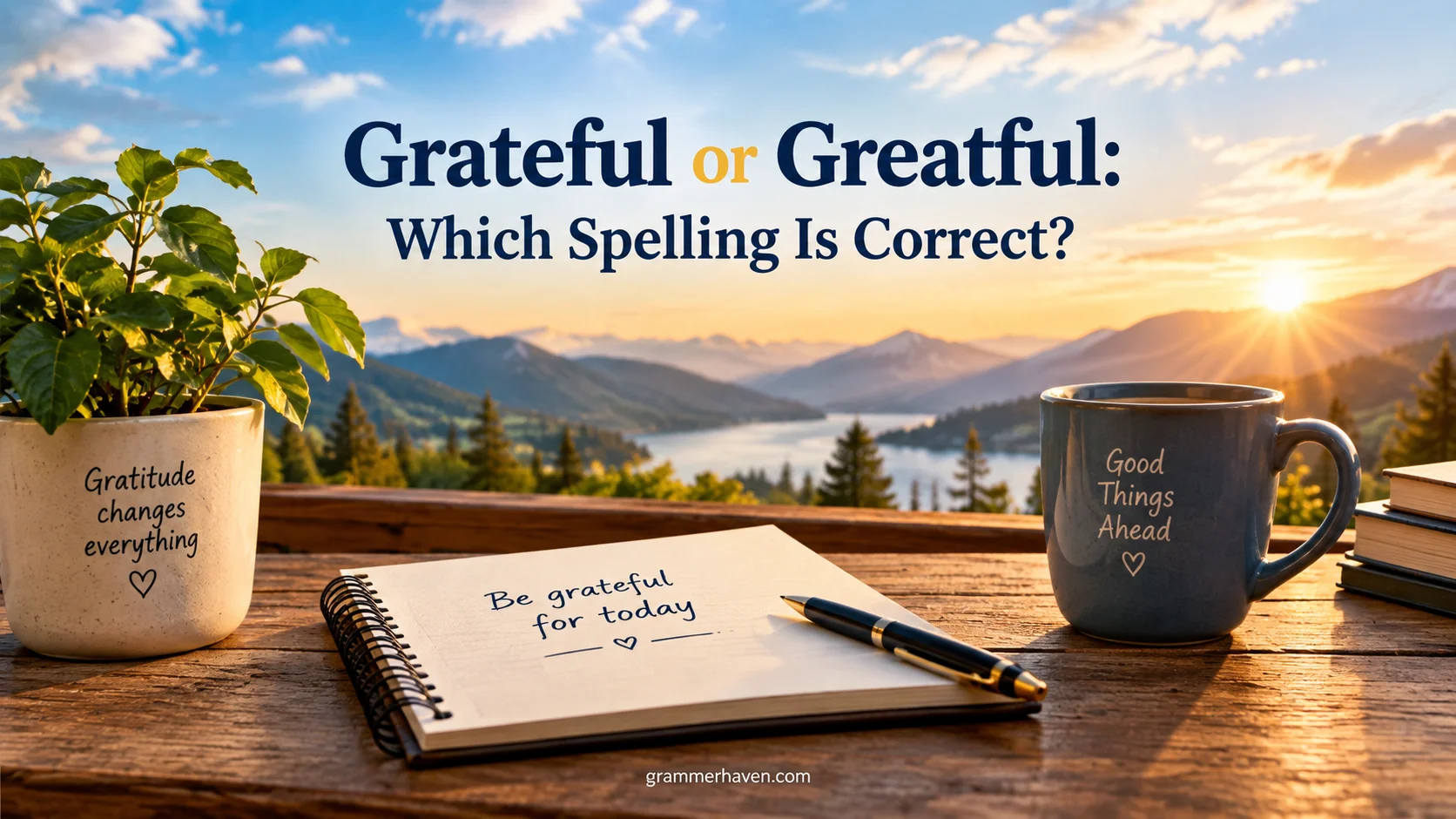
Grateful or Greatful can confuse readers at first glance, since greatful seems natural when you combine great with the suffix -ful, but the correct spelling is grateful. The standard spelling in English is grateful, a word listed in major dictionaries, including Merriam-Webster. Its meaning describes being thankful or appreciative, often for something helpful, pleasing, or providing comfort. The spelling does not come from simply adding -ful to great.
The word origin explains the spelling difference and provides useful help. Grateful is related to grate and the Latin word gratus, with a first known use recorded in 1552. Greatful is not the standard modern spelling, although the form may appear through typing, writing, or online spelling questions. References to obsolete English do not make it the correct word for current use. Choose grateful in a school assignment, article, thank-you note, professional message, email, or any other form of professional writing.
People have searched this keyword after they wondered which form to use, especially when typing quickly. Common mistakes with grateful and greatful can appear in emails, resumes, social posts, and other writing, where an error may reduce clarity. Users need quick, reliable guidance from a clear guide to avoid mistakes. Usage examples and clear rules make the right spelling easier to remember and use correctly.
Quick Answer: Grateful or Greatful?
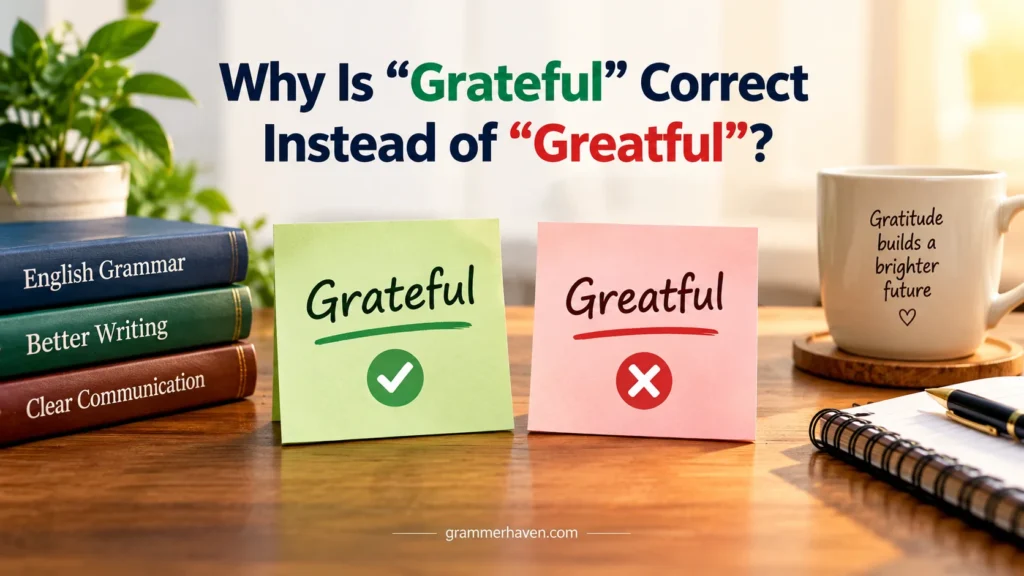
Grateful is correct. Greatful is a misspelling.
Use grateful when you mean thankful, appreciative, or pleased because of something beneficial.
| Spelling | Correct? | Meaning |
| Grateful | ✅ Yes | Thankful or appreciative |
| Greatful | ❌ No | Common misspelling of grateful |
Examples
- Correct: I’m grateful for your help.
- Correct: She’s grateful to her parents.
- Correct: We’re grateful for this opportunity.
- Incorrect: I’m greatful for your help.
- Incorrect: She’s greatful to everyone who supported her.
A useful rule is simple:
If you mean “thankful,” spell it grateful.
The spelling has “grat”, not “great.”
What Does Grateful Mean?
Grateful is an adjective that describes a feeling or expression of thanks. You typically feel grateful when someone helps you, gives you something valuable, shows kindness, or creates an opportunity that benefits you.
Cambridge defines grateful as showing or expressing thanks, particularly toward another person. Its examples include patterns such as grateful to, grateful for, and grateful to + infinitive.
For example:
- I’m grateful for your support.
- She was grateful to her teacher.
- We’re grateful to everyone who helped.
- He was grateful to receive another chance.
The word often carries more emotional weight than a quick “thanks.”
Imagine that a friend stays beside you during a difficult week. You might say, “Thanks.” But you could also say, “I’m genuinely grateful that you were there.” The second expression highlights appreciation for the person’s kindness and support.
Grateful Can Describe Appreciation for Things
You don’t have to feel grateful only toward people.
You can be grateful for:
- An opportunity
- Someone’s advice
- A second chance
- Good health
- Family support
- A safe outcome
- A useful lesson
- A kind gesture
- Someone’s time
- A difficult experience that taught you something
For example:
I’m grateful for the opportunity to learn from experienced professionals.
Here, opportunity receives the preposition for. The person isn’t the object of for.
Why Is “Grateful” Correct Instead of “Greatful”?
Here’s where the confusion starts.
At a glance, greatful looks perfectly reasonable. English has countless words formed by adding -ful to another word:
- helpful
- useful
- careful
- thoughtful
- joyful
- hopeful
So someone might naturally think:
great + ful = greatful
Unfortunately, English doesn’t always work like a neat mathematical formula.
The word grateful didn’t develop by taking the modern adjective great and adding -ful. Its history follows a different path.
Merriam-Webster traces grateful to the obsolete word grate, meaning pleasing or thankful, which came from Latin gratus, meaning something like pleasing or acceptable. The dictionary records the first known use of grateful in 1552.
That history explains why greatful isn’t simply an alternative spelling.
Grateful Is Not “Great + Ful”
This distinction is worth remembering:
grateful ≠ great + ful
Instead, grateful has its own historical development.
That means you shouldn’t try to reconstruct its spelling from the modern word great.
English spelling can be quirky. Sometimes the word’s history matters more than what appears visually logical today.
Why Do People Spell Grateful as Greatful?
The error isn’t random. There’s a clear reason it happens.
The Word “Great” Creates a Visual Trap
When people see grateful, they may mentally break it into:
great + ful
That makes greatful feel intuitive.
There’s also a semantic temptation. If you’re feeling grateful, you may feel that something is great. The meanings can appear loosely connected in your mind.
But that connection doesn’t determine the spelling.
Consider these two words:
- great = large, excellent, important, or impressive
- grateful = thankful or appreciative
They aren’t simply two forms of the same word.
Pronunciation Doesn’t Help Much
Another reason the mistake survives is pronunciation.
Grateful is pronounced approximately GRAYT-fuhl in American English. Cambridge gives the US pronunciation as /ˈɡreɪt.fəl/.
The imagined spelling greatful would sound essentially the same.
That creates a classic spelling problem: your ears can’t reliably distinguish the forms.
When two spellings sound alike, memory has to do the heavy lifting.
Grateful vs. Greatful: Side-by-Side Comparison
The difference becomes obvious when you put the forms next to each other.
| Feature | Grateful | Greatful |
| Standard English spelling | ✅ Yes | ❌ No |
| Means thankful | ✅ Yes | ❌ Not as a standard form |
| Used in formal writing | ✅ Yes | ❌ No |
| Used in everyday English | ✅ Yes | ❌ No |
| Pronunciation | /ˈɡreɪt.fəl/ | Intended as the same sound |
| Related adverb | gratefully | Incorrect |
| Related noun | gratefulness | Incorrect |
So if you’re choosing between the two, there isn’t really a contest.
Choose grateful.
How to Use Grateful Correctly in a Sentence
Knowing the spelling solves only half the problem. You also need to know how the word behaves in a sentence.
Fortunately, the grammar is fairly straightforward.
Grateful for + Something
Use grateful for when you want to identify the thing, action, opportunity, circumstance, or benefit you appreciate.
Examples
- I’m grateful for your advice.
- She’s grateful for the opportunity.
- We’re grateful for your continued support.
- He was grateful for the second chance.
- They’re grateful for everything you’ve done.
A simple way to think about this construction is:
grateful for + the thing you appreciate
For example:
I’m grateful for your kindness.
Here, your kindness represents the thing being appreciated.
Grateful to + Person
Use grateful to when you identify the person or group you’re thanking.
Examples
- I’m grateful to my parents.
- She’s grateful to her teacher.
- We’re grateful to everyone who helped.
- He’s grateful to his friends.
- The organization is grateful to its volunteers.
The pattern looks like this:
grateful to + person or group
You can also combine both structures:
I’m grateful to my parents for their support.
That’s one of the most useful patterns to remember.
To identify the person.
For identifies the thing.
Grateful to + Verb
You can also use grateful ” before an infinitive.
This construction often describes appreciation for being able to do, experience, or receive something.
Examples
- I’m grateful to be here.
- She’s grateful to have another opportunity.
- We’re grateful to receive your support.
- He was grateful to have someone nearby.
- They were grateful to get home safely.
Cambridge specifically lists this structure in examples such as feeling grateful to be alive after an earthquake.
Grateful That + Clause
You can also follow grateful with that and a complete clause.
Examples
- I’m grateful that you came.
- She’s grateful that everyone is safe.
- We’re grateful that the problem was resolved quickly.
- He was grateful that someone noticed the mistake.
This construction lets you express appreciation for an entire situation rather than one noun.
Grateful to vs. Grateful for: What’s the Difference?
This distinction causes fewer problems once you see the pattern.
| Construction | Use it for | Example |
| grateful to + person | The person you appreciate | I’m grateful to Sarah. |
| grateful for + thing | The thing you appreciate | I’m grateful for Sarah’s help. |
| grateful to + verb | An action or experience | I’m grateful to have her help. |
| grateful that + clause | A situation | I’m grateful that she helped. |
You can combine them:
I’m grateful to Sarah for helping me.
That sentence contains both parts naturally.
Grateful vs. Thankful: Are They the Same?
Grateful and thankful overlap significantly. In many everyday sentences, you can use either one without changing the basic meaning.
However, there can be a subtle difference in emphasis.
Cambridge notes that grateful commonly describes appreciation when another person has been kind or done you a favor. It also notes that thankfulness often appears when someone feels relieved that something unpleasant or dangerous didn’t happen.
Compare these examples:
I’m grateful to my neighbor for helping me move.
This focuses on someone’s kindness.
Now compare:
I’m thankful that nobody was injured.
This focuses on relief about an outcome.
The distinction isn’t absolute. Native speakers often use the words interchangeably. Still, the pattern can help you choose the more natural word.
Quick Comparison
| Word | Common emphasis | Example |
| Grateful | Appreciation for kindness, help, or benefits | I’m grateful for your support. |
| Thankful | Gratitude or relief about an outcome | I’m thankful that everyone is safe. |
Examples of Grateful in Real Sentences
Seeing the word in different contexts makes its usage easier to remember.
Personal Relationships
- I’m grateful for everything my family has done for me.
- She was grateful to her friend for staying late.
- He’s deeply grateful for their friendship.
Work and Business
- We’re grateful for your continued partnership.
- The team is grateful to everyone who contributed.
- I’m grateful for the opportunity to work on this project.
Education
- She was grateful to her teacher for the extra guidance.
- I’m grateful for everything I learned during the course.
- The students were grateful to receive additional feedback.
Difficult Situations
- He was grateful to be alive after the accident.
- We’re grateful that everyone made it home safely.
- She felt grateful for the support she received during a difficult period.
Everyday Conversation
- I’m really grateful for your help.
- I’m so grateful you came.
- Seriously, I’m grateful for this.
Notice how naturally grateful fits both formal and casual writing.
Incorrect “Greatful” Examples and Their Corrections
The best way to eliminate this mistake is to see it clearly.
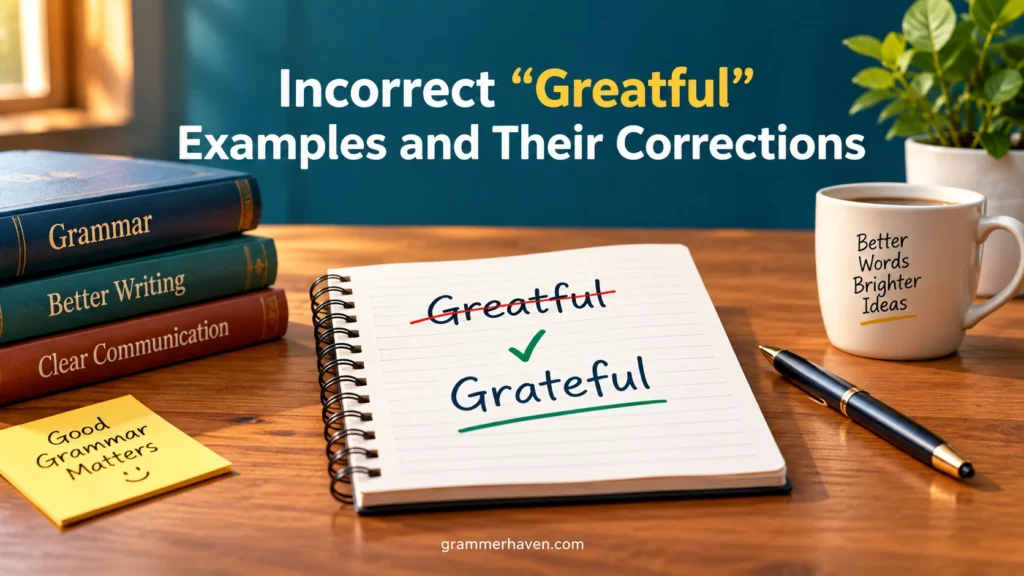
| Incorrect | Correct |
| I’m greatful for your help. | I’m grateful for your help. |
| She was greatful to her parents. | She was grateful to her parents. |
| We’re greatful for the opportunity. | We’re grateful for the opportunity. |
| He felt greatful for the support. | He felt grateful for the support. |
| I’m greatful that you came. | I’m grateful that you came. |
The correction doesn’t change the pronunciation or meaning. It simply restores the standard spelling.
Common Phrases With Grateful
Some expressions appear so often that memorizing them can reinforce the correct spelling.
Common combinations include:
- grateful for your help
- grateful for your support
- grateful for the opportunity
- grateful to you
- grateful to everyone
- grateful to my parents
- grateful to be here
- grateful to have the opportunity
- deeply grateful
- truly grateful
- eternally grateful
- forever grateful
- very grateful
Cambridge and Merriam-Webster both provide examples showing grateful with for and to, including combinations involving help, support, attention, and other benefits.
Grateful in Formal Writing
Grateful works particularly well in professional and formal communication.
For example:
I’m grateful for your time and consideration.
Or:
We’re grateful to the committee for reviewing our proposal.
You can also use the somewhat formal construction:
I would be grateful if you could provide the requested information.
Cambridge identifies “I would be very grateful if…” as a formal construction.
This phrase is especially useful in professional emails because it makes a request sound courteous without becoming excessively wordy.
Compare the Tone
Direct:
Please send the report by Friday.
Polite:
I’d be grateful if you could send the report by Friday.
The second version softens the request while keeping the message clear.
Grateful in Informal Writing
The word doesn’t belong only in formal documents.
You can use it in texts, conversations, social posts, personal messages, and thank-you notes.
For example:
- I’m so grateful for you.
- I’m honestly grateful for your help.
- I’m grateful you showed up.
- Forever grateful for this opportunity.
- Really grateful to everyone who supported me.
The surrounding language determines the tone. Grateful itself works comfortably across different registers.
Word Forms Related to Grateful
Learning the related forms can help you avoid additional spelling mistakes.
Gratefully
Gratefully is the adverbial form of grateful.
It describes an action performed with gratitude.
Examples:
- She gratefully accepted the offer.
- We gratefully acknowledge your support.
- He gratefully thanked everyone who helped.
Cambridge lists gratefully as the adverb form.
Gratefulness
Gratefulness is a noun referring to the state or quality of being grateful.
Example:
Her gratefulness was obvious from the way she thanked everyone.
However, gratitude is often the more natural noun in everyday writing:
Her gratitude was obvious.
Gratitude
Gratitude is the closely related noun and is extremely common.
Examples:
- I want to express my gratitude.
- He showed his gratitude by writing a thank-you note.
- The award was accepted with gratitude.
Oxford also lists gratefully and gratitude within the word family associated with grateful.
Ungrateful
The opposite of grateful is ungrateful.
Someone who fails to appreciate kindness or assistance may be described as ungrateful.
Compare:
- She was grateful for the help.
- He seemed ungrateful after receiving the favor.
A Simple Trick to Remember “Grateful”
Here’s the easiest practical memory aid:
Grateful means thankful, and grateful is spelled with “grat,” not “great.”
Write it mentally as:
G-R-A-T-E-F-U-L
The word contains GRATE, not GREAT.
Another useful reminder is:
You can feel great and still be grateful, but gratitude is spelled with “grat.”
That little distinction can save you from repeatedly making the same spelling error.
A Quick Spelling Test
When you’re unsure, ask yourself:
Am I trying to say “thankful”?
If the answer is yes, write:
GRATEFUL
Not:
GREATFUL
It’s a tiny spelling check, but it works.
Is “Greatful” Ever Correct?
For standard English writing, no. If you intend to express the meaning thankful or appreciative, use grateful.
You may encounter greatful online because people make spelling mistakes. Search engines, social media, comments, and informal messages contain plenty of nonstandard spellings.
Seeing a spelling repeatedly doesn’t automatically make it correct.
That distinction matters when you’re writing:
- Academic assignments
- Resumes
- Business emails
- Articles
- Reports
- Applications
- Formal letters
- Professional correspondence
In these settings, grateful is the form to use.
A Closer Look at the History of Grateful
The history of grateful explains why the spelling doesn’t follow the tempting great + ful pattern.
Merriam-Webster traces the word through the older adjective grate, meaning pleasing or thankful, to Latin gratus. The dictionary gives 1552 as the first known use of grateful.
The Latin connection is also related to a wider family of words associated with favor, thanks, and pleasing qualities.
That history matters because modern English speakers often analyze words according to their visible parts. We see:
great + ful
and assume that’s how the word formed.
But English contains many words whose modern appearance can mislead us about their origins. Historical development doesn’t always match the tidy word-building patterns we use today.
So don’t let great trick your spelling instincts trick you.
A Useful Case Study: Why “Greatful” Feels So Natural
Consider a learner writing this sentence:
“I am greatful for your support.”
Why does it look almost right?
Three things are happening.
First, “great” is a familiar word
The writer already knows great. That makes the brain more likely to recognize it inside a longer word.
Second, “-ful” is a familiar suffix
English uses -ful in many common adjectives:
- careful
- helpful
- useful
- hopeful
- meaningful
So greatful looks like a normal compound.
Third, pronunciation doesn’t expose the error
The intended pronunciation sounds like GRAYT-fuhl, which gives the writer no obvious auditory warning.
The result is a spelling that looks logical but isn’t standard.
This is why simply saying “memorize it” isn’t enough. Understanding why the mistake happens gives you a stronger defense against it.
Grateful or Greatful: Quick Reference Guide
| Question | Answer |
| Which spelling is correct? | Grateful |
| Is greatful correct? | No |
| What does grateful mean? | Thankful or appreciative |
| What part of speech is grateful? | Adjective |
| What comes after grateful for? | Usually a thing, benefit, action, or circumstance |
| What comes after grateful to? | Usually a person or group |
| Can grateful be followed by an infinitive? | Yes: grateful to be here |
| Can grateful be followed by that? | Yes: grateful that you came |
| What is the adverb? | Gratefully |
| What is a related noun? | Gratefulness |
| What common noun means the feeling? | Gratitude |
| What is a common synonym? | Thankful |
| What is the opposite? | Ungrateful |
| When was grateful first recorded according to Merriam-Webster? | 1552 |
The definitions, grammatical patterns, word family, and historical information above align with current dictionary references from Merriam-Webster, Cambridge, and Oxford.
See also: Discrete or Discreet: Which Word Is Correct?
FAQs:
Is “Grateful” Correct?
Yes. Grateful is the correct standard spelling when you mean thankful or appreciative.
Is “Greatful” a Word?
Greatful isn’t the standard spelling for the adjective meaning thankful. Use grateful instead.
Why Do People Spell Grateful as Greatful?
The error probably feels natural because greatful looks like great + -ful. The actual word has a different historical origin.
How Do You Spell Grateful?
Spell it:
G-R-A-T-E-F-U-L
The correct form contains “grat,” not “great.”
Is It Grateful for or Grateful to?
Both are correct, but they serve different purposes.
- Grateful for + thing: I’m grateful for your help.
- Grateful to + person: I’m grateful to you.
- Grateful to + verb: I’m grateful to have this opportunity.
Is Grateful the Same as Thankful?
They have closely related meanings and often work interchangeably. Grateful frequently emphasizes appreciation for another person’s kindness or help, while thankful can emphasize relief that something bad didn’t happen.
What Is the Adverb of Grateful?
The adverb is gratefully.
Example:
She gratefully accepted the invitation.
What Is the Noun Form of Grateful?
Gratefulness is a noun form. Gratitude is another closely related noun and is generally more common.
How Do You Pronounce Grateful?
In US English, grateful is pronounced approximately GRAYT-fuhl, represented by Cambridge as /ˈɡreɪt.fəl/.
Conclusion:
Grateful is the correct spelling, while greatful is a common spelling mistake. Although “great” may make greatful look logical, the correct word comes from gratus, meaning thankful or pleasing. Use grateful in emails, professional writing, school assignments, social posts, and everyday communication whenever you want to express thanks or appreciation.