Either or questions give you two alternatives, helping you choose between options in restaurants, classrooms, interviews, work, and conversations. A classic example is asking a friend, “Do you prefer Coffee or tea?” You can also ask whether someone wants to leave now or later, or stay home or go out. These questions help you identify a possibility and express a preference clearly.
The meaning of either … or becomes easier when you understand the grammar and basic patterns. The subjects and choices should fit the same grammatical forms, while subject-verb agreement keeps the sentence correct. In writing and teaching, small grammar details can leave learners confused, but the rules are remarkably easy when the structure is supported by clear examples.
An English learner, teacher, or content creator can practice these patterns every day to master the skill with greater confidence. Start with short choices, then create longer questions when you feel comfortable. This method makes teaching easier and helps you identify the pattern instead of seeing it as tricky. Regular practice makes English questions feel natural.
Quick Answer: What Are Either or Questions?
Either or questions are questions that present two alternatives and ask you to choose, identify, or express a preference between them.
Examples include:
- Do you want coffee or tea?
- Are you staying or leaving?
- Should we meet today or tomorrow?
- Would you rather walk or drive?
- Is the meeting online or in person?
The word either isn’t required in every either-or question. English speakers frequently use or by itself to present alternatives. Cambridge Dictionary describes or as a conjunction used to connect different possibilities.
You can also use the explicit paired structure either … or:
You can either stay here or come with us.
Grammatically, either … or is a correlative conjunction. It joins words, phrases, or clauses that have an equivalent grammatical role.
What Does “Either-or” Mean?
The expression either-or describes a choice between alternatives. In a strict either-or situation, you can’t choose both.
For example:
It’s an either-or situation: we can buy a new car or take a vacation, but we can’t do both.
That’s the traditional sense of an either-or choice. Cambridge Dictionary describes an either-or situation as one in which two plans are alternatives and cannot both happen.
However, everyday questions aren’t always this rigid.
Consider:
Would you like coffee or dessert?
Someone could answer:
Both, please.
So while an either-or question presents alternatives, context determines whether the choices are genuinely exclusive.
That’s an important distinction. The grammar can present two options without logically proving that only one option is possible.
Do Either or Questions Always Use “Either”?
No.
This is one of the most common misconceptions about either-or questions.
You can ask:
Do you want tea or coffee?
There’s no either, yet the question clearly offers two alternatives.
You can also say:
Do you want either tea or coffee?
The second sentence puts more emphasis on the alternatives. In ordinary conversation, however, the first version often sounds more natural.
Compare the Different Forms
| Question | Main effect |
| Do you want tea or coffee? | Simple, direct choice |
| Do you want either tea or coffee? | Emphasizes the alternatives |
| Would you rather have tea or coffee? | Asks about preference |
| Tea or coffee? | Very short, conversational choice |
The important lesson is simple: don’t add “either” just because two choices appear.
The conjunction or can stand on its own to connect alternatives.
How to Form Either or Questions
The question structure changes depending on what you’re asking.
Do and Does Questions
Use do or does when asking about actions, choices, preferences, or habits.
Examples:
- Do you want coffee or tea?
- Does Maria prefer walking or driving?
- Do they want to stay or leave?
The basic pattern looks like this:
Do/Does + subject + verb + option A + or + option B?
For example:
Do you want pizza or pasta?
The auxiliary verb comes before the subject you, while the two choices follow the main verb.
Questions With “Be”
Use forms of be when the alternatives describe a state, identity, location, condition, or classification.
Examples:
- Is the meeting online or in person?
- Are you ready or tired?
- Was the package damaged or intact?
- Is this a noun or a verb?
These questions don’t need either.
Is the meeting online or in person?
is completely natural.
Modal Questions
Modal verbs also work well with either-or questions.
Common examples include:
- Can you call or email me?
- Should we stay or leave?
- Will you drive or take the train?
- Could we meet Monday or Tuesday?
- May I call or text you later?
The modal usually comes before the subject:
Should we stay or leave?
Not:
Should we stay or leave?
The second version can occur in conversation as an informal echo or fragment, but it isn’t the standard question structure.
“Would You Rather” Questions
Would you rather questions are especially useful when you want to ask about preference.
Examples:
- Would you rather walk or drive?
- Would you rather work from home or from an office?
- Would you rather eat now or later?
- Would you rather read a book or watch a movie?
These questions belong to the broader family of either-or questions because they offer alternatives. The key difference is that it would rather strongly signal personal preference.
The Most Important Rule: Keep Either-or Choices Parallel
Here’s the rule worth remembering:
The alternatives connected by either … or should normally have parallel grammatical structures.
In other words, if one side uses a noun, the other should generally use a noun. If one side uses a verb, the other should use a verb. If one side uses a prepositional phrase, the other should use a matching prepositional phrase.
The Language Portal of Canada specifically recommends parallel structures with either … or.
Think of parallelism as two matching lanes on a road. Your reader shouldn’t have to swerve mentally from one grammatical structure into another.
Noun + Noun
Do you want coffee or tea?
Both alternatives are nouns.
Another example:
Are you choosing the red shirt or the blue shirt?
Both alternatives are noun phrases.
Verb + Verb
Would you rather walk or drive?
Both alternatives are base-form verbs.
Avoid:
Would you rather walking or drive?
The forms don’t match.
Prepositional Phrase + Prepositional Phrase
Did you travel by train or by bus?
Both alternatives begin with a preposition.
You could also say:
Did you travel by train or bus?
English often allows the repeated preposition to disappear when the meaning remains clear.
Infinitive + Infinitive
You can repeat to:
Do you want to stay or to leave?
You can also omit the second to:
Do you want to stay or leave?
Both are grammatical when the structure remains clear.
Clause + Clause
Either we leave now or we wait until morning.
Both alternatives are complete clauses:
- we leave now
- we wait until morning
The two halves match structurally.
How to Check Parallel Structure in Either or Questions
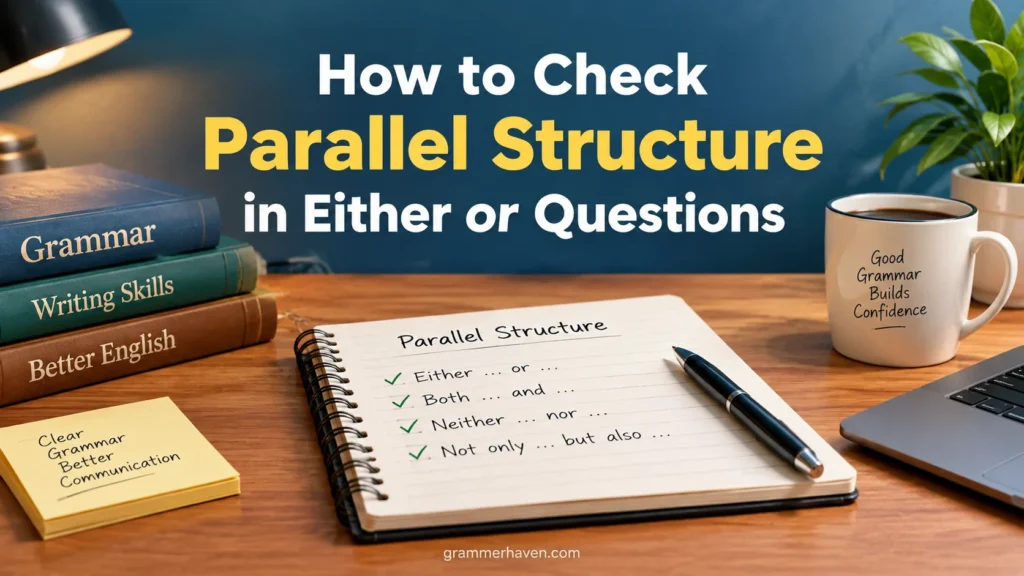
There’s a simple editing trick.
Strip away everything except the alternatives.
Take this sentence:
She can either travel by train or a bus.
The alternatives are:
- by train
- a bus
Those structures don’t match.
A cleaner version is:
She can either travel by train or by bus.
Now you have:
- by train
- by bus
Both are prepositional phrases.
You could also rewrite the sentence:
She can take either the train or the bus.
Now both alternatives are noun phrases.
The Language Portal of Canada uses similar examples to show how changing the placement of either can restore parallel structure.
Either or Questions With Different Types of Choices
Either-or questions aren’t limited to basic yes-or-no decisions. You can use them to compare people, places, actions, times, objects, and even abstract ideas.
Things
- Do you want coffee or tea?
- Should I buy the blue shirt or the black one?
- Would you choose a laptop or a tablet?
- Do you want the large package or the small one?
Actions
- Should we call or text?
- Would you rather walk or drive?
- Can you stay or leave?
- Will you study or work tonight?
Places
- Are you going to New York or Chicago?
- Should we meet at home or at the office?
- Would you rather live in a city or the countryside?
- Are you traveling to Boston or Philadelphia?
Times
- Can you meet Monday or Tuesday?
- Should we leave now or later?
- Would morning or afternoon work better?
- Are you available today or tomorrow?
People
- Will Sarah or James lead the meeting?
- Should I ask John or Maria?
- Is David or Mark responsible for the report?
Qualities and Conditions
- Is the room hot or cold?
- Was the movie funny or serious?
- Is the problem simple or complicated?
- Was the decision easy or difficult?
Either … Or vs. Simple “Or”
These structures often communicate the same basic choice, but they aren’t identical in every context.
Compare:
Do you want pizza or pasta?
with:
You can choose either pizza or pasta.
The first sentence asks directly for a choice. The second explicitly describes the available alternatives.
A Useful Comparison
| Structure | Example | Typical purpose |
| A or B? | Do you want tea or coffee? | Direct choice |
| either A or B | You can choose either tea or coffee. | Explicit alternatives |
| would rather A or B | Would you rather have tea or coffee? | Preference |
| A or B? as a fragment | Tea or coffee? | Casual conversation |
Don’t treat one as universally superior. Good English depends on context, meaning, and tone.
Either-or Questions vs. Would You Rather Questions
These forms overlap, but they aren’t interchangeable in every situation.
Either-or Question About a Fact
Are you taking the train or the bus?
The speaker may simply want to know what you’ve decided.
Would-you-rather Question About Preference
Would you rather take the train or the bus?
This asks what you prefer.
The distinction becomes even clearer with hypothetical choices:
Would you rather live near the beach or in the mountains?
You’re not necessarily planning a move. You’re expressing a preference.
Quick Comparison
| Question | Main focus |
| Are you taking the train or the bus? | Actual choice or plan |
| Will you take the train or the bus? | Future decision |
| Would you rather take the train or the bus? | Preference |
| Can you take the train or the bus? | Possibility or ability |
| Should you take the train or the bus? | Advice or recommendation |
The alternatives remain similar. The auxiliary or modal verb changes the question’s purpose.
How to Answer Either or Questions
Either-or questions usually don’t require long answers.
If someone asks:
Coffee or tea?
You can simply respond:
Coffee.
That’s perfectly natural.
You could also give a complete sentence:
I’d choose coffee.
Or:
I’d rather have coffee.
Short Answers Are Often Better
In conversation, repeating the entire question can sound unnecessarily stiff.
Question:
Would you rather go today or tomorrow?
Natural answer:
Tomorrow.
Longer answer:
I’d rather go tomorrow.
Both work.
What If Neither Choice Works?
Real life doesn’t always cooperate with neatly packaged alternatives.
Suppose someone asks:
Do you want tea or coffee?
You might prefer neither.
You can say:
Neither.
Or:
Neither one. I’d like water.
Neither rejects both choices.
Cambridge Dictionary gives neither as a natural response when someone offers two alternatives.
What If Both Choices Work?
You can also answer both when the situation allows both alternatives.
For example:
Are you available Monday or Wednesday?
You might answer:
Both.
That’s perfectly reasonable if you’re available on both days.
Likewise:
Do you want coffee or tea?
could receive:
Either is fine.
Here, either means that you have no preference between the two choices. Cambridge Dictionary specifically illustrates this use of either as a pronoun.
Either vs. Neither in Choice Questions
These two words sit on opposite sides of the choice spectrum.
Either … Or
Use either … or to present alternatives:
You can choose either tea or coffee.
Neither … Nor
Use neither … nor to reject both alternatives:
I want neither tea nor coffee.
The distinction becomes easier with a table.
| Structure | Meaning | Example |
| either … or | One alternative or the other | Choose either tea or coffee. |
| neither … nor | Not one and not the other | I want neither tea nor coffee. |
| either | One of two or no preference | Either is fine. |
| neither | Not one and not the other | Neither works. |
Both either … or and neither … nor are correlative conjunctions. They connect parallel elements and can join words, phrases, or clauses.
Subject-Verb Agreement With Either … Or
Subject-verb agreement becomes more interesting when either … or connects two subjects.
The standard rule is that the verb generally agrees with the subject closest to it.
Consider:
Either the manager or the employees are responsible.
The nearest subject is employees, which is plural. Therefore, are works.
Reverse the order:
Either the employees or the manager is responsible.
Now manager is closest to the verb, so it works.
The Language Portal of Canada explicitly recommends agreement with the nearest subject in these constructions.
Singular + Singular
Either John or Maria is coming.
Plural + Plural
Either the teachers or the students are presenting.
Singular + Plural
Either the teacher or the students are presenting.
Plural + Singular
Either the students or the teacher is presenting.
Quick Rule
Either A or B + verb → the verb generally agrees with B, the nearer subject.
This same principle applies to neither … nor.
Punctuation in Either or Questions
Simple either-or questions normally don’t need a comma before or.
Correct
Do you want coffee or tea?
Are you staying or leaving?
Would you rather walk or drive?
The conjunction or doesn’t automatically trigger a comma.
However, longer sentences can involve independent clauses, where ordinary compound-sentence punctuation rules apply. The Language Portal of Canada notes that commas can separate independent clauses joined by coordinating conjunctions, including or, although short closely related clauses can sometimes omit the comma.
For example:
We can stay home, or we can go to the restaurant.
That’s different from:
Do you want pizza or pasta?
The second sentence simply connects two alternatives inside one question.
Either-or vs. Either … Or: What’s the Difference?
The hyphenated and unhyphenated forms serve different grammatical purposes.
Either … Or
Use this when you’re connecting alternatives:
You can choose either tea or coffee.
Either-or
Use the hyphenated form when it functions as a compound expression.
We faced an either-or decision.
Cambridge Dictionary treats either-or as an adjective referring to a situation involving a choice between two alternatives.
So don’t write:
You can choose either-or tea or coffee.
Instead, write:
You can choose either tea or coffee.
Common Mistakes With Either or Questions
Using the Wrong Verb Form
Incorrect:
Would you rather walk or drive?
Correct:
Would you rather walk or drive?
Both choices need the same verb form.
Assuming Every Question Needs “Either”
Incorrect assumption:
An either-or question must contain either.
Not true.
Do you want tea or coffee?
is already an either-or question.
Mixing Parallel and Nonparallel Structures
Awkward:
We can either travel by train or a car.
Better:
We can either travel by train or by car.
Or:
We can take either the train or the car.
The alternatives now match.
Putting “Either” in the Wrong Place
Consider:
Either Maria is in the library or the cafeteria.
This structure can sound as if the alternatives aren’t properly balanced.
Better:
Maria is either in the library or in the cafeteria.
Or:
Maria is in either the library or the cafeteria.
The Language Portal of Canada’s grammar exercises use this same kind of placement issue to demonstrate the importance of parallel structure.
Confusing Either and Neither
Compare:
Either option works.
This means one of the two options can work.
Now compare:
Neither option works.
This means both options fail.
One prefix flips the meaning completely.
Creating a False Either-or Choice
Some questions look grammatically perfect but logically oversimplify the situation.
For example:
Do you work from home or from the office?
What if the person works from home three days a week and from the office two days a week?
A better question might be:
What’s your usual work arrangement?
The lesson is important: grammar can’t rescue a poorly designed question.
Either-or Questions in Everyday Conversation
People use these questions constantly because they’re efficient.
At a restaurant:
Soup or salad?
While making plans:
Friday or Saturday?
At work:
Should I call or email the client?
At home:
Movie or game?
These short forms work because conversation supplies the missing context.
You don’t need to say:
Would you like to select either coffee or tea as your preferred beverage?
That sounds like a form designed by a committee.
Instead:
Coffee or tea?
Natural English usually favors the shorter option when the context is obvious.
Either-or Questions in Formal and Academic Writing
Formal writing uses either-or questions too, but precision becomes more important.
You might encounter them in:
- surveys
- questionnaires
- research
- interviews
- classroom assessments
- business forms
- decision documents
- polls
Consider this survey question:
Do you prefer online classes or in-person classes?
That’s useful if those are the only two choices.
But suppose many respondents prefer hybrid learning. The question now excludes a legitimate third option.
A better survey might provide:
| Choice | Response |
| Online | ☐ |
| In person | ☐ |
| Hybrid | ☐ |
| Other | ☐ |
The principle is simple: the question should reflect the actual decision space.
Either-or Questions for English Learners
These questions are also useful for practicing English.
Beginner Level
- Do you like tea or coffee?
- Do you have a cat or a dog?
- Is it hot or cold?
- Do you want rice or bread?
These questions reinforce basic vocabulary and sentence patterns.
Intermediate Level
- Would you rather study in the morning or at night?
- Do you prefer traveling by car or by train?
- Would you rather work alone or with a group?
These require learners to express preferences more naturally.
Advanced Level
- Would you prioritize lower costs or faster delivery?
- Would you rather invest in short-term growth or long-term stability?
- Should companies prioritize flexibility or consistency in workplace policies?
At this level, either-or questions can move beyond vocabulary practice and encourage nuanced discussion.
How to Create Better Either or Questions
Creating a strong question is easier when you follow a logical process.
Identify the Decision
First, determine exactly what you want the other person to choose.
Don’t start with the grammar. Start with the meaning.
Choose Two Genuine Alternatives
Make sure both options belong to the same category.
Weak:
Would you rather run or a gym membership?
The choices aren’t equivalent.
Better:
Would you rather run or lift weights?
Now both choices describe activities.
Check Parallel Structure
Look at the alternatives by themselves.
- walk or drive
- by train or by bus
- the red shirt or the blue shirt
- to stay or to leave
If the structures match, you’re usually on solid ground.
Choose the Correct Question Pattern
Use:
- Do you…? for choices and actions
- Is/Are…? for states or classifications
- Can…? for ability or possibility
- Should…? for advice or decisions
- Will…? for future plans
- Would you rather…? for preferences
Remove Unnecessary Words
Compare:
Would you prefer to potentially consider choosing either the train or the bus for your journey?
with:
Would you rather take the train or the bus?
The second sentence wins easily.
Good writing doesn’t make readers work harder than necessary.
Case Study: Fixing a Poor Either-or Question
Consider this example:
Would you rather working from home or commute to the office?
The meaning is understandable, but the structure is faulty.
The alternatives are:
- working from home
- commute to the office
The first uses an -ing form. The second uses a base verb.
Correct Version
Would you rather work from home or commute to the office?
Now both alternatives use base verbs:
- work
- commute
Another option is:
Would you rather work from home or work from the office?
That version repeats work, but it makes the parallel structure extremely obvious.
This kind of correction illustrates why parallelism matters. Grammar guidance from the Language Portal of Canada emphasizes matching the structures joined by correlative conjunctions.
50+ Either or Question Examples
Food and Drinks
- Do you want coffee or tea?
- Would you rather have pizza or pasta?
- Do you prefer sweet or salty snacks?
- Should we order burgers or sandwiches?
- Would you rather eat at home or at a restaurant?
- Do you want water or juice?
- Is the soup spicy or mild?
- Would you choose chocolate or vanilla?
- Should we have breakfast now or later?
- Do you want rice or potatoes?
Travel
- Are you traveling by car or train?
- Would you rather fly or drive?
- Should we leave Friday or Saturday?
- Do you want to visit New York or Chicago?
- Would you rather stay in a hotel or rent an apartment?
- Are you taking the bus or a taxi?
- Should we travel in summer or winter?
- Would you rather visit the mountains or the beach?
- Do you want a window seat or an aisle seat?
- Are we leaving in the morning or evening?
Work and School
- Should I call or email the client?
- Are you working from home or the office?
- Would you rather work alone or with a team?
- Is the assignment written or oral?
- Should we meet today or tomorrow?
- Do you want to study math or science?
- Are you taking the morning class or afternoon class?
- Would you rather present first or last?
- Should we print the document or send it digitally?
- Is the meeting online or in person?
Personal Preferences
- Would you rather read or watch a movie?
- Do you prefer mornings or evenings?
- Would you rather live in a city or the countryside?
- Are you more interested in music or sports?
- Would you rather call or text?
- Do you prefer cats or dogs?
- Would you rather save money or travel?
- Is your style casual or formal?
- Would you rather go out or stay home?
- Do you prefer books or podcasts?
Fun Either-or Questions
- Would you rather be invisible or able to fly?
- Would you rather travel to the past or the future?
- Would you rather have unlimited money or unlimited free time?
- Would you rather live near the ocean or in the mountains?
- Would you rather never use social media or never watch television?
- Would you rather be extremely lucky or extremely intelligent?
- Would you rather explore space or the deep ocean?
- Would you rather always be early or always be exactly on time?
- Would you rather have perfect memory or perfect concentration?
- Would you rather speak every language or play every musical instrument?
- Would you rather have a four-day workweek or a six-hour workday?
- Would you rather know your future or change your past?
- Would you rather be famous or completely anonymous?
- Would you rather live without music or movies?
- Would you rather have summer all year or winter all year?
Either or Questions vs. Other Question Types
Not every situation calls for an either-or question.
| Question type | Purpose | Example |
| Either-or | Choose between alternatives | Do you want tea or coffee? |
| Yes/no | Confirm something | Do you want coffee? |
| Open-ended | Invite a broad response | What would you like to drink? |
| Wh-question | Ask for specific information | What do you want to drink? |
| Would-you-rather | Ask about preference | Would you rather have tea or coffee? |
| Multiple-choice | Choose from several options | Which do you prefer: tea, coffee, juice, or water? |
A useful rule is to work backward from the answer you need.
If you need one of two choices, use an either-or question.
If you want the person to explain themselves, use an open-ended question.
If four or five legitimate choices exist, don’t squeeze them into an artificial two-option box.
When an Either-or Question Is the Wrong Choice
An either-or question isn’t automatically better because it’s shorter.
Suppose someone asks:
Do you prefer working from home or at the office?
That question assumes two categories.
A hybrid worker might answer:
Neither exactly. I split my time between both.
A better question would be:
What’s your preferred work arrangement?
Likewise, consider:
Do you want pizza or pasta?
This works perfectly at dinner when those are the available options.
But:
Do you want to study medicine or engineering?
could be far too restrictive if the person is considering dozens of careers.
The lesson is worth remembering:
Use an either-or question when the two alternatives genuinely represent the decision.
Don’t manufacture a false choice just to make the question shorter.
Quick Facts About Either or Questions
- Either-or questions present alternatives.
- The word either isn’t mandatory.
- Or can connect alternatives without either.
- Either … or is a correlative conjunction.
- The structures joined by either … or should generally be parallel.
- Neither … nor presents the negative counterpart of the structure.
- When either … or joins subjects, the verb generally agrees with the nearest subject.
- “Tea or coffee?” is a perfectly natural conversational question.
- Would you rather emphasizes preference.
- You can answer both, either, or neither when the context allows it.
- A grammatically correct either-or question can still be a poor question if it creates a false choice.
See also: Laid or Layed: Which Spelling Is Correct?
FAQs:
What is an either-or question?
An either-or question presents two alternatives and asks someone to choose, identify, or express a preference.
Example:
Do you want coffee or tea?
Do either-or questions always use “either”?
No. Or alone can present two alternatives.
Do you want coffee or tea?
Is “Coffee or tea?” an either-or question?
Yes. It’s a shortened conversational question presenting two alternatives.
What is the difference between “either … or” and “or”?
Or connects alternatives. Either … or explicitly pairs alternatives as a correlative conjunction.
Do you want tea or coffee?
You can choose either tea or coffee.
Does either … or require parallel structure?
Yes, the alternatives should generally have matching grammatical structures.
You can either walk or drive.
Both alternatives are verbs.
What is the difference between either and neither?
Either presents or accepts one of two alternatives.
Neither rejects both.
Either option works.
Neither option works.
Can you answer an either-or question with “both”?
Yes, when both choices can logically apply.
Are you available Monday or Wednesday?
Both.
Can you answer an either-or question with “neither”?
Yes.
Do you want tea or coffee?
Neither. I’d like water.
Is “would you rather” an either-or question?
It can be. Would you rather commonly presents two alternatives while focusing on preference.
Would you rather walk or drive?
Should you put a comma before “or”?
Not in a simple either-or question.
Do you want tea or coffee?
A comma may appear when or connects longer independent clauses, depending on the sentence structure.
Is “either-or” hyphenated?
Use either … or for the correlative conjunction.
You can choose either tea or coffee.
Use either-or when it functions as a compound expression.
It was an either-or decision.
Conclusion:
Either or questions make it simple to present alternatives, choose between options, and express a preference in everyday English. With a clear understanding of either … or, basic patterns, grammar, and subject-verb agreement, you can create natural questions with confidence. Regular practice with simple examples will help you recognize the structure, avoid common mistakes, and use these questions comfortably in both speaking and writing.