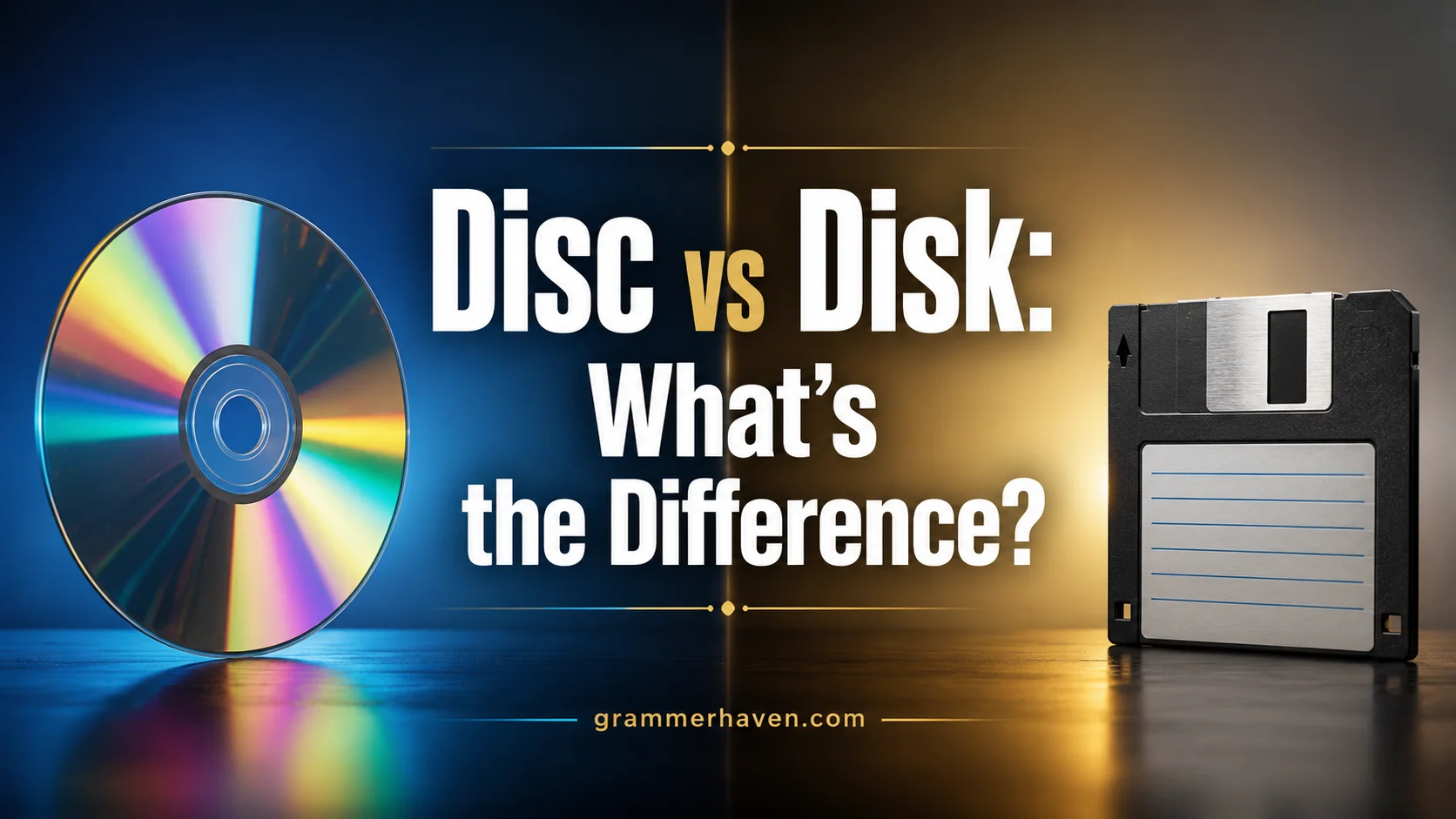
Disc vs Disk shows a subtle difference in spelling based on context, with each form linked to different meanings and uses.
Disc describes a circular, flat-shaped object for storing information, data, music, or movies. Optical discs are thin, flat discs that store data with laser technology, including CDs, DVDs, and Blu-ray discs.
Disk commonly describes magnetic disks made from plates that are not necessarily circular in every technical description and use magnetic fields to store data. Examples include hard drives, floppy disks, a hard disk, floppy disk, and disk drive. Computers use magnetic digital storage, magnetic storage, digital storage, computer disk, storage device, electronic storage, files, and related technology. American English favors disk in computer terms, while British English often uses disc, showing regional spelling differences in general terms.
Outside computer storage, disc appears in Audio, video, optical formats, compact disc, CD, DVD, Blu-ray disc, optical media, and laser storage. Anatomy, medical, and medical terms include spinal disc and intervertebral disc. Sports, body parts, and recreation include disc brake and disc golf. Important usage depends on the intended meaning and context.
Disc vs Disk: The Quick Difference
The easiest way to understand disc vs disk is to look at how each spelling is commonly used.
| Word | Common Meaning | Typical Examples |
| Disc | A circular physical object, optical media, or medical term | Compact disc, brake disc, spinal disc, flying disc |
| Disk | A computer storage device or data-related technology term | Hard disk, floppy disk, disk drive, disk partition |
A simple memory trick:
Disk with a “k” usually connects to computers. Disc with a “c” usually connects to physical objects.
This rule works in most situations, although some exceptions exist.
For example:
- ✅ Hard disk drive
- ❌ Hard disc drive
- ✅ Compact disc
- ❌ Compact disk
The reason comes from history. Different industries standardized different spellings.
What Is the Meaning of Disc?
A disc refers to a flat, circular object. The spelling comes from older European language traditions and remains common in many areas outside computer technology.
The word traces back to the Greek diskos, meaning a round object or plate. Ancient Greeks used the term for the discus, a circular object thrown in athletic competitions.
Over time, “disc” became associated with many round objects, including:
- Sports equipment
- Mechanical parts
- Medical structures
- Optical storage media
Today, the word appears in many fields.
Examples of Disc Usage
Optical Media
The entertainment industry commonly uses disc.
Examples include:
- Compact disc (CD)
- Digital versatile disc (DVD)
- Blu-ray Disc
A CD stores information using tiny physical marks that a laser reads. Unlike a hard disk, it does not rely on magnetic storage.
Automotive Systems
Cars use brake discs as part of their braking systems.
A brake disc is a metal rotor that spins with the wheel. When you press the brake pedal, brake pads clamp onto the disc and create friction, slowing the vehicle.
Modern vehicles commonly use disc brakes because they provide:
- Better heat management
- More consistent braking performance
- Improved reliability compared with older drum brake systems
Medicine
Medical professionals use disc when describing structures in the human body.
Examples:
- Spinal disc
- Intervertebral disc
- Herniated disc
The discs between spinal bones act like cushions. They absorb pressure and allow movement.
A damaged spinal disc can cause:
- Back pain
- Nerve irritation
- Limited mobility
Sports
Sports also use the “disc” spelling.
Examples:
- Flying disc
- Disc golf
- Discus throwing
The famous flying toy brand Frisbee helped make the word “disc” familiar worldwide, although “flying disc” remains the general term.
What Is the Meaning of Disk?
A disk usually refers to computer storage or data technology.
The spelling became especially common in computing because engineers adopted “disk” when developing magnetic storage systems.
A computer disk stores information by recording data onto circular magnetic surfaces.
Common examples include:
- Hard disk drives
- Floppy disks
- Disk drives
- Disk storage systems
Why Do Computers Use “Disk” Instead of “Disc”?
The answer comes from the history of computer hardware.
Early computers needed ways to store large amounts of information. Engineers developed magnetic storage systems using rotating circular platters.
These devices became known as magnetic disks.
A traditional hard disk drive contains:
- Magnetic platters
- A spindle motor
- Read/write heads
- Controller electronics
The platters spin thousands of times per minute while the read/write heads move across their surfaces.
For example:
| Storage Device | Uses Disk Technology? | Description |
| Hard disk drive (HDD) | Yes | Uses magnetic platters to store data |
| Floppy disk | Yes | Removable magnetic storage used widely in the past |
| SSD | No traditional disk | Uses flash memory instead of spinning disks |
| CD/DVD | No | Uses optical technology |
Disc vs Disk in Computer Storage
The biggest confusion around disc vs disk happens in technology.
Many people assume all circular storage devices use “disk.” However, that is not true.
Different technologies use different terms.
Hard Disk Drive (HDD)
A hard disk drive stores data magnetically.
Inside an HDD:
- Circular platters spin rapidly.
- A read/write head moves across the surface.
- Magnetic patterns represent digital information.
A typical modern consumer HDD may offer:
- 1TB to 20TB+ storage capacities
- Speeds around 5,400 to 7,200 revolutions per minute (RPM)
- Lower cost per gigabyte compared with SSDs
Optical Disc Storage
Optical storage uses lasers instead of magnetic fields.
Examples:
- CDs
- DVDs
- Blu-ray discs
A Blu-ray disc can store significantly more data than a CD.
| Format | Approximate Storage Capacity |
| CD | 700 MB |
| DVD | 4.7 GB (single layer) |
| Blu-ray Disc | 25 GB (single layer) |
The industry chose “disc” for these formats.
Optical Disc vs Optical Disk: Which Is Correct?
The standard spelling is:
✅ Optical disc
Not:
❌ Optical disk
Organizations and manufacturers generally use “optical disc” because the technology developed under the optical media industry.
Examples:
- Compact Disc (CD)
- Digital Versatile Disc (DVD)
- Blu-ray Disc
Although “optical disk” may appear occasionally, “optical disc” remains the accepted industry term.
The History Behind Disc and Disk
The difference between disc and disk did not happen because one spelling was wrong. Instead, both developed from the same ancient word.
The Origin of Disc
The word “disc” comes from:
- Greek: diskos
- Latin: discus
Ancient athletes used a discus during competitions. The circular shape became the foundation for the modern meaning.
Over centuries, English speakers used “disc” for round objects.
The Rise of Disk
The spelling “disk” became popular in American English.
Technology played a major role.
When computer engineers created magnetic storage devices, companies and technical communities adopted “disk” terminology.
This created familiar computing terms such as:
- Disk drive
- Disk space
- Disk operating system
- Disk partition
The technology world essentially gave “disk” a specialized identity.
Disc vs Disk in Different Industries
Different fields have their own preferred spelling.
Computing
Use:
Disk
Examples:
- Hard disk
- Disk drive
- Disk image
- Disk cleanup
- Disk partition
Optical Media
Use:
Disc
Examples:
- Compact disc
- Optical disc
- Blu-ray Disc
Automotive
Use:
Disc
Examples:
- Brake disc
- Disc brake
Medicine
Use:
Disc
Examples:
- Spinal disc
- Disc degeneration
Sports
Use:
Disc
Examples:
- Flying disc
- Disc golf
American English vs British English: Disc or Disk?
Language differences also influence spelling.
American English often separates the two words more strongly:
- Disk → computing
- Disc → other physical uses
British English tends to use “disc” more broadly.
For example:
| Term | American English | British English |
| Computer storage | Hard disk | Hard disk |
| CD media | Compact disc | Compact disc |
| Brake component | Brake disc | Brake disc |
The difference is smaller today because technology companies worldwide often follow American computing terminology.
Common Mistakes With Disc and Disk
Understanding the rules helps prevent common writing errors.
Writing “Hard Disc”
Incorrect:
My laptop has a 1TB hard disc.
Better:
My laptop has a 1TB hard disk.
A hard disk is a computer storage device, so the “k” spelling applies.
Writing “Compact Disk”
Incorrect:
I bought a compact disk of my favorite album.
Better:
I bought a compact disc of my favorite album.
The music industry standardized “compact disc.”
Using “Disk” for Every Circular Object
Incorrect:
The athlete threw a flying disk.
Better:
The athlete threw a flying disc.
Although people may understand the meaning, “disc” is the standard spelling in sports.
A Simple Way to Remember Disc vs Disk
Use this shortcut:
Use “Disk” for Data
Think:
K = Keyboard + Knowledge + Computer
Examples:
- Hard disk
- Disk storage
- Disk drive
Use “Disc” for Circular Things
Think:
C = Circle
Examples:
- Disc brake
- Compact disc
- Spinal disc
This method works for most everyday situations.
See also: Canvas or Canvass: What’s the Difference?
FAQs:
1. What is the difference between disc and disk?
Disc and disk have the same basic pronunciation but different common uses. Disc often refers to optical media or anatomy, while disk commonly refers to computer storage.
2. Is it a disk or disc for a computer?
Disk is generally preferred for computer storage in American English, such as hard disk, disk drive, and floppy disk.
3. Is a CD called a disc or disk?
A CD is called a disc. The standard term is compact disc, not compact disk.
4. Is DVD spelled disc or disk?
The standard spelling is DVD, which stands for Digital Versatile Disc.
5. Is Blu-ray a disc or disk?
The standard term is Blu-ray Disc because it uses optical laser technology to store digital information.
6. Is hard disk correct?
Yes. Hard disk is the standard term for a computer storage device that traditionally uses magnetic storage.
7. Is floppy disk correct?
Yes. Floppy disk is the standard spelling for this older magnetic storage medium.
8. Is spinal disc or spinal disk correct?
Spinal disc is the standard spelling in American English medical terminology. Intervertebral disc is also commonly used.
9. Does British English use disc or disk?
British English generally uses disc in many contexts where American English uses disk, although disk still appears in some technical and computing terms.
10. How can I remember disc vs disk?
A simple memory trick is disc = optical media and anatomy, while disk = computer storage. This rule covers many common examples, though some specialized terms vary by region and field.
Conclusion:
The difference between disc vs disk mainly depends on context, technology, regional spelling, and meaning. Use disc for CDs, DVDs, Blu-ray media, spinal anatomy, disc golf, and disc brakes. Use disk for hard disks, floppy disks, disk drives, and many computer storage terms, especially in American English. Knowing these common patterns will help you choose the correct spelling without confusion.