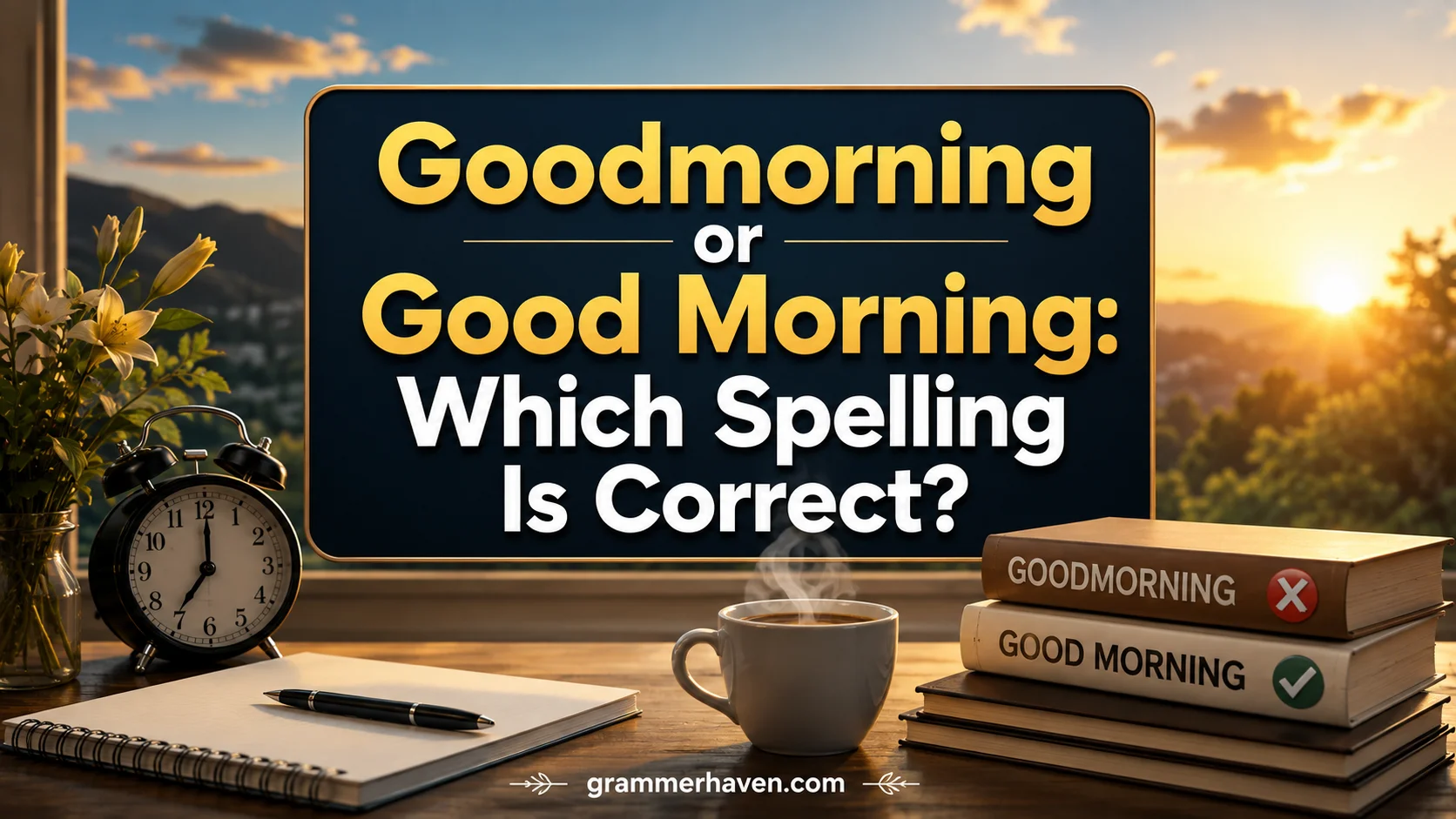
Many people search Goodmorning or Good Morning: Which Spelling Is Correct? after they typed goodmorning in a text, email, social media caption, or posts and wondered if it was correct. This mistake is common because English learners and native speakers often confuse similar expressions that sound natural in spoken language but follow different grammar rules in written communication. The correct form is Good morning, a greeting that follows standard word spacing, while Goodmorning is an incorrect spelling in everyday language use.
When I review writing and messages, I regularly notice this common phrase written incorrectly. These mistakes can affect professionalism, clarity, and credibility in professional, formal, and everyday communication. A good understanding of compound words, separated words, confidence, phrase usage, vocabulary, accuracy, correctness, and real-life examples helps improve your writing. This guide also explains common patterns so you can write confidently in both casual and informal situations.
The context decides when you should say Good morning because the time can change depending on the situation. For example, 2 a.m. is usually considered nighttime, yet coworkers starting an early shift at that hour may greet each other this way. Spoken and written expression, sentence structure, learning, and knowledge all influence good communication. For extra improvement, a free Paraphraser tool like Quillbot can help you find alternatives to greetings while creating emails, captions, and other digital content that strengthens your communication skills.
Goodmorning or Good Morning: The Correct Spelling Explained
The correct spelling is good morning.
The phrase contains two separate words:
- Good → an adjective that describes something positive.
- Morning → a noun that refers to the early part of the day.
Together, they create a greeting that means:
“I hope you have a good morning.”
For example:
✅ Good morning, Sarah. I hope you’re doing well.
❌ Goodmorning, Sarah. I hope you’re doing well.
The incorrect version, “goodmorning,” combines two words that English speakers normally keep separate.
Although many people write it this way online, especially in quick messages or social media posts, it does not follow standard English spelling rules.
Goodmorning or Good Morning: Quick Comparison
| Phrase | Correct? | Explanation |
| Good morning | ✅ Correct | Standard English greeting |
| Goodmorning | ❌ Incorrect | Not recognized as a standard compound word |
| Good Morning | ✅ Sometimes correct | Used in titles or headings |
| GOOD MORNING | ✅ Correct | Used for emphasis, signs, or announcements |
The safest choice in everyday writing is:
Good morning
It works in almost every situation.
Why Is Good Morning Written as Two Words?
Understanding the grammar behind the phrase makes the spelling easier to remember.
English uses adjectives to describe nouns. In the phrase good morning, the word good describes the type of morning someone wishes for.
Think about these examples:
| Phrase | Word Relationship |
| Good morning | Good describes morning |
| Beautiful day | Beautiful describes day |
| Happy birthday | Happy describes birthday |
| Cold weather | Cold describes weather |
| Bright future | Bright describes future |
The pattern is simple:
Adjective + Noun
The word good does not change into part of the noun. It remains a separate describing word.
A helpful comparison:
A “good morning” is a type of morning, just like a “beautiful day” is a type of day.
You wouldn’t normally write:
- Beautifulday ❌
- Happydirthday ❌
- Coldweather ❌
The same rule applies to:
- Good morning ✅
Why Don’t We Write Goodmorning as One Word?
English has thousands of compound words, which makes this confusing.
Some words that started as separate words eventually merged:
| Originally Separate | Modern Form |
| Bed room | Bedroom |
| News paper | Newspaper |
| Sun light | Sunlight |
| Air plane | Airplane |
However, not every word combination becomes a single word.
Many phrases stay separated permanently:
| Correct Phrase | Incorrect Combined Form |
| Good morning | Goodmorning |
| Good night | Goodnight (when used as a greeting/farewell is sometimes accepted informally, but “good night” remains standard in most contexts) |
| High school | Highschool |
| Ice cream | Icecream |
| Living room | Livingroom |
Language changes slowly. A combination becomes one word only when speakers widely adopt that form over time.
Good morning has never developed into a standard single word.
What Does Good Morning Mean?
The phrase good morning has both a literal and social meaning.
Literal Meaning of Good Morning
Literally, it means:
“A pleasant or positive morning.”
The words describe the quality of the morning.
For example:
“It’s a good morning for a walk because the weather is cool.”
Here, good morning is not a greeting. It simply describes the morning itself.
Greeting Meaning of Good Morning
Most commonly, people use good morning as a greeting.
It communicates:
- Politeness
- Friendliness
- Respect
- Recognition of another person
Examples:
“Good morning, everyone. Welcome to today’s meeting.”
“Good morning! How did you sleep?”
“Good morning, Mom. I’ll make breakfast.”
A simple greeting can influence the tone of an entire conversation. A friendly “good morning” creates a warmer interaction than immediately jumping into a request.
When Should You Use Good Morning?
The phrase works in many situations. However, the tone can change depending on where and how you use it.
Good Morning in Professional Communication
In workplaces, good morning remains one of the safest greetings.
It works well in:
- Emails
- Business meetings
- Workplace chats
- Customer messages
- Presentations
Example:
Good morning, Mr. Anderson. I’m following up regarding yesterday’s discussion.
This sounds professional without feeling overly formal.
Another example:
Good morning, team. Here are the updates for this week’s project.
The phrase helps establish a respectful tone.
Good Morning in Casual Conversations
Among friends and family, people often use shorter versions.
Examples:
- Good morning!
- Morning!
- Morning, everyone!
- Morning, sleepyhead!
A close friend might say:
“Morning! Coffee is ready.”
This feels relaxed and natural.
Good Morning in Formal Writing
Formal writing requires correct spelling and punctuation.
Examples:
✅ Good morning, Professor Williams.
✅ Good morning, members of the committee.
✅ Good morning. I am writing to request additional information.
Avoid:
❌ Goodmorning Professor Williams.
❌ Goodmorning members of the committee.
Goodmorning or Good Morning in Text Messages
Texting has changed the way people communicate. Many people type quickly and ignore traditional spelling rules.
That’s why you might see:
- Goodmorning
- Gud morning
- GM
- Gm
- Morninggg
These forms appear often online, but they do not represent standard English.
Why Do People Write Goodmorning?
Several reasons explain this mistake:
Speed and Convenience
When people type quickly, they often combine words.
For example:
- Goodmorning
- Alot
- Everyday (when they mean every day)
Fast typing encourages shortcuts.
Influence From Usernames and Social Media
Many platforms require usernames without spaces.
Someone might create:
- @goodmorningworld
- @goodmorningcoffee
Seeing combined words frequently can make the spelling feel normal.
However, usernames do not determine grammar rules.
Confusion With Compound Words
People know many English words combine:
- Basketball
- Toothbrush
- Notebook
So they assume:
- Good + Morning = Goodmorning
But English does not work that way automatically.
Good Morning vs Good Morning Capitalization Rules
Many people know the correct spelling but still wonder:
Should both words be capitalized?
The answer depends on where the phrase appears.
Beginning of a Sentence
Capitalize the first word because it begins a sentence.
Correct:
Good morning, everyone.
Incorrect:
Good morning, everyone.
In the Middle of a Sentence
Usually, keep it lowercase.
Correct:
I sent her a good morning message.
Incorrect:
I sent her a Good Morning message.
In Titles and Headlines
Titles often use title cases.
Correct:
Good Morning America Announces New Host
or:
Good Morning: A Guide to Starting Your Day
Different style guides have different title capitalization rules, but major words are usually capitalized.
Common Mistakes With Good Morning
Even though good mornings seem simple, several mistakes appear frequently.
Writing Goodmorning as One Word
This is the biggest mistake.
Incorrect:
Goodmorning, everyone!
Correct:
Good morning, everyone!
The solution is simple: remember that good describes morning.
Forgetting the Comma When Greeting Someone
When you directly address someone, add a comma.
Incorrect:
Good morning John.
Correct:
Good morning, John.
The comma separates the greeting from the person’s name.
More examples:
✅ Good morning, Lisa.
✅ Good afternoon, everyone.
✅ Hello, David.
Capitalizing Every Word
Some writers capitalize greetings unnecessarily.
Incorrect:
Good Morning Everyone
Correct:
Good morning, everyone.
However, if the phrase appears as a title, capitalization may change.
Example:
Good Morning America
Read More: Vender vs Vendor: Understanding the Correct Spelling?
Good Morning vs Similar Greetings
English has several greetings based on the time of day.
| Greeting | When Used | Example |
| Good morning | Morning | Good morning, everyone |
| Good afternoon | After noon | Good afternoon, Mr. Smith |
| Good evening | Late day/evening | Good evening, guests |
| Good night | Leaving or sleeping | Good night, see you tomorrow |
A common confusion is good evening versus good night.
You say:
Good evening, welcome to the event.
when you arrive.
You say:
Good night, sleep well.
when you leave or go to bed.
Read More: Shiny vs Shiney: Which Spelling Is Correct?
FAQs:
1. Is it Goodmorning or Good morning?
The correct spelling is Good morning. It should always be written as two words in standard English. Goodmorning is considered an incorrect spelling.
2. Why do people write Goodmorning as one word?
Many people type Goodmorning because the greeting is spoken quickly in conversation. However, spoken language and written language follow different grammar and spelling rules.
3. Can I use Good morning in formal emails?
Yes. Good morning is appropriate for formal emails, business messages, professional communication, and everyday conversations.
4. Is Goodmorning ever accepted in English?
No. Standard English dictionaries and grammar guides recognize Good morning as the correct form. Goodmorning is generally treated as a spelling error.
5. How can I avoid this spelling mistake?
Remember that Good morning is a greeting made of two separate words. Proofreading your writing or using a grammar or proofreading tool can help you catch this and other common mistakes before sending your message.
Conclusion:
Using Good morning instead of Goodmorning is a small change that makes a big difference in your writing. Since Good morning is the correct spelling in standard English, it helps your messages look clear, professional, and grammatically correct. Whether you’re writing an email, sending a text, posting on social media, or greeting coworkers, remembering to write it as two words will improve your communication and help you avoid a common spelling mistake.