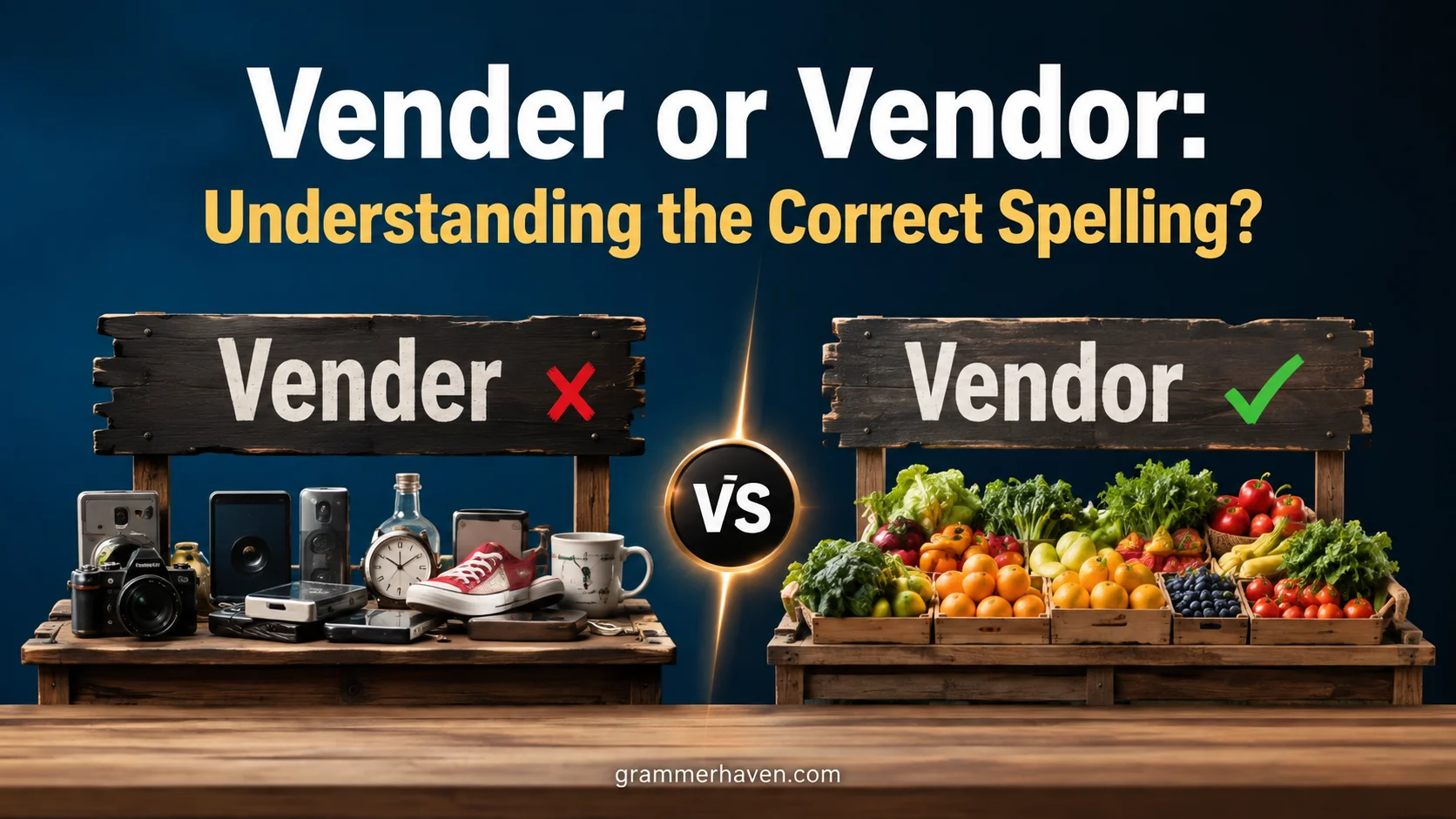
Vender vs Vendor: Understanding the Correct Spelling? starts with one simple rule: Vendor is the correct spelling in modern English, while Vender is an alternative spelling found mainly in older texts, dictionaries, and historical references. This quick guide explains the biggest difference, highlights the spelling comparison, and shows why Vendor remains the standard, accepted spelling for business, technology, and everyday communication.
The term Vendor is the preferred word in the English language because it follows current grammar, vocabulary, usage standards, and accepted usage. Although Vender exists as an alternative form, it is far less common in modern usage and mostly appears in historical usage or older dictionary entries. From reviewing professional writing, I have found that using Vendor improves accuracy, avoids a common mistake, strengthens business writing, accurate writing, business communication, and professional communication, and helps writers, students, business owners, and native English speakers make the correct word choice in every context without confusion.
For the best correct usage, always use Vendor unless you are quoting historical material or discussing language history. Whether you create reports, emails, website copy, or other business content, the look of the correct spelling makes your writing more accurate and trustworthy. Keeping this guide in mind will help you understand, avoid errors, and choose the right form every time.
Vender vs Vendor: Quick Answer
The short answer:
Vendor is the preferred spelling.
A vendor is a person, company, or organization that sells products or services.
A vender means the same thing, but it is an uncommon spelling that appears much less frequently in modern writing.
| Word | Meaning | Usage Today |
| Vendor | A person or business that sells goods or services | Common and widely accepted |
| Vender | A person who sells something | Correct but rare |
Examples
Common modern usage:
The company hired a new software vendor to manage its cloud services.
Local food vendors sold fresh meals at the festival.
Less common usage:
The fruit vender stood near the busy street corner.
The second sentence is understandable, but most modern readers would expect vendor instead.
What Does Vendor Mean?
The word vendor refers to someone who sells something. That “someone” can be an individual, a small business, or a large corporation.
Unlike the simple word seller, vendor often suggests a professional relationship between the buyer and the person or company providing goods or services.
For example:
- A person selling handmade crafts at a market is a vendor.
- A company providing accounting software is a vendor.
- A business supplying office equipment is a vendor.
The term is especially common in industries where companies regularly purchase products or services from outside organizations.
Vendor Definition
A vendor is:
A person, business, or organization that provides goods or services to customers or other businesses.
The word appears frequently in:
- Business contracts
- Procurement documents
- Technology discussions
- Retail operations
- Supply chain management
- Online marketplaces
Examples of Vendor Usage
Retail:
The clothing vendor displayed new products during the weekend sale.
Technology:
The company contacted its software vendor about a security update.
Business:
The manager reviewed several vendors before selecting a supplier.
What Does Vender Mean?
The word vender has the same basic meaning as vendor.
A vender is someone who sells something.
However, the word has lost popularity over time. While dictionaries still recognize it, most writers avoid it because vendor has become the accepted modern form.
Think of it like two roads leading to the same destination. Both roads exist, but one is wider, faster, and used by almost everyone.
That road is vendor.
Why Is Vender Less Common?
Several factors contributed to the decline of vender:
Business Standardization
Modern business language strongly favors vendor.
Companies use phrases like:
- Vendor management
- Vendor agreement
- Vendor relationship
- Vendor evaluation
- Vendor contract
You rarely see professional organizations use:
- Vender management
- Vender agreement
- Vender evaluation
Even though people understand the meaning, those phrases look unusual.
Technology Influence
The technology industry helped make vendor even more common.
Companies often refer to:
- Software vendors
- Hardware vendors
- Cloud vendors
- Security vendors
- Technology vendors
Because technology businesses operate globally, their terminology spreads quickly.
Vender vs Vendor: Main Differences Explained
Although these words share the same meaning, their practical differences matter.
Vendor Is the Modern Standard
The biggest difference is popularity.
Vendor appears far more frequently in modern English writing.
You will find it in:
- Business reports
- Newspapers
- Academic writing
- Product documentation
- Corporate websites
- Government documents
For example:
The organization selected three vendors after reviewing their pricing and services.
This sounds natural because vendor matches modern expectations.
Vender Sounds Old-Fashioned
Using vender will not make your sentence grammatically wrong. However, many readers may notice it because it feels unusual.
Compare:
The street vendor sold handmade jewelry.
Most people find this completely natural.
Now:
The street vender sold handmade jewelry.
The meaning remains clear, but the spelling may distract the reader.
When one spelling is familiar and another feels unusual, writers usually choose the familiar option.
Why Is Vendor More Common Than Vender?
The Role of Professional Language
Language changes based on how people use it.
Businesses did not simply choose “vendor” randomly. Over decades, organizations built an entire vocabulary around the term.
A company does not usually say:
We need to improve our vender relationships.
It says:
We need to improve our vendor relationships.
This happens because professional communities create patterns. Once a word becomes common in contracts, software systems, and business conversations, it becomes the expected choice.
Vendor in Business and Corporate Communication
In business environments, vendor has a specific professional meaning.
A vendor is often an outside company that provides something valuable to another organization.
For example:
A restaurant may work with:
- Food vendors
- Cleaning service vendors
- Equipment vendors
- Delivery vendors
A technology company may work with:
- Software vendors
- Cloud vendors
- Hardware vendors
- Security vendors
Common Business Vendor Terms
| Term | Meaning |
| Vendor management | The process of managing relationships with suppliers and service providers |
| Vendor agreement | A contract between a company and a vendor |
| Vendor evaluation | Reviewing a vendor’s performance, pricing, and reliability |
| Vendor onboarding | Adding a new vendor into company systems |
| Vendor relationship | The ongoing connection between a company and provider |
Example
The company improved its vendor management process to reduce costs and increase service quality.
Vendor vs Seller vs Supplier: What Is the Difference?
Many people use these words interchangeably, but they are not always identical.
Vendor
A vendor sells products or services.
Example:
A software vendor provides accounting tools for businesses.
Seller
A seller is anyone who sells something.
Example:
The seller shipped the package yesterday.
Seller is the broadest term.
Anyone who sells something is a seller.
Supplier
A supplier usually provides materials, products, or resources to another business.
Example:
The automobile manufacturer works with several parts suppliers.
A supplier may not interact directly with the final customer.
Comparison Table: Vendor vs Seller vs Supplier
| Word | Main Meaning | Example |
| Vendor | Professional seller of goods or services | A software vendor provides business applications |
| Seller | Anyone who sells something | A seller lists products online |
| Supplier | Provides goods or materials, often to businesses | A supplier provides factory materials |
| Merchant | A person or business involved in trade | A merchant sells products in a marketplace |
Simple Way to Remember
Think of the supply chain:
Supplier → Vendor → Customer
Example:
A factory supplier provides parts.
↓
A technology vendor sells finished computers.
↓
A customer buys the computer.
Read More: Natzi or Nazi: Which Spelling Is Correct?
Vendor Usage Across Different Industries
The word vendor appears in almost every major industry.
Technology Industry
Technology companies use vendor constantly.
Examples include:
- Software vendors
- Cloud vendors
- Hardware vendors
- Cybersecurity vendors
A company purchasing business software might compare several vendors before making a decision.
Example:
The company evaluated five software vendors before selecting a customer management platform.
Retail Industry
Retail vendors sell products directly to customers or businesses.
Examples:
- Market vendors
- Clothing vendors
- Food vendors
- Online vendors
Example:
Hundreds of vendors participated in the annual shopping event.
Healthcare Industry
Healthcare organizations work with many vendors.
Examples:
- Medical equipment vendors
- Pharmaceutical vendors
- Technology vendors
Hospitals often evaluate vendors based on:
- Product quality
- Reliability
- Safety standards
- Pricing
Event Industry
Events depend heavily on vendors.
Wedding planners, conferences, and festivals often hire:
- Catering vendors
- Photography vendors
- Decoration vendors
- Entertainment vendors
Example:
The event organizer coordinated with several vendors to prepare the venue.
FAQS:
1. Is Vender or Vendor the correct spelling?
Vendor is the correct spelling in modern English. It is the standard form used in business, education, technology, and professional writing. Vender is an uncommon alternative spelling that mainly appears in older sources.
2. Why do some dictionaries include Vender?
Some dictionaries list Vender because it has historical usage and has appeared in older English texts. However, it is not the preferred spelling in modern writing.
3. Can I use Vender in business documents?
It is best to avoid Vender in business documents. Using Vendor follows current English standards and makes your writing look more professional and accurate.
4. Is Vendor used in both American and British English?
Yes. Vendor is the accepted spelling in both American English and British English. It is the standard term across most industries and professional contexts.
5. How can I remember the correct spelling?
A simple tip is to remember that Vendor is the spelling you will see on contracts, invoices, software, eCommerce platforms, and business websites. If you’re writing for a modern audience, Vendor is almost always the right choice.
Conclusion:
The Vender vs Vendor debate is easier to resolve than it first appears. In modern English, Vendor is the correct and widely accepted spelling for business, technology, legal documents, and everyday writing. Although Vender exists as an alternative spelling in some older dictionaries and historical sources, it is rarely used today. Choosing Vendor improves clarity, keeps your writing professional, and ensures your message follows current English standards. When in doubt, use Vendor unless you are referring to historical texts or discussing the history of the word itself.