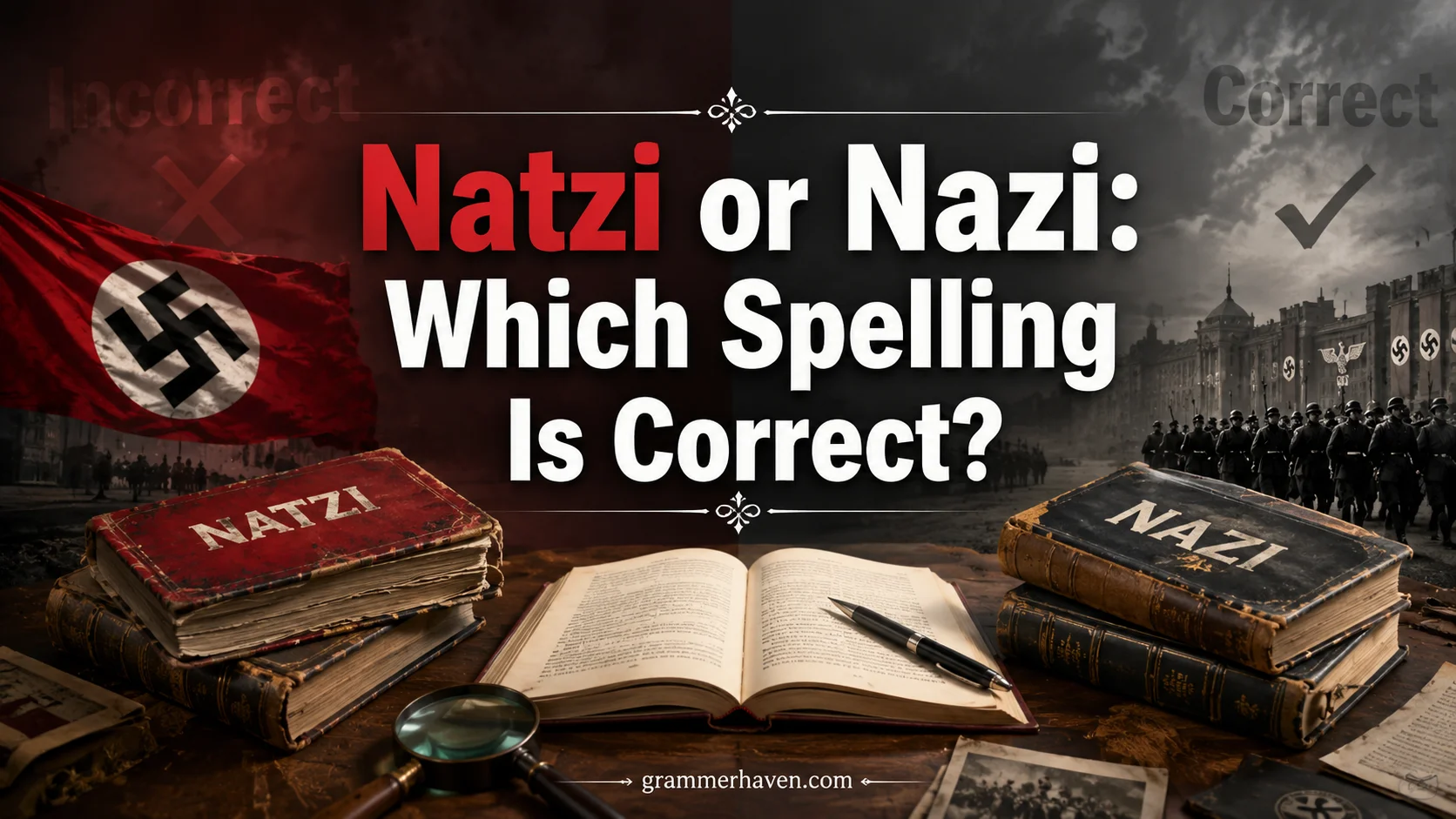
The phrase Natzi or Nazi: Which Spelling Is Correct? appears when you search online and wonder why the correct spelling is Nazi in history writing. While reading a history article or writing an essay, you may pause and ask yourself about the difference between Natzi and Nazi. This common mistake appears in blogs, comments, and school papers every single day because both spellings look similar. The right form is Nazi, and this guide helps you learn, understand, and discover why this confusion exists so you can never hesitate about the word’s origin.
The Nazi term comes from the German word Nationalsozialist, which means national socialist. It became a shortened contraction, abbreviation, and nickname connected with the Nazis and their opponents. The word was coined through an analogy with Sozi, a shortened version of Sozialist. The pronunciation is commonly Na-zee, although some people connect the z and ts sound with the Italian word pizza and say Na-tsi. Winston Churchill also used the pronounced Na-zee form. The incorrect Natzi version developed from this sound confusion, while Ignaz, a stereotypical name in Germany, is completely unrelated. Although the mistake may make the word seem reckless or clumsy, understanding its historical meaning helps you use it accurately.
Natzi or Nazi: Which Spelling Is Correct?
The correct spelling is Nazi.
The spelling Natzi is incorrect.
| Spelling | Correct or Incorrect? | Explanation |
| Nazi | ✅ Correct | Standard English spelling of the historical term |
| Natzi | ❌ Incorrect | Common misspelling based on pronunciation |
If you are writing about history, politics, education, or research, always use Nazi.
Examples:
✅ Correct:
The Nazi Party controlled Germany from 1933 to 1945.
Historians continue to study Nazi Germany and its impact on the world.
❌ Incorrect:
The Natzi Party controlled Germany from 1933 to 1945.
The second example contains a spelling error. The meaning may still be understood, but the word itself is not accurate.
Why Is Nazi Correct and Natzi Wrong?
The confusion between Natzi and Nazi happens because English spelling does not always perfectly match pronunciation.
Many people spell words based on how they hear them. This process is called phonetic spelling.
For example:
- Someone hears “Nazi” and thinks it sounds like “Nat-see.”
- They add the letter t because the pronunciation appears to include that sound.
- They write Natzi instead of Nazi.
However, spelling does not always follow sound.
English has many examples where pronunciation and spelling differ:
| Word | Common Sound-Based Mistake | Correct Spelling |
| Definitely | Definately | Definitely |
| Separate | Seperate | Separate |
| Necessary | Neccessary | Necessary |
| Nazi | Natzi | Nazi |
The same principle applies here. The pronunciation may cause confusion, but the spelling remains Nazi.
What Does Nazi Mean?
The word Nazi refers to a member, supporter, or follower of the National Socialist German Workers’ Party.
The German name of the party was:
Nationalsozialistische Deutsche Arbeiterpartei (NSDAP)
The term “Nazi” comes from shortening the German word Nationalsozialist, meaning National Socialist.
Although the full political name included the word “socialist,” the Nazi movement was a far-right authoritarian ideology that promoted:
- Extreme nationalism
- Racism
- Antisemitism
- Military expansion
- Dictatorship under Adolf Hitler
The term became globally associated with the government that ruled Germany from 1933 to 1945.
Nazi Meaning and Historical Background
To understand why the spelling matters, it helps to understand the history behind the word.
The Nazi Party began in Germany after World War I during a period of economic hardship and political instability.
Germany faced several major problems:
- Economic struggles
- High unemployment
- Anger over the Treaty of Versailles
- Political divisions
The Nazi Party used these frustrations to gain support.
Important Timeline of Nazi Germany
| Year | Event |
| 1919 | The German Workers’ Party was founded, later becoming the Nazi Party |
| 1920 | The party adopted the name National Socialist German Workers’ Party (NSDAP) |
| 1921 | Adolf Hitler became leader of the party |
| 1933 | Hitler became Chancellor of Germany |
| 1939 | Germany invaded Poland, beginning World War II in Europe |
| 1941 | Nazi Germany expanded mass persecution and genocide during the Holocaust |
| 1945 | Nazi Germany collapsed after defeat in World War II |
The Origin of the Word Nazi
The word Nazi did not originally appear as a random English term. It came from the German language.
The German word:
Nationalsozialist
was shortened to:
Nazi
This type of abbreviation is common in languages around the world.
For example:
| Full Name | Short Form |
| Nationalsozialist | Nazi |
| Automobile | Auto |
| Advertisement | Ad |
| Laboratory | Lab |
The shortened form became widely used during the 1920s and 1930s.
Although the word began as a political abbreviation, its meaning became permanently connected with the actions of Hitler’s government.
Nazi Pronunciation: Why It Sounds Like Natzi
One reason people search for “Natzi or Nazi” is pronunciation.
The word Nazi is commonly pronounced in English as:
NAH-zee
or:
NAHT-see
The pronunciation can make people think the spelling includes “tz.”
However, the spelling remains:
N-A-Z-I
not:
N-A-T-Z-I
American English Pronunciation of Nazi
In American English, many speakers pronounce it like:
NAH-zee
The first syllable sounds similar to:
- “not” without the “t”
- “father” with a shorter sound
The second syllable sounds like:
- “zee”
Example:
Nazi = NAH-zee
German Pronunciation of Nazi
In German, the pronunciation is closer to:
NAHT-see
The “z” sound in German often represents a sound similar to “ts.”
This creates the illusion that the word contains a “t.”
However, German spelling still uses:
Nazi
not:
Natzi
This is one of the most important points to remember:
Pronunciation can change between languages, but spelling does not automatically change with it.
Why Do People Write Natzi Instead of Nazi?
The Natzi vs Nazi mistake happens for several reasons.
Pronunciation Confusion
The biggest reason is simple:
People write what they hear.
When someone hears:
NAHT-see
they may naturally think:
N-A-T-Z-I
This mistake is especially common among people who encounter the word mostly through conversations, documentaries, or videos rather than reading.
Influence From Other Languages
Different languages represent sounds differently.
For example:
- German uses “z” for a sound similar to “ts.”
- Some languages use “tz” combinations more frequently.
Someone familiar with those spelling patterns may incorrectly transfer them into English.
Memory Mistakes
Words connected to history are often remembered visually.
If someone rarely writes the word but hears it often, their brain may store the pronunciation instead of the spelling.
This happens with many words:
- Accommodate
- Embarrass
- Rhythm
- Nazi
The solution is simple: remember the correct written form.
Read More: Vender vs Vendor: Understanding the Correct Spelling?
Nazi vs Nazism: What Is the Difference?
Many people confuse Nazi and Nazism, but they describe different things.
| Word | Meaning | Example |
| Nazi | A person connected to the Nazi movement | “The Nazi government controlled Germany.” |
| Nazis | More than one Nazi | “The Nazis committed numerous war crimes.” |
| Nazism | The political ideology | “Nazism spread in Germany during the 1930s.” |
Think of the difference this way:
- Nazi = person
- Nazism = belief system
Similar examples:
| Person | Ideology |
| Communist | Communism |
| Capitalist | Capitalism |
| Fascist | Fascism |
| Nazi | Nazism |
Nazi Germany: Understanding the Term
The phrase Nazi Germany refers to Germany under the control of Adolf Hitler and the Nazi Party between 1933 and 1945.
During this period, the government:
- Removed democratic institutions
- Controlled media and education
- Started aggressive military campaigns
- Created concentration camps
- Carried out the Holocaust
The Holocaust was the systematic murder of approximately six million Jewish people by Nazi Germany and its collaborators.
Millions of other victims were also persecuted and killed, including:
- Roma people
- Disabled individuals
- Soviet prisoners of war
- Political opponents
- LGBTQ+ people
- Others considered enemies of the Nazi regime
FAQs:
1. Is Natzi or Nazi the correct spelling?
Nazi is the correct spelling. Natzi is a common misspelling caused by confusion about the pronunciation of the word.
2. Why do some people spell Nazi as Natzi?
Some people write Natzi because they hear the word pronounced as Na-tsi, where the “z” sound can seem similar to a “ts” sound. However, the standard spelling remains Nazi.
3. What does the word Nazi mean?
The word Nazi is a shortened form of the German term Nationalsozialist, meaning National Socialist. It originally referred to members of the National Socialist German Workers’ Party in Germany.
4. How is Nazi pronounced correctly?
The common English pronunciation of Nazi is Na-zee. Some languages may pronounce the “z” sound differently, which creates confusion about the spelling.
5. Is Natzi ever considered an alternative spelling?
No, Natzi is not considered a correct alternative spelling. It is generally treated as a spelling mistake, while Nazi is the accepted and historically accurate form.
Conclusion:
Understanding the difference between Natzi and Nazi helps you avoid a common spelling mistake and use historical terms correctly. The correct spelling is Nazi, which comes from the German word Nationalsozialist and refers to members or supporters of the National Socialist German Workers’ Party. Although Natzi may appear because of pronunciation confusion, especially due to the Na-tsi sound comparison, it is not the accepted spelling. Learning the word’s origin, pronunciation, and historical background makes it easier to recognize the correct form whenever you encounter it in an article, essay, or online discussion.