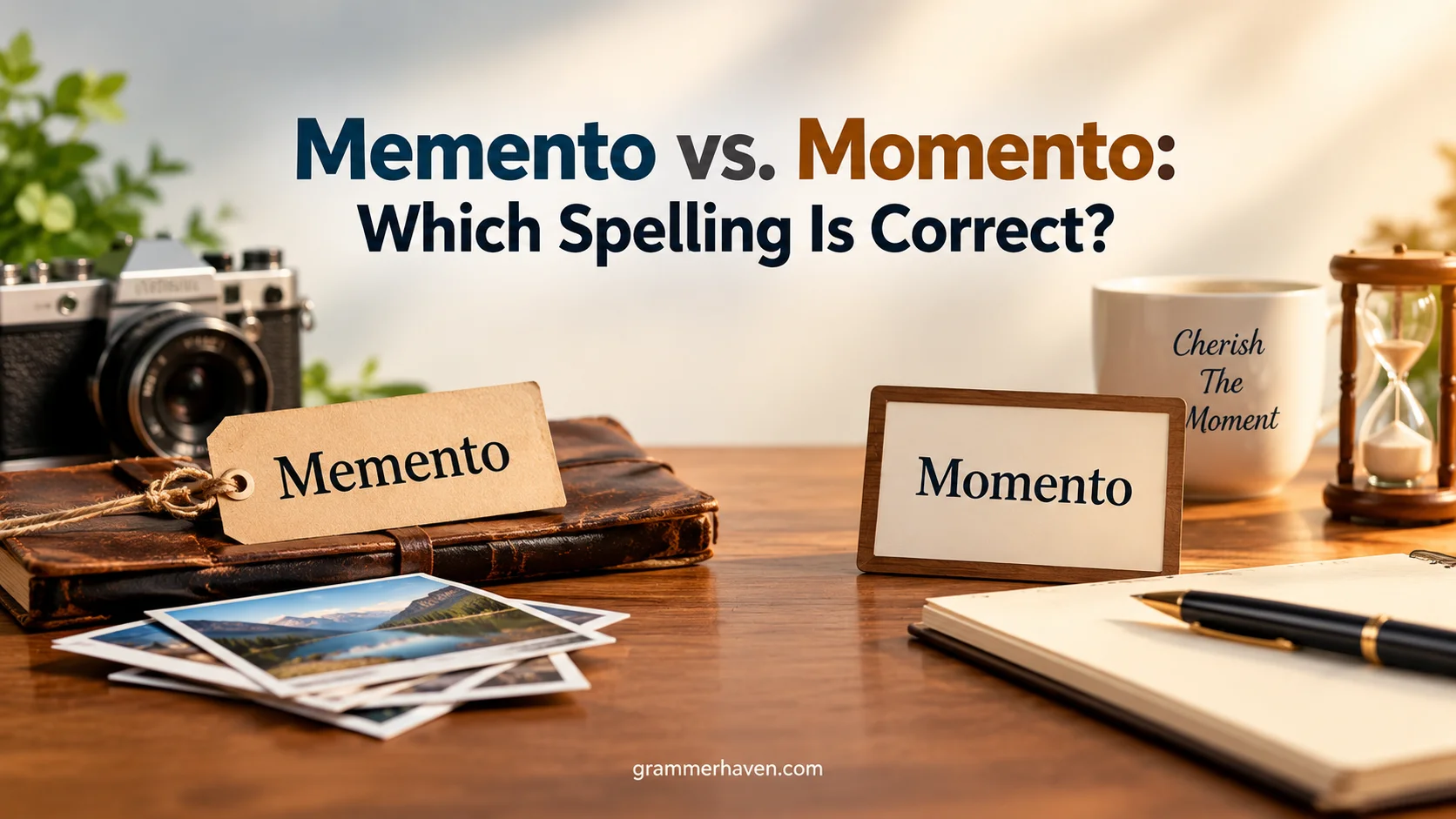
Memento vs. Momento explains the correct spelling, meaning, and usage so you can avoid a common mistake in formal and professional English writing. Memento vs. Momento focuses on a simple distinction: memento is the correct English spelling, while momento is a common misspelling. A memento is a keepsake, reminder, or memory-evoking object connected to a person, place, or event. The word comes from Latin and relates to the idea of remembering. The spelling momento can appear because people associate it with moment, while momento means “moment” in Spanish and Italian. Students, professionals, and writers can avoid spelling and grammar mistakes by learning the correct form.
A language slip can affect professional communication. Email, meetings, business communication, project management updates, client-facing messages, reports, and documents require spelling accuracy, clarity, correctness, and precision. Strong word choice supports credibility, trust, and expertise in formal writing. US English and UK English use memento as the standard English spelling. Checking the exact meaning and context of a word helps you choose the correct form instead of relying on how it sounds.
Practical examples show how a memento works in everyday communication. A ticket stub can become a memento of a first date. A small memento from a country you visited can preserve a memory. A photograph can serve as a memento of your time abroad. An object or souvenir connected to a person, place, or event can become a memento. A team can give someone a memento to mark their retirement. Context, regional language habits, creative expression, business settings, and communication may influence word choice, but they don’t change the correct English spelling.
Memento vs. Momento: Quick Answer
Memento is the preferred spelling in standard English when you mean a keepsake or something that reminds you of a person, place, event, or experience.
Momento is commonly encountered as a spelling of memento. Merriam-Webster lists it as a variant spelling, while noting that many usage guides still consider it a misspelling.
| Word | Meaning | Recommended in standard English? | Example |
| Memento | A keepsake or reminder | Yes | She kept the ticket as a memento. |
| Momento | Variant spelling of memento | Usually avoid in formal writing | She kept the ticket as a momento. |
So, if you’re unsure which one to type, choose memento.
Easy rule: If you mean a keepsake or reminder, spell it memento.
There is one important nuance, though. Calling a momento simply “not a word” oversimplifies the evidence. Merriam-Webster currently lists momento as a variant spelling of memento, and its fuller discussion explains that the variant has appeared often enough in edited writing to gain dictionary recognition.
What Does Memento Mean?
A memento is an object you keep because it helps you remember someone, somewhere, or something meaningful.
Cambridge defines it as an object kept to remember a person, place, or event. Oxford gives a similar definition and notes that a memento can be something you keep or give to remind someone of a person or place.
For example, imagine that you visit a beach with your family and bring home a small seashell. The shell itself may have little practical value. Yet every time you see it, you remember the trip.
That shell has become a memento.
A memento might be:
- A photograph from a memorable trip
- A handwritten letter from someone you love
- A concert ticket
- A graduation medal
- A family heirloom
- A souvenir from a vacation
- A wedding invitation
- A child’s first drawing
- A sports jersey from an important game
- A watch given to someone after years of service
The object doesn’t need to be expensive. In fact, some of the most meaningful mementos cost almost nothing.
A faded photograph can carry more emotional weight than an expensive piece of jewelry because its value comes from the memory it preserves, not its price.
Memento Can Mean More Than a Souvenir
Although memento and souvenirs overlap, they don’t always emphasize exactly the same idea.
A souvenir often refers to something brought back from a place as a reminder of that visit. A memento has a broader meaning. It can remind you of a person, event, achievement, relationship, or period of your life. Cambridge lists souvenir as a synonym, while Oxford uses the same comparison.
Consider these examples:
- I bought a magnet as a souvenir from Chicago.
- The photograph became a memento of my grandmother.
The first sentence emphasizes the trip. The second emphasizes the memory attached to the photograph.
What Does Momento Mean?
Here’s where the memento vs. momento question gets interesting.
In English, momento is commonly used when writers intend to mean memento. Merriam-Webster lists it as a variant spelling. At the same time, Merriam-Webster’s usage discussion explains that most usage guides have traditionally regarded momento as an error.
That means two statements can both be true:
- Memento is the standard spelling you should normally use.
- Momento has gained enough real-world usage to appear as a dictionary-recognized variant.
This distinction matters because dictionaries don’t always divide words into a simple “real” and “fake” category. Language changes through actual use. Sometimes a frequently repeated spelling eventually becomes recognized as a variant, even when editors have historically preferred another form.
For everyday and professional English, however, memento remains the safest choice.
Why Does Momento Look So Natural?
The spelling makes intuitive sense because of the word moment.
A memento often reminds you of a particular moment in your life. Your brain can easily make this connection:
moment → memory → memento
From there, it’s tempting to write momento.
The problem is that the English word didn’t originate from moment. Its history points somewhere else entirely.
Why Is Memento Spelled With an “E”?
The answer lies in the word’s Latin origin.
Memento comes from Latin mementō, an imperative form of meminisse, meaning “to remember.” Merriam-Webster traces the English noun to Latin and gives 1580 as its first known English use in the relevant sense.
Oxford likewise traces memento to Latin and explains that it literally means “remember!” in its original use.
That history explains the spelling:
memento → remember → memory
The beginning mem- isn’t accidental. It reflects the word’s historical relationship with remembering and the mind.
That’s also why connecting the spelling to moment can lead you astray. The meanings are related in modern use, but the words don’t share the same origin.
A Simple Memory Trick
Think of:
ME + MENTO → memory
Or simply remember:
Memento begins with “mem,” like memory.
When you’re choosing between memento and momento, ask yourself what the word means. If it means something kept to remember, the mem- spelling gives you the answer.
Memento vs. Momento: What’s the Difference?
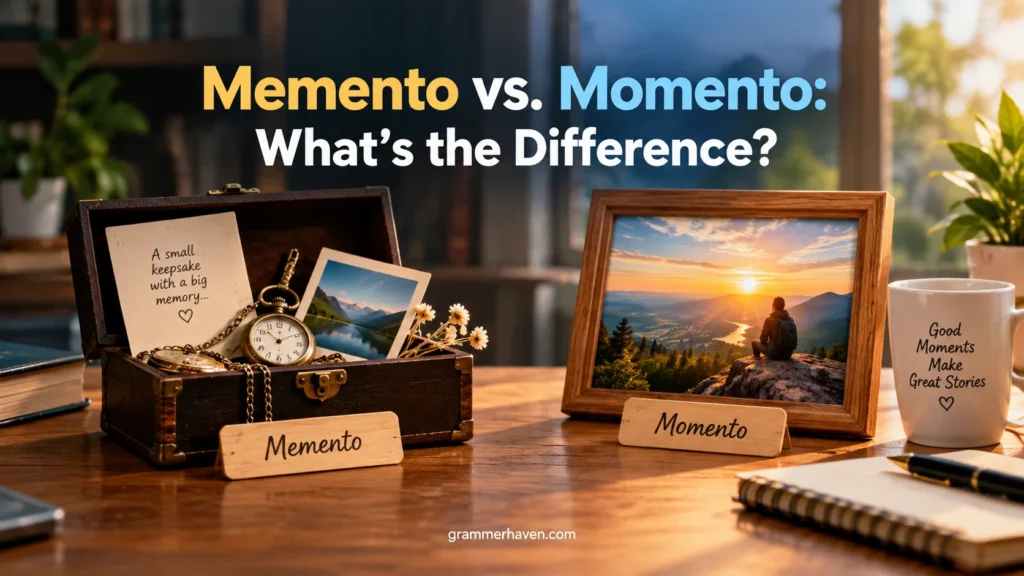
The practical difference comes down to spelling preference and usage.
| Feature | Memento | Momento |
| Standard English form | Yes | Variant |
| Common meaning in English | Keepsake or reminder | Usually intended as memento |
| Latin origin | Yes | Not the original English spelling |
| Recommended for formal writing | Yes | Generally avoid |
| Appears in dictionaries | Yes | Yes, as a variant |
| Plural | Mementos / mementoes | Can follow variant usage |
| Best choice when unsure | Memento | No |
The safest conclusion is straightforward: write memento unless you have a specific reason to preserve the variant spelling.
How to Use Memento in a Sentence
Understanding a definition is useful. Seeing the word in realistic sentences makes it stick.
Memento for a Person
The old watch became a memento of her grandfather.
Here, the watch has emotional significance because it reminds the speaker of a particular person.
Memento for a Place
He kept the seashell as a memento of his vacation.
The shell represents the experience of visiting that place.
Memento for an Event
The concert ticket became a memento of an unforgettable night.
The ticket has little practical use after the concert. Its value comes from the memory attached to it.
Memento for an Achievement
She kept her first championship medal as a memento of years of hard work.
In this example, the medal represents more than an event. It symbolizes the effort that led to the achievement.
Memento in a Professional Setting
A memento can also have a formal or ceremonial purpose.
The company presented him with a watch as a memento of his years of service.
Oxford specifically provides examples of mementos given in recognition of long service.
This use shows that memento doesn’t always describe something privately treasured. Organizations can give mementos to commemorate important contributions or milestones.
Memento vs. Momento Examples
The following examples show the preferred spelling clearly.
| Less preferred spelling | Preferred spelling |
| She saved the ticket as a momento of the concert. | She saved the ticket as a memento of the concert. |
| The photograph is a momento of our childhood. | The photograph is a memento of our childhood. |
| He kept the medal as a momento of his victory. | He kept the medal as a memento of his victory. |
| The letter became a precious momento. | The letter became a precious memento. |
| They gave her a watch as a momento of her service. | They gave her a watch as a memento of her service. |
The issue isn’t the meaning. In these examples, readers can understand what momento means from context. The issue is that memento is the established form you should normally choose.
Is Momento a Real Word?
Yes, but the answer needs some nuance.
Momento appears in dictionaries as a variant spelling of memento. Merriam-Webster’s dedicated entry defines it simply as a “variant spelling of memento.”
However, Merriam-Webster also explains that most usage guides consider momento an error, even though it appears often enough in edited prose to receive dictionary recognition.
That’s why the best advice isn’t merely “momento is fake.”
Instead:
Momento is a recognized variant, but memento is the preferred spelling for standard, polished English.
This distinction is particularly useful when writing for school, work, publishing, or professional websites.
Memento vs. Momento in Formal Writing
When you have a choice, use memento in formal writing.
That includes:
- Academic papers
- School assignments
- Business documents
- Professional emails
- Articles
- Reports
- Resumes and cover letters
- Books
- Museum descriptions
- Formal speeches
Why take the risk with a less-preferred variant when the standard form is easy to use?
A reader might recognize momento without hesitation. Another reader might mark it as a spelling error. Memento avoids that uncertainty.
There are exceptions. If you’re quoting a historical source, reproducing an original document, discussing the variant itself, or preserving an official name or title, the original spelling may need to remain unchanged.
Context always matters.
What Is the Plural of Memento?
Both mementos and mementoes are accepted plural forms.
Cambridge lists both forms, as does Oxford.
Examples include:
- She keeps several mementos from her travels.
- The museum displayed personal mementoes from the era.
- His desk was filled with family mementos.
- The photographs became treasured mementoes of their childhood.
For most modern American writing, mementos is a natural and straightforward choice.
Is “Mementoes” Correct?
Yes.
Mementoes isn’t a misspelling. It’s an accepted plural form of memento.
So you can write:
The box contained old photographs and other family mementoes.
Or:
The box contained old photographs and other family mementos.
Both are correct.
Memento vs. Souvenir: Are They the Same?
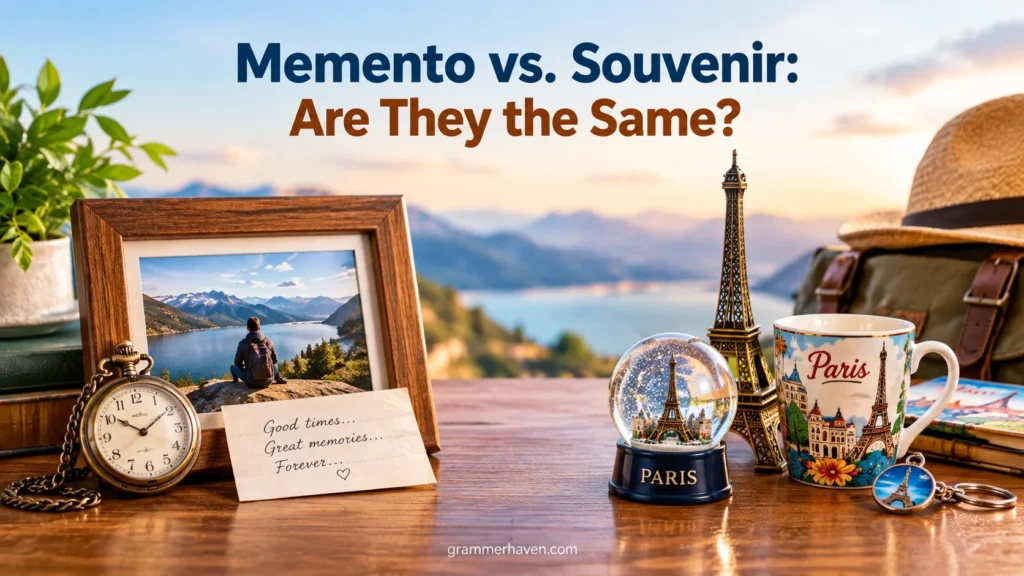
The two words overlap, but there’s a useful difference in emphasis.
A souvenir usually brings a place or trip to mind. A memento can commemorate almost anything meaningful.
| Word | Main idea | Example |
| Memento | Something that preserves a memory | Her father’s letter was a memento. |
| Souvenir | Something kept to remember a place or trip | He bought a postcard as a souvenir. |
| Keepsake | Something retained because of sentimental value | She treasured the necklace as a keepsake. |
One object can fit all three descriptions.
For instance, a small ceramic cup bought during a vacation could be a souvenir because it came from the trip, a memento because it reminds you of that experience, and a keepsake because you value it emotionally.
Memento vs. Keepsake: What’s the Difference?
A keepsake emphasizes the fact that you keep something because it has sentimental value.
A memento emphasizes the object’s role as a reminder.
That distinction can be subtle.
Consider a handwritten birthday card from a close friend. Calling it a keepsake highlights its sentimental value. Calling it a memento highlights how it preserves the memory of that person or occasion.
Neither word requires the object to have monetary value.
That’s an important point. A memento isn’t defined by how much it costs. Its meaning comes from what it represents.
What Does “Memento Mori” Mean?
The phrase memento mori provides one of the clearest clues to the word’s original meaning.
Memento mori refers to a reminder of mortality. Merriam-Webster explains that the Latin phrase literally carries the sense “remember that you must die.”
Here, memento retains its original command-like sense of remember.
That makes the spelling easier to understand:
memento → remember
Not:
momento → moment
The phrase has a long history in art, literature, religion, and philosophy, where objects or images can remind people of the temporary nature of life.
Common Mistakes With Memento
The spelling isn’t the only place people stumble.
Mistake: Writing “Momento”
This is the most common problem.
Preferred: The photograph is a memento of my childhood.
Less preferred: The photograph is a momento of my childhood.
Mistake: Assuming It Comes From “Moment”
The connection feels logical, but the word comes from Latin meminisse, meaning “to remember.”
Mistake: Assuming Every Memento Is a Souvenir
A memento can be a souvenir, but it can also be a personal letter, medal, photograph, family object, or gift.
Mistake: Thinking “Mementoes” Is Wrong
Both mementos and mementoes are accepted plural forms.
Mistake: Writing “Momento Mori”
The established Latin phrase is memento mori.
The first word comes from the same Latin form that gives English memento.
How to Remember the Correct Spelling
If the spelling keeps slipping away, use one of these memory aids.
Connect Memento With Memory
Memento → memory → remember
Both memento and memory begin with mem.
Don’t Follow the “Moment” Trap
A memento may remind you of a particular moment, but the word isn’t spelled from moment.
Think:
A memento helps you remember.
That simple connection is stronger than trying to memorize every letter individually.
Remember the Original Meaning
Latin memento means “remember.”
Once you know that, the spelling makes much more sense.
Memento vs. Momento: A Practical Verdict
So, memento vs. momento—which one should you use?
For standard English, choose memento.
It is the established spelling for an object that serves as a reminder or keepsake. Cambridge and Oxford define the word this way, while Merriam-Webster traces it to Latin and records its first known English use in 1580.
Momento deserves a little more nuance than a simple “wrong” label. It appears frequently enough to have gained dictionary recognition as a variant. Still, Merriam-Webster notes that most usage guides consider it an error, making memento the stronger choice for polished writing.
The Final Rule
Memento = the preferred spelling for a keepsake or reminder.
Momento = a recognized variant, but generally not the best choice in formal English.
When in doubt, remember the root: memento means “remember.” That little connection can save you from one of English spelling’s sneakiest traps.
See also: Practices or Practises: Which Spelling Is Correct?
FAQs:
Is “memento” the correct spelling?
Yes. Memento is the established and preferred English spelling for a keepsake or reminder.
Is “momento” a real word?
Yes, as a variant spelling of memento. Merriam-Webster lists momento as a variant, although traditional usage guidance generally prefers memento.
Is momento an accepted spelling of memento?
It is recognized as a variant by dictionaries, but memento remains the safer and more widely preferred form, particularly in formal writing.
Why do people spell memento as momento?
The word often relates to a memorable moment, so writers naturally connect memento with moment. Merriam-Webster specifically identifies this association as a reason for the variant spelling.
What does memento mean?
A memento is something kept or given as a reminder of a person, place, event, or experience.
What is the plural of memento?
Both mementos and mementoes are correct plural forms.
Is memento the same as souvenir?
Not exactly. A souvenir commonly refers to something kept to remember a place or trip, while a memento has a broader meaning and can remind you of people, events, achievements, or experiences.
Is memento the same as keepsake?
They’re close in meaning. Keepsake emphasizes sentimental value, while memento emphasizes the object’s function as a reminder.
How do you pronounce memento?
In American English, it is commonly pronounced approximately muh-MEN-toh. Cambridge gives the US pronunciation as /məˈmen.toʊ/.
Where does the word memento come from?
Memento comes from Latin mementō, an imperative form of meminisse, meaning “to remember.”
What does memento mori mean?
Memento mori is a Latin phrase referring to a reminder of mortality. Literally, it carries the meaning “remember that you must die.”
Should you use memento or momento in formal writing?
Use memento. Although momento is recognized as a variant, memento is the more established choice and avoids unnecessary spelling questions.
Can momento be used in a sentence?
It can appear as a variant of memento, but memento is generally the better choice in standard formal English.
How can you remember the spelling of memento?
Connect memento with memory and remember. Both begin with mem, which reflects the word’s Latin history.
Conclusion:
Memento is the correct English spelling when you mean a keepsake, reminder, or object that brings a memory to mind. Momento is a common misspelling in English, often influenced by the familiar word “moment.” Remember the simple rule: if you’re talking about something you keep to remember a person, place, event, or experience, use memento. Using the correct spelling keeps your writing clear, accurate, and professional.