Thank You Very Much vs Thank You So Much: What’s the Difference? explains how gratitude expressions differ in tone, context, and usage clearly. These phrases show how Thank You Very Much and Thank You So Much create different feelings in professional and personal interactions. The difference comes from the level of gratitude, the expressions of thanks, and the impact your words create. Using the right phrase with proper appreciation, a clear and sincere message becomes more natural in English communication. My experience with everyday conversations shows that understanding these nuances improves conversational and formal English while maintaining etiquette and courtesy.
The main distinction between these phrases relates to tone, context, usage, formality, and emotional intensity. Thank You Very Much often sounds more formal and works well in written interpersonal communication, including emails, letters, and notes. In contrast, Thank You So Much feels warmer, more casual, and suitable for conversations where you want to express genuine and heartfelt appreciation. Both phrases are correct, but choosing the right expression, variant, and style depends on your language, audience, and social context.
Using these expressions effectively requires attention to clarity, sentence structure, and how your polite words are perceived. By observing these subtle differences, you can adapt your speech and writing for different contexts. When combined with proper recognition and acknowledgment, these powerful tools support effective communication in various settings. These expressions of gratitude are not always interchangeable because they help you with expressing thanks, convey gratitude, and showing good manners, showing appreciation, and building connections at the most appropriate moment with the right depth.
Thank You Very Much vs Thank You So Much: Quick Comparison
Before diving deeper, here’s a side-by-side overview.
| Feature | Thank You Very Much | Thank You So Much |
| Formality | More formal | More casual |
| Tone | Polite and respectful | Warm and friendly |
| Emotional expression | Moderate | Stronger |
| Business emails | Common | Sometimes |
| Everyday conversations | Common | Very common |
| Customer service | Frequently used | Less common |
| Sounds conversational | Less | More |
| Sounds traditional | More | Less |
The Short Answer
If you’re writing to a client, manager, customer, or professional contact, thank you very much often works best.
If you’re thanking a friend, colleague, family member, or someone who has personally helped you, thank you so much usually sounds more natural.
What Does “Thank You Very Much” Mean?
The phrase thank you very much is a traditional expression of gratitude.
The words very much function as an intensifier. They strengthen the meaning of “thank you” by emphasizing appreciation.
Without the intensifier:
Thank you.
With the intensifier:
Thank you very much.
The second version communicates stronger gratitude while maintaining a respectful and professional tone.
Tone of Thank You Very Much
People often associate this phrase with:
- Professionalism
- Courtesy
- Respect
- Formal communication
- Traditional English etiquette
Because of this, businesses, customer service teams, public speakers, and professionals frequently use it.
Examples of Thank You Very Much
Professional email
Thank you very much for your assistance with this project.
Business meeting
Thank you very much for taking the time to meet with us today.
Customer service
Thank you very much for contacting our support team.
Public speaking
Thank you very much for attending tonight’s event.
Notice how each example sounds polite and polished without becoming overly emotional.
What Does “Thank You So Much” Mean?
The phrase thank you so much also expresses gratitude. However, it often carries a stronger emotional element.
The word so acts as an intensifier. It highlights how deeply the speaker appreciates something.
Many native English speakers use this phrase when they genuinely feel touched, relieved, or grateful.
Tone of Thank You So Much
People often associate this phrase with:
- Warmth
- Sincerity
- Friendliness
- Emotional appreciation
- Personal connection
As a result, it appears frequently in conversations, text messages, social media posts, and personal emails.
Examples of Thank You So Much
Friendship
Thank you so much for helping me move this weekend.
Family
Thank you so much for the thoughtful gift.
Workplace
Thank you so much for covering my shift.
Personal support
Thank you so much for being there when I needed help.
These examples feel more personal than their “very much” counterparts.
The Main Difference Between Thank You Very Much and Thank You So Much
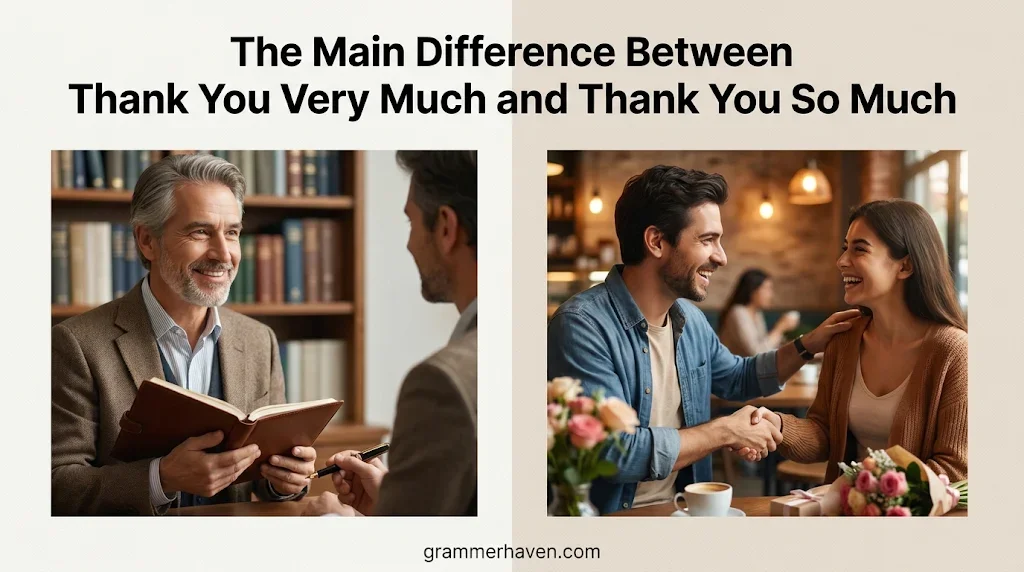
Although both phrases communicate gratitude, they create different emotional impressions.
Thank You Very Much Emphasizes Politeness
When someone says:
Thank you very much.
The focus is often on respect and proper etiquette.
The phrase sounds measured and professional.
Thank You So Much Emphasizes Emotion
When someone says:
Thank you so much.
The focus shifts toward genuine feeling and personal appreciation.
The phrase feels warmer and more heartfelt.
A Simple Analogy
Think of the difference like clothing.
Thank you very much is a well-tailored suit.
Thank you so much is a comfortable sweater.
Both are appropriate. The best choice depends on the occasion.
Formality Differences Between the Two Expressions
Formality is one of the biggest distinctions.
Why Thank You Very Much Sounds More Formal
Historically, English speakers have used very much in formal writing and public communication.
As a result, the phrase often sounds:
- More professional
- More structured
- More traditional
- More business-oriented
Why Thank You So Much Sounds More Casual
The phrase so much gained popularity in conversational English.
Today, many native speakers use it naturally in:
- Text messages
- Personal emails
- Social media
- Informal workplace conversations
That doesn’t mean it’s unprofessional. It simply feels more relaxed.
Emotional Intensity: Which Sounds More Sincere?
Many learners wonder whether one phrase sounds more sincere than the other.
The answer depends on context.
Thank You Very Much
Often communicates:
- Respect
- Courtesy
- Appreciation
Thank You So Much
Often communicates:
- Gratitude
- Excitement
- Relief
- Emotional connection
Consider these examples.
Professional
Thank you very much for your feedback.
Personal
Thank you so much for your support during a difficult time.
The second sentence naturally feels more emotional.
Which Phrase Sounds More Natural in Modern English?
Language changes over time.
While both expressions remain common, many native speakers now favor thank you so much in everyday conversation.
Why?
Because modern English increasingly values conversational and authentic communication.
Common Everyday Usage
Today you’re more likely to hear:
- Thank you so much.
- Thanks so much.
- Thanks a lot.
- I really appreciate it.
than:
- Thank you very much.
in casual situations.
Where Thank You Very Much Still Excels
Despite changing trends, thank you very much remains popular in:
- Business correspondence
- Customer support
- Formal speeches
- Official announcements
- Hospitality industries
It still sounds professional and appropriate.
When to Use Thank You Very Much

Certain situations naturally call for a more formal expression.
Professional Emails
Business communication often benefits from a polished tone.
Examples:
Thank you very much for your prompt response.
Thank you very much for considering our proposal.
Customer Service Interactions
Customer-facing organizations frequently use this phrase because it sounds respectful.
Example:
Thank you very much for bringing this issue to our attention.
Formal Presentations
Public speakers often choose this wording.
Example:
Thank you very much for joining us today.
Job Interviews
Candidates can use the phrase effectively.
Example:
Thank you very much for the opportunity to discuss the position.
When to Use Thank You So Much
Other situations benefit from a more personal approach.
Personal Messages
Friends and family often prefer warmth over formality.
Examples:
Thank you so much for coming.
Thank you so much for the surprise.
Expressing Genuine Appreciation
When someone goes out of their way to help you, the emotional tone feels appropriate.
Example:
Thank you so much for staying late to help me finish.
Informal Workplace Communication
Many modern offices favor conversational language.
Example:
Thank you so much for helping with the presentation.
Social Media and Online Communities
People commonly use the phrase online.
Examples:
- Instagram comments
- Facebook posts
- LinkedIn replies
- Community forums
Real-Life Case Study: Choosing the Right Expression
Imagine two employees.
Employee A
Sends this message to a client:
Thank you so much for reviewing our proposal.
The message sounds friendly and approachable.
Employee B
Sends this message:
Thank you very much for reviewing our proposal.
The message sounds professional and polished.
Neither is wrong.
However, many organizations would prefer Employee B’s wording when communicating with external clients.
Now imagine the message goes to a close coworker.
Suddenly Employee A’s version feels more natural.
This example highlights an important truth:
The best phrase depends on the relationship, not just the grammar.
Thank You Very Much vs Thank You So Much in Emails
Email communication deserves special attention because tone matters.
Formal Client Email
Recommended
Thank you very much for your continued trust in our services.
This wording creates a professional impression.
Thanking a Supervisor
Both options can work.
Formal:
Thank you very much for your guidance.
Friendly:
Thank you so much for your support.
Choose based on your workplace culture.
Internal Team Communication
Many modern teams prefer conversational language.
Example:
Thank you so much for helping us meet the deadline.
Customer Service Email
Traditional customer service writing often favors:
Thank you very much for contacting us.
This phrasing remains common because it sounds courteous and professional.
Common Mistakes People Make
Even simple expressions can be misused.
Assuming One Is Correct and the Other Is Wrong
This is the most common mistake.
Both expressions are grammatically correct.
The issue isn’t correctness.
The issue is tone.
Using Excessive Intensifiers
Many learners write:
Thank you so very very much.
Or:
Thank you so so so much.
While grammatically possible, these versions often sound unnatural.
Using Formal Language in Casual Situations
Imagine texting a close friend:
Thank you very much for bringing pizza.
It isn’t wrong.
It may simply sound stiff.
Using Casual Language in Highly Formal Situations
Imagine writing:
Thank you so much for reviewing our legal contract.
Some industries may prefer a more formal expression.
Thank You Very Much vs Thank You So Much: Native Speaker Perspective

If you listen carefully to native speakers, you’ll notice patterns.
In Business Settings
You’ll hear:
- Thank you very much.
- Many thanks.
- Much appreciated.
In Everyday Conversation
You’ll hear:
- Thank you so much.
- Thanks so much.
- Thanks a lot.
- I appreciate it.
In Emotional Situations
You’ll often hear:
Thank you so much.
because it feels more heartfelt.
Other Ways to Say Thank You
Repeating the same phrase every time can make communication feel repetitive.
Fortunately, English offers many alternatives.
Formal Alternatives
| Expression | Formality |
| Many thanks | Medium |
| Much appreciated | Medium |
| I sincerely appreciate it | High |
| My sincere thanks | High |
| I am very grateful | High |
Friendly Alternatives
| Expression | Formality |
| Thanks so much | Casual |
| Thanks a lot | Casual |
| I appreciate it | Casual |
| You’re the best | Informal |
| Couldn’t have done it without you | Informal |
Strong Expressions of Gratitude
Use these when someone has made a significant impact.
- I can’t thank you enough.
- I’m deeply grateful.
- I truly appreciate your support.
- Thank you from the bottom of my heart.
- Your help means a lot to me.
Situations and the Best Expression to Use
| Situation | Best Choice |
| Business proposal | Thank You Very Much |
| Customer support email | Thank You Very Much |
| Formal speech | Thank You Very Much |
| Thanking a professor | Thank You Very Much |
| Thanking a close friend | Thank You So Much |
| Personal gift | Thank You So Much |
| Family support | Thank You So Much |
| Social media comment | Thank You So Much |
| Team chat message | Thank You So Much |
| Appreciation after emotional support | Thank You So Much |
This table provides a practical shortcut whenever you’re unsure.
See also: Lies Ahead or Lays Ahead? Which Is Correct?
FAQs:
1. What is the difference between Thank You Very Much and Thank You So Much?
The main difference is in tone and feeling. Thank You Very Much sounds more formal and polite, while Thank You So Much feels more emotional, friendly, and personal.
2. Is Thank You Very Much more formal than Thank You So Much?
Yes, Thank You Very Much is generally considered more formal. People often use it in professional settings, written communication, emails, and situations where extra politeness is expected.
3. Can I use Thank You So Much in professional communication?
Yes, you can use Thank You So Much in professional communication, especially when you want to sound warm and appreciative. However, for highly formal situations, Thank You Very Much may be a better choice.
4. Are Thank You Very Much and Thank You So Much interchangeable?
They can often be used interchangeably because both expressions show gratitude. However, they have subtle differences in emotional intensity, tone, and context.
5. Which phrase sounds more sincere: Thank You Very Much or Thank You So Much?
Both can sound sincere, but Thank You So Much often feels more heartfelt because it adds stronger emotional emphasis. The sincerity depends more on your tone, situation, and intention than the phrase itself.
Conclusion:
Understanding Thank You Very Much vs Thank You So Much: What’s the Difference? helps you choose the right expression for every situation. Both phrases show gratitude and appreciation, but their tone and emotional impact can feel different. Thank You Very Much usually sounds more formal and respectful, while Thank You So Much often feels warmer, more personal, and heartfelt. By paying attention to the context, audience, and level of sincerity, you can make your communication more natural and effective. Small language choices like these can improve your English and help you build stronger connections with others.
Latest Post:
- Is It Correct to Say “A Big Congratulations”? The Complete Grammar Guide
- Two Crows Being an Attempted Murder: Meaning, Origins & Real Behavior
- Farther vs. Further: What’s the Difference?
- Result In or Result To: Which Is Correct? (With Examples)
- A Dime a Dozen: Meaning, Definition, Origin and Real-Life Usage